 Quran
Quran
| Key Takeaways |
| Children in the UK can begin learning the Quran from age 4–5, starting with Arabic letter recognition through structured phonics tools like Noorani Qaida. |
| The most effective approach follows a clear sequence: Arabic letters first, then reading fluency, then Tajweed rules, then memorisation — not all at once. |
| One-to-one online Quran lessons have become the most accessible and consistent option for UK families balancing school, work, and extracurricular schedules. |
| Children who begin memorisation before age 10 typically retain Quran more effectively, as early years are the strongest period for long-term memory formation. |
| A free trial lesson with a qualified instructor is the most reliable way to assess a child’s starting level and identify the right course pathway. |
If you are a parent in the UK trying to figure out how to get your child started with the Quran, the chances are you have already encountered the confusion — too many apps, conflicting advice from family members, and the nagging worry that your child is falling behind.
Whether your child is four years old and has never seen an Arabic letter, or nine years old and can read a little but has no Tajweed, the question is the same: where do I actually start, and how do I make sure this sticks?
Teaching children the Quran in the UK follows a clear, proven sequence: begin with Arabic letter recognition using a structured phonics method, build reading fluency, introduce basic Tajweed rules, and then — when the child is reading confidently — begin memorisation. Each step has its own tools, timelines, and common pitfalls. This guide walks through all of them.
Step 1: Start With the Arabic Alphabet Using a Structured Phonics Method
The first step in teaching any child the Quran in the UK is building accurate Arabic letter recognition — and the most effective tool for this is a structured phonics programme, most commonly the Noorani Qaida. This is not optional groundwork; it is the foundation every subsequent skill is built on.
The Noorani Qaida is a systematic booklet that introduces Arabic letters, their forms, vowel sounds (Harakaat — Fatha, Kasra, Damma), and letter joining rules in a logical, incremental sequence.
Children who work through it properly with a qualified teacher will be able to read Arabic script fluently before they have memorised a single verse of the Quran. That fluency is what protects them from mispronunciation later.
The pattern we see most often with children who come to us having learned informally — at home or through apps — is that they have memorised short surahs by ear without being able to read the text independently.
When they sit with a Mushaf, they are essentially guessing. Structured phonics work from the beginning prevents this entirely.
Our Noorani Qaida for Kids course is designed specifically for young learners, teaching letter sounds and reading mechanics through a method that is engaging for children and manageable in short daily sessions.
Enroll your child in our Noorani Qaida classes for kids with a FREE session

| Learning Stage | What the Child Masters | Typical Duration |
| Letters and forms | All 28 letters in isolated and joined form | 2–4 weeks |
| Harakaat (short vowels) | Fatha, Kasra, Damma with single letters | 2–3 weeks |
| Tanwin and Sukoon | Double vowels and resting sounds | 2–3 weeks |
| Madd (long vowels) | Alif, Waw, Ya extensions | 2–3 weeks |
| Joining and fluency | Reading words and short phrases smoothly | 4–6 weeks |
Step 2: Build Quran Reading Fluency Before Moving to Memorisation
Once a child can read Arabic letters with their vowel markings, the next step is building reading fluency directly from the Quran — reading actual Quranic text at a steady, accurate pace. This is the bridge between knowing letters and being ready to memorise.
Reading fluency means the child can look at a line of the Quran and read it accurately without sounding out each letter individually. It does not require perfect Tajweed at this stage — that comes in the next step — but it does require that the child is reading the actual words rather than reciting from memory of what they have heard.
In our sessions, children typically begin reading from Juz Amma — the 30th Juz — because the shorter surahs offer natural completion points that keep young learners motivated.
A child who finishes reciting Surah Al-Ikhlas correctly from the text for the first time experiences a real sense of achievement, and that matters enormously for sustaining engagement.
Parents sometimes ask whether children should be memorising at the same time as building reading fluency. The answer, in almost every case, is no — at least not formally. A child who is still sounding out words cannot consolidate memory effectively.
Fluency first, memorisation second. The two can begin to overlap once the child is reading smoothly and consistently.
Step 3: Introduce Basic Tajweed Rules in a Child-Appropriate Way
Tajweed — the set of rules governing correct Quranic recitation — should be introduced once a child is reading fluently, not before. Introducing Tajweed rules to a child who is still building reading confidence creates cognitive overload and often damages motivation.
The foundational Tajweed rules to introduce first are the ones that affect every line of the Quran: Noon Saakinah and Tanwin rules (including Idgham, Ikhfa, and Iqlab), the rules of Meem Saakinah, basic Madd extensions, and the correct pronunciation of letters with distinct Makhaarij (points of articulation) — particularly letters like ع (Ayn), ح (Ha), خ (Kha), and ق (Qaf) that have no equivalent in English.
The Makhaarij point is worth emphasising for UK-based parents specifically. Children growing up speaking English have no natural reference point for these sounds.
Without explicit instruction and regular correction from a qualified teacher, British children almost always default to the nearest English approximation — and these errors embed quickly.
A child who has been mispronouncing ق as a plain “k” for two years will find the correct sound much harder to acquire than one who was corrected from the start.
Our Tajweed for Kids course introduces rules gradually, in an age-appropriate sequence, with a qualified instructor who gives live, real-time pronunciation correction — which no app or pre-recorded resource can replicate.
Enroll your child in our Tajweed classes for kids with a FREE session

Step 4: Establish a Daily Revision Routine at Home
Consistent daily revision at home is what converts lessons into lasting ability. Without it, even the best weekly or twice-weekly lessons produce slow progress, because the gaps between sessions are too long for new learning to consolidate — especially in children.
The good news is that children do not need long sessions. Fifteen to twenty minutes of focused daily practice is far more effective than a ninety-minute session once a week. At that age, attention spans are short but retention from short, repeated exposures is remarkably strong.
A practical home routine for primary-school-age children looks like this: five minutes reviewing the previous lesson’s reading, five to ten minutes of new practice, and five minutes listening to a recitation of what they are currently learning.
Listening to correct recitation — ideally from a qualified reciter — helps children internalise the sound of proper Tajweed before they can fully apply the rules themselves.
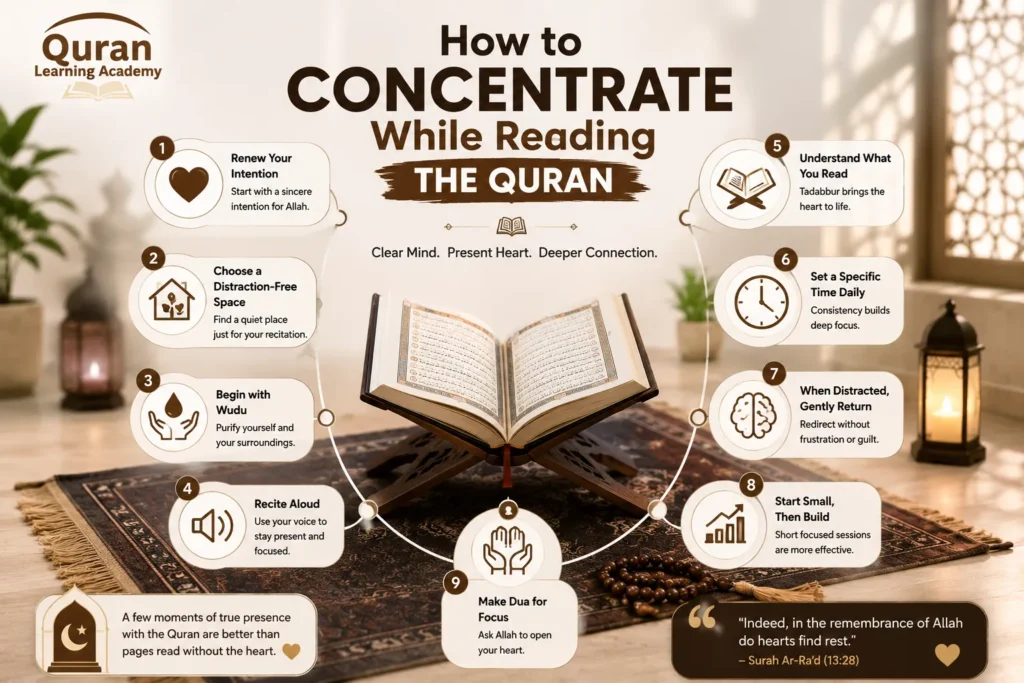
As parents, your role in this routine is consistency, not correction. You do not need to know Tajweed yourself to sit with your child during their daily practice. Your presence signals that this matters, and that signal is more powerful than most parents realise.
Shots Videos from Our Courses
Start Your Quranic Journey in the UK
Join our academy for structured online lessons with expert tutors, tailored to fit your schedule.
Book Your Free TrialStep 5: Begin Quran Memorisation (Hifz) Once Reading Is Solid
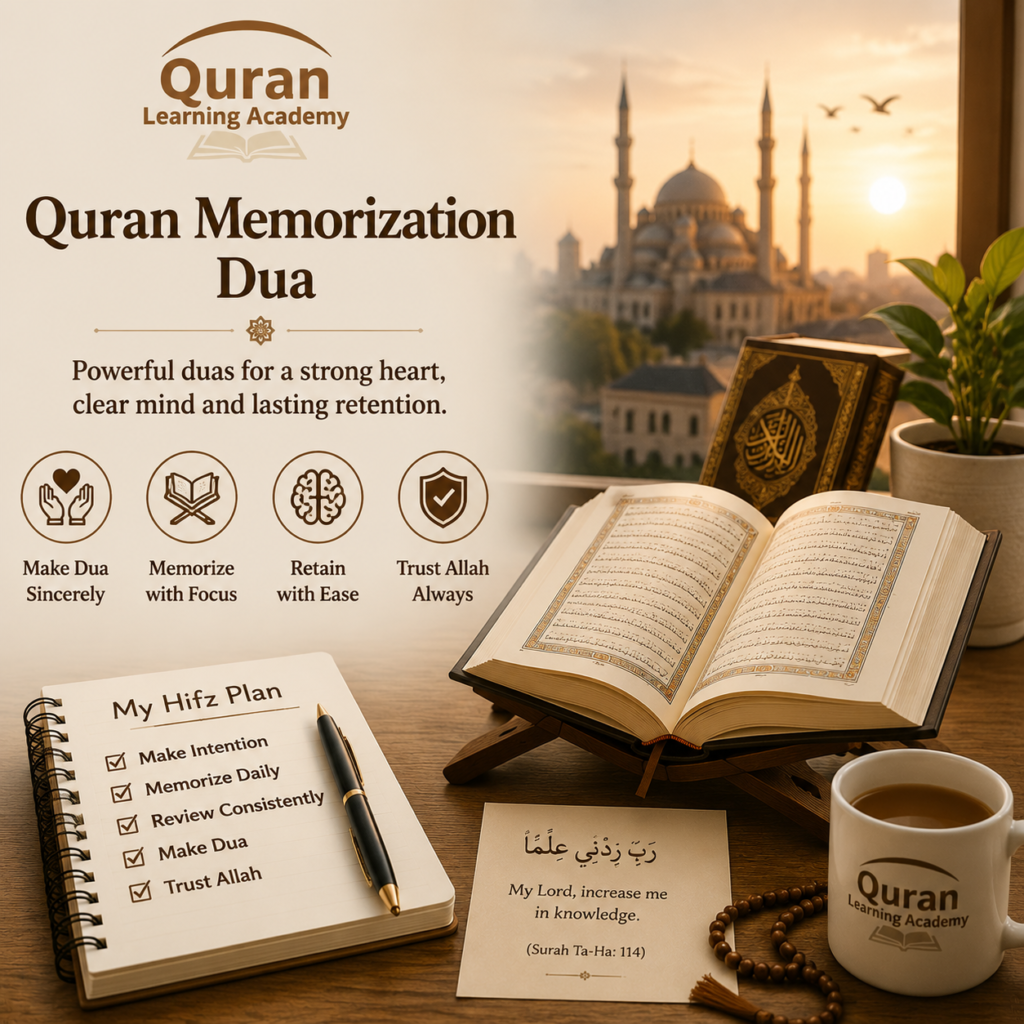
Hifz — Quran memorisation — is one of the greatest gifts a parent can give a child, and the right age and moment to begin depends entirely on the child’s reading level, not their calendar age.
A child who reads fluently and accurately is ready to begin memorisation; a child who is still struggling to read is not.
The research on memory development, and the centuries of Islamic pedagogical tradition, both point to the same conclusion: children between the ages of 6 and 12 are in the strongest period of their lives for long-term memorisation.
The Quran memorised in these years, with consistent review, tends to stay for life. This is not to create anxiety for parents of older children — children and adults of all ages can and do complete Hifz — but it is a genuine reason to prioritise beginning early when the child is ready.
The memorisation method that works for children follows a structure: new memorisation (Hifz) of a short, manageable portion each session, combined with daily review of recently memorised portions (Recent Review) and regular revision of earlier memorised material (Old Revision). Without all three components working in parallel, new memorisation piles up faster than it can be retained, and the child ends up with fragile, unreliable recall.
| Memorisation Component | Description | Recommended Frequency |
| New Hifz | Learning a new portion for the first time | Every session |
| Recent Review | Revising the last 1–2 weeks of memorised material | Daily |
| Old Revision | Revisiting memorised material from earlier weeks | 2–3 times per week |
The UK Quran Learning Academy’s Hifz for Kids programme is built around exactly this three-part structure, with qualified instructors who track each child’s memorisation and review load individually.
Start your child’s Hifz path with a FREE trial session
Step 6: Choose the Right Learning Format for Your Child
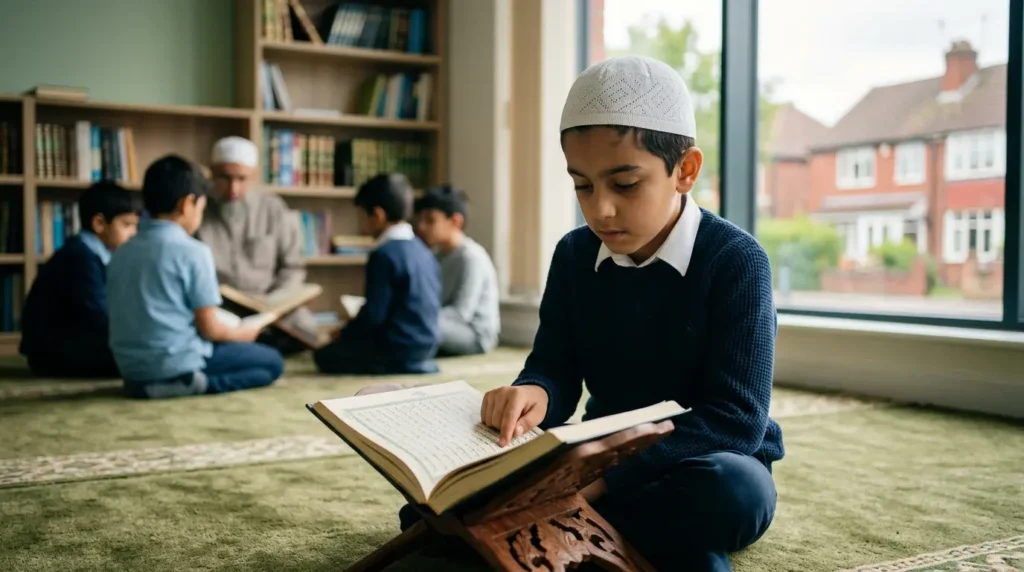
Children in the UK have several options for Quran learning — local mosque classes, weekend Islamic schools, private home tutors, and online one-to-one lessons.
Each has genuine advantages and genuine limitations, and the right choice depends on your child’s age, learning style, and your family’s schedule.
Local mosque classes offer community and group learning, but the teacher-to-student ratio is often high, which means individual pronunciation correction is limited. Weekend Islamic schools face a similar challenge — the time available per child is constrained.
Private home tutors offer personalised attention but finding a qualified, vetted instructor who teaches using a structured methodology can be difficult.
Online one-to-one lessons have, for many UK families, become the most practical and consistent option. As of 2026, the quality of online Quran instruction has advanced considerably — qualified teachers can hear and correct pronunciation in real time, lessons can be scheduled around school hours and extracurricular commitments, and children who might feel self-conscious reading aloud in a group often respond much better to the one-to-one format.
The UK Quran Learning Academy offers structured, one-to-one online Quran lessons for children, taught by qualified instructors with experience teaching British learners specifically. Our Quran classes for kids cover every level from absolute beginner to advanced Hifz, with flexible scheduling built around UK family life.
Enroll your child in our Quran classes for kids with a FREE session

Step 7: Track Progress With Milestones, Not Just Attendance
Signing your child up for lessons is the beginning, not the goal. The goal is measurable progress — and that requires tracking milestones, not simply counting the weeks of attendance.
Milestones to track include: completing the Noorani Qaida, reading the first Juz fluently, applying the first three Tajweed rules consistently in recitation, memorising the first ten surahs of Juz Amma, and completing the full 30th Juz.
Each of these is a concrete, verifiable achievement — not a subjective sense that “it’s going well.”
When progress stalls — and it will, at various points — the cause is almost always one of three things: insufficient daily revision at home, a mismatch between the lesson content and the child’s current level, or motivational fatigue that needs to be addressed directly. A good instructor will identify which it is and adjust accordingly.
If your child’s teacher cannot explain clearly why progress has slowed and what the plan is to address it, that is worth raising directly.
Read Also: How Long Does It Take to Learn Arabic in the UK?
Our Students Reviews
Start Your Quranic Journey in the UK
Join our academy for structured online lessons with expert tutors, tailored to fit your schedule.
Book Your Free TrialRead Also: How to Learn Quran in the UK?
Start Your Child’s Quran Learning With the Right Support at The UK Quran Learning Academy
Every child deserves a structured, qualified start — not guesswork. The UK Quran Learning Academy offers one-to-one online Quran lessons for children at every level, taught by experienced instructors who understand the specific challenges facing British Muslim families.
- Qualified, experienced instructors who teach UK-based learners
- Fully personalised one-to-one sessions — no classroom format
- Flexible scheduling that fits around school hours and family life
- Courses covering Noorani Qaida, Quran reading, Tajweed, and Hifz for children
- Free trial lesson — no commitment required
- A welcoming, structured environment for children of all starting levels
Book your child’s free trial lesson today and let a qualified instructor assess exactly where your child is and what the right next step looks like.
Check out our top courses for Quran learning:
- Quran Classes for Adults
- Tajweed Classes
- Hifz Quran
- Noorani Qaida classes
- Quran classes for kids
- Tajweed classes for kids
- Hifz for Kids
- Noorani Qaida classes for kids
- Ijazah Course
Book your FREE trial session today
Frequently Asked Questions About Learning Quran for Kids in the UK
What is the best age to start Quran lessons for children in the UK?
Most children are ready to begin structured Quran learning between ages 4 and 6, when they can hold focus for short sessions and are beginning to develop phonetic awareness. Starting with Arabic letter recognition through the Noorani Qaida at this age sets a strong foundation. That said, children who begin later at 8, 9, or 10 can progress quickly when taught with a structured methodology.
Does my child need to know any Arabic before starting Quran lessons?
No prior Arabic knowledge is needed. Quran lessons for children begin with the Arabic alphabet from scratch, using a structured phonics method like the Noorani Qaida. The ability to read Arabic script is taught as part of the course — children do not need to arrive already able to read.
How long does it take for a child to memorise the full Quran?
The timeline varies depending on the child’s starting age, the consistency of daily practice, and the structured review system used. Children who begin Hifz at age 7–8 with daily memorisation and consistent review can complete the full Quran in 4–7 years. Children who begin older or have less consistent daily practice typically take longer. Quality of memorisation matters more than speed.
Can online Quran lessons really work for young children?
Yes — in our experience, many young children respond well to the one-to-one online format because the undivided attention of the teacher makes the session focused and personalised. Short sessions of 25–30 minutes work well for younger children. The key is a qualified teacher who knows how to engage children online and a stable internet connection on both ends.
What is the difference between Quran reading and Quran memorisation lessons for kids?
Quran reading lessons focus on building the child’s ability to read Arabic script accurately and fluently from the Mushaf, with correct Tajweed. Quran memorisation (Hifz) lessons are for children who are already reading confidently and want to commit portions of the Quran to memory. Both require regular sessions with a qualified teacher — but Hifz additionally requires significant daily revision at home to retain what has been memorised.






Leave a Reply