 Quran
Quran
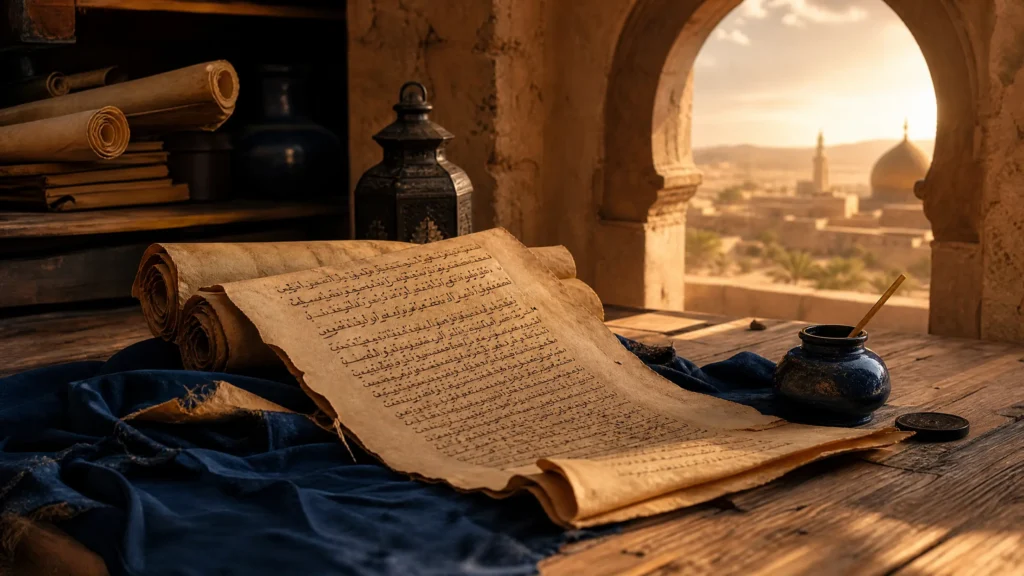
The Quran was not preserved through paper alone. It was preserved through hearts — hundreds of them — long before a single Mushaf was compiled between two covers. Understanding how many Sahaba memorised the Quran is not merely a historical question. It is the story of how every word in the Mushaf you hold today reached you intact across fourteen centuries.
This guide covers the most prominent Companions who memorised the Quran, their stories, and what their example means for every Muslim pursuing Hifz today.
How Many Sahaba Memorised the Quran?
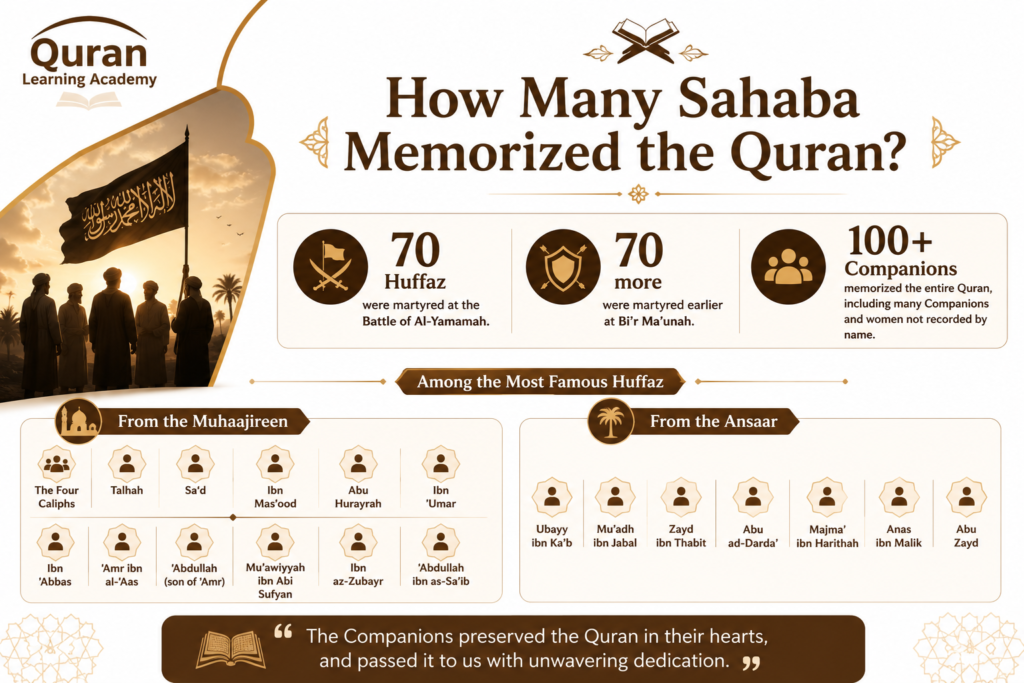
The most direct evidence comes from the Battle of al-Yamaamah. Seventy Companions who had memorised the entire Quran were killed in a single engagement against Musaylamah the Liar, as stated by Al-Qurtubi and others. A similar number had been killed earlier at the Battle of Bi’r Ma’oonah during the Prophet’s ﷺ own lifetime.
Scholars of Quranic sciences, including Al-Zarkashi in Al-Burhan and As-Suyuti in Al-Itqan, place the total well above one hundred. This figure excludes unnamed Companions and the many women of the Muhaajireen and Ansaar whose memorisation was not recorded by name in the transmitted sources.
Among the Muhaajireen who memorised the Quran during the Prophet’s ﷺ lifetime: the Four Caliphs, Talhah, Sa’d, Ibn Mas’ood, Hudhayfah, Salim, Abu Hurayrah, Ibn ‘Umar, Ibn ‘Abbas, ‘Amr ibn al-‘Aas and his son ‘Abdullah, Mu’aawiyyah, Ibn az-Zubayr, and ‘Abdullah ibn as-Sa’ib.
Among the Ansaar: Ubayy ibn Ka’b, Mu’adh ibn Jabal, Zayd ibn Thabit, Abu ad-Darda’, Majma’ ibn Harithah, Anas ibn Malik, and Abu Zayd.
Ubayy ibn Ka’b Was the Most Prominent Hafiz and Qari Among the Sahaba
When scholars discuss who was the first Hafiz of Quran in Sahaba, Ubayy ibn Ka’b is consistently named as the most prominent. He memorised the Quran during the lifetime of the Prophet ﷺ, served as one of the scribes of revelation, and completed the full Quran in recitation every eight days.
The Prophet ﷺ named him among the four recommended teachers of recitation:
“ خُذُوا الْقُرْآنَ مِنْ أَرْبَعَةٍ مِنْ عَبْدِ اللَّهِ بْنِ مَسْعُودٍ ـ فَبَدَأَ بِهِ ـ وَسَالِمٍ مَوْلَى أَبِي حُذَيْفَةَ، وَمُعَاذِ بْنِ جَبَلٍ، وَأُبَىِّ بْنِ كَعْبٍ ”
‘Learn the recitation of Qur’an from four from `Abdullah bin Mas`ud — he started with him–Salim, the freed slave of Abu Hudaifa, Mu`adh bin Jabal and Ubai bin Ka`b.”
Ubayy ibn Ka’b died in Madinah in approximately 20 AH. His students carried his recitation to the next generation, and his chain of transmission remains one of the most authenticated in the history of Quranic preservation.
Step Inside Our Virtual Classrooms
See how our interactive lessons work. Watch these brief highlights of our students engaging with instructors.
Start Your Quranic Journey in the UK
Join our academy for structured online lessons with expert tutors, tailored to fit your schedule.
Book Your Free TrialAbdullah ibn Mas’ood Learned Seventy Surahs Directly from the Prophet ﷺ
Abdullah ibn Mas’ood memorised the Quran during the lifetime of the Messenger of Allah ﷺ and narrated that he had learned more than seventy Surahs directly from the Prophet’s own mouth. He was named alongside Ubayy ibn Ka’b as one of the four authoritative teachers of recitation.
He died in Madinah at the end of 32 AH. His students in Kufa formed the foundation of one of the great early schools of recitation, and his chain of transmission is among the most authenticated in classical scholarship.
British Muslim adults who want to connect their own recitation to this tradition through structured, teacher-supervised learning can begin with the Adult Quran Classes in the UK at UK Quran Learning Academy, taught by qualified Azhari teachers online.
Start building a recitation that connects to the Companions’ tradition
Zayd ibn Thabit Led the First and Second Official Compilations of the Quran
Zayd ibn Thabit memorised the Quran during the Prophet’s ﷺ lifetime and was one of his principal scribes of revelation. He died in 45 AH.
His significance extends beyond personal Hifz. Abu Bakr appointed him to lead the first official written compilation of the Quran after al-Yamaamah. ‘Uthman appointed him again to lead the committee that produced the standardized Mushafs distributed to the major cities of the Islamic world.
Every Mushaf in existence today traces its written form to the committee that Zayd ibn Thabit led. His role is therefore not merely personal — it is the foundation of the written transmission that accompanies the oral one across every generation since.
Mu’adh ibn Jabal and Abu ad-Darda’ Built the First Structured Hifz System
Mu’adh ibn Jabal memorised the Quran from the Messenger of Allah ﷺ and died in 17 or 18 AH at the age of thirty-four. He was among the four Companions of the Ansaar specifically confirmed as having completed memorisation during the Prophet’s ﷺ lifetime.
Abu ad-Darda’ took the institutional dimension further than any other Companion. In the mosque of Damascus, he divided students into groups of ten, assigned a qualified teacher to each group, and positioned himself in the mihrab to supervise all groups simultaneously.
Ibn Mushkam narrated that Abu ad-Darda’ once asked him to count the students in his circle. The count reached more than 1,600 students — organized into groups of ten with one teacher per group, each teacher accountable to Abu ad-Darda’ himself.
This was not informal learning. It was a structured, supervised system for Quranic transmission that prefigured every Hifz institution that followed.
Children pursuing Hifz today benefit most from a similarly structured system. The Quran Memorisation for Kids in the UK at UK Quran Learning Academy applies this approach with qualified teachers for learners aged 5 to 15.
Enrol your child in a structured Hifz programme with qualified supervision
The Four Rightly-Guided Caliphs Each Memorised the Quran
All four Rightly-Guided Caliphs memorised the Quran, though the timing and circumstances of each differed. The following table summarises what the classical sources record about each:
| Caliph | Key Detail | Year of Death |
| Abu Bakr as-Siddeeq | The Prophet ﷺ appointed him to lead prayer — confirming his Quranic mastery | 13 AH |
| Umar ibn al-Khattab | Upon completing Surah al-Baqarah, he slaughtered a camel in gratitude | 23 AH |
| Uthman ibn ‘Affan | memorised during the Prophet’s lifetime; known to complete the full Quran in a single night | 35 AH |
| Ali ibn Abi Talib | memorised the Quran; scholarly opinion differs on whether this was during or after the Prophet’s ﷺ lifetime | 40 AH |
‘Uthman’s contribution extended beyond personal Hifz. His commission of the standardized Mushaf ensured that oral and written transmission remained aligned across the expanding Islamic world — a decision whose effect every Muslim still benefits from today.
Start Your Quranic Journey in the UK
Join our academy for structured online lessons with expert tutors, tailored to fit your schedule.
Book Your Free TrialSalim the Freed Slave of Abu Hudhayfah Was Among the First Recommended Teachers
Salim memorised the Quran from the Messenger of Allah ﷺ and was one of the four specifically named by the Prophet ﷺ as authoritative teachers of recitation. He died in 11 AH on the Day of al-Yamaamah — martyred in the very battle that made the first written compilation of the Quran urgent.
His inclusion in the Prophet’s list of recommended teachers despite his background as a freed slave reflects a core Quranic principle: distinction in this community is measured by knowledge and piety, not lineage or social standing.
Three Wives of the Prophet ﷺ Memorised the Complete Quran
Among the women who memorised the Quran, three wives of the Prophet ﷺ are specifically named in the classical sources. All three learned directly from the Messenger of Allah ﷺ:
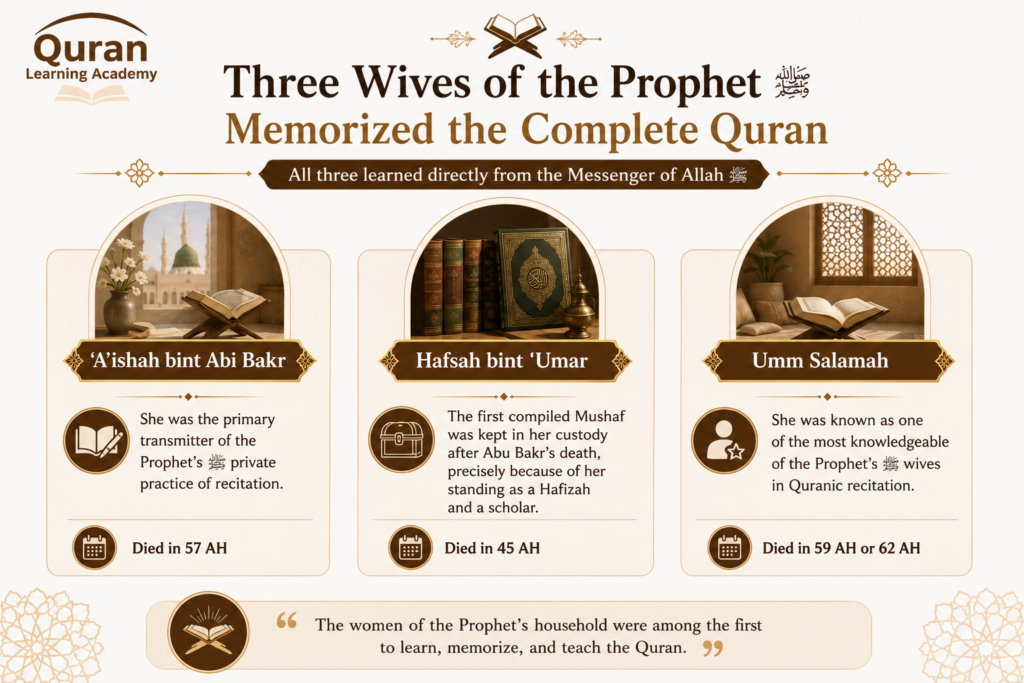
- ‘A’ishah bint Abi Bakr died in 57 AH and was the primary transmitter of the Prophet’s private practice of recitation.
- Hafsah bint ‘Umar died in 45 AH. The first compiled Mushaf was kept in her custody after Abu Bakr’s death, precisely because of her standing as a Hafizah and a scholar.
- Umm Salamah died in 59 AH or 62 AH and was known as one of the most knowledgeable of the Prophet’s wives in Quranic recitation.
Umm Waraqah bint ‘Abdullah ibn al-Harith is also named by As-Suyuti as a woman who memorised the complete Quran. The Prophet ﷺ called her “the martyr” and appointed her to lead her household in prayer — a distinction that reflects the honour he placed upon her memorisation.
Sisters pursuing Hifz today carry the same tradition these women established. The Quran Hifz for Ladies in the UK at UK Quran Learning Academy provides qualified female teachers and a fully private environment for sisters across Britain.
Read Also: The Best Gift for Hafiz-e-Quran
Begin your Hifz in the tradition of the women who memorised from the Prophet ﷺ
Abdullah ibn ‘Abbas and Abdullah ibn ‘Umar Represent the Second Generation of Hifz Transmission
Abdullah ibn ‘Abbas learned the Quran from Ubayy ibn Ka’b and died in at-Ta’if in 68 AH. He became the foremost Quranic scholar of his generation and the foundation of classical Tafsir scholarship.
Abdullah ibn ‘Umar learned the Quran from the Prophet ﷺ himself, from ‘Uthman ibn ‘Affan, and from Zayd ibn Thabit. He died in 73 or 74 AH.
His breadth of teachers reflects the Sahabah’s understanding that Quranic memorisation was transmitted through a chain of qualified teachers, each correcting the student in real time. This principle is the reason Ijazah exists today.
The Quran Ijazah Program in the UK at UK Quran Learning Academy connects British learners to the authenticated chain of transmission that stretches back through these Companions to the Prophet ﷺ himself.
Read Also: Can I Memorise Quran During Periods?
Connect your recitation to the unbroken chain that began with the Sahaba
The Method the Sahaba Used to Memorise the Quran
The Sahaba did not memorise quickly and move on. They memorised in small portions and refused to advance until each portion was understood, applied, and retained. Ibn Jazari documented in Munjad al-Muqri’in that the Companions memorised in portions of three, five, and ten verses at a time and did not exceed this. This is why the Prophet ﷺ warned against rushing:
“تَعَاهَدُوا الْقُرْآنَ فَوَالَّذِي نَفْسِي بِيَدِهِ لَهُوَ أَشَدُّ تَفَصِّيًا مِنَ الإِبِلِ فِي عُقُلِهَا ”
” “Commit yourself to the Qur’an, for by Him in whose Hand is my soul, it is surely more prone to break away than a camel in its bind.”
Three principles defined how the Sahaba memorised the Quran:
- Small portions at a time, never exceeding ten verses before full retention.
- Understanding and application before advancement to new material.
- Consistent review without gaps, because the Quran leaves memory faster than any other knowledge.
Read Also: Does Memorising the Quran Improve Memory?
Experience the Academy in Action
Curious about our teaching style? Take a quick look inside a live session to see our immersive, supportive learning environment first-hand.
Start Your Quranic Journey in the UK
Join our academy for structured online lessons with expert tutors, tailored to fit your schedule.
Book Your Free TrialUK Quran Learning Academy Delivers Hifz in the Tradition the Sahaba Established
The Sahaba memorised under direct teacher supervision. They were corrected in real time, reviewed regularly, and advanced only when ready. Every effective Hifz programme today is built on this same structure.
UK Quran Learning Academy delivers live, one-to-one Hifz and Tajweed programmes for British Muslim learners of all ages, taught by qualified Azhari teachers online. Every programme includes:
- Real-time Tajweed and pronunciation correction at every session.
- Structured memorisation and revision schedules managed by the teacher.
- Flexible scheduling built around UK work, school, and family commitments.
- Qualified male and female teachers matched to learner preference.
Discover Our Quran Courses
- Quran Online Academy
- Quran Recitation Classes
- Quran Reading Classes
- Online Quran Classes for Kids
- Quran Classes for Adults
- Quran Classes for Female / Sisters
- Learn Quran Course for Beginners
- Quran Memorization (Hifz) Course
- Hifz Classes for Adults
- Quran Memorization and Hifz Course for Kids
- Quran Hifz Course for Ladies
- Quran Ijazah Program
- Quran Qirat Learning Course
- Quran Tafsir Course
- Noorani Qaida Course
- Noorani Qaida Course for Kids
- Weekend Quran Classes
- Intensive Quran Course
- Al-Azhar Quran Course
- Online Tajweed Classes
- Tajweed Course for Kids
- Tajweed Course for Adults
- Tajweed Course for Ladies
Book a free trial and begin your Hifz with the structure the Sahaba relied upon
Start Your Quranic Journey in the UK
Join our academy for structured online lessons with expert tutors, tailored to fit your schedule.
Book Your Free TrialFAQ
How many Sahaba memorised the Quran in total?
The number exceeded one hundred named Companions, based on classical sources including As-Suyuti’s Al-Itqan and Al-Zarkashi’s Al-Burhan. The actual number was significantly higher when unnamed Companions and the women of the Muhaajireen and Ansaar are included.
Who was the first Hafiz of Quran in Sahaba?
Scholarly consensus points to Ubayy ibn Ka’b as the most prominent Hafiz and Qari among the Sahaba. The Prophet ﷺ named him among the four authoritative teachers of recitation and he memorised the Quran during the Prophet’s ﷺ own lifetime.
Did any women among the Sahaba memorise the complete Quran?
Yes. ‘A’ishah, Hafsah, Umm Salamah, and Umm Waraqah are specifically named in classical sources as women who memorised the complete Quran. All learned directly from the Messenger of Allah ﷺ.
How did the Sahaba memorise the Quran so effectively?
They memorised in small portions of three, five, or ten verses at a time, did not advance until each portion was fully understood and applied, and reviewed consistently. They combined memorisation with comprehension of meaning rather than treating the two as separate activities.
Why was the Quran compiled into a written Mushaf if so many had memorised it?
The Battle of al-Yamaamah killed seventy Huffaz in a single day. ‘Umar ibn al-Khattab feared that continued warfare could destroy so many Huffaz that oral transmission would be endangered. Abu Bakr then commissioned the first written compilation under Zayd ibn Thabit to safeguard what the hearts of the Sahaba carried.





Leave a Reply