 Quran
Many British Muslims begin Hifz with genuine commitment, repeating verses after Fajr, only to find their memorisation fading days later. So, how to memorise Quran fast in the UK without losing what you have learned?
The answer is not simply memorising more verses each day. A structured system that fits around work, university, and family commitments can help strengthen retention while making consistent Hifz more achievable.
1. Use the 6446 Method to Distribute Daily Exposure
Single-session memorisation is the most common reason British students forget verses overnight. When a verse is encountered only once in a day, the brain has no signal that it is worth retaining long-term.
The 6446 method solves this by spreading exposure across four points in the day: memorise 6 verses after Fajr, revise 4 in the afternoon, revise 4 in the evening, and review all 6 before sleeping. This repeated retrieval across different mental states forces the brain to consolidate the material rather than discard it overnight.
Hifz teachers at structured online programmes apply this method specifically for students who want to memorise Quran quickly without the loss cycle. The Hifz Classes for Adults in the UK at UK Quran Learning Academy builds daily session scheduling around exactly this kind of distributed practice for learners balancing work and family commitments.

Start your structured Hifz journey today
2. Apply the 3×3 Method to Every Single Verse
Repeating a verse ten times while looking at the Mushaf is not memorisation. It is familiarisation. The 3×3 method pushes past that into actual encoding.
Repeat each verse three times in three consecutive focused cycles before moving to the next. The test of correct encoding is not “I can recite this when I concentrate.” The test is whether the verse comes out correctly when attention is divided.
Close your eyes, recite the target verse, and simultaneously think about something unrelated. If it comes out cleanly, the verse is encoded at the right depth. If it does not, continue the cycles.
This method is particularly effective for verses that sound phonetically similar to adjacent verses, which is where British learners most commonly embed errors without realising it.
3. Apply the Mirror Method to Difficult Verses
Some verses contain long words or challenging letter combinations that resist the standard repetition approach. The mirror method addresses these directly.
Recite the verse backwards, from the last word to the first, then forward again from the first word to the last. This forces the brain to process each individual word carefully rather than riding the phonetic rhythm of the verse as a whole.
After the mirror pass, reciting the verse forward feels significantly easier because every word has been isolated and processed.
This is not a method for every verse. It is a targeted tool for the specific verses that keep slipping despite repeated standard practice.
Step Inside Our Virtual Classrooms
See how our interactive lessons work. Watch these brief highlights of our students engaging with instructors.
Start Your Quranic Journey in the UK
Join our academy for structured online lessons with expert tutors, tailored to fit your schedule.
Book Your Free Trial4. Follow the 3×10 Revision Cycle for Each Session
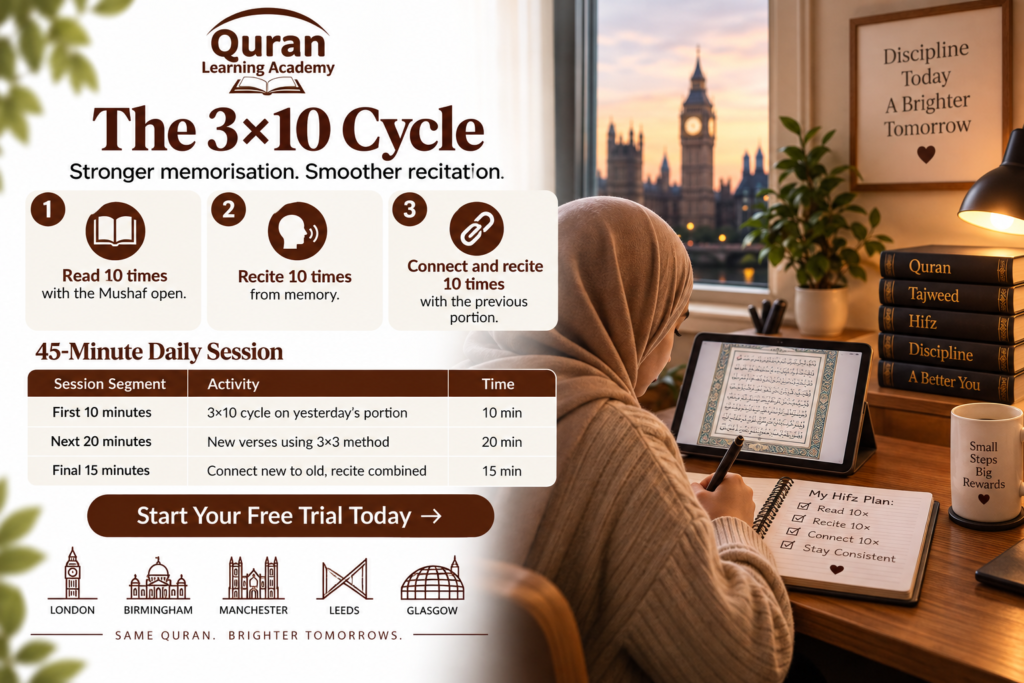
Before moving to any new material in a session, apply the 3×10 cycle to the previous portion. Read the target passage 10 times with the Mushaf open, recite it 10 times from memory, then connect it to the portion immediately before it and recite both together 10 times.
The third step is what most students skip, and skipping it is why memorised sections feel solid alone but collapse during continuous recitation. The connection between portions is itself a skill that must be practised deliberately.
The following table shows how this cycle distributes across a 45-minute daily session:
| Session Segment | Activity | Time |
| First 10 minutes | 3×10 cycle on yesterday’s portion | 10 min |
| Next 20 minutes | New verses using 3×3 method | 20 min |
| Final 15 minutes | Connect new to old, recite combined | 15 min |
5. Commit to One Mushaf and Never Substitute It
The brain encodes Quranic verses alongside their physical position on the page. Which word sits at the end of a line, where the page break falls, how the text is spaced — all of this becomes part of the memory trace. Switch to a different print layout and that spatial anchor resets entirely.
Most British learners cycle between a phone app during the commute, a printed copy at home, and a different edition at the masjid. Every layout change costs memorisation speed. Choose the 15-line Madinah Mushaf and treat switching as non-negotiable. Mark difficult words in the margins and note pause points in pencil. The Mushaf itself becomes part of the memory system.
Read more: Hadith About Memorizing Quran.
6. Use a Weekly Schedule That Protects What You Have Built
Six days of new memorisation followed by one full day of revision is the structure that experienced Hifz teachers recommend consistently. On the revision day, recite the entire week’s new material from beginning to end without consulting the Mushaf. Note only the points where hesitation occurs, then return to those sections specifically.
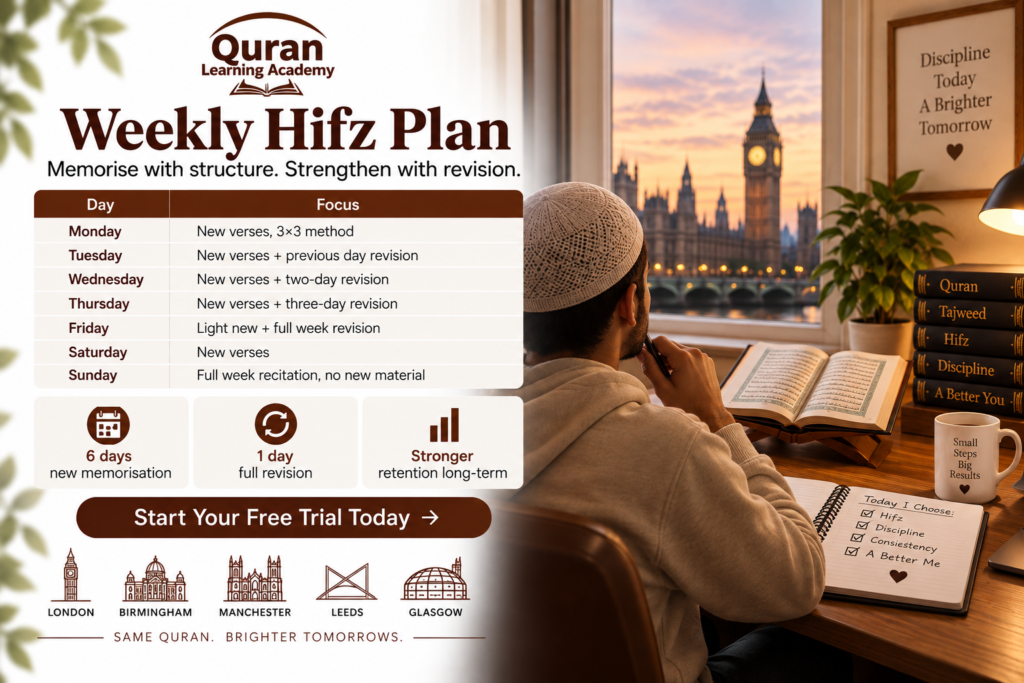
The following schedule reflects this principle for a British learner with weekday work commitments:
| Day | Focus |
| Monday | New verses, 3×3 method |
| Tuesday | New verses plus previous day revision |
| Wednesday | New verses plus two-day revision |
| Thursday | New verses plus three-day revision |
| Friday | Light new, full week revision |
| Saturday | New verses |
| Sunday | Full week recitation, no new material |
Read more: Memorise Quran in 30 Days.
7. Recite New Verses in Every Prayer
Each of the five daily prayers is a retrieval opportunity that most students waste by defaulting to familiar short surahs. Reciting newly memorised material in salah combines physical ritual, focused spiritual presence, and verbal production into a memory trace that outlasts desk-based revision many times over.
The practical approach is to use the most recently memorised verses in sunnah prayers first, then move them to fard prayers once recitation feels stable. Older portions rotate through nawafil prayers.
Over the course of a week, this cycles through a significant volume of memorised material without requiring additional dedicated revision time beyond the daily schedule.
Allah سبحانه وتعالى drew the connection between the Quran and the night hours clearly. Reciting in prayer, particularly in the quieter sunnah and night prayers, deepens the trace that daytime desk practice builds.
إِنَّ نَاشِئَةَ اللَّيْلِ هِيَ أَشَدُّ وَطْئًا وَأَقْوَمُ قِيلًا
Inna nāshi’ata al-layli hiya ashaddu wat’an wa-aqwamu qīlā
“Indeed, the hours of the night are more effective for concurrence [of heart and tongue] and more suitable for words..”
For British Muslim women seeking this structure with female instructors, the Quran Hifz for Ladies in the UK programme at UK Quran Learning Academy provides structured memorisation training with one-on-one sessions, Tajweed-compliant recitation, and revision schedules built specifically for female learners across Britain.

Start your Hifz with daily accountability from a qualified female instructor.
8. Track Progress to Identify Weak Points Before They Harden
Recording which verses were memorised, which were revised, and where hesitation occurred in each session turns subjective feeling into actionable data. A simple notebook or even a paper checklist achieves this.
The most important thing to track is not how many new verses were added but how many old verses remained solid during revision. Students who measure retention rather than acquisition shift their daily behaviour automatically toward the revision ratio that actually produces lasting memorisation.
When the same verse appears in the weak-point column three sessions in a row, it signals that the encoding depth was insufficient from the start. At that point, thirty or more consecutive repetitions in a single session, well past the point of feeling confident, is the correct response.
Experience the Academy in Action
Curious about our teaching style? Take a quick look inside a live session to see our immersive, supportive learning environment first-hand.
Start Your Quranic Journey in the UK
Join our academy for structured online lessons with expert tutors, tailored to fit your schedule.
Book Your Free TrialStart Your Hifz Journey with Qualified Guidance
Memorising alone means errors embed silently over weeks of private practice. By the time they surface, they have become deeply habituated and require significant effort to correct.
UK Quran Learning Academy connects British learners with qualified Azhari instructors who hold verified Ijazah credentials and bring both the formal chain of transmission and practical experience teaching diverse UK learners to every live session.
Lessons are scheduled flexibly to accommodate working professionals, parents managing school-age children, and university students across London, Birmingham, Manchester, and beyond. A qualified teacher hears the errors that self-correction cannot catch.
Discover Our Quran Courses
- Quran Recitation Classes
- Online Quran Classes for Kids
- Quran Classes for Adults
- Quran Classes for Female / Sisters
- Learn Quran Course for Beginners
- Quran Memorization (Hifz) Course
- Hifz Classes for Adults

Conclusion
How to memorise Quran fast in the UK is not a question that has a single trick as its answer. It has a system. Fix one Mushaf. Use the Fajr window without exception. Apply the 3×3 method until automaticity replaces effort. Distribute daily exposure using the 6446 structure. Protect existing memorisation at a two-to-one ratio over new material. Recite in every prayer. Reserve one full day each week for consolidation with no new material added.
British learners who apply this system find that the memorisation they build holds under the real pressure of busy weeks, exam periods, and Ramadan commitments. The verses stay because the system was designed to keep them.
Frequently Asked Questions
How many verses should I memorise each day to avoid forgetting?
Three to five verses memorised thoroughly can support better retention than ten verses learned loosely. Always revise at least twice the volume of new material before adding more.
Is the Fajr window genuinely more effective or is it just tradition?
The mind is often more rested immediately after sleep, making the first 30 to 45 minutes after Fajr a practical window for focused memorisation.
What should I do when I keep forgetting the same verse repeatedly?
Repeat the difficult verse 30 or more times, practise its transition from the preceding verse, then recite it in salah daily for the following week.
Can adults who work full-time realistically memorise Quran quickly?
Yes. Adults may memorise more slowly but can benefit from stronger comprehension and structured revision. With consistent focused practice, full-time workers can make substantial Hifz progress.








[…] Read more: Memorise Quran Fast in the UK […]