 Quran
Many British Muslims can read the Arabic text but struggle to understand its meaning. Others hesitate to begin, believing Arabic is too difficult or that they have missed their chance.
Learning how to read and understand the Quran is a skill built in stages, available to anyone willing to begin.
The steps below offer a structured approach for British Muslims, balancing busy schedules, English as a first language, and a genuine desire to connect with Allah’s words beyond recitation alone.
1. Set a Sincere Intention Before Opening the Mushaf
Before you open the Mushaf, you need to know why you are opening it. Without a clear intention, the session becomes a task to complete rather than an act of worship to sustain.
Your Niyyah does not need to be elaborate. It simply needs to be honest: are you seeking guidance, or are you trying to draw closer to Allah?
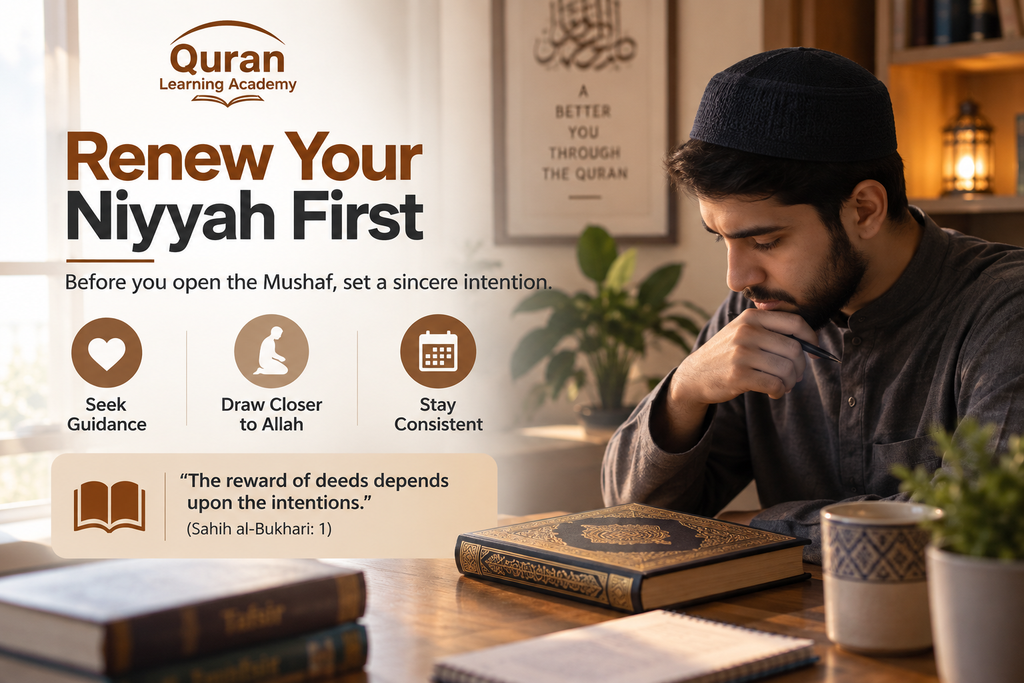
Renewing your Niyyah before each session protects long-term consistency. It reconnects the action to its purpose and prevents the reading from becoming a mechanical routine that loses its effect over weeks.
“إِنَّمَا الأَعْمَالُ بِالنِّيَّاتِ، وَإِنَّمَا لِكُلِّ امْرِئٍ مَا نَوَى”
Innamā al-aʿmālu bin-niyyāt, wa innamā likulli mri’in mā nawā.
“The reward of deeds depends upon the intentions and every person will get the reward according to what he has intended.”
2. Master Basic Tajweed Before Reading at Speed
Tajweed is not separate from understanding. It is directly connected to it. When you apply Makharij correctly, pronouncing each letter from its proper articulation point, words become distinct, pauses fall in the right places, and meaning becomes accessible in a way it cannot be when pronunciation is rough.
Arabic is a language where a single vowel change alters meaning entirely. You do not need to master every rule before starting.
The basic rules covering vowels, joining, and letter characteristics are enough to read accurately, with advanced rules built gradually on top of this foundation.
Many British adults have spent years repeating the same recitation errors without knowing it.
The UK Quran Learning Academy’s Online Tajweed Classes in the UK offer live correction from qualified Azhari instructors, identifying embedded errors and replacing them with accurate habits at a pace that fits around work and family.

Enrol in Online Tajweed Classes and recite accurately from your first session.
3. Read a Reliable Translation Alongside the Arabic
Reading the Quran without a translation means reciting sounds without meaning. The method that works is straightforward: read one or two verses in Arabic, read the translation of those same verses, then pause before moving forward.
This connects the sound of the Arabic to the meaning it carries and builds comprehension naturally over time.
Not all translations communicate the same level of clarity. The three most suitable options for British readers are:
| Translation | Best For | Style |
| Sahih International | Beginners and general readers | Clear, neutral, accessible English |
| The Clear Quran (Dr. Mustafa Khattab) | Contemporary readers | Modern English with helpful headings |
| Abdel Haleem (Oxford) | Academic readers | Smooth, meaning-focused delivery |
A translation gives you meaning but not depth. The nuances of Quranic Arabic, including root meanings and literary precision, are beyond what any translation fully conveys. Translation is the door, and what lies behind it requires further study.
Read more: How Much Quran Should I Memorise Daily?
4. Study Tafsir to Access the Context Behind Each Verse
Translation tells you what a verse says. Tafsir tells you what it means, why it was revealed, and how scholars across centuries understood and applied it.
Reading without Tafsir is what leads to verses being misunderstood or applied out of context.
The difference between translation and Tafsir in practical terms is as follows:
| Element | Translation | Tafsir |
| Word meaning | Yes | Yes |
| Reason for revelation | No | Yes |
| Historical context | No | Yes |
| Connection to Sunnah | No | Yes |
| Scholarly interpretation | No | Yes |
Two Tafsir works are particularly suited for British beginners:
- Tafsir Ibn Kathir: The most widely used classical commentary in English. It explains reasons for revelation and connects verses to authentic narrations. Abridged editions are appropriate for beginners.
- Tafsir As-Sa’di: Written in simple language with a focus on spiritual clarity. It avoids lengthy technical debates and gives a heart-centred reading of each verse.
The UK Quran Learning Academy’s Quran Tafsir Course in the UK guides students through classical Tafsir methodology using Ibn Kathir and al-Tabari, covering linguistic analysis and the principles of interpretation so that each verse is understood rather than merely recognised.
Begin the Quran Tafsir Course and read every verse with real depth.
5. Build a Daily Reading Habit Around Your Actual Schedule
Consistency is the single most important factor in how to read and understand the Quran over time. Reading ten pages once a week produces far less comprehension than reading two verses every single day.
The brain builds understanding through regularity, not through occasional large sessions.The most sustainable approach for British Muslims is to attach Quran reading to something that already happens daily.
After Fajr works best because the mind is clear and the house is quiet before the demands of a working day accumulate. Even ten minutes at a fixed time builds more than an hour done whenever it happens to be convenient.
A practical framework based on available daily time is as follows:
| Daily Time Available | Recommended Target | Completion Timeline |
| 10 to 15 minutes | Half a page with reflection | Approximately one year |
| 20 to 30 minutes | One page with translation | Six-month plan |
| 45 minutes or more | One Juz per day | Thirty-day plan |
The most common failure pattern among British learners is starting with an ambitious target, missing a few days during a busy week, and never fully returning to the habit. Setting a minimum session that is short enough to be non-negotiable, even two verses and their translation, protects the habit through difficult periods.
Step Inside Our Virtual Classrooms
See how our interactive lessons work. Watch these brief highlights of our students engaging with instructors.
Start Your Quranic Journey in the UK
Join our academy for structured online lessons with expert tutors, tailored to fit your schedule.
Book Your Free Trial6. Reflect on Each Verse Before Moving to the Next
Tadabbur is the act of deep reflection on the Quran’s verses, and it is not an advanced practice reserved for scholars. It is the baseline of how to read and understand the Quran as Allah commanded.
The Quran was not revealed to be raced through. It was revealed to be pondered and lived.
“أَفَلَا يَتَدَبَّرُونَ الْقُرْآنَ أَمْ عَلَىٰ قُلُوبٍ أَقْفَالُهَا”
Afalā yatadabbarūna al-Qurʾāna am ʿalā qulūbin aqfāluhā.
“Then do they not reflect upon the Qur’an, or are there locks upon [their] hearts?”
After reading a verse and its translation, pause and ask yourself three questions before moving on:
- What is Allah communicating in this verse?
- How does this relate to my current circumstances or struggles?
- What change does this verse invite in my thinking or behaviour?
A single verse absorbed and applied is more valuable than a page completed without attention. The scholars of the early generations would sometimes spend days on a single verse examining its layers.
The principle worth carrying into every session is that quality of engagement always outweighs quantity of pages.
7. Listen to Quran Recitations to Reinforce What You Read
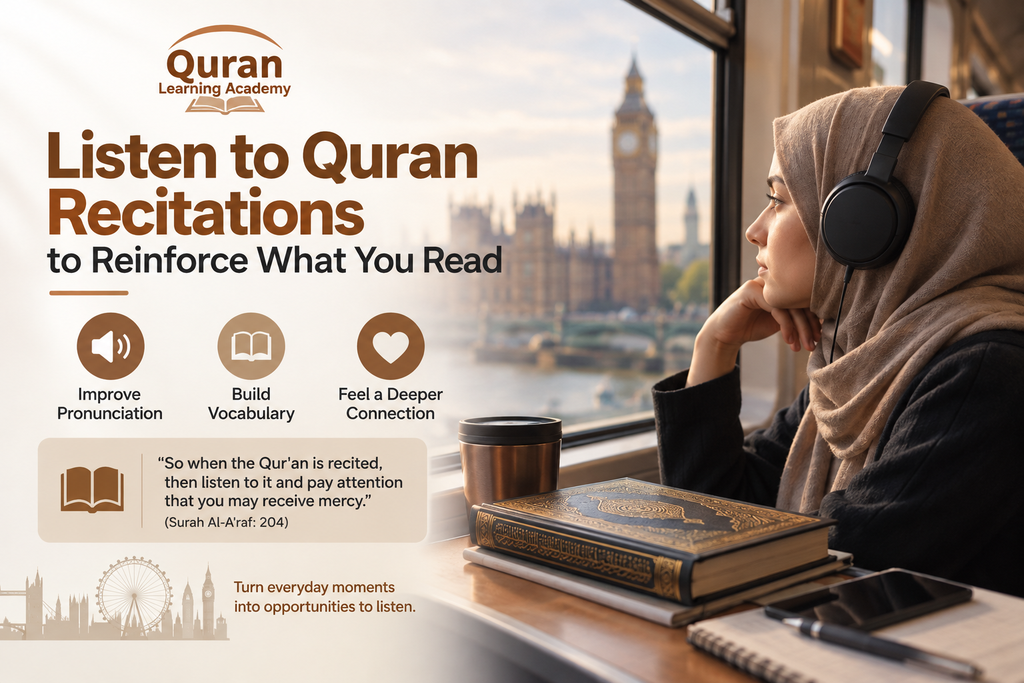
Listening is one of the most underused tools in learning how to read and understand the Quran.
The auditory experience, particularly when following along with a translation, reinforces pronunciation, builds vocabulary familiarity, and creates an emotional connection to the text that silent reading alone cannot always produce.
“وَإِذَا قُرِئَ الْقُرْآنُ فَاسْتَمِعُوا لَهُ وَأَنصِتُوا لَعَلَّكُمْ تُرْحَمُونَ”
Wa idhā quri’a al-Qurʾānu fastami’ū lahu wa anṣitū laʿallakum turḥamūn.
“So when the Qur’an is recited, then listen to it and pay attention that you may receive mercy.”
One of the most practical aspects of Quran listening for British Muslims managing full schedules is that it does not require a dedicated session.
A commute into central London, time spent cooking, or a walk between appointments can all become moments of Quranic immersion without displacing other responsibilities.
Read more: Memorise Quran in 1 Year.
8. Learn Quranic Arabic to Read the Quran in Its Original Form
Every translation is an interpretation. The Quran was revealed in Arabic and the depth, precision, and literary beauty of its language cannot be fully carried across into English.
Learning Quranic Arabic is one of the most significant steps any British Muslim can take toward genuinely understanding how to read and understand the Quran as it was intended.
Quranic Arabic study is not the same as learning to speak Modern Standard Arabic. It focuses on specific disciplines that unlock the Quran directly. Those disciplines are:
- Root-word recognition, so that unfamiliar words can be understood from their three-letter root.
- Basic grammar (Nahw), covering how sentence structure works in Quranic verses.
- Morphology (Sarf), covering how words change form to carry different meanings.
- Direct Quranic text analysis, applying grammar knowledge to actual verses.
The difference Arabic knowledge makes to the reading experience is significant:
| Without Arabic | With Quranic Arabic |
| Dependent on translator’s choices | Direct access to original word meanings |
| Cannot appreciate linguistic precision | Sees the literary craft in each verse |
| Tafsir study remains surface-level | Tafsir becomes fully accessible |
| Reading feels like reading about the Quran | Reading feels like the Quran speaking directly |
The UK Quran Learning Academy’s Quranic Arabic Course in the UK moves through Classical Arabic grammar, Quranic vocabulary, and direct text analysis in a structured sequence.
Each lesson builds on the one before, so students engage with actual Quranic verses rather than abstract grammar drills.
Start the Quranic Arabic Course and access the Quran in the language it was revealed in.
9. Avoid the Mistakes That Slow Most Beginners Down
Understanding what goes wrong for most learners is part of how to read and understand the Quran correctly from the start. Many British Muslims have spent years with habits that limit their progress without realising it.
The most common errors and what to do instead are as follows:
| Common Mistake | Why It Limits Progress | What to Do Instead |
| Reading verses in isolation | Leads to misinterpretation without context | Always read with a Tafsir reference |
| Relying only on translation | Misses nuance and word-level meaning | Pair translation with Arabic study |
| Rushing through large portions | Volume without comprehension builds nothing | Read less and reflect more |
| Studying without a teacher | Errors in recitation go uncorrected | Learn with qualified live instruction |
| Setting unsustainable targets | Leads to burnout and abandoning the habit | Start small and increase gradually |
Misreading isolated verses is the most serious error of all. Some of the most widely misunderstood Quranic verses appear to say something entirely different from their actual meaning when read without their context of revelation. This is not a failing of the Quran. It is a consequence of reading without the scholarly framework that Tafsir provides.
Experience the Academy in Action
Curious about our teaching style? Take a quick look inside a live session to see our immersive, supportive learning environment first-hand.
Start Your Quranic Journey in the UK
Join our academy for structured online lessons with expert tutors, tailored to fit your schedule.
Book Your Free Trial10. Begin With Short Surahs to Build Confidence Early
One of the most effective strategies for how to read and understand the Quran as a beginner is to start with the shorter Surahs of Juz Amma rather than opening at Al-Baqarah and working forward.
The short Surahs of the thirtieth Juz are already familiar to most British Muslims from daily prayer, which means the words are partially known and the confidence barrier is significantly lower.
The reasons Juz Amma is the right starting point for beginners are as follows:
- The Surahs are short enough to be read, reflected upon, and studied with Tafsir in a single session.
- Many verses are already memorised from Salah, creating an immediate connection between study and worship.
- The themes of accountability, mercy, and the nature of this life are universally relevant regardless of where a learner is in their faith journey.
- Completing a full Surah in one sitting produces a sense of accomplishment that motivates continued study.
After building confidence with the shorter Surahs, a learner is better equipped to approach the longer chapters.
They have established a method, practised reflection, and experienced what it feels like to finish a Surah with genuine understanding rather than just having moved through its words.
For children across Britain who are starting this journey, the UK Quran Learning Academy’s Noorani Qaida Course for Kids in the UK builds the foundational reading skills, letter recognition, and pronunciation accuracy that every child needs before engaging with the Quran’s text. Giving children the right start makes the entire journey significantly easier.
Enrol your child in the Noorani Qaida Course and build a strong foundation from the very beginning.
Read And Understand The Quran now with the UK Quran Learning Academy
Learning how to read and understand the Quran is a journey with multiple stages, and each stage requires a different kind of support. Reading accurately requires Tajweed instruction.
Understanding requires Tafsir guidance. Going deeper into the original language requires structured Arabic study. Sustaining all of this alongside a British lifestyle requires flexibility, qualified teachers, and a curriculum designed for learners whose first language is English.
The UK Quran Learning Academy connects British learners with qualified Azhari instructors across all of these areas through live, interactive online sessions.
Whether you are beginning from the Arabic alphabet or building on years of reading to finally understand what you recite, there is a structured programme designed for exactly where you are. Key features of every programme include:
- Qualified instructors holding verified Ijazah in Quranic recitation.
- Live sessions scheduled around work, school, and family commitments anywhere in the UK.
- Courses covering Tajweed, Tafsir, Hifz, Quranic Arabic, and Islamic studies.
- Programmes for children, adults, sisters, and complete beginners at every level.
Discover Our Quran Courses
- Online Tajweed Classes in the UK
- Quran Tafsir Course in the UK
- Quranic Arabic Course in the UK
- Noorani Qaida Course for Kids in the UK
- Learn Quran Course for Beginners
- Quran Memorization (Hifz) Course
- Hifz Classes for Adults
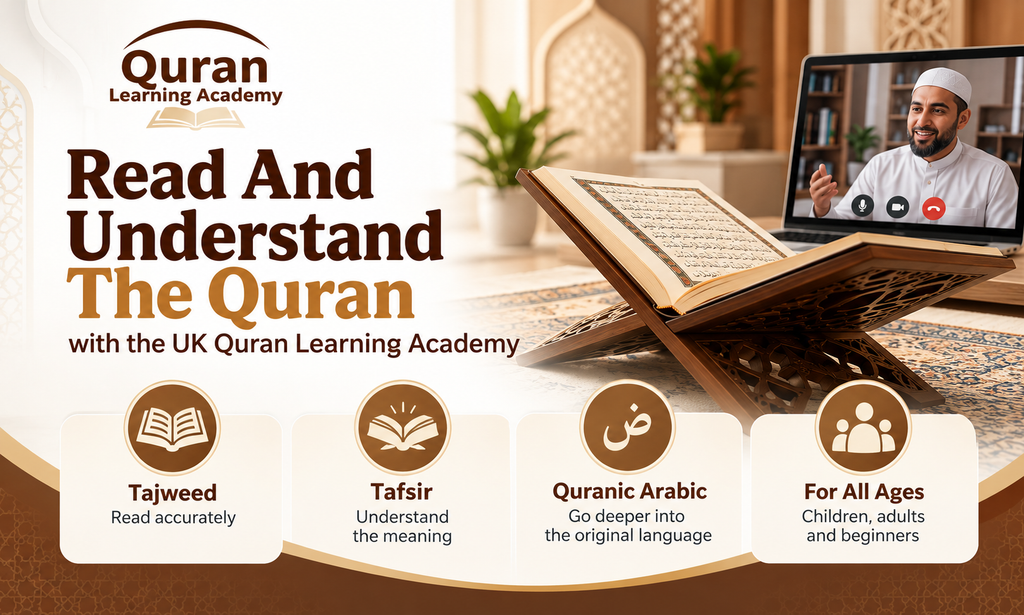
Book your free trial session with the UK Quran Learning Academy today.
Conclusion
Learning how to read and understand the Quran is a gradual journey. You do not need to master Arabic or Tafsir before you begin. Start with a few verses, read their translation, reflect on their meaning, and build your knowledge step by step.
With consistency, the words you once simply recited can become words you understand, remember, and apply in your daily life. Every verse you understand brings you closer to the guidance and meaning within the Quran.
Frequently Asked Questions
Is it valid to read the Quran in English as a beginner?
Yes. Reading the Quran in English translation is an appropriate starting point for those with no Arabic background. It allows a beginner to access meaning and build familiarity with the Quran’s themes before adding Arabic study. It should be understood as a foundation to build on rather than a permanent substitute.
Can a non-Arabic speaker truly understand the Quran?
A non-Arabic speaker can reach a meaningful level of Quran understanding through consistent use of a reliable translation, engagement with beginner-level Tafsir, and gradual Quranic Arabic study. Many British Muslims have done exactly this. Arabic fluency deepens the experience significantly but is not a prerequisite for beginning.
Is it sinful to make mistakes while reciting the Quran?
No, making mistakes while reciting the Quran are not sinful if you are genuinely trying to learn and improve. Keep practicing, seek guidance, and do not let mistakes discourage you.
What is the best time of day to read the Quran?
After Fajr is the time most consistently recommended by scholars. The mind is clear, the environment is quiet, and the reading is done before other demands have accumulated. For British Muslims managing full working days, attaching Quran time to an existing prayer creates a reliable daily anchor for the habit.
Do I need a teacher to learn how to read and understand the Quran?
While self-study is possible, learning with a qualified teacher accelerates progress considerably. A teacher corrects recitation errors before they become embedded habits, explains Tafsir in context, answers questions about specific verses, and provides the structured progression that self-directed study consistently lacks.





Leave a Reply