 Quran

Most British Muslims who attempt solo Hifz stop within the first month. Not because they lack sincerity, but because they start without a system built for independent learning. When there is no teacher correcting your Tajweed, no class schedule forcing consistency, and no peer group holding you accountable, the entire weight falls on your own structure.
This guide is built exclusively for that situation: how to memorise Quran by yourself in the UK, with every step addressing what happens when you are learning alone.
1. Set a Daily Limit Based on Your Actual UK Schedule
A teacher sets your pace for you. Without one, you must set it yourself based on what your week genuinely allows, not what you wish it allowed. A British Muslim working full-time, commuting, and managing family will not sustain two pages daily.
Three to five verses after Fajr is realistic and far more powerful than ten verses memorised poorly on the weekend.
The specific risk for solo learners is exceeding the daily limit when motivation is high, then burning out and stopping entirely. Your limit exists to protect your consistency, not to cap your potential. Once you reach it, stop new memorisation and spend remaining time on repetition of what you have just learnt.
2. Build an Error-Detection System to Replace Teacher Correction
The most dangerous gap in solo Hifz is undetected error. A teacher catches a mispronounced letter immediately. When you learn alone, that error gets memorised alongside the verse and becomes harder to remove with every repetition.
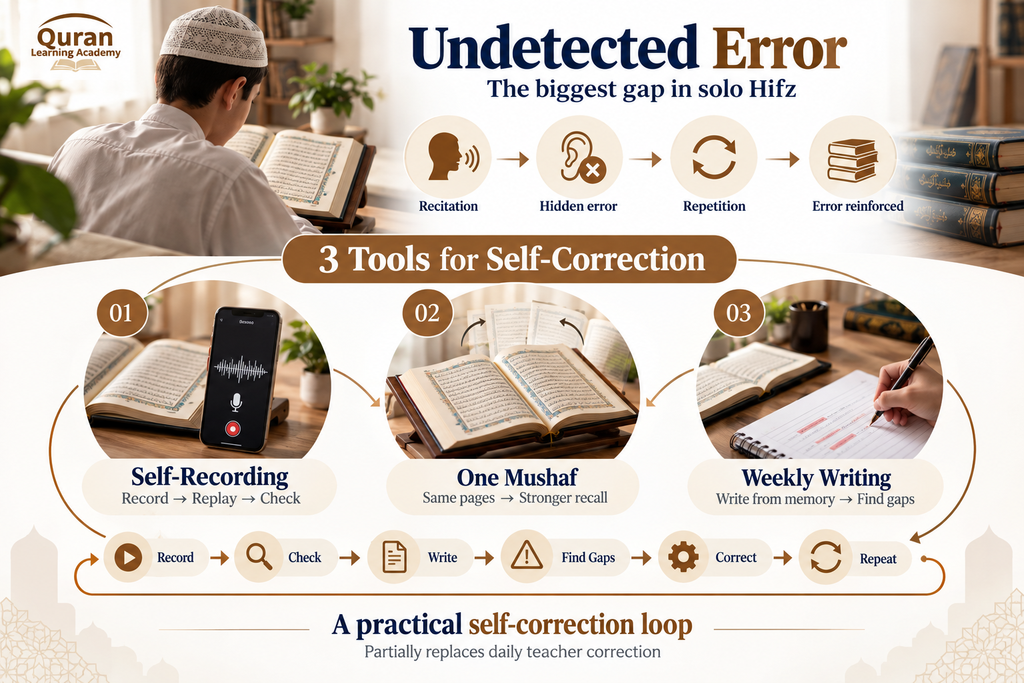
Three tools that directly replace teacher correction for solo UK learners:
- Self-recording: Recite each newly memorised section into your phone, then play it back while following the Mushaf. Errors that feel invisible during recitation become audible immediately on playback.
- Single Mushaf consistency: Always memorise from the same printed copy. Visual memory of the page layout supports recall and makes deviations easier to spot when you review.
- Weekly written recitation: Once a week, recite a recently memorised section and write it from memory. Gaps in what you write reveal exactly where your memorisation has holes.
These three together create a correction loop that partially replaces what a teacher provides daily.
Step Inside Our Virtual Classrooms
See how our interactive lessons work. Watch these brief highlights of our students engaging with instructors.
Start Your Quranic Journey in the UK
Join our academy for structured online lessons with expert tutors, tailored to fit your schedule.
Book Your Free Trial3. Apply Tajweed from Verse One, Not After Memorisation
Solo learners frequently plan to memorise first and fix pronunciation later. This creates a serious problem: every repetition of a Tajweed error strengthens that error in memory. By the time you attempt correction, the mistake is deeply embedded.
The Quran commands its own precise recitation. Allah says:
” وَرَتِّلِ الْقُرْآنَ تَرْتِيلًا”
Wa rattilil-Qur’āna tartīlā
“and recite the Qur’an with measured recitation.”
For a solo learner, this means Tajweed study must run in parallel with memorisation from the first session. Before memorising a new section, listen to a verified reciter reciting that exact passage and match your pronunciation to his. This listening-then-memorising sequence catches errors before they become habits.
UK Quran Learning Academy offers structured Online Tajweed Classes in the UK that run alongside your independent Hifz practice, correcting your recitation without requiring you to pause your memorisation progress.

4. Understand the Meaning Before Each New Section
English-speaking British Muslims who memorise Arabic sounds without understanding them are building phonetic memory, which is the weakest form of retention.
Meaning-based memory is significantly more durable, and for a solo learner with no teacher to re-engage you when motivation drops, meaning is what keeps the connection alive.
Before memorising any new verses, read the English translation and understand what Allah is specifically saying in those lines. Note what the verse is describing, who is being addressed, and what follows it.
This context transforms recitation from repetition into conversation, and that shift dramatically reduces the forgetting rate for independent learners.
5. Chunk Each Page Into Three Sections
Attempting to memorise a full page in one session is the approach that makes solo learners feel they are failing when they are not. The problem is not capacity, it is method.
Divide each page into three sections of roughly equal length. Work on section one until you can recite it without looking. Move to section two and repeat. Then recite sections one and two together before touching section three.
By the end of the page, you are connecting material you have already secured, not racing through unfamiliar text.
This method matters more for solo learners than for classroom learners because there is no teacher breaking material into portions for you. You must impose that structure yourself.
Experience the Academy in Action
Curious about our teaching style? Take a quick look inside a live session to see our immersive, supportive learning environment first-hand.
Start Your Quranic Journey in the UK
Join our academy for structured online lessons with expert tutors, tailored to fit your schedule.
Book Your Free Trial6. Use Voluntary Prayers as a Daily Retention Test
Obligatory prayers in congregation limit what you can recite. Voluntary prayers, Duha, Qiyam al-Layl, and Witr, belong entirely to you. For a solo learner, these are not just acts of worship. They are the only daily test of whether your memorisation is genuinely solid.

Reciting from memory in prayer exposes weak verses immediately. If you stumble during Qiyam al-Layl, you know exactly which section needs more work tomorrow. No teacher needed.
The prayer itself becomes your assessment tool, and this is one of the most honest feedback systems available to a solo Hifz learner.
Read more: Hadith About Memorizing Quran
7. Build a Fixed Weekly Revision Schedule
Without a teacher enforcing revision, solo learners consistently prioritise new memorisation over review. The result is a growing body of verses that slowly deteriorate while new ones are added on top. This is the primary reason solo Hifz stalls after a few months.
A fixed weekly structure for British learners with a standard working week:
| Day | Focus |
| Saturday | New memorisation only |
| Sunday | New memorisation only |
| Monday | Revision of this week’s new material |
| Tuesday | Revision of last week’s material |
| Wednesday | Revision of the week before |
| Thursday | Revision of this month’s full portion |
| Friday | Light revision and recitation in prayers |
The key principle is that revision occupies five days and new memorisation only two. This feels counterintuitive but it is exactly what prevents the deterioration that ends most solo Hifz attempts.
8. Recite to Someone Every Week
Solo Hifz does not mean completely isolated Hifz. One of the most effective accountability tools available to a UK learner without a formal teacher is weekly recitation to any knowledgeable person in your life. A family member, a friend who reads Arabic, or someone at your local mosque who can hold the Mushaf while you recite.
This weekly recitation serves two functions that are impossible to replicate alone. First, it creates external accountability that prevents the gradual relaxation of standards that solo learners experience over time.
Second, another person listening catches errors your own ears have stopped noticing because familiarity dulls self-correction.
If no one is available locally, UK Quran Learning Academy provides structured Quran Memorisation Course in the UK with qualified instructors who can serve as your weekly accountability check without requiring full-time enrolment.

Book Your Weekly Recitation Session
9. Address the Verses That Resemble Each Other
The Quran contains numerous verses that are nearly identical in wording but differ in one or two words. These similar verses are the primary source of mixing errors for solo learners and the hardest to catch without a teacher.
Examples of verses that solo UK learners consistently confuse:
| Surah and Verse | Wording |
| Al-Baqarah: 58 | فَكُلُوا مِنْهَا |
| Al-A’raf: 161 | وَكُلُوا مِنْهَا |
| Al-Baqarah: 170 | مَا وَجَدْنَا عَلَيْهِ آبَاءَنَا |
| Luqman: 21 | مَا أَلْفَيْنَا عَلَيْهِ آبَاءَنَا |
When you encounter a verse that feels familiar from another Surah, stop. Locate both verses in your Mushaf, place them side by side, and memorise the difference specifically before continuing. This targeted approach prevents the mixing errors that become very difficult to correct once they are embedded.
Read more: Memorise The Quran In The UK.
10. Support Your Children’s Hifz Alongside Your Own
Many British Muslim parents beginning solo Hifz discover that their children are ready to memorise at the same time. Memorising alongside your child creates mutual accountability, shared revision sessions, and a household environment that reinforces Quran daily.
Children memorise differently from adults. They need structured, age-appropriate progression, qualified instruction, and consistent encouragement. UK Quran Learning Academy offers Quran Memorisation for Kids in the UK, designed for children aged 5 to 15 with spaced repetition techniques and structured review cycles tailored to developing minds.

Start Your Hifz Journey with UK Quran Learning Academy
Independent memorisation is possible, but the learners who complete it are those who combine personal discipline with qualified support at the right moments.
UK Quran Learning Academy connects British Muslims with qualified Azhari instructors who understand the specific challenges of Hifz in the UK, flexible scheduling around work and school, British English instruction, and live interactive sessions that fit into a real British week.
Whether you need Tajweed correction, a structured memorisation programme, or qualified oversight of your independent progress, the Academy provides the support that makes the difference between a Hifz journey that continues and one that stops.
Discover Our Quran Courses
- Online Tajweed Classes in the UK
- Quran Memorisation Course in the UK
- Quran Memorisation for Kids in the UK
- Noorani Qaida Course for Kids
- Weekend Quran Classes
- Intensive Quran Course

Book your free trial session and begin today
Conclusion
Learning how to memorise Quran by yourself in the UK is not about doing everything alone. It is about building the right structure for when a teacher is not present daily.
The steps above address the specific gaps that appear without teacher oversight: error detection, revision discipline, Tajweed accuracy, and the similar-verse confusion that catches solo learners off guard.
Start with a limit you can keep, build your error-detection loop from day one, and protect your revision schedule as strictly as your new memorisation.
Frequently Asked Questions
Can I memorise the Quran by myself without any teacher at all?
You can make significant progress independently, but zero teacher involvement carries real risk. Tajweed errors and similar-verse mixing accumulate without detection. Most successful solo learners use periodic qualified oversight, even if not daily classes, to verify their accuracy at key stages.
How long does solo Hifz take for a working British Muslim?
With three to five verses daily and consistent weekly revision, most working adults complete Juz Amma within six to eight months. Full Quran memorisation at that pace takes between four and six years. Consistency matters more than daily quantity.
What is the single biggest mistake solo Hifz learners make in the UK?
Neglecting revision while adding new memorisation. New verses feel urgent and rewarding. Revision feels like repetition. But without revision, older material deteriorates faster than new material is added, and the entire memorisation begins to collapse silently.
How do I know if my Tajweed is correct when learning alone?
Self-recording and comparing your recitation to verified reciters covers most errors. However, periodic sessions with a qualified Tajweed instructor remain the only way to catch subtle articulation errors that neither recordings nor apps can fully identify.







Leave a Reply