 Quran

How many people have memorised the Quran? Millions of Muslims worldwide have committed all 6,236 verses to memory in classical Arabic. For British Muslims balancing work, school, and family life, understanding the scale of this achievement can provide inspiration and show how consistent practice makes Quran memorisation an attainable goal.
Estimates vary considerably, and for a specific reason: no global registry of Huffaz exists. Qur’anic schools operate through mosques, private madrassas, online academies, and home circles, and certification standards differ from country to country.
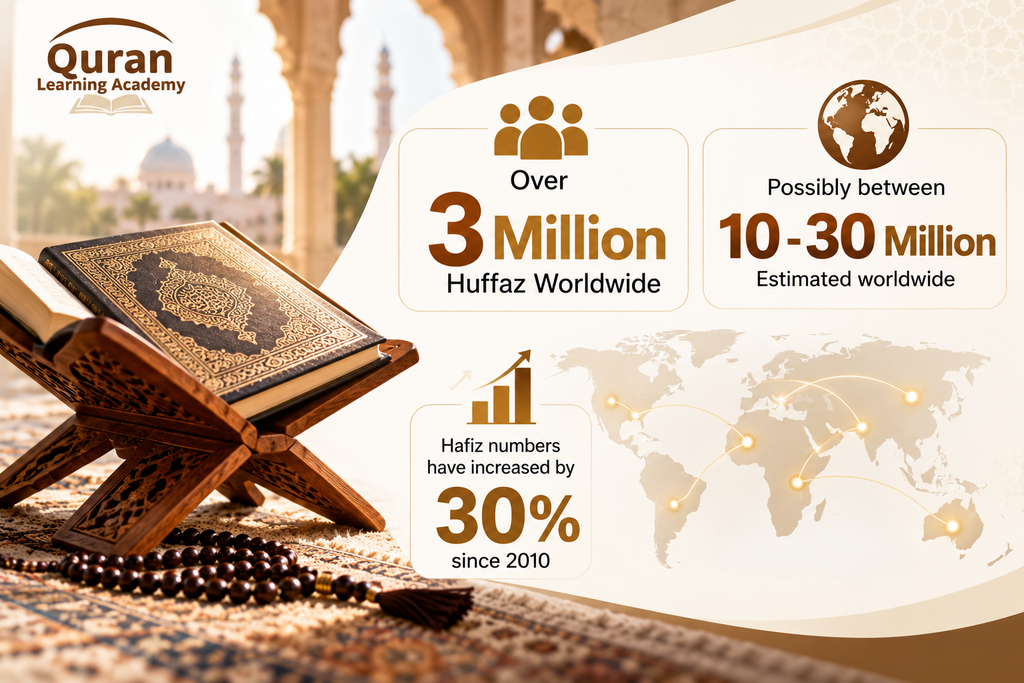
Scholarly and religious research places the number of living Huffaz at over three million worldwide. Because major Muslim countries such as India, Bangladesh, and Nigeria have not released consolidated data, the true figure is widely suspected to be significantly higher, with many analysts placing it between 10 and 30 million.
One figure that circulates widely online is 200 million. This number, however, includes those who have memorised substantial portions of the Quran rather than the complete text, which is why the more conservative academic estimate remains the more reliable benchmark for full memorisation.
What every source agrees on is that the number is growing. Hafiz populations have increased by approximately 30% since 2010, driven by the global expansion of structured online memorisation programmes.
Read more: How to Memorise the Quran in 2 Years
Which Countries Produce the Most Huffaz
While Pakistan and Saudi Arabia dominate media coverage on this topic, significant Hafiz communities exist in Egypt, Indonesia, Morocco, Nigeria, and Bangladesh. The following table summarises the leading countries:
| Country | Key Driver | Notable Figure |
| Pakistan | Wafaq ul Madaris madrassa network | Over 1 million certified graduates |
| Saudi Arabia | State-funded programmes and national competitions | Approx. 5,000 new Huffaz annually |
| Egypt | Al-Azhar scholarly tradition | Among the highest per-capita scholarly output |
| Indonesia | School-integrated Hifz curriculum | Largest Muslim population in the world |
| Morocco | Government-backed memorisation infrastructure | High per-capita Hafiz density |
| Nigeria | Community mosque programmes | Africa’s fastest-growing Hafiz population |
Pakistan is widely cited as the country with the highest number of certified Huffaz. The Wafaq ul Madaris network has produced over one million certified graduates since formal examinations began in 1982, with more than 78,000 new Huffaz completing memorisation every year, including 14,000 female students.
Children enrol as young as four years old and typically complete the full Quran within two years..Egypt’s contribution is rooted in Al-Azhar University, the oldest centre of Islamic scholarship in the world.
Al-Azhar’s methodology has been exported across Muslim communities globally, and Egypt consistently ranks among the highest in per-capita Huffaz numbers, supported by annual government-sponsored national competitions.
Indonesia integrates Hifz into its national school curriculum at many levels. Morocco operates one of the most structured government-backed memorisation systems globally, resulting in a notably high density of Huffaz relative to population size.
Turkey has publicly announced an ambition to make one per cent of its entire population, approximately 840,000 people, full memorisers of the Quran.
Step Inside Our Virtual Classrooms
See how our interactive lessons work. Watch these brief highlights of our students engaging with instructors.
Start Your Quranic Journey in the UK
Join our academy for structured online lessons with expert tutors, tailored to fit your schedule.
Book Your Free TrialWhy the Number of Huffaz Keeps Growing
Several factors explain why how many Muslims have memorized the Quran continues to increase year on year. For most of Islamic history, Hifz required physical proximity to a qualified teacher. That constraint no longer applies.
Structured online Hifz programmes now connect students in Birmingham, Manchester, and London directly with qualified instructors, making daily memorisation sessions accessible around full-time schedules.
British Muslims who previously had no access to a local Hafiz teacher can now learn from Azhari-trained scholars from their own homes.
For those ready to take that step, UK Quran Learning Academy offers a structured Hifz Classes for Adults in the UK designed specifically for working professionals and parents who cannot commit to fixed weekly schedules at a local mosque.
National and international Quran memorisation competitions held across Egypt, Saudi Arabia, Iran, Malaysia, Indonesia, Jordan, and Libya have also created a global culture of aspiration around Hifz.
Televised recitation events attract millions of viewers annually and have directly contributed to a surge in enrolments in memorisation programmes worldwide.
What Islamic Scholarship Says About Memorising the Quran
The Prophetic tradition around Hifz is unambiguous. The status of the Hafiz in Islamic scholarship is not merely ceremonial.
It carries genuine consequence in this life and the next, and understanding this is what drives hundreds of millions of Muslims to pursue one of the most demanding acts of worship in the tradition.
Allah’s Messenger ﷺ said:
“مَثَلُ الَّذِي يَقْرَأُ الْقُرْآنَ وَهْوَ حَافِظٌ لَهُ مَعَ السَّفَرَةِ الْكِرَامِ الْبَرَرَةِ”
“Such a person as recites the Qur’an and masters it by heart, will be with the noble righteous scribes (in Heaven).”
The Prophet ﷺ also described the elevated rank awaiting those who carry the Quran:
“يُقَالُ يَعْنِي لِصَاحِبِ الْقُرْآنِ اقْرَأْ وَارْتَقِ وَرَتِّلْ كَمَا كُنْتَ تُرَتِّلُ فِي الدُّنْيَا فَإِنَّ مَنْزِلَتَكَ عِنْدَ آخِرِ آيَةٍ تَقْرَأُ بِهَا”
“It shall be said – meaning to the one who memorized the Qur’an – ‘Recite, and rise up, recite (melodiously) as you would recite in the world. For indeed your rank shall be at the last Ayah you recited.”
The Quran itself makes the divine commitment to preservation explicit. Before a student begins memorisation, understanding this verse grounds the entire endeavour in certainty rather than effort alone:
“إِنَّا نَحْنُ نَزَّلْنَا الذِّكْرَ وَإِنَّا لَهُ لَحَافِظُونَ “
Innā naḥnu nazzalnā al-dhikra wa-innā lahu laḥāfiẓūn
“Indeed, it is We who sent down the Qur’an and indeed, We will be its guardian.”
Step Inside Our Virtual Classrooms
See how our interactive lessons work. Watch these brief highlights of our students engaging with instructors.
Start Your Quranic Journey in the UK
Join our academy for structured online lessons with expert tutors, tailored to fit your schedule.
Book Your Free TrialHow Hifz Works: From First Lesson to Final Juz
Memorising the Quran is not a single event. It is a structured, cumulative process with distinct stages that every Hafiz passes through regardless of age or background.
The process begins with mastering Tajweed and correct pronunciation. A student who cannot articulate Arabic letters from their correct points of articulation will embed errors into memory that become progressively harder to correct. Makharij al-Huroof, the articulation points of each letter, forms the non-negotiable foundation.
From there, a student begins with shorter chapters, typically from Juz Amma, before progressing to longer and more complex sections.
Daily new memorisation is paired with systematic revision of previously memorised material, because Hifz without consistent review deteriorates. The Prophetic tradition emphasises this: the memorised Quran must be attended to consistently, or it slips away.
The final stage is full recitation of the complete Quran before a qualified teacher who holds an Ijazah, a certified chain of transmission connecting them back to the Prophet ﷺ. Completing Hifz without this final verification leaves the memorisation academically unverified.
For sisters seeking a structured path through every stage of this process, UK Quran Learning Academy offers a dedicated Quran Hifz for Ladies in the UK, led by qualified female instructors who understand the specific challenges women in Britain face when balancing worship with daily responsibilities.
Join Our Female-Led Quran Memorisation Classes for Sisters
The Specific Challenges British Muslims Face in Memorising the Quran
How many Muslims have memorized the Quran in the UK is not a figure that is formally recorded, but the Muslim community in Britain faces a distinct set of barriers that do not apply to students in Pakistan or Egypt.
British Muslims typically do not grow up in environments where Arabic is the medium of daily life. The sounds of Quranic Arabic, the letters that have no English equivalent, the length of a 30-Juz text: all of these require structured scaffolding that informal mosque classes often cannot provide consistently.
Working adults and parents face the additional pressure of time. A Hifz programme that requires daily four-hour sessions is simply incompatible with most lives in London or Birmingham. Programmes designed without this reality in mind produce high dropout rates.
Children face a different challenge. Parents want their children to memorise the Quran but are not always able to assess whether the programme they have enrolled them in uses pedagogically sound methods, whether revision is being built in, and whether the teacher has the qualifications to correct Tajweed errors at the root.
The Quran Memorisation for Kids in the UK programme at UK Quran Learning Academy addresses this directly, using spaced repetition, auditory reinforcement, and structured review cycles tailored to developing minds aged 5 to 15.
Help Your Child Build a Lasting Quran Memorisation Habit
The Role of Tajweed in Accurate Quran Memorisation
Every Hafiz in the world memorises the same text with the same rules of recitation. Tajweed is not optional within Hifz; it is the standard by which every memorised verse is judged. A student who memorises 30 Juz with consistent Tajweed errors has not memorised the Quran as it was revealed.
Tajweed governs how each letter is pronounced from its correct articulation point, how long vowels are elongated, how certain letters affect those around them, and how the breath moves through specific sounds.
For English-speaking British Muslims, these rules require deliberate, structured instruction because Arabic phonetics operate on principles entirely absent from English. The practical consequence is that Hifz and Tajweed cannot be separated into sequential stages.
A student who memorises first and corrects Tajweed later will find that errors have become embedded in muscle memory, making correction significantly harder than if Tajweed had been taught from the first lesson.
UK Quran Learning Academy’s Online Tajweed Classes in the UK are structured specifically to build Tajweed accuracy before and during the memorisation process, so that what students commit to memory is correct from the outset.
Improve Your Quran Recitation with Guided Tajweed Practice
Quran Memorisation for Women: A Growing Global Movement
How many Muslims memorized the Quran includes a significant and growing proportion of women. In Pakistan alone, 14,000 of the 78,000 annual Hafiz graduates are female.
Morocco, Egypt, and Indonesia each have structured programmes specifically for women, and the global trend of female Hifz enrolment is accelerating.
In the UK, sisters face the specific challenge of finding female-only instruction from teachers who are both qualified in Tajweed and experienced in teaching adult women. General community classes rarely meet all three criteria simultaneously.
The Quran Classes for Sisters in the UK at UK Quran Learning Academy provide fully female-only instruction, with qualified female teachers who hold formal credentials in Tajweed and Quranic recitation, offering flexible scheduling that works around the realities of life as a Muslim woman in Britain.
Find a Quran Class That Fits Your Schedule as a Muslim Woman
How Ijazah Completes the Chain of Quran Memorisation
Understanding how many people have memorised the Quran requires understanding what formal completion actually means. In classical Islamic scholarship, Hifz is not considered complete without Ijazah: a formal certification granted by a qualified scholar after the student recites the entire Quran from memory without error.
Ijazah connects every certified Hafiz to an unbroken chain of transmission leading back to the Prophet Muhammad ﷺ himself. This is the mechanism by which the Quran has remained unchanged for fourteen centuries.
The Hafiz is not simply a person who has memorised a text. He or she is a living link in a chain that stretches across 1,400 years.
For British Muslims seeking formal recognition of their memorisation, the Quran Ijazah Program in the UK at UK Quran Learning Academy provides certified transmission in Hafs ‘an ‘Asim, the most widely recited narration globally, after the student demonstrates mastery of Tajweed application and complete Quran recitation under qualified scholars holding verified Ijazah credentials.
Start Memorising The Quran with UK Quran Learning Academy
UK Quran Learning Academy connects British learners with Azhari-qualified instructors who hold verified Ijazah credentials and teach through live, interactive sessions built around real UK schedules. Every programme is delivered entirely online, with flexible timing for working adults, parents, and students across London, Birmingham, Manchester, and beyond.
Lessons are conducted in English-medium instruction, making the methodology accessible to British Muslims regardless of their Arabic background. Female students are taught exclusively by qualified female instructors.
Discover Our Quran Courses
- Hifz Classes for Adults in the UK
- Quran Hifz for Ladies in the UK
- Quran Memorisation for Kids in the UK
- Online Tajweed Classes in the UK
- Quran Classes for Sisters in the UK
- Quran Ijazah Program in the UK
- Quran Classes for Adults
- Quran Classes for Female / Sisters
- Learn Quran Course for Beginners
Start your free trial today at UK Quran Learning Academy
Conclusion
Exploring how many people have memorised the Quran reveals the dedication of Muslims worldwide to preserving the Holy Book across generations.
Although the exact number remains unknown, millions have completed this achievement, reflecting the lasting importance of Quran memorisation in Islamic tradition and its role in passing the Quran from one generation to the next.
Read more: Hadith About Memorizing Quran.
Frequently Asked Questions
How many hafiz in the world are there today?
Scholarly estimates place the number of living Huffaz at between 3 million and 30 million, depending on whether the count includes only formally certified graduates or all those who have completed memorisation through informal and home-based channels. The figure is rising annually.
How many people memorised the Quran without understanding Arabic?
Research from the University of York found that half of the Hafiz participants in a study did not understand Arabic, yet performed at equivalent levels to those who did. This confirms that Quran memorisation is achievable for non-Arabic speakers, including British Muslims, without requiring prior Arabic fluency.
How long does it take to memorise the Quran?
Timelines vary by method, daily commitment, and starting level. Students in full-time programmes in Pakistan typically complete memorisation in two years. Adult learners in part-time structured programmes typically take between three and six years with consistent daily practice.
Which country has the most Huffaz per capita?
Morocco and Libya consistently rank among the highest globally for per-capita Hafiz density, supported by government-backed memorisation infrastructure and a strong national culture of Quranic education from early childhood.
Can adults memorise the Quran while working full time in the UK?
Yes, with the right structure. Online Hifz programmes designed for adult British Muslims build around work schedules and family commitments, using shorter daily sessions and structured revision to maintain progress without requiring hours of uninterrupted study.




[…] Read more: How Many People Have Memorised the Quran […]