 Quran

Many Muslims in Britain grow up hearing the Quran but struggle to read Arabic independently. Whether you are a beginner or returning to lessons after years away, learning How to Read the Quran starts with recognizing Arabic letters, understanding vowel marks, and practicing correct pronunciation.
This guide explains the essential steps to help you build confidence, improve your recitation, and develop a consistent Quran reading routine.
1. Recognise the Arabic Alphabet in All Four Letter Forms
Most beginners learn the 28 Arabic letters in their isolated forms and then assume they can read. They cannot. When those same letters appear inside a Quranic word, they look entirely different, and the learner stalls at every line.
Every Arabic letter has four forms depending on where it appears in a word:
| Form | When It Appears | Example with Ba (ب) |
| Isolated | Letter stands alone | ب |
| Initial | Beginning of a word | بـ |
| Medial | Middle of a word | ـبـ |
| Final | End of a word | ـب |
The body of the letter stays constant. What changes is the connection on either side. Six Arabic letters never connect to the letter that follows them: ا، د، ذ، ر، ز، و. They only connect backwards. This is why some Quranic words appear to break into separate pieces even though they form a single word. A learner who does not know this rule reads gaps as word boundaries and loses fluency entirely.
Many letters also share the same base shape and are differentiated only by the number and position of dots. The letters ب، ت، ث، ن، ي all use the same boat-like form in their initial and medial positions. Grouping letters by shared shape reduces the memorisation burden from 28 entirely separate entities to roughly 17 distinct forms.
British learners who grew up reading English left-to-right face an additional adjustment: Arabic runs right-to-left, and the initial form of a letter appears where English speakers would expect a word to end. This requires deliberate re-training of the eye, not just letter memorisation.
2. Complete the Noorani Qaida Before Opening the Mushaf
The single most common mistake British learners make is opening the Quran before building their phonetic foundation. They stumble over every word, lose confidence, and eventually stop. The correct sequence is to complete the Noorani Qaida first.
The Noorani Qaida is a 17-lesson phonics primer compiled by Sheikh Noor Muhammad Haqqani. It was designed specifically for non-Arabic speakers and takes a learner from zero Arabic knowledge to the point where they can sound out Quranic words accurately. Its 17 lessons follow a strict progression:
- Lessons 1 to 3 cover recognition of all 28 Arabic letters in isolated form, then in compound and connected forms.
- Lessons 4 to 7 cover short vowels — Fatha, Kasra, Dhamma — and the doubled vowel sounds of Tanween, along with Sukoon rules for letters carrying no vowel.
- Lessons 8 to 15 cover long vowels, letters of elongation, soft letters, and correct breathing pauses at the end of words.
- Lessons 16 to 17 apply Noon Sakinah rules, Meem Sakinah rules, and Waqf conventions to short Quranic passages.
Many learners in Britain skip this stage and go straight to Surah Al-Fatihah. The result is transliteration-dependent reading, meaning they rely on romanised English approximations of Arabic sounds and never develop genuine Arabic decoding ability. Transliteration cannot capture the distinction between ص and س, between ط and ت, or between ع and a plain vowel. These distinctions exist in virtually every Surah and cannot be bypassed.
If you are at this stage, the Noorani Qaida Course in the UK from UK Quran Learning Academy covers all 17 lessons through live sessions with qualified Azhari instructors who provide real-time pronunciation correction.
Enrol today and build the foundation that makes everything else possible.
3. Understand How Vowel Marks Control Every Sound You Produce
Reading Arabic without understanding vowel marks is like reading English with all vowels removed. The Mushaf uses a complete system of diacritical marks that tell you exactly how to pronounce every letter. The core marks every Quran reader must know:
- Fatha (ـَ): a small diagonal stroke above the letter, producing a short “a” sound. The letter ب with Fatha reads “ba.”
- Kasra (ـِ): a small diagonal stroke below the letter, producing a short “i” sound.
ب with Kasra reads “bi.” - Dhamma (ـُ): a small loop above the letter, producing a short “u” sound.
ب with Dhamma reads “bu.” - Sukoon (ـْ): a small circle above the letter, meaning the letter carries no vowel and produces a stopped, closed sound.
- Shaddah (ـّ): a small “w”-shape above the letter, meaning the letter is doubled and must be pronounced twice.
- Tanween: a doubled Fatha, Kasra, or Dhamma placed at the end of words, producing an “n” sound after the vowel.
Beyond these individual marks, Tajweed editions of the Mushaf use colour-coded symbols to indicate elongation rules, nasal sounds, and stopping points. A beginner using a colour-coded Mushaf can visually identify where to apply each rule before they have memorised them all theoretically.
Step Inside Our Virtual Classrooms
See how our interactive lessons work. Watch these brief highlights of our students engaging with instructors.
Start Your Quranic Journey in the UK
Join our academy for structured online lessons with expert tutors, tailored to fit your schedule.
Book Your Free Trial4. Master the Core Tajweed Rules That Protect Quranic Meaning
Tajweed is not an aesthetic preference. The Prophet Muhammad (peace be upon him) recited the Quran with precise articulation, and that recitation was transmitted through chains of teachers across fourteen centuries. Mispronunciation is categorised in Islamic scholarship into two levels: Lahn Jali, which is an obvious error such as substituting one letter for another, and Lahn Khafi, which is a subtle error such as dropping a Ghunnah or shortening a Madd. Both distort the intended sound.
Heavy and Light Letters (Tafkheem and Tarqeeq)
Seven Arabic letters are always pronounced with a full mouth, meaning the back of the tongue rises and the sound fills the oral cavity. These are: خ ص ض ط ظ غ ق, remembered by scholars through the phrase خُصَّ ضَغْطٍ قِظ. Every other letter is light, pronounced with the mouth relaxed and the tongue low.
British English has no equivalent of heavy letters, which is why learners consistently pronounce ص as س and ط as ت, two substitutions that change the meaning of the word entirely.
Qalqalah (The Echo Sound)
Five letters produce a slight bouncing echo when they appear with a Sukoon: ق ط ب ج د, collected as قطب جد. Qalqalah has three levels of intensity:
- Light Qalqalah occurs when the letter appears with Sukoon in the middle of a word.
- Medium Qalqalah occurs when the letter appears at the end of a word when you pause briefly.
- Heavy Qalqalah occurs when the letter carries a Shaddah.
When reciting Surah Al-Ikhlas and stopping at أَحَدْ, the Dal produces a Medium Qalqalah. This is not an exaggerated bounce but a controlled vibration that releases the stopped consonant cleanly.
Ghunnah (The Nasal Sound)
When the letters Noon (ن) or Meem (م) carry a Shaddah, a two-beat nasal sound is held through the nose before the mouth opens. Pinching the nose closed while attempting to produce a Meem with Shaddah demonstrates the Ghunnah: the sound disappears entirely when the nasal passage is blocked, which confirms it is being produced correctly when unblocked. British learners frequently rush past this or reduce it to one beat.
Madd (Elongation Rules)
Madd governs how long certain vowel sounds are held. The natural Madd is two beats. When a Madd letter is followed by a Hamzah in the same word (Madd Muttasil), the elongation extends to four or five beats. When a Madd letter is followed by a letter carrying a Shaddah (Madd Laazim), the elongation reaches six beats. Shortening these is a Tajweed error. Lengthening them beyond the correct count is also an error.
For adults who want structured correction across all of these areas, the Tajweed Course for Adults in the UK from UK Quran Learning Academy covers Makharij, Sifaat, Ghunnah, Qalqalah, and Madd in progressive modules built for British learners with no prior background.
5. Apply Noon Sakinah and Meem Sakinah Rules Correctly
These two rule-sets govern some of the most frequent letter combinations in the entire Quran. A learner who does not know them will make errors on virtually every page.
Noon Sakinah and Tanween have four rules depending on the letter that follows:
| Rule | Name | Letters That Trigger It | What Happens |
| Izhar | Clear pronunciation | ء ه ع ح غ خ | The Noon is pronounced clearly with no merging |
| Idghaam | Merging | ي ر م ل و ن | The Noon merges into the following letter |
| Iqlaab | Substitution | ب only | The Noon converts to a Meem sound with Ghunnah |
| Ikhfa | Concealment | The remaining 15 letters | The Noon is partially hidden between clear and merged |
Meem Sakinah has three rules:
- Idghaam Shafawi applies when Meem is followed by another Meem, merging with Ghunnah.
- Ikhfa Shafawi applies when Meem is followed by Ba (ب), concealing with Ghunnah.
- Izhar Shafawi applies when Meem is followed by any other letter, pronouncing clearly.
British learners most commonly confuse Ikhfa with Idghaam, applying either too much merging or too much clarity. The Ikhfa is a deliberate middle position: the tongue approaches but does not fully reach the articulation point of the following letter, and a nasal sound is held for two beats throughout.
Read more: Best Wishes for Hafiz e Quran in English and Arabic.
6. Learn to Recite Surah Al-Fatihah With Full Rule Application
Once the Noorani Qaida is complete and the core Tajweed rules are understood, Surah Al-Fatihah is the correct first practical application. It appears in every unit of Salah, which means correct recitation has direct and immediate relevance to every British Muslim’s daily worship.
Allah commands measured, careful recitation. This is the Quranic basis for Tajweed and deliberate recitation:
“وَرَتِّلِ الْقُرْآنَ تَرْتِيلًا ”
Wa rattil il-Qur’aana tarteelaa.
“and recite the Qur’an with measured recitation.”
Surah Al-Fatihah contains examples of almost every foundational rule: the Madd in بِسْمِ ٱللَّهِ ٱلرَّحْمَٰنِ ٱلرَّحِيمِ, the Idghaam in مَالِكِ يَوْمِ, the Ghunnah in ٱلرَّحْمَٰنِ, and the Madd before Sukoon in وَلَا ٱلضَّالِّينَ. Mastering this one Surah with full Tajweed application gives a learner a working model they can apply across the entire Quran.
A common error specific to British English speakers occurs with the Dhad (ض) in الضَّالِّينَ. Dhad is one of the seven heavy letters, produced with the side of the tongue pressing against the upper molars. British English has no phoneme remotely similar to it, and learners almost always substitute a regular “d” or “dh” sound. This is a Lahn Jali error in a word recited in every unit of Salah.
For sisters who want to build accurate recitation in a private, female-only environment, the Quran Classes for Sisters in the UK from UK Quran Learning Academy offer live instruction from qualified female teachers who understand the precise errors British English speakers produce.
7. Build a Consistent Daily Reading Schedule That Fits British Life
The Prophet (peace be upon him) established a clear principle about acts of worship:
“أَحَبَّ الأَعْمَالِ أَدْوَمُهَا إِلَى اللَّهِ، وَإِنْ قَلَّ”
“the most beloved deed to Allah is the most regular and constant even if it were little.”
For British Muslims managing work, school runs, commutes, and evening commitments, this is the operational principle. Fifteen focused minutes after Fajr, before Isha, or during a lunch break compounds over months into genuine fluency. Two hours on a Saturday followed by nothing for six days does not.
Three practical reading schedules depending on available time:
| Daily Time Available | Recommended Volume | Realistic Completion Rate |
| 15 to 20 minutes | Half a page, approximately 8 to 10 lines | Full Quran in 4 to 5 years with correction |
| 30 to 45 minutes | One full page, approximately 15 lines | Full Quran in 2 years with correction |
| 60 to 90 minutes | Two to three pages | Full Quran in under a year with correction |
These figures assume active, corrected reading rather than passive listening. The time after Fajr is particularly effective because the mind is clear, commitments have not yet accumulated, and the house is quiet.
Attaching the reading session to an established anchor — immediately after Fajr prayer, immediately after the school run, immediately after arriving at the office — removes the daily decision-making burden that causes most people to skip.
Experience the Academy in Action
Curious about our teaching style? Take a quick look inside a live session to see our immersive, supportive learning environment first-hand.
Start Your Quranic Journey in the UK
Join our academy for structured online lessons with expert tutors, tailored to fit your schedule.
Book Your Free Trial8. Progress From Reading to Understanding the Words You Recite
Reading the Quran with correct pronunciation is a distinct skill from understanding its meaning. The most spiritually engaged recitation comes when the reader knows what they are saying.
British Muslims who have recited Surah Al-Fatihah hundreds of times in Salah often have no clear understanding of what الصِّرَاطَ الْمُسْتَقِيمَ means precisely, or why الضَّالِّينَ and الْمَغْضُوبِ عَلَيْهِمْ are distinguished as two separate categories.
Quranic Arabic is not identical to Modern Standard Arabic. Its vocabulary, grammatical structures, and rhetorical patterns belong to the classical language. However, building even a basic Quranic vocabulary transforms recitation from a phonetic exercise into a conversation with the text.
The classical Tafsir works of Ibn Kathir, Al-Tabari, and Al-Qurtubi explain not only what each verse means but why specific words were chosen over their alternatives.
Allah describes the nature of this Book:
“إِنَّ هَٰذَا الْقُرْآنَ يَهْدِي لِلَّتِي هِيَ أَقْوَمُ “
Inna haadhal-Qur’aana yahdee lillatee hiya aqwam.
“Indeed, this Qur’an guides to that which is most suitable.”
For learners who want to connect recitation to comprehension, the Quran Tafsir Course in the UK from UK Quran Learning Academy teaches classical Tafsir methodology through the works of Ibn Kathir, Al-Tabari, and Al-Qurtubi.
9. Use Weekend Sessions to Supplement, Not Replace, Daily Practice
Many British Muslims can only commit to structured learning at weekends because of work patterns, school schedules, and family obligations during the week. Weekend learning is entirely valid as a structured component, provided it supports rather than substitutes for smaller daily engagement.
The specific risk of weekend-only learning is that six days without active practice causes regression. Letters become less automatic. Tajweed rules that were applied correctly on Saturday require re-correction by the following Saturday. The net progress per month is slow.
The more effective model combines a brief daily self-practice session of five to ten minutes reading aloud what was covered in the last lesson, with a weekend class that introduces new material, corrects accumulated errors, and structures the progression. The weekend session functions as the checkpoint; the daily practice sessions are the actual training.
The Weekend Quran Classes in the UK from UK Quran Learning Academy are structured for British families managing weekday commitments, covering Quranic recitation, Tajweed, Noorani Qaida, and Hifz techniques across Saturday and Sunday sessions with qualified Azhari instructors.
Why UK Quran Learning Academy Serves British Learners Precisely
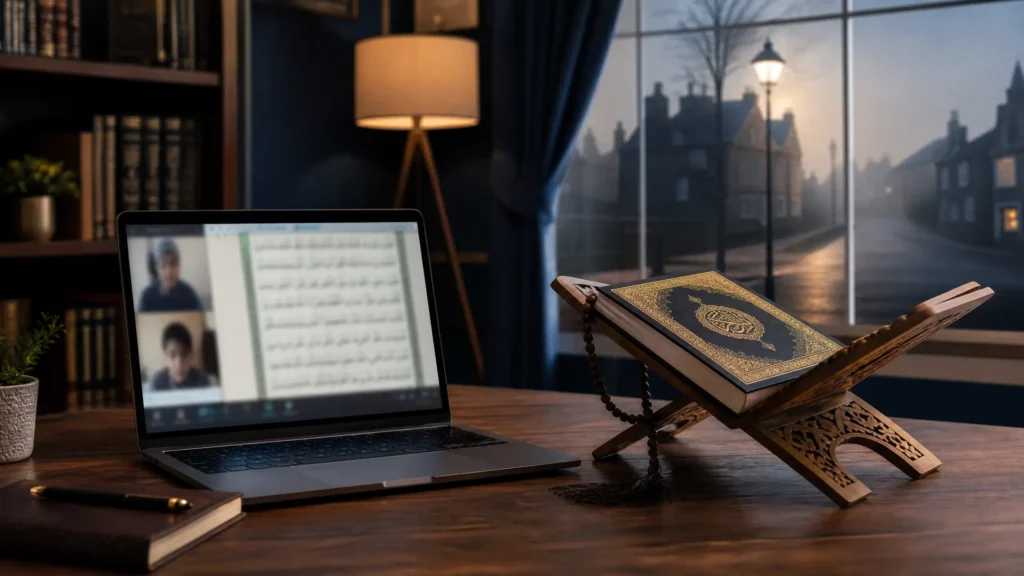
Learning how to read the Quran requires more than access to a text or an app. It requires a qualified teacher who hears your recitation in real time, identifies the specific errors your English phonetic background produces, and corrects them before they become fixed habits. UK Quran Learning Academy connects British learners directly with qualified Azhari instructors through live, interactive sessions that fit around British working hours and time zones.
The academy offers:
- Live one-to-one and group sessions scheduled around UK time zones.
- Qualified instructors holding verified Ijazah credentials in Hafs ‘an ‘Asim.
- Female-only sessions led by qualified female instructors for sisters.
- Structured programmes for children, adults, working professionals, and complete beginners across England, Scotland, and Wales.
- Flexible scheduling that accommodates shift workers, parents, and university students.
Discover Our Quran Courses
- Noorani Qaida Course in the UK
- Tajweed Course for Adults in the UK
- Quran Tafsir Course in the UK
- Weekend Quran Classes in the UK
- Tajweed Course for Kids
- Tajweed Course for Adults
- Tajweed Course for Ladies

Start your free trial at UK Quran Learning Academy today.
Conclusion
Learning How to Read the Quran correctly helps Muslims strengthen their connection with Allah and improve their recitation skills. With regular practice, proper Tajweed guidance, and support from qualified teachers, learners can develop accurate pronunciation, recite verses with confidence, and deepen their understanding of the Quran’s teachings.
Read more: Memorise Quran in 30 Days.
Frequently Asked Questions
Can an adult with no Arabic background learn to read the Quran properly?
Yes. Adults with no prior Arabic exposure follow the same sequence as any other beginner: Noorani Qaida first, then short vowels and Sukoon rules, then Tajweed principles applied to Quranic text. Adults often progress faster than children because they understand the rule system analytically. The Noorani Qaida was designed for non-Arabic speakers of any age.
How long does it take to read the Quran fluently from scratch?
A learner who completes the Noorani Qaida and then reads the Quran daily with correction can reach functional fluency within one to two years. Fluency here means reading any verse accurately without stopping to decode individual letters, not memorisation of the full text.
Is it permissible to read the Quran if pronunciation is imperfect?
A sincere learner who is actively working to improve their recitation is rewarded for the effort regardless of imperfection. The obligation is to seek correction, not to avoid reading until perfection is achieved.
What is the difference between Tajweed and Tarteel?
Tarteel is the mode of recitation: slow, measured, and deliberate, as commanded in Surah Al-Muzzammil. Tajweed is the technical rule system that governs how each letter, vowel, and rule is applied within that recitation. All correct Quranic recitation combines both.
Do I need a teacher, or can I learn to read the Quran independently?
A teacher is necessary for correct Quran reading. The Quran is an oral tradition transmitted from mouth to ear across fourteen centuries. Rules like Makhraj, Qalqalah, and Ghunnah cannot be verified through a book or app alone because you cannot hear your own errors with accuracy. A qualified instructor identifies and corrects sounds you believe are correct but are not.






Leave a Reply