 Quran
Many British adults want to learn Quran reading but struggle to find the right starting point, especially if they have little or no knowledge of Arabic. How to Read Quran for Beginners starts with learning the Arabic alphabet, understanding vowel sounds, and progressing through the Noorani Qaida before reading directly from the Mushaf.
With a qualified teacher, regular practice, and a structured learning plan, beginners can develop accurate pronunciation, avoid common reading mistakes, and gradually build confidence in reciting the Quran alongside their daily responsibilities.
1. Learn the Arabic Alphabet in Isolated Form First
Do not open the Mushaf yet. The Arabic alphabet has 28 letters, each with a name, a sound, and up to four different written shapes depending on its position in a word.
A beginner who jumps straight to the Mushaf is memorising shapes with no phonetic foundation underneath them. Start with every letter in its isolated form. Say the name of the letter, then its sound. The name and the sound are different things.
The name of the letter ب is “Ba.” The sound it produces when vowelled is a short “b” followed by the vowel. Confusing the name with the sound is the first error most beginners make, and it creates reading errors immediately.
Letters that have no English equivalent and require dedicated drilling before anything else:
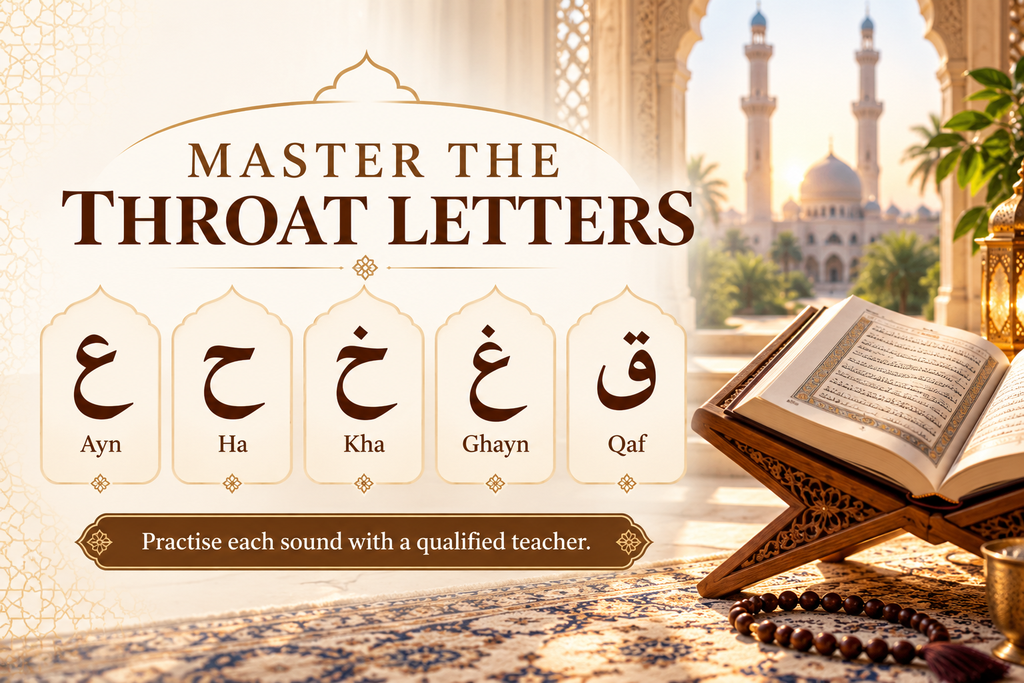
- ع (Ayn): produced through constriction of the mid-pharynx. No English equivalent exists.
- ح (Ha): a strong, breathy exhalation from the throat. Not the English “h.”
- خ (Kha): produced at the back of the throat with friction. Closer to the Scottish “loch.”
- غ (Ghayn): a voiced version of Kha, similar to a gargled “r.”
- ق (Qaf): produced at the very back of the tongue against the uvula. Not the English “k.”
These five letters must be correct from the start. Substituting English sounds for them is not a beginner’s approximation. It is a permanent error that gets harder to fix the longer it is repeated.
The Learn Quran for Beginners Classes in the UK at UK Quran Learning Academy begin precisely at this point, with Azhari-certified instructors who isolate each letter’s articulation point and correct production errors before the student advances.
2. Master the Three Short Vowels Before Joining Any Letters
Once every isolated letter is secure, the next step is the three short vowels (Harakaat). These are the small symbols written above or below letters that tell you how to sound them. Without Harakaat control, the beginner cannot read a single word of the Quran.
The three short vowels:
| Vowel | Arabic Name | Symbol | Sound Produced |
| Fatha | فَتْحة | (ـَ) above the letter | Short “a” sound as in “cat” |
| Kasra | كَسْرة | (ـِ) below the letter | Short “i” sound as in “bit” |
| Damma | ضَمَّة | (ـُ) above the letter | Short “u” sound as in “put” |
Every beginner must practise each of the 28 letters with all three vowels in sequence before moving forward. This is not optional revision. It is the mechanical foundation of Quran reading basics. A student who cannot read بَ بِ بُ automatically, without hesitation, across every letter, is not ready for the next stage.
Two additional symbols at this stage:
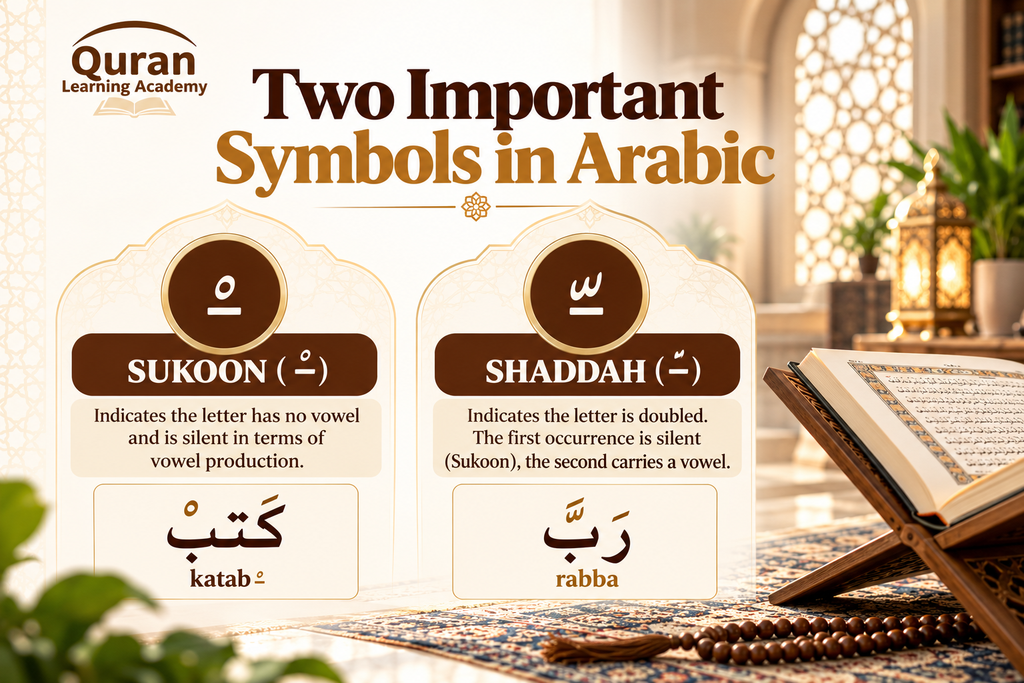
- Sukoon (ـْ): indicates the letter has no vowel and is silent in terms of vowel production.
- Shaddah (ـّ): indicates the letter is doubled. The first occurrence is silent (Sukoon), the second carries a vowel.
Skipping Shaddah and Sukoon at this stage is the second most common beginner error. Both appear constantly across the Quran and both must be automatic responses, not conscious calculations.
Step Inside Our Virtual Classrooms
See how our interactive lessons work. Watch these brief highlights of our students engaging with instructors.
Start Your Quranic Journey in the UK
Join our academy for structured online lessons with expert tutors, tailored to fit your schedule.
Book Your Free Trial3. Learn Letter Joining Rules Through the Noorani Qaida
This is where to start reading the Quran in a structured sense: the Noorani Qaida. After isolated letters and Harakaat are secure, the Noorani Qaida takes the beginner through the exact sequence needed to move from letters to words to Quranic verses. No comparable self-teaching method exists for this stage.
The Noorani Qaida progression:
- Individual letters in isolation.
- Letters with each of the three short vowels.
- Letters in joined pairs, showing how shape changes by position.
- Letters with long vowels (Madd letters: Alif, Waw, Ya).
- Sukoon exercises across letter combinations.
- Shaddah exercises.
- Small joined words drawn from Quranic vocabulary.
- Basic Tajweed rules in context: Noon Sakinah, Tanween, simple Qalqalah.
The critical rule at this stage: every letter changes shape depending on whether it appears at the start, middle, or end of a word, or in isolation.
The letter ع in isolation looks different from ع at the start of a word, different again in the middle, and different at the end. The Noorani Qaida trains the eye to recognise all four positions automatically across every letter.
Beginners who attempt to learn joining rules from a Mushaf directly face the same problem every time: the Mushaf does not explain why letters look the way they do. The Noorani Qaida does.
The Noorani Qaida Course in the UK at UK Quran Learning Academy delivers this entire sequence live, one-to-one, with a qualified instructor who hears every error and corrects it before it becomes a habit.
4. Understand Long Vowels and Madd Before Reading Full Words
Long vowels are the natural extension of short vowels held for two counts instead of one. They appear constantly across the Quran and must be distinct and consistent in length.
Beginners who collapse long vowels into short ones produce a flattened, incorrect recitation that alters the meaning of words. The three long vowels and their conditions:
| Long Vowel | How It Appears | Duration |
| Alif Madd (ا) | Fatha followed by Alif with no vowel | 2 counts |
| Waw Madd (و) | Damma followed by Waw with no vowel | 2 counts |
| Ya Madd (ي) | Kasra followed by Ya with no vowel | 2 counts |
The word “قَالَ” (he said) contains a Fatha followed by Alif. The Alif must be held for 2 counts. Shortening it to 1 produces a different word in Arabic. The word “يَقُولُ” (he says) contains a Damma followed by Waw.
The same rule applies. At beginner level, the target is consistent 2-count elongation every single time, with no variation.
This is also where the beginner encounters the Leen letters: Waw and Ya when they carry Sukoon and are preceded by Fatha, as in the word “خَوْف” (fear). These are not Madd letters.
They produce a softer, shorter glide sound and must not be elongated to 2 counts. The distinction between a Madd letter and a Leen letter is one of the first quran reading basics errors that a qualified teacher identifies in a beginner’s recitation.
Read more: How to Learn Quran Reading with Tajweed Juz 30.
5. Begin Reciting from Surah Al-Fatiha with a Teacher Listening
This is where to start reading the Quran once letters, Harakaat, joining rules, and long vowels are secure. Not from the beginning of the Mushaf (Surah Al-Baqarah). Not from any Surah chosen at random. The starting point for every beginner is Surah Al-Fatiha.
The reasons are practical and specific:
- Al-Fatiha is 7 verses and contains the most frequently recited text in Islamic practice. Every Muslim recites it 17 times daily in salah.
- It contains examples of Madd, Sukoon, Shaddah, and basic Tajweed markers all within a short, manageable text.
- Errors in Al-Fatiha are corrected immediately with high-frequency repetition, which embeds correct habits faster than any other Surah.
After Al-Fatiha is correct and stable, the next stage is Juz Amma, the 30th part of the Quran. The Surahs of Juz Amma are short, structured, phonetically manageable, and frequently used in salah.
Surah Al-Ikhlas (4 verses), Surah Al-Falaq (5 verses), and Surah An-Nas (6 verses) are the natural progression after Al-Fatiha. The critical rule at this stage: a teacher must be present and listening. Reading alone at this stage embeds errors silently.
The beginner cannot hear their own mistakes because they have no reference point for what correct recitation sounds like in their own voice. A qualified teacher hears the error in real time and corrects it before the next repetition re-embeds it.
The Quran Reading Classes in the UK at UK Quran Learning Academy are structured precisely around this stage, with live sessions where instructors listen to every verse, identify specific errors, and provide targeted correction in the same session.
6. Build Consistent Daily Practice Around UK Life
Progress in how to read Quran for beginners is entirely determined by two variables: session quality and session frequency. Neither alone is sufficient.
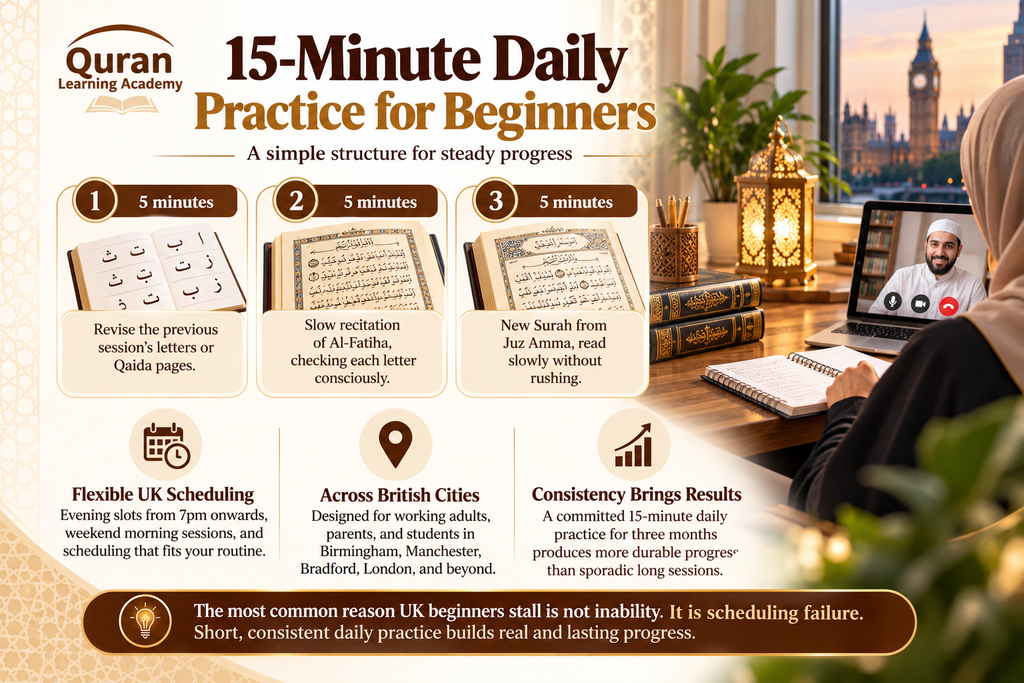
A 30-minute session with a qualified teacher twice a week, combined with 10 to 15 minutes of daily solo practice between sessions, produces measurable progress within 8 to 12 weeks for most adults starting from zero.
The daily solo practice structure for beginners:
- 5 minutes: revision of the previous session’s letters or Qaida pages.
- 5 minutes: slow recitation of Al-Fatiha, checking each letter consciously.
- 5 minutes: new Surah from Juz Amma, read slowly without rushing.
British Muslim adults managing work, school runs, and weekend commitments in Birmingham, Manchester, Bradford, or London need sessions that fit within that reality.
Evening slots from 7pm onwards, weekend morning sessions, and flexible scheduling are not conveniences. They are the conditions under which consistent progress actually happens.
The most common reason UK beginners stall is not inability. It is scheduling failure. A committed 15-minute daily practice maintained consistently for three months produces more durable progress than sporadic two-hour sessions that leave gaps of days in between.
Read more: How to Read the Quran? A Step-by-Step Guide for British Muslims
7. Introduce Basic Tajweed Rules While Still at Beginner Level
How to start reading Quran for beginners does not mean postponing Tajweed until an advanced stage. The basic rules must be introduced during the Noorani Qaida phase itself, because correct habits built from the start cost nothing to maintain, while incorrect habits built without Tajweed cost months of correction later.
The three basic Tajweed rules every read Quran for beginners student must learn during the Qaida stage:
Noon Sakinah and Tanween basics:
when Noon Sakinah (نْ) or Tanween is followed by one of the six throat letters (ء ه ع ح غ خ), the Noon is pronounced clearly. This is Idh-har. Beginners who are not taught this apply a slight nasal blend in every position, which is incorrect.
Basic Qalqalah:
the five Qalqalah letters (ق ط ب ج د) produce a small echo when they carry Sukoon. In Surah Al-Falaq alone, the ق in “الْفَلَقِ” and “غَاسِقٍ” both carry this echo at stopping points. Every beginner encounters Qalqalah in the first Surahs they learn, so it must be taught at that point rather than deferred.
Shaddah and Ghunna:
when Noon (نّ) or Meem (مّ) carries a Shaddah, it produces a nasal resonance called Ghunna held for 2 counts. In Surah Al-Fatiha, “الضَّالِّينَ” contains a Lam with Shaddah. In Surah Al-Ikhlas, “اللَّهُ الصَّمَدُ” contains a Lam with Shaddah in the name of Allah. Beginners who are not taught Shaddah treatment recite these words incorrectly from their very first attempt.
The Online Tajweed Classes in the UK at UK Quran Learning Academy integrate these foundational rules from the first sessions, ensuring that read Quran for beginners students build correct Tajweed habits simultaneously with their reading skills rather than having to unlearn incorrect habits later.

8. Track Progress with a Clear Milestone Structure
How to read Quran for beginners becomes sustainable when the learner knows exactly what the next milestone is. Vague progress feels like no progress. Specific milestones create momentum.
A realistic beginner milestone timeline for UK adults:
| Milestone | Target Timeframe |
| All 28 letters recognised in isolation | Weeks 1 to 2 |
| All letters with three short vowels | Weeks 2 to 4 |
| Joining rules and letter position forms | Weeks 4 to 8 |
| Long vowels, Sukoon, and Shaddah | Weeks 6 to 10 |
| Noorani Qaida completion | Months 2 to 4 |
| Surah Al-Fatiha recited correctly | Month 3 to 4 |
| Juz Amma short Surahs (10 Surahs) | Months 4 to 6 |
| Fluent reading from the Mushaf | Months 6 to 12 |
These timelines apply to adults studying with a qualified teacher twice weekly and practising daily. Self-study without a teacher doubles or triples the timeline and introduces uncorrected errors at every stage.
Experience the Academy in Action
Curious about our teaching style? Take a quick look inside a live session to see our immersive, supportive learning environment first-hand.
Start Your Quranic Journey in the UK
Join our academy for structured online lessons with expert tutors, tailored to fit your schedule.
Book Your Free TrialStart Your Quran Journey with UK Quran Learning Academy Today
If you have wanted to read Quran for beginners but have never found the right structure, the right teacher, or the right timing, UK Quran Learning Academy removes all three obstacles at once.
Every instructor holds Ijazah in Hafs ‘an ‘Asim through verified chains connected to Al-Azhar. Every session is live and one-to-one. Every lesson is scheduled around UK working hours, school commitments, and the realistic demands of British Muslim life across London, Birmingham, Manchester, Bradford, and beyond.
You do not need prior Arabic knowledge. You do not need to have tried before and succeeded. You need one session with a qualified teacher who listens to where you are and builds from that point.
Discover Our Quran Courses
- Learn Quran for Beginners Classes in the UK
- Noorani Qaida Course in the UK
- Quran Reading Classes in the UK
- Online Tajweed Classes in the UK
- Noorani Qaida Course
- Noorani Qaida Course for Kids
- Quran Hifz Course for Ladies

Start your Quran journey with UK Quran Learning Academy today
Conclusion
Learning How to Read Quran for Beginners becomes more manageable when learners follow a clear sequence and receive guidance from a qualified teacher. Starting with Arabic letters and Noorani Qaida builds the foundation needed for accurate Quran reading, while regular practice helps reinforce pronunciation and essential reading rules.
Beginners who have struggled with previous attempts can identify their learning gaps and continue from the appropriate stage. With consistent lessons and realistic goals, British adults can gradually improve their recitation and develop a lasting Quran reading habit.
Frequently Asked Questions
Where should a beginner start reading the Quran with zero Arabic knowledge?
Start with the Arabic alphabet, short vowels, and Noorani Qaida before progressing to the Mushaf and short Surahs.
How long does it take to read the Quran for beginners in the UK?
Most UK adults studying twice weekly and practising daily can reach basic Quran reading within 6 to 12 months.
Is the Noorani Qaida necessary for beginners?
Yes, Noorani Qaida teaches Arabic letter forms, vowels, Sukoon, Shaddah, and foundational Tajweed rules in a structured sequence.
What are the most common Quran reading errors among British beginners?
Common errors include mispronouncing Arabic letters, shortening long vowels, ignoring Sukoon, omitting Qalqalah, and reading too quickly.
How can beginners restart Quran reading after giving up?
Identify where learning stalled, then resume from that stage with a qualified teacher who can correct errors and guide progress.






[…] Read more: How to Read Quran for Beginners: Where to Start and What to Do First. […]