 Quran
Many British Muslims need to memorise the Quran in 2 months without ever starting because the plan feels too vague and the timeline too uncertain. The 2-month path exists, but it is not for everyone, and knowing whether it fits your situation before you commit is what separates productive effort from exhaustion.
The Quran contains 604 pages across 30 Juz’. To memorise the Quran in 2 months, it requires memorising roughly 10 pages every single day for 60 consecutive days. This is the territory of full-time Hifz students with prior Tajweed grounding, not a casual pursuit. If you are a working adult in London or Birmingham balancing shifts, family, and worship commitments, the pace described here needs honest assessment before you begin.
1. Audit Your Tajweed Before You Memorise a Single Ayah
Auditing your tajweed is the first step to memorise the Quran in 2 months. Students aiming for 6 or 12 months have time to correct Tajweed errors mid-journey. At 10 pages per day, you do not.
Memorising with consistent Tajweed errors at this pace embeds those errors permanently into muscle memory. By week three, correcting a recurring Makhraj mistake across 200 already-memorised pages is a near-impossible task without restarting entire sections.
The minimum Tajweed requirements before beginning this plan are:
- Correct Makhraj (articulation points) for all Arabic letters.
- Basic Ghunnah application on noon and meem mushaddad.
- Idgham and Ikhfa’ rules for noon sakinah and tanween.
- Proper Waqf and Ibtida’ (stopping and resuming) practices.
A student who cannot read one full page fluently with these rules applied should not begin 10-page daily memorisation. The errors compound at speed in a way they simply do not at slower paces.
The Quran Memorisation Course at UK Quran Learning Academy includes a Tajweed evaluation in the first session to establish exactly where each student stands before a single page of Hifz begins.

[Start with a Free Tajweed Assessment]
2. Build Your Daily Session Structure Around the Fajr Window
Ten pages per day cannot be absorbed in a single sitting. Cognitive overload sets in after four to five pages of new memorisation, and retention drops sharply. The 2-month plan specifically demands session architecture that no slower timeline requires.
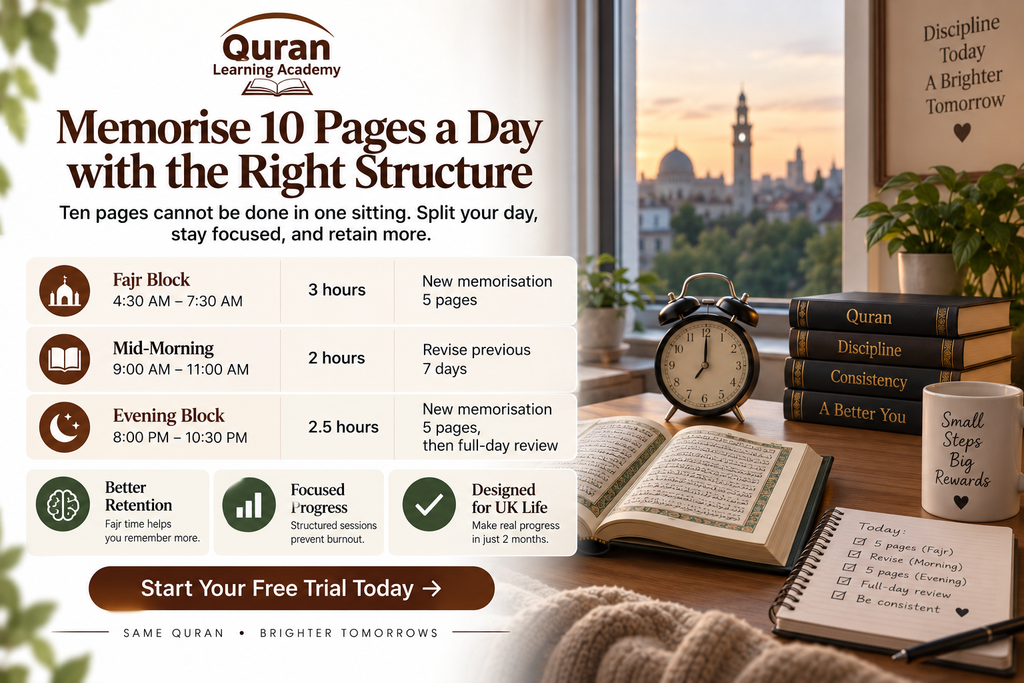
The structure that works for this pace divides each day into three committed blocks:
| Session | Time Window | Duration | Task |
| Fajr Block | 4:30 AM to 7:30 AM | 3 hours | New memorisation, 5 pages |
| Mid-Morning Block | 9:00 AM to 11:00 AM | 2 hours | Revision of previous 7 days |
| Evening Block | 8:00 PM to 10:30 PM | 2.5 hours | New memorisation, 5 pages, then full-day review |
Students who memorise in the Fajr window consistently demonstrate stronger retention in weekly assessments compared to those who shift this block to afternoon or evening. The mind is rested, the house is quiet, and early morning in the UK offers a genuine stillness that is difficult to replicate at other hours.
3. Calculate Your Exact Daily Target Using the 604-Page Framework
This arithmetic is specific to the 2-month goal. A student targeting 6 months needs 3 to 4 pages daily. A student targeting 1 year needs approximately 2 pages. The 2-month student operates at a categorically different scale, and treating the numbers loosely is what causes most plans to collapse by week four.
The 60-day page framework breaks down as follows:
| Week | Days | New Pages Per Day | Cumulative Pages |
| Weeks 1 to 2 | Days 1 to 14 | 10 | 140 |
| Weeks 3 to 4 | Days 15 to 28 | 10 | 280 |
| Weeks 5 to 6 | Days 29 to 42 | 10 | 420 |
| Weeks 7 to 8 | Days 43 to 56 | 10 | 560 |
| Final Buffer | Days 57 to 60 | 11 | 604 |
Every seventh day within this structure should be a pure revision day with no new memorisation. This is not optional. Without structured revision days, retention collapses after the first 150 pages in a way that students on slower timelines never encounter.
Read more: How Much Quran Should I Memorise Daily?
4. Apply the Connection Technique Between Every Page Transition
At 10 pages per day, the risk of memorising isolated fragments of text is significant. Moving quickly through material without connecting the end of one page to the opening of the next produces a Hifz that sounds fluent within a passage but breaks down at transitions.
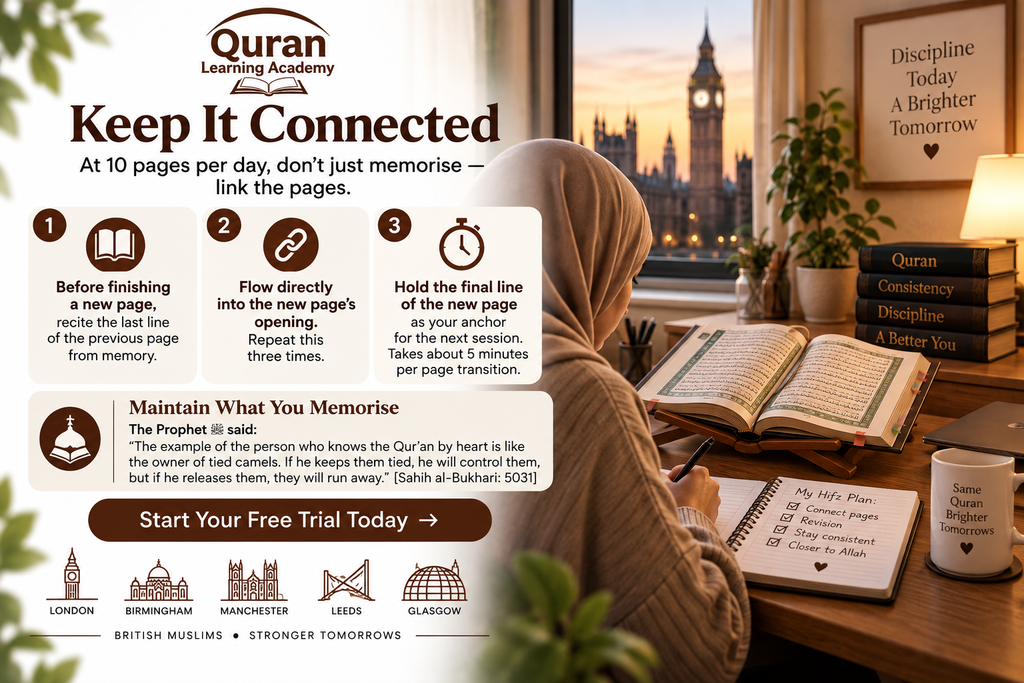
Before completing any new page, recite the last line of the previous page from memory and flow directly into the new page’s opening. Do this three consecutive times, then hold the final line of the new page as your anchor for the next session. This drill takes approximately five minutes per page transition.
The Quran warns about negligence in protecting memorised text. Allah’s Messenger (peace be upon him) addressed this directly. The importance of maintaining what has been memorised is captured in a Hadith recorded in Sahih al-Bukhari, where the Prophet described the Quran leaving a person who does not maintain consistent review, in the same way a camel escapes its owner who does not secure it.
” إِنَّمَا مَثَلُ صَاحِبِ الْقُرْآنِ كَمَثَلِ صَاحِبِ الإِبِلِ الْمُعَقَّلَةِ إِنْ عَاهَدَ عَلَيْهَا أَمْسَكَهَا وَإِنْ أَطْلَقَهَا ذَهَبَتْ”
“The example of the person who knows the Qur’an by heart is like the owner of tied camels. If he keeps them tied, he will control them, but if he releases them, they will run away.”
This warning carries special weight at the 2-month pace, where new material accumulates faster than most students can naturally consolidate without deliberate connection drills.
Step Inside Our Virtual Classrooms
See how our interactive lessons work. Watch these brief highlights of our students engaging with instructors.
Start Your Quranic Journey in the UK
Join our academy for structured online lessons with expert tutors, tailored to fit your schedule.
Book Your Free Trial5. Scale Your Revision Load Every Week Without Exception
Muraja’ah is not a supplement to the 2-month plan. It constitutes half of the daily work, and unlike slower timelines where revision load grows gradually over months, the 2-month student faces a rapidly increasing revision burden within the first two weeks.
The weekly revision targets that must accompany new memorisation are:
| Week | Pages Memorised So Far | Daily Muraja’ah Target |
| Week 1 | 0 to 70 | 10 to 15 pages in Session 2 |
| Week 2 | 71 to 140 | 20 pages in Session 2 |
| Week 3 | 141 to 210 | 25 to 30 pages across Sessions 2 and 3 |
| Week 4 onwards | 210 to 350 and beyond | 35 to 40 pages split across all three sessions |
By week five, revision time will exceed new memorisation time. This is correct and expected at this pace. Reducing revision to accelerate new pages is a trade that consistently results in fragmented Hifz where no portion is securely retained.
Many UK students working through the Quran Memorisation Course at UK Quran Learning Academy carry family and professional responsibilities alongside Hifz. The structured revision scheduling within the course ensures that Muraja’ah does not get quietly dropped when life pressures increase.

[Begin Your Structured Hifz Journey Today]
6. Identify the Similar Verses Before You Reach Them
Mutashabihat, verses that appear similar to one another across different Surahs, become a significant memorisation risk at 10 pages per day. At slower paces, students encounter these gradually over months. At this pace, they arrive in clusters before the student is prepared for them.
Juz’ 18 to 22 contains repeated narrative themes where similar phrasing appears across multiple Surahs. Without deliberate preparation, the mind conflates these Ayaat and produces fluent-sounding but incorrect recitation.
Allocate 15 minutes daily to drilling similar-sounding Ayaat side by side. The Surahs requiring the most attention in this regard are:
- Al-Baqarah and Al-Imran, which share significant thematic vocabulary.
- The paired narratives in Surat Hud and Surat Al-Shu’ara.
- The repeated refrains in Surat Al-Qamar, which can blur together under speed.
This 15-minute drill is specific to the 2-month timeline. Students on longer plans encounter these Surahs far apart in time and the distinction forms naturally. At 10 pages per day, the proximity makes deliberate drilling non-negotiable.
Read more: How to Memorise the Quran in 2 Years
7. Use a Certified Hafiz to Test You Every Three Days
Self-verification is the most dangerous habit in high-pace Hifz. A student memorising 10 pages daily accumulates errors faster than they can self-detect. Without external testing at this frequency, errors layer and solidify into the memorisation before the student realises they are present.
Every three days, recite your accumulated new memorisation to a certified Hafiz without the Mushaf, from the beginning of the most recent phase. The instructor listens for Tajweed errors, sequencing mistakes, omitted Ayaat, and Makhraj inconsistencies.
This is not optional in a 2-month plan. It is the error-correction mechanism that keeps the entire structure sound. A student on a 12-month plan can afford weekly or even fortnightly assessments. The 2-month student cannot.
The Hifz Classes for Adults offered by UK Quran Learning Academy include scheduled listening sessions with certified instructors who specialise in exactly this kind of rapid-pace error detection. Sessions are available across flexible UK-compatible time slots to accommodate working adults and students.

[Book Your First Assessment Session Free]
8. Protect the Final 10 Days for Complete Quran Consolidation
Days 51 to 60 should shift entirely from new memorisation to full-Quran consolidation. By day 50, new memorisation should be complete or within the final Juz’. The last 10 days serve a single purpose: sealing all 604 pages into a coherent, connected recitation from Al-Fatihah to An-Nas.
The target during this window is reciting 60 to 80 pages per day across the three sessions. This is achievable for material already memorised, as recitation speed increases significantly compared to the initial memorisation phase.
Complete at least two full Quran recitations from memory within these final 10 days. The second recitation will be measurably more fluent than the first, which confirms that the Hifz is consolidating rather than fading. Students who skip this consolidation phase and consider the task complete at day 60 consistently report significant retention loss within the following six weeks.
Step Inside Our Virtual Classrooms
See how our interactive lessons work. Watch these brief highlights of our students engaging with instructors.
Start Your Quranic Journey in the UK
Join our academy for structured online lessons with expert tutors, tailored to fit your schedule.
Book Your Free TrialUK Quran Learning Academy: Structured Hifz with Qualified Guidance
Completing Hifz in 2 months without expert oversight is possible in theory. In practice, the students who succeed consistently are those with qualified instructors monitoring their Tajweed accuracy, revision consistency, and daily targets in real time.
UK Quran Learning Academy connects British learners with Ijazah-certified Azhari instructors who have structured and supervised intensive Hifz programmes for students across London, Birmingham, Manchester, and beyond. The methodology is built specifically for non-Arabic speakers navigating full-time Hifz at pace, with flexible scheduling that respects the realities of life in the UK.
Whether you are a working professional, a student, or a parent, the Academy provides personalised 1-on-1 instruction with qualified instructors who hold verified credentials and bring real classroom experience to every session.
Discover Our Quran Courses
- Quran Memorisation Course
- Quran Memorisation Course
- Hifz Classes for Adults
- Tajweed Course for Kids
- Tajweed Course for Adults
- Tajweed Course for Ladies

[Begin with a Free Trial Session]
Conclusion
To memorise the Quran in 2 months is one of the most demanding spiritual and cognitive commitments a Muslim can make. It requires 10 pages daily, a structured three-session routine, a scaling revision system, and regular assessment by a certified Hafiz. Every element of this plan is specific to the 2-month timeline. Remove any of them and the plan does not hold at this pace.
For British Muslims who are serious about beginning this journey, the foundation is a qualified instructor, a sound Tajweed level, and a daily structure built around the Fajr window. The how to memorise Quran in 2 months question has a clear answer. The commitment required to execute it is equally clear.
Frequently Asked Questions
Is memorising the Quran in 2 months realistic for a working adult in the UK?
For most working adults, 10 pages per day for 60 consecutive days requires 6 to 10 hours of daily commitment, which is incompatible with full-time employment without significant life adjustment. A 6 to 12-month structured plan produces stronger, more durable Hifz for students balancing work and family.
What happens if I miss a day in the 2-month Hifz plan?
Missing a single day in the 2-month plan creates a deficit of 10 pages that cannot be absorbed by adding to the following day without disrupting the revision cycle. The plan does not contain recovery days. A missed day requires an honest reassessment of whether the 2-month timeline remains viable or whether a longer, more sustainable plan better serves your Hifz.
How is the 2-month Hifz plan different from a 6-month plan in daily practice?
The 2-month plan operates at 10 pages of new memorisation per day with a revision load that reaches 35 to 40 pages daily by week four. A 6-month plan operates at 3 to 4 new pages per day with a revision load that scales far more gradually. The difference is not only in pace but in the cognitive and time demands placed on the student every single day.
Do I need to be an Arabic speaker to begin this plan?
No, but you must have solid Tajweed grounding before beginning. Non-Arabic speakers who have completed a structured Tajweed course and can read the Quran fluently with correct articulation rules applied have successfully completed the 2-month plan. Non-Arabic speakers without prior Tajweed training should not attempt this timeline.








[…] Read more: How to Memorise the Quran in 2 Months. […]
[…] Read more: How to Memorise the Quran in 2 Months. […]