 Quran

Many Muslims growing up in the UK go through years of Quran lessons, completing the Noorani Qaida, moving through Juz Amma, and reading page after page with confident Tajweed, yet understanding almost nothing of what they recite. The worry that follows is understandable: does any of this count? Is beautiful recitation without comprehension a form of worship, or just a performance?
This question is not a personal failing. It is one of the most commonly asked questions in Muslim households across London, Birmingham, and Manchester, and it deserves a direct, honest answer grounded in scholarship.
1. The Scholarly Ruling on Reciting Without Understanding
The settled position across all four schools of jurisprudence is that reading the Quran without understanding its meaning is not only permissible but rewarded. Shaykh Abd al-Aziz ibn Baz, one of the most widely referenced scholars of the twentieth century, stated clearly that believing men and women may read the Quran even without understanding the meaning, and that the believer is encouraged to reflect and ponder, not required to do so before their recitation counts.
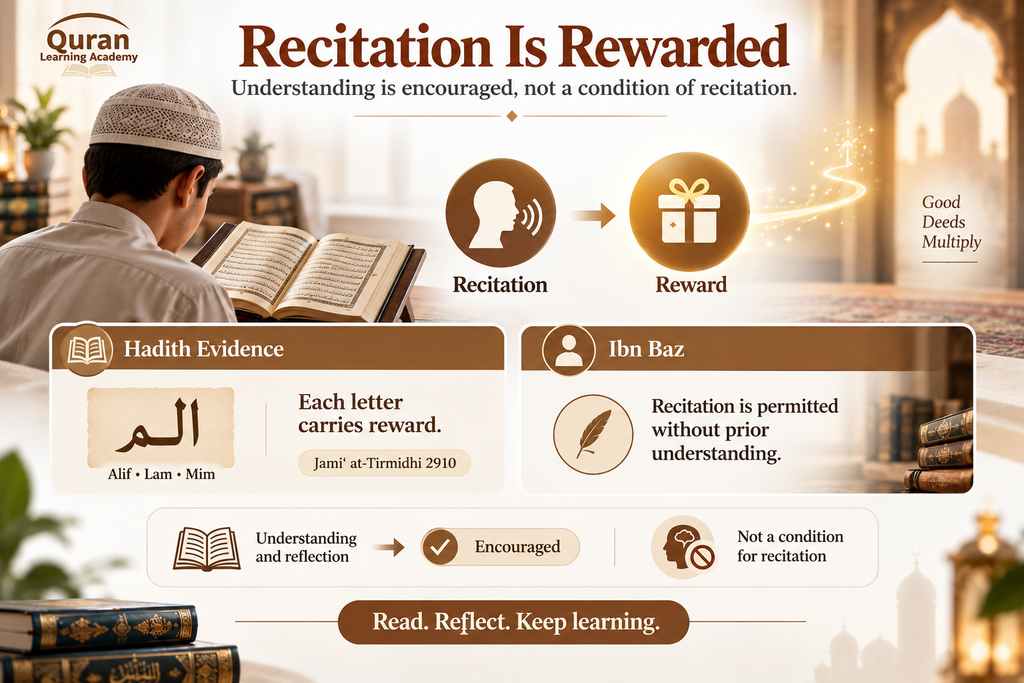
The evidence for this is found in one of the most cited hadith on the subject:
“مَنْ قَرَأَ حَرْفًا مِنْ كِتَابِ اللَّهِ فَلَهُ بِهِ حَسَنَةٌ وَالْحَسَنَةُ بِعَشْرِ أَمْثَالِهَا لاَ أَقُولُ الم حَرْفٌ وَلَكِنْ أَلِفٌ حَرْفٌ وَلاَمٌ حَرْفٌ وَمِيمٌ حَرْفٌ”
“Whoever recites a letter] from Allah’s Book, then he receives the reward from it, and the reward of ten the like of it. I do not say that Alif Lam Mim is a letter, but Alif is a letter, Lam is a letter and Mim is a letter.”
The Prophet chose the example of Alif Lam Mim, letters whose meaning no scholar has definitively explained, to illustrate the reward of recitation. If comprehension were a condition, this example would have been pointless. It was not.
2. Reflection Is Commanded Separately from Recitation
Accepting that recitation without understanding carries reward does not mean comprehension is unimportant. The Quran itself draws a clear distinction between the two. Allah addresses those who recite without reflection in a verse that carries a genuine weight of warning:
“أَفَلَا يَتَدَبَّرُونَ الْقُرْآنَ أَمْ عَلَىٰ قُلُوبٍ أَقْفَالُهَا”
Afala yatadabbaroonal-qur’ana am ‘ala quloobun aqfaaluhaa
“Then do they not reflect upon the Qur’an, or are there locks upon [their] hearts?”
This verse does not say recitation is invalid without reflection. It asks why reflection is absent when the Book is there to be opened. Islamweb’s fatwa on this question draws the distinction precisely: “The Quran is a book of guidance for mankind. Allah revealed it for reflection.” Recitation is an act of worship in its own right. Reflection is a second obligation, asked for separately, described as one of the reasons the Book was revealed.
Holding both truths together is the scholarly position. Recitation counts. Reflection is additionally commanded. Neither cancels the other.
Step Inside Our Virtual Classrooms
See how our interactive lessons work. Watch these brief highlights of our students engaging with instructors.
Start Your Quranic Journey in the UK
Join our academy for structured online lessons with expert tutors, tailored to fit your schedule.
Book Your Free Trial3. Why Fluent Recitation Without Comprehension Is the Normal Outcome
The sequence in which Quran is taught almost guarantees this gap. Noorani Qaida teaches Arabic as a decoding skill: a child learns to see a letter, identify its sound, apply vowel markers, and produce the correct output. This is a mechanical process, and it can be trained to a high standard in a learner with no vocabulary at all. It is closer to learning to read music than to acquiring a language.
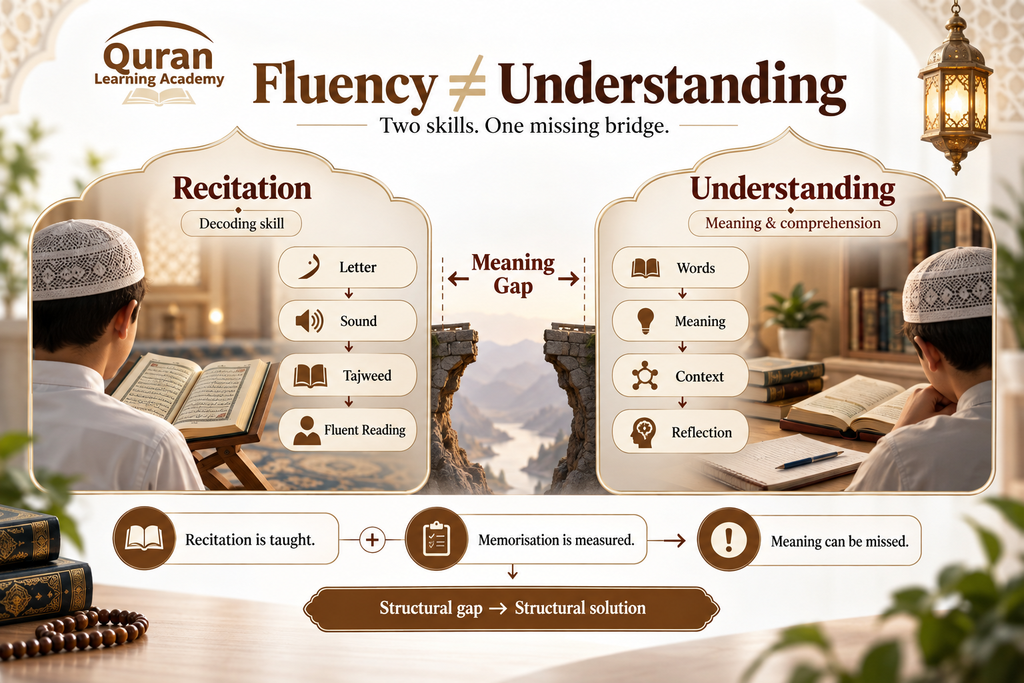
The result is that a child can sight-read six hundred pages of Quranic text with near-perfect Tajweed and have no attachment to meaning whatsoever. Recitation teachers are evaluated on recitation. Weekend madrasahs measure memorisation. Tafsir and comprehension sit in the gap between these two systems, and gaps are where things disappear.
This is not a quality problem with the teaching. It is a scope problem. Nobody was given responsibility for meaning, so meaning was never taught. Understanding that this is structural rather than personal matters, because a structural problem has a structural solution.
Read more: Hadith About Memorizing Quran.
4. The Benefits of Reciting Quran Without Understanding
Rather than treating fluent recitation as a problem to be corrected, it is worth naming what it actually provides:
- Spiritual reward is accumulated letter by letter, as established above, regardless of comprehension.
- Correct pronunciation, Makharij, and Tajweed application are already in place, so when meaning is added later, the learner does not have to divide attention between sounding correct and understanding simultaneously.
- Memorised text is the best raw material for comprehension later. A learner who has memorised Al-Asr does not need to learn its sounds when they begin studying its meaning; they can focus entirely on understanding.
- The habit of engaging with the Quran regularly is formed before the intellectual challenge of Arabic grammar enters the picture.
If you are a British Muslim who has been reciting for years without understanding, nothing was wasted. What you built is a foundation, and the next step is to place meaning onto it.
Many learners in the UK reach this point and want structured guidance on what comprehension actually looks like. The Quran Tafsir Course in the UK offered by UK Quran Learning Academy is built precisely for this transition. It uses classical commentaries including Ibn Kathir and al-Tabari to bring the meaning of Quranic verses into direct contact with daily life, taught live by qualified instructors.
5. The Difference Between Recitation and Full Engagement with the Quran
The scholars who addressed this question most carefully did not argue against recitation. They argued for raising it. Ibn al-Qayyim described the People of the Quran not as those who have memorised it, but as those who have learned it and act according to it, even if they have not committed every word to memory. The distinction is between holding the text and being shaped by it.
The gap between the two is bridged in stages, not all at once:
| Stage | What It Involves | Who Is Responsible |
| Recitation | Correct pronunciation, Tajweed, fluency | Quran teacher |
| Memorisation | Retention of full or partial text | Hifz instructor |
| Comprehension | Word meanings, context, Tafsir | Often no one |
| Application | Living by what the Quran instructs | The learner |
The table makes plain where the gap sits. Comprehension is the stage that most British Muslim learners pass through without a teacher assigned to it. Filling that gap does not require becoming an Arabic scholar. It begins with one word at a time, attached to text already memorised, and it compounds quickly.
Experience the Academy in Action
Curious about our teaching style? Take a quick look inside a live session to see our immersive, supportive learning environment first-hand.
Start Your Quranic Journey in the UK
Join our academy for structured online lessons with expert tutors, tailored to fit your schedule.
Book Your Free Trial6. Practical Steps to Move from Recitation Toward Understanding
The path from fluent recitation to genuine comprehension is gradual and does not require restarting from the beginning. Three approaches work reliably for British adult learners:
Starting with short, frequently recited surahs
Al-Fatiha is recited seventeen times in the five daily prayers. A learner who attaches meaning to its seven verses will encounter those meanings seventeen times tomorrow without any additional effort. Beginning with what is already memorised and already being said makes comprehension self-reinforcing from the first week.
Using word-by-word Quranic tools
Platforms like quran.com offer a word-by-word view that places the English meaning directly beneath each Arabic word. Three words per sitting, chosen from a surah already memorised, is a manageable and sustainable starting point.
Seeking structured Quranic Arabic instruction
For those who want to move beyond word meanings into grammatical understanding, the Quranic Arabic Course at UK Quran Learning Academy provides structured instruction in Classical Arabic grammar, Quranic vocabulary, and morphology, taught progressively so that learners develop the ability to read and comprehend Quranic verses independently.
Start the Quranic Arabic Course
7. A Note for Parents of Children Who Recite Fluently
Many families across the UK have children who finish a page of the Quran, close the mushaf, and have no idea what any of it said. The instinct to feel that something went wrong is understandable but misplaced. The recitation is real. The reward is real. What is missing is a second layer that was never anyone’s assigned job.
Allah says in Surah Sad:
“كِتَابٌ أَنزَلْنَاهُ إِلَيْكَ مُبَارَكٌ لِّيَدَّبَّرُوا آيَاتِهِ وَلِيَتَذَكَّرَ أُولُو الْأَلْبَابِ”
Kitaabun anzalnaahu ilayka mubaarakun liyaddabbaroo aayaatihi wa liyatazakkara ulul albaab
“[This is] a blessed Book which We have revealed to you, [O Muhammad], that they might reflect upon its verses and that those of understanding would be reminded.”
The verse does not say the Book was sent so that it could be recited perfectly. It says the Book was sent so that its verses could be reflected upon. For a child who recites without understanding, the recitation is done. The reflection is the next chapter, and it does not have to wait until adulthood.
The Online Quran Classes for Kids in the UK at UK Quran Learning Academy are taught by qualified instructors trained in structured Islamic pedagogy. Lessons integrate Tajweed with Makharij correction and Quranic foundations, giving children the tools to grow toward comprehension alongside their recitation.
8. For Adult Learners Returning to the Quran
A significant number of British Muslim adults find themselves in their twenties, thirties, or forties having recited well in childhood, drifted away from the Quran during adolescence, and now wanting to return, but feeling that too much time has passed. Nothing in the scholarly tradition supports this conclusion.
The benefit of returning as an adult is that the motivation is internal rather than parental, and internal motivation produces more durable engagement. An adult who wants to understand what they recite is better positioned to sustain that work than a child doing it because they were told to.
The Adult Quran Classes in the UK at UK Quran Learning Academy connect British learners with qualified Azhari teachers who specialise in recitation, Tajweed, and Quranic Arabic comprehension. Lessons are structured for adults balancing work, family, and worship commitments across London, Birmingham, Manchester, and beyond.
Start Learning with UK Quran Learning Academy
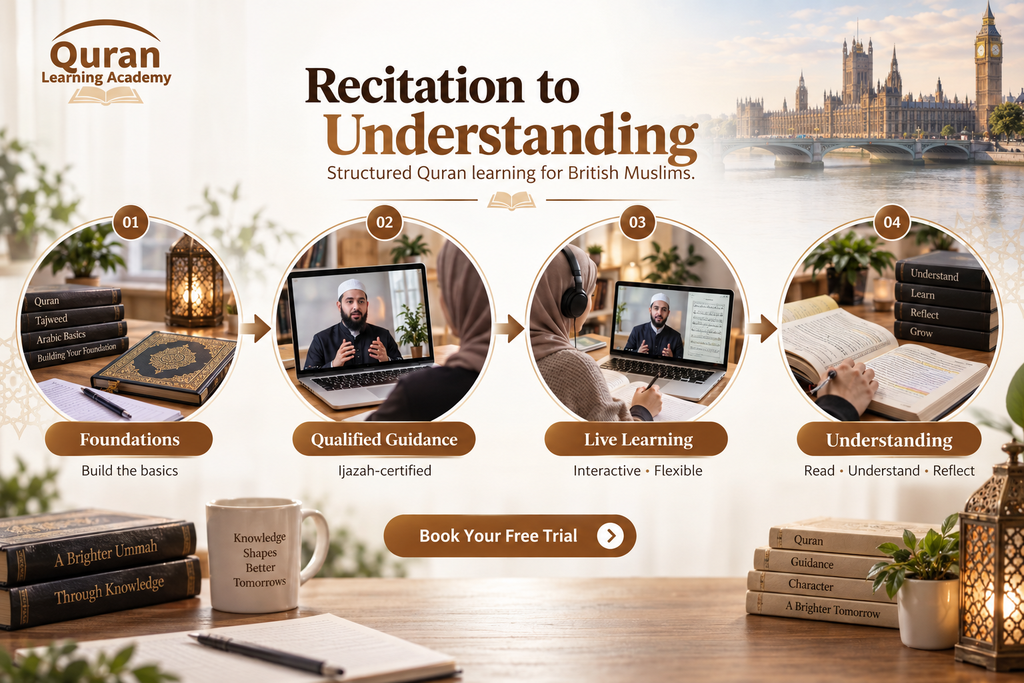
UK Quran Learning Academy connects British Muslims with qualified Azhari instructors who hold Ijazah certification and teach through live, interactive sessions. The methodology moves learners from recitation toward genuine comprehension through a structured curriculum that does not skip foundations.
Lessons are flexible to fit the realities of British working life, available across all time zones, and taught in English so that families without Arabic at home can follow every session. Whether you are an adult returning to the Quran, a parent seeking structured learning for a child, or a learner ready to move from fluency to understanding, a free trial class is the starting point.
Discover Our Quran Courses
- Quran Tafsir Course in the UK
- Quranic Arabic Course
- Online Quran Classes for Kids in the UK
- Adult Quran Classes in the UK
- Quran Ijazah Program
- Quran Qirat Learning Course
- Quran Tafsir Course
Conclusion
Reading Quran without understanding is the normal starting point for most British Muslims, and the scholarly tradition is clear that recitation carries genuine reward letter by letter. Reflection is a second obligation asked for separately, not a condition for the first to count.
The gap between fluent recitation and comprehension is real, but it is bridgeable, and the structured path toward it is available to every learner regardless of age or background.
Read more: How to Memorise the Quran in 2 Years.
Frequently Asked Questions
Is reading the Quran without understanding it sinful?
No. The scholarly consensus across the four schools is that recitation without comprehension is both permissible and rewarded. What is additionally encouraged, as a separate obligation, is reflection and effort to understand the meanings over time.
Does memorising the Quran without understanding count?
Yes. Memorised text carries reward and is the best possible foundation for comprehension later. A learner who has memorised Al-Asr and then studies its meaning at fourteen will find the surah opens up rapidly, because the sounds are already embedded. Nothing in the memorisation process is wasted.
At what age should a child start learning the meanings of Quranic verses?
Most scholars and experienced teachers suggest that comprehension can begin in stages from around eight years old. Before that age, the focus is on recitation, Tajweed foundations, and making the lessons enjoyable. The period to watch is the approach to adolescence, as a learner who reaches their teens without any connection to meaning is significantly harder to re-engage.
Can a learner understand the Quran without becoming fluent in Arabic?
Yes, through a combination of word-by-word tools, Tafsir study in English, and structured Quranic Arabic courses that teach the specific grammar and vocabulary of the Quran rather than Modern Standard Arabic. Full Arabic fluency is a long-term goal; meaningful engagement with Quranic content can begin much earlier.
Is a translation of the Quran the same as understanding it?
A translation is an interpretation, not the Quran itself. Two translators will render the same verse differently, and important nuances are inevitably lost. However, for a learner who currently understands nothing, a reliable English translation is far more useful than no translation at all. It becomes insufficient only when a learner begins to notice what the translation cannot capture, which is itself a sign of progress.







[…] Read more: Reading Quran Without Understanding: What Islam Actually Says. […]