 Learn Arabic
| Key Takeaways |
| Learning Arabic in one month is achievable as a foundation — not fluency — if you follow a structured, skills-balanced daily plan. |
| British learners must develop reading, listening, speaking, and writing simultaneously from week one, not sequentially. |
| Skipping to grammar before building basic vocabulary and ear-training is the most common mistake that stalls UK adult learners. |
| A daily commitment of 45–60 minutes, applied consistently, produces measurable progress in spoken and written Arabic within one month. |
You want to learn Arabic in one month. You are in the UK, you have a busy life, and you have probably already spent more time researching how to start than actually starting.
That experience is not unique to you — it is one of the most consistent patterns we see among adult learners who come to us after months of preparation and very little practice.
The honest answer: you will not reach fluency in 30 days. No serious educator will tell you that. What you can do — with a realistic, skills-balanced plan — is build a genuine Arabic foundation: functional reading, basic listening comprehension, essential spoken phrases, and an understanding of how the language works.
Days 1–3: Build Your Foundations Across All Four Skills Simultaneously
To learn Arabic in one month in the UK, you must resist the temptation to spend the first two weeks on the alphabet alone. That approach — common in older learning materials — leaves you able to decode letters but unable to speak, listen, or understand a word.
From day one, your study sessions must touch reading, listening, speaking, and writing, even at the most basic level.
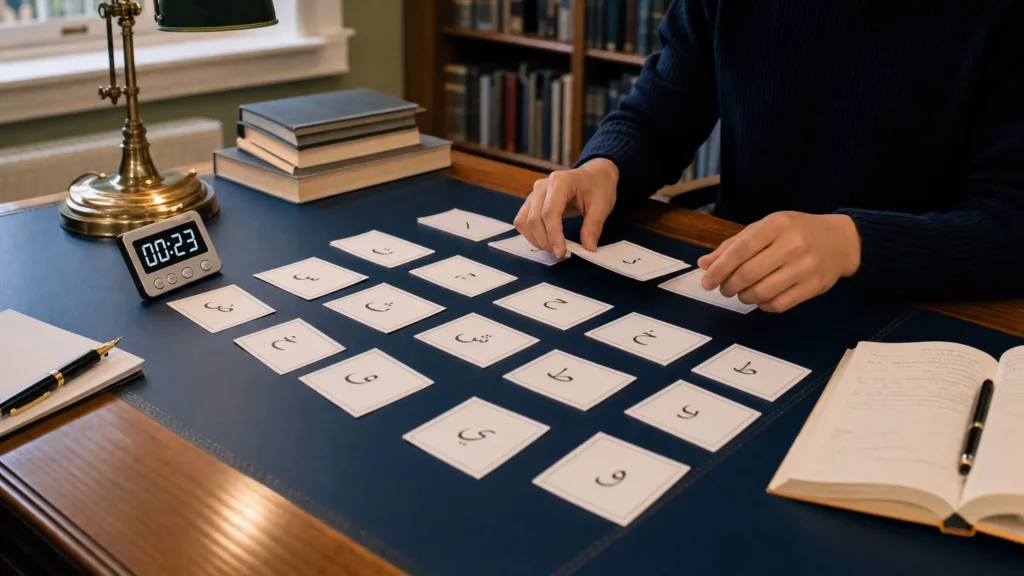
Start with the Arabic alphabet — all 28 letters, their four positional forms (isolated, initial, medial, final), and their basic sounds. This is genuinely achievable in 72 hours of focused effort.
Use a resource like the Madinah Arabic Reader series or the free lessons on ArabicPod101 for audio-supported alphabet learning.
Simultaneously, listen to native Arabic audio — even 10 minutes of a slow Arabic podcast or YouTube channel — to begin training your ear for the rhythm and sound patterns of the language before you can understand a word.
Write each letter by hand, not just type it. The physical act of writing Arabic script — from right to left — creates a muscle memory that digital input cannot replicate.
By the end of day three, you should know every letter, recognise its forms, and be able to pronounce the 28 core sounds with basic accuracy.
Shots Videos from Our Courses
Start Your Quranic Journey in the UK
Join our academy for structured online lessons with expert tutors, tailored to fit your schedule.
Book Your Free TrialDays 4–10: Build Your Core Vocabulary and First Spoken Sentences
Functional Arabic begins with vocabulary, not grammar rules. During days four through ten, your target is 150–200 high-frequency Arabic words — nouns, verbs, adjectives, and common phrases — alongside your first structured exposure to basic sentence patterns.
Use a spaced repetition system (SRS) — Anki is free, widely used, and available on every device. Download or build a deck of the 500 most common Modern Standard Arabic (MSA) words. Aim for 20–30 new words per day, with daily review of previous cards. At this rate, you will have covered 140–210 words by the end of week one — enough to begin constructing simple sentences.
For speaking, start with the most practical sentence structure in Arabic: المبتدأ والخبر (al-mubtada’ wal-khabar), the nominal sentence — essentially “X is Y.” Arabic does not require a verb “to be” in the present tense, which means “The book is big” (الكتابُ كبيرٌ — al-kitābu kabīrun) is structurally simpler than its English equivalent.
Practise building these sentences aloud using your new vocabulary every day. Record yourself on your phone and play it back. The discomfort of hearing your own voice is part of the process — do not skip it.
Listening remains non-negotiable during this phase. Watch Arabic content with Arabic subtitles — Al Jazeera’s simplified Arabic channel, Al Jazeera Arabic for Learners, is one of the best free resources available to UK learners.
Fifteen minutes of listening per session, every day, even without full comprehension, is building your auditory foundation.
| Days 4–10 Daily Breakdown | Time |
| Vocabulary review (Anki SRS) | 15 minutes |
| New word learning | 10 minutes |
| Speaking practice (nominal sentences aloud) | 10 minutes |
| Listening (Arabic audio with subtitles) | 15 minutes |
| Writing practice (writing new words by hand) | 10 minutes |
| Total | 60 minutes |
Days 11–17: Introduce Arabic Grammar in Context, Not in Isolation
Arabic grammar has a reputation for complexity that is not entirely unearned — but it is almost always taught in a way that front-loads abstraction before function. The result, which we see repeatedly in adult learners who come to us after self-study, is a learner who can explain the dual form grammatically but cannot order a coffee or ask for directions.
During days eleven through seventeen, introduce grammar through the sentences and vocabulary you already know. The three concepts to target in this phase are: verb conjugation in the present tense (المضارع — al-muḍāri’), the definite article (ال — al-) and its assimilation rules with Sun and Moon letters (الحروف الشمسية والقمرية), and basic sentence negation using ليس (laysa) and لا (lā).
Do not approach these as abstract rules to memorise. Take a sentence you already know how to say, apply the grammar rule to it, and practise saying the result aloud. Grammar studied in isolation from speaking is grammar that will not transfer to actual communication.
For UK learners looking for structured support during this phase, our Arabic language course at The UK Quran Learning Academy covers grammar in exactly this applied, communicative way — taught one-to-one by an experienced instructor who will correct your spoken errors in real time, not just mark exercises.
Continue your Anki vocabulary reviews daily without fail. By day seventeen, you should be approaching 350–400 known words — enough to hold a very basic conversation on familiar topics.
Book a FREE trial class in our Arabic Course in the UK

Days 18–22: Develop Arabic Conversational Confidence Through Structured Speaking Practice
Spoken Arabic for genuine communication requires exposure to a native speaker or a qualified instructor — not just passive listening. During days eighteen through twenty-two, prioritise structured speaking practice. This is the phase where the progress made in isolation either consolidates or stalls.
If you have not already, this is the point to book at least two or three one-to-one online sessions with a qualified Arabic tutor.
A single hour of guided spoken practice — where someone corrects your pronunciation of ث (not an English “th” but a soft, dental fricative), your vowelling of case endings, and your word order in questions — is worth more than three hours of self-study listening.
The common errors that British English speakers make in Arabic phonology — particularly with ع (ayin), غ (ghayn), ح (ha’), and the emphatic consonants ص، ض، ط، ظ — will not self-correct through listening alone.
For conversational Arabic specifically, our Arabic conversation and speaking course is structured precisely for learners at this stage — those who have built a vocabulary base and basic grammar awareness but need a structured environment to activate it in spoken form.
Book a FREE trial class in our Speaking Arabic Course in the UK
Practice topics for this phase: introducing yourself, describing your family, asking about times and locations, expressing opinions on simple topics.
These are the conversational domains that cover the highest proportion of real-world Arabic interactions for beginner speakers.
Days 23–27: Consolidate Arabic Reading and Writing to an Independent Level
Reading and writing in Arabic — not just decoding letters, but reading texts at a comfortable pace — requires deliberate practice that many 30-day plans underserve. By day twenty-three, your letter recognition should be automatic. Now is the time to move from recognition to fluency.
Read short, fully-vowelled Arabic texts aloud every day. Graded readers designed for Arabic learners are ideal for this stage. As you read, note unfamiliar words, add them to your Anki deck, and then re-read the same passage the following day. Repeated reading of familiar texts dramatically increases reading speed and builds pattern recognition for Arabic word forms.
For writing, progress beyond copying vocabulary. By this phase, write three to five sentences in Arabic from memory each day — without looking at your notes. Describe something from your day: what you ate, where you went, what you saw.
Simple, functional, personal — this is the writing practice that builds real compositional ability rather than mechanical copying.
If your goal extends to reading and comprehending Arabic for wider purposes — literature, news, or formal correspondence — our Arabic grammar course at The UK Quran Learning Academy builds the structural foundation needed for reading texts at that level, including understanding الإعراب (i’rāb — grammatical inflection) and formal written Arabic.
Book a FREE trial class in our Arabic grammar Course in the UK
Read Also: How Long Does It Take to Learn Arabic in the UK?
Days 28–30: Assess, Review, and Set Your Month-Two Targets
The final three days of your 30-day plan are not a rest period — they are a structured assessment and consolidation phase.
How to learn Arabic in one month online or in person ends the same way: you review what you know, identify what has not consolidated, and set a clear direction forward.
Run a self-assessment across all four skills.
For reading: can you read a short, vowelled Arabic paragraph aloud without halting?
For listening: can you follow a slow Arabic audio clip and pick out key vocabulary?
For speaking: can you introduce yourself, your family, your daily routine, and your opinions on a simple topic entirely in Arabic?
For writing: can you write ten sentences in Arabic from memory with correct basic grammar?
Where gaps appear, note them as targets for month two. No learner covers everything in 30 days — the purpose of this final phase is to make your progress visible and concrete, which sustains motivation far more effectively than vague encouragement.
Read Also: How to Learn Quran for Kids in the UK?
How to Learn Arabic in One Month Online Free?
Learning Arabic online for free in the UK is genuinely possible as a supplement — not as a complete learning system on its own. The best free resources available to UK learners are: Anki for vocabulary (free, cross-platform, with shared Arabic decks available); Arabic Pod 101 for listening and beginner lessons (free tier available); Madinah Arabic free PDF textbooks for structured grammar; and YouTube channels such as Arabic with Sam and Maha Arabic for spoken practice videos.
The limitation of free-only learning is the absence of corrective feedback. You can practise speaking into a recording app for thirty days and consistently reinforce a mispronunciation that a qualified instructor would have corrected in the first session.
For learners serious about reaching a functional level in one month, combining free resources with structured tuition — even two or three sessions across the month — produces measurably better outcomes than free resources alone.
For those seeking a more intensive route, our intensive Arabic course at The UK Quran Learning Academy is designed specifically for learners who want structured, accelerated progression — with the personalised instruction that free platforms cannot provide.
Book a FREE trial class in our intensive Arabic Course in the UK
Our Students Reviews
Start Your Quranic Journey in the UK
Join our academy for structured online lessons with expert tutors, tailored to fit your schedule.
Book Your Free TrialRead Also: How to Learn Quran in the UK?
Start Your Arabic Learning With Structured Support at The UK Quran Learning Academy
A structured 30-day plan produces real results — and structured support makes the difference between a foundation that holds and one that fades.
- Qualified, experienced instructors who teach British learners
- One-to-one personalised sessions — no group class format
- Flexible scheduling built for UK work and family life
- Courses covering Arabic reading, writing, speaking, listening, grammar, and conversation
- Free trial lesson with no commitment required
- Welcoming environment for adults, beginners, parents, and new Muslims
Book your free trial Arabic lesson today
Check out our top Arabic courses for UK students:
- Intensive Arabic course
- Arabic grammar course
- Arabic conversation and speaking course
- Arabic language course
Book your FREE trial session today

Conclusion
Learning Arabic in one month is less about speed and more about structure. A balanced routine that combines vocabulary, listening, speaking, reading, and writing creates a practical foundation that supports genuine long-term development.
The most effective approach introduces grammar through real language use, not isolated theory, while regular speaking practice and corrective feedback help learners avoid mistakes that often persist in self-study.
Free online tools can accelerate progress, but sustained improvement comes from consistency, applied practice, and clear month-to-month goals. With the right plan, UK beginners can finish thirty days with visible skills, stronger confidence, and a clear path forward.
Read Also: How to Learn Arabic in 6 Months in the UK?
Read Also: How to Learn Arabic in 5 Minutes in the UK?
Frequently Asked Questions About Learning Arabic in One Month in the UK
Is it really possible to learn Arabic in one month as a complete beginner in the UK?
Yes — as a foundation, not as fluency. In 30 days of structured, daily practice, a complete beginner can achieve functional literacy in the Arabic script, a working vocabulary of 300–400 words, basic spoken sentence construction, and the ability to follow slow Arabic audio. That is a genuine, usable foundation for continued learning.
How to learn Arabic in 30 days if I only have 45 minutes a day?
Forty-five minutes is enough if you distribute it deliberately: ten minutes of vocabulary review, ten minutes of new input (grammar or vocabulary), fifteen minutes of listening, and ten minutes of speaking or writing practice. Consistency across all four skills matters more than the total time. Missing listening or speaking entirely — even for a few days — creates gaps that slow overall progress.
What is the best free resource for learning Arabic online in the UK?
Anki with a quality shared Arabic deck is the highest-value free tool for vocabulary acquisition. For listening, Al Jazeera’s Arabic content and YouTube channels such as Arabic with Sam provide accessible, native-speaker audio. For structured grammar, the free Madinah Arabic PDFs remain one of the best self-study resources available. Used together, these cover significant ground — but they work best alongside guided instruction.
Should I learn Modern Standard Arabic or a dialect first?
For UK learners starting from zero, Modern Standard Arabic (MSA) is the recommended starting point. MSA is understood across the Arab world, is the language of formal media, literature, and education, and provides the grammatical foundation from which all dialects derive. Dialects are valuable for specific conversational contexts, but beginning with a dialect limits your ability to read, understand broadcasts, or communicate across different Arabic-speaking communities.







Leave a Reply