 Quran
Quran
Every Muslim who has ever sat with the Mushaf and whispered verses under their breath is continuing a tradition that began over fourteen centuries ago. But before the millions of Huffaz who exist today, before the Hifz schools and the online academies, there was a first. Understanding who was the first person to memorize the Holy Quran is not just a historical question. It is the origin story of an unbroken chain of preservation that connects every reciter alive today to the moment revelation first descended.
For British Muslims especially, this question carries weight. Whether you grew up attending Saturday classes at the local mosque, had a parent who memorised Juz Amma before you, or are only now considering beginning your own Hifz journey, knowing where this tradition began gives the pursuit its full meaning and its full gravity.
Who Was the First Person to Memorize the Holy Quran?
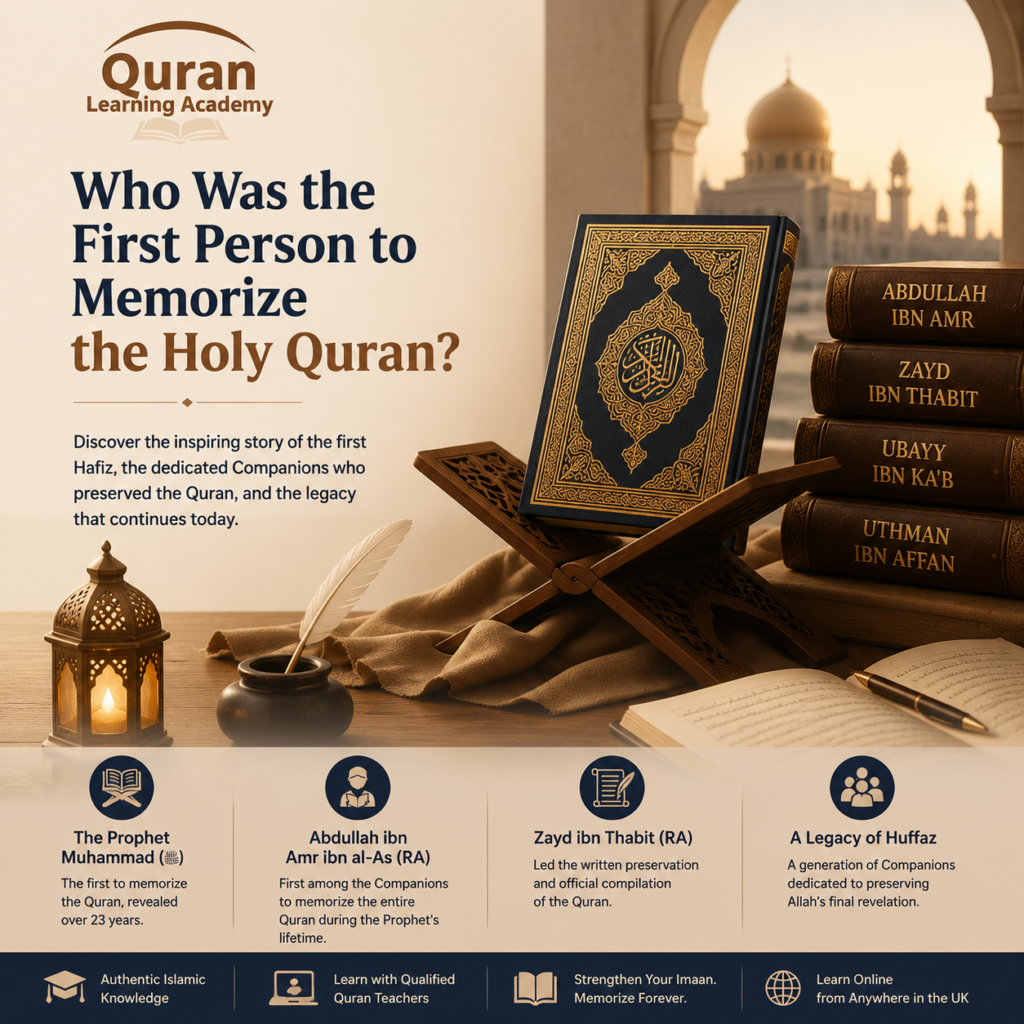
The first person to memorize the Holy Quran was Prophet Muhammad (ﷺ), who received the Quran gradually over 23 years through Angel Jibreel (AS). He memorized every revelation as it was revealed and reviewed the entire Quran with Jibreel each Ramadan, making him the first guardian of its preservation.
Among the Prophet’s Companions, Abdullah ibn Amr ibn al-As (RA) is widely recognized as the first to complete memorizing the entire Quran during the Prophet’s lifetime, setting the example for generations of Huffaz who followed.
Read also: Who Is the Youngest Person to Memorize the Quran?
The Prophet Muhammad Was the First to Memorize the Quran
The answer to who was the first person to memorize the Holy Quran begins with the Prophet Muhammad (PBUH) himself. The Quran was not delivered as a completed book in a single moment. It was revealed gradually, over a span of twenty-three years, with each passage descending in response to specific circumstances, events, and the needs of the early Muslim community.
Each time Jibreel (AS) brought a new revelation, the Prophet memorised it immediately, retained it completely, and then transmitted it to his Companions. This was not incidental. Preservation through the heart was the primary method, with written documentation serving as a secondary record.
Allah addresses this directly in the Quran:
“إِنَّ عَلَيْنَا جَمْعَهُۥ وَقُرْءَانَهُۥ”
Inna ʿalaynā jamʿahu wa-qurʾānah
“Indeed, upon Us is its collection and its recitation.” Surah Al-Qiyamah: 17
This verse confirms that the preservation of the Quran was a divine responsibility, and the Prophet (PBUH) was its first human vessel. He would review the entire Quran with Jibreel (AS) once every Ramadan, and in the final year of his life, this review took place twice, as reported in Sahih al-Bukhari.
Abdullah ibn Amr ibn al-As Was the First Complete Hafiz Among the Companions
While the Prophet (PBUH) was the original memoriser of the Quran, the question of who was the first person to memorize the Holy Quran in its entirety among the Companions points to Abdullah ibn Amr ibn al-As (RA).
Abdullah was a devoted companion known for his exceptional eagerness to learn and his impeccable discipline. He had initially been recording the sayings of the Prophet (PBUH), but upon realising that the Quranic revelation was still ongoing and required his complete focus, he redirected his efforts entirely toward memorisation. He spent countless hours committing the verses to memory while revelation was still being received, making him the first among the Sahabah to complete the full Quran in his heart.
Ibn Maajah (1346) records that Abdullah ibn Amr himself said:
“مَثَلُ الَّذِي يَقْرَأُ الْقُرْآنَ وَهُوَ حَافِظٌ لَهُ مَعَ السَّفَرَةِ الْكِرَامِ الْبَرَرَةِ”
“Such a person as recites the Qur’an and masters it by heart will be with the noble righteous scribes.”
His achievement set a standard and an aspiration that has motivated generations of Muslims ever since.
Read also: What Is the Best Age to Memorize the Quran in the UK? A Parent’s Complete Guide
Zayd ibn Thabit Led the Written Preservation of the Quran
To fully understand who was the first person to memorize the Holy Quran and how that memorisation was safeguarded, the role of Zayd ibn Thabit (RA) cannot be overlooked. He was the Prophet’s (PBUH) primary scribe, appointed to record each new revelation in writing as soon as it descended.
Zayd memorised the Quran during the Prophet’s lifetime and was described as one of the most precise and meticulous of the Companions in this regard. After the Battle of Yamama in 12 AH, when a significant number of Huffaz were martyred, Caliph Abu Bakr charged Zayd with the monumental task of compiling the Quran into a single written Mushaf. He carried this out by cross-referencing memorised recitations with written fragments, ensuring every verse was verified by multiple witnesses before being recorded.
This compiled Mushaf was later used by Caliph Uthman to produce standardised copies that were distributed across the expanding Muslim world, the same textual tradition that every Mushaf in use today descends from.
| Companion | Role in Preservation | Period |
| Abdullah ibn Amr ibn al-As | First complete memorizer among Companions | During Prophet’s lifetime |
| Zayd ibn Thabit | Primary scribe; led official compilation | During Abu Bakr’s caliphate |
| Ubayy ibn Ka’b | Leading reciter; taught many Companions | During Prophet’s lifetime |
| Uthman ibn Affan | Standardised and distributed the Mushaf | 650 CE |
The Most Prominent Companions Who Memorized the Quran
The question of who was the first person to memorize the Holy Quran opens into a broader story of a generation that treated Quranic memorisation as a collective responsibility. Scholars have documented a substantial list of Companions who achieved complete memorisation, among them:
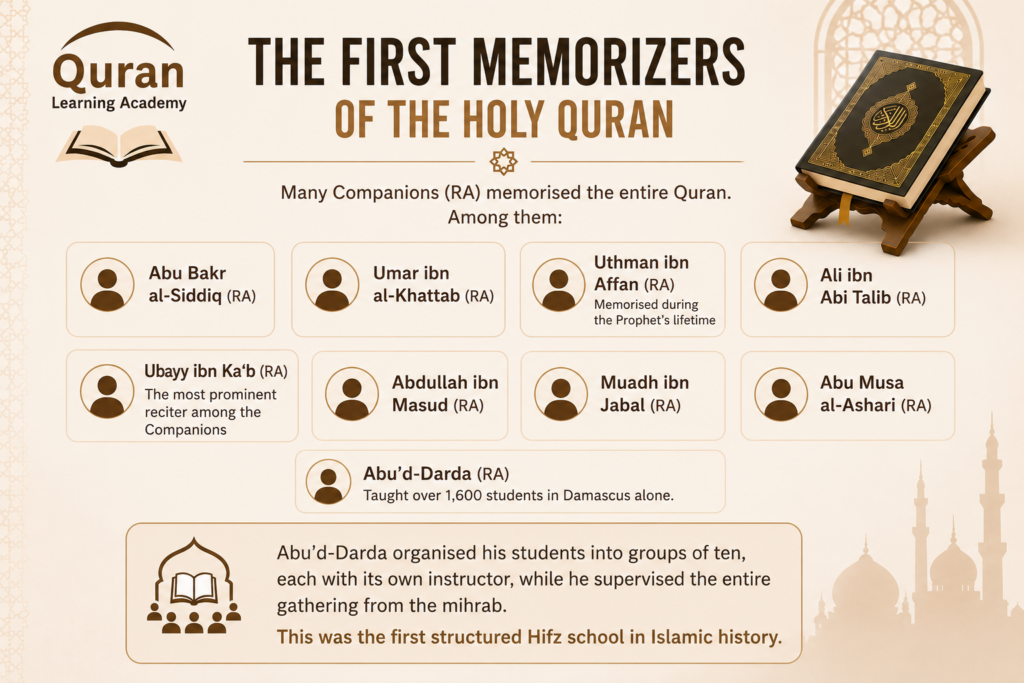
- Abu Bakr al-Siddiq (RA)
- Umar ibn al-Khattab (RA)
- Uthman ibn Affan (RA), who memorised during the Prophet’s lifetime
- Ali ibn Abi Talib (RA)
- Ubayy ibn Ka’b (RA), considered the most prominent reciter among the Companions
- Abdullah ibn Masud (RA)
- Muadh ibn Jabal (RA)
- Abu Musa al-Ashari (RA)
- Abu’d-Darda (RA), who taught over one thousand and six hundred students in Damascus alone
Abu’d-Darda organised his students into groups of ten, each with its own instructor, while he himself supervised the entire gathering from the mihrab. This was, in effect, the first structured Hifz school in Islamic history.
If you are a British Muslim looking to begin your own memorisation journey under the kind of structured, qualified guidance the Companions valued, the UK Quran Learning Academy’s Quran Memorisation Course provides exactly that framework. Qualified teachers guide students Juz by Juz, with regular review cycles and Tajweed correction built into every session.
Start your Hifz with the Quran Memorisation Course at UK Quran Learning Academy
Step Inside Our Virtual Classrooms
See how our interactive lessons work. Watch these brief highlights of our students engaging with instructors.
Start Your Quranic Journey in the UK
Join our academy for structured online lessons with expert tutors, tailored to fit your schedule.
Book Your Free TrialHafsa bint Umar Was the First Woman to Memorize the Complete Quran
The history of who was the first person to memorize the Holy Quran extends to women as well, and the record here is clear. Hafsa bint Umar (RA), daughter of Caliph Umar and wife of the Prophet (PBUH), is the first woman in Islamic history to memorise the entire Quran.
What made Hafsa (RA) uniquely significant was not only her memorisation but her literacy. Unlike most women of her era, she could read and write fluently. This allowed her to receive and record verses through both oral and written channels, giving her a precision that the Caliphs recognised and trusted. When Caliph Abu Bakr commissioned the first official compilation, the completed Mushaf was placed in Hafsa’s custody. When Caliph Uthman later standardised the Quran, it was Hafsa’s copy that served as the reference text.
Other notable female Huffaz from among the Companions include:
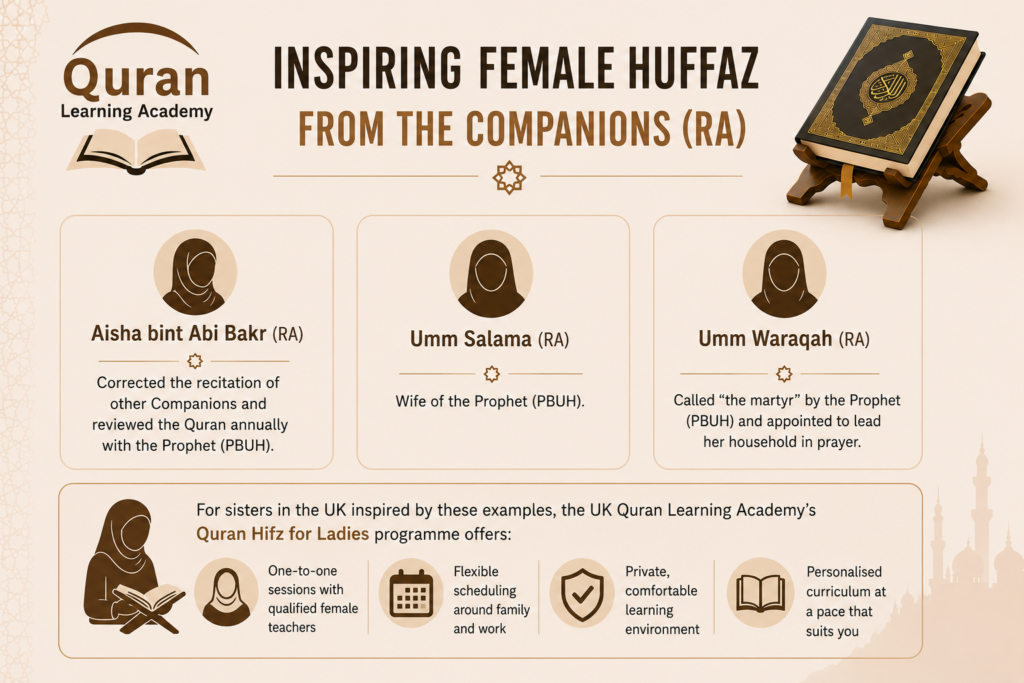
- Aisha bint Abi Bakr (RA), who corrected the recitation of other Companions and reviewed the Quran annually with the Prophet (PBUH)
- Umm Salama (RA), wife of the Prophet
- Umm Waraqah (RA), whom the Prophet (PBUH) called “the martyr” and who was appointed to lead her household in prayer
For sisters in the UK who feel inspired by these examples and want to pursue their own Hifz in a structured, private environment, the UK Quran Learning Academy’s Quran Hifz for Ladies programme offers one-to-one sessions with qualified female teachers, flexible scheduling built around family and work commitments, and a curriculum that progresses at a pace suited to each individual student.
Start your Hifz journey with expert female teachers today.
How the Companions Taught the Quran to the Next Generation
Understanding who was the first person to memorize the Holy Quran also means understanding how that knowledge was passed forward. The Companions did not simply memorise for themselves. They taught with the same urgency and rigour with which they learned.
Abu Ubayd al-Qasim documented how the Companions would learn ten verses at a time, refusing to move forward until they had not only memorised those ten verses but also understood their meaning and put their guidance into practice. This integration of memorisation and application was the defining feature of the Prophetic teaching method.
| Teaching Method Used by Companions | Modern Equivalent |
| Group sessions with individual instructors | Structured class-based Hifz with teacher oversight |
| Daily recitation to the Prophet or a trusted Companion | Daily recitation to a qualified online Hifz teacher |
| Annual review of the full Quran in Ramadan | Monthly and term-based revision cycles |
| Correction of errors in real time | Live one-to-one sessions with Tajweed correction |
| Learning meaning alongside memorisation | Integrated Tafseer study within Hifz programmes |
This tradition of structured, teacher-supervised learning is exactly what the UK Quran Learning Academy’s Hifz Classes for Adults preserves. Designed for working professionals and parents across Britain who carry the intention to memorise but need a programme that fits around real life, the course provides systematic progression, qualified correction, and accountability from the very first session.
Achieve your Hifz goals with flexible adult Quran classes.
The Spiritual Significance of Being a Hafiz in the Islamic Tradition
The question of who was the first person to memorize the Holy Quran is ultimately inseparable from the question of why Muslims memorise at all. The Companions memorised not for academic distinction but out of love for Allah’s words and a commitment to preserving them.
The Prophet (PBUH) spoke directly to this motivation:
“يُقَالُ لِصَاحِبِ الْقُرْآنِ يَوْمَ الْقِيَامَةِ: اقْرَأْ وَارْتَقِ وَرَتِّلْ كَمَا كُنْتَ تُرَتِّلُ فِي الدُّنْيَا”
“One who was devoted to the Qur’an will be told to recite, ascend and recite carefully as he recited carefully when he was in the world, for he will reach his abode when he comes to the last verse he recites.”
The rank of the Hafiz in the hereafter is not ceremonial. It is determined by the last verse they reach. This is why accuracy, Tajweed, and consistent revision matter as much as initial memorisation.
For children in the UK whose parents want this inheritance planted early, the UK Quran Learning Academy’s Quran Memorisation for Kids programme offers child-friendly scheduling, age-appropriate pacing, and teachers experienced in keeping young learners motivated through the full journey from the opening Surahs to the final Juz.
Help your child begin a rewarding Hifz journey today.
How the Tradition of Hifz Has Reached the UK
The chain that began with the Prophet (PBUH) and passed through Abdullah ibn Amr, Zayd ibn Thabit, Hafsa (RA), and the generation of Companions has reached every corner of the world, including Britain. Muslim communities across London, Birmingham, Manchester, Bradford, and beyond carry this tradition in their local mosques, madrasas, and now through live online instruction.
What has changed is access and structure. British Muslims today do not need to relocate or restructure their lives to begin memorising the Quran. They need a qualified teacher, a consistent schedule, and a programme that understands the specific challenges of balancing Hifz with a UK lifestyle.
The Huffaz of the Companions’ generation learned under pressure and with total commitment. That spirit is still the foundation. What the UK Quran Learning Academy offers is the scaffolding that makes it sustainable for a British Muslim in 2026.
Experience the Academy in Action
Curious about our teaching style? Take a quick look inside a live session to see our immersive, supportive learning environment first-hand.
Start Your Quranic Journey in the UK
Join our academy for structured online lessons with expert tutors, tailored to fit your schedule.
Book Your Free TrialBegin Your Hifz Journey with the UK Quran Learning Academy
The story of who was the first person to memorize the Holy Quran is a story of intention, dedication, and transmission. The Prophet (PBUH) was its origin. The Companions were its first carriers. The scholars of every generation since have kept the chain unbroken. And today, that chain extends to Muslims living in Britain who carry the same intention.
UK Quran Learning Academy offers a complete range of programmes for every type of learner across the UK:
- Quran Memorisation Course — structured Juz-by-Juz progression with qualified Azhari teachers
- Hifz Classes for Adults — built around real schedules for working professionals and parents
- Quran Hifz for Ladies — private sessions with female teachers in a comfortable environment
- Quran Memorisation for Kids — age-appropriate, child-friendly pacing from the very first session
- Online Tajweed Classes — ensuring every memoriser recites with the accuracy the tradition demands
All programmes are delivered live, one-to-one, and accessible from anywhere in the UK. Certified teachers correct your Tajweed, track your progress, and keep you on target from Day One.
Book your free trial session at UK Quran Learning Academy and begin your Hifz today

Discover Our Quran Courses
- Quran Online Academy
- Quran Recitation Classes
- Quran Reading Classes
- Online Quran Classes for Kids
- Quran Classes for Adults
- Quran Classes for Female / Sisters
- Learn Quran for Beginners
- Quran Memorization (Hifz) Course
- Hifz Classes for Adults
- Quran Memorization and Hifz for Kids
- Quran Hifz for Ladies
- Quran Ijazah Program
- Quran Qirat Learning Course
- Quran Tafsir Course
- Noorani Qaida Course
- Noorani Qaida Course for Kids
- Weekend Quran Classes
- Intensive Quran Course
- Al-Azhar Quran Course
- Online Tajweed Classes
- Tajweed Course for Kids
- Tajweed Course for Adults
- Tajweed Course for Ladies / Sisters
Start Your Quranic Journey in the UK
Join our academy for structured online lessons with expert tutors, tailored to fit your schedule.
Book Your Free TrialConclusion
Who was the first person to memorize the Holy Quran? The Prophet Muhammad (PBUH) holds that distinction, with Abdullah ibn Amr ibn al-As recognised as the first Companion to complete it in full, Zayd ibn Thabit as its primary written guardian, and Hafsa bint Umar (RA) as the first woman to carry the entire Quran in her heart.
These were not isolated individuals. They were the beginning of a community committed to preservation, and their method, memorisation under qualified guidance with regular review and live correction, remains the proven path today. For British Muslims, the tradition is alive, accessible, and more structured than ever. The question now is not who will be first. It is who will be next.
Frequently Asked Questions
Who was the first person to memorize the Holy Quran in history?
The first person to memorize the Holy Quran was Prophet Muhammad (PBUH) himself, who retained every verse as it was revealed over twenty-three years. Among the Companions, Abdullah ibn Amr ibn al-As is recognised as the first to complete full memorisation during the Prophet’s lifetime.
Was Zayd ibn Thabit the first to memorize the Quran?
Zayd ibn Thabit (RA) was the Prophet’s primary scribe and himself a memoriser, but he is distinguished more for his role in compiling the written Mushaf under Caliph Abu Bakr. The title of first complete memoriser among the Companions belongs to Abdullah ibn Amr ibn al-As.
Who was the first woman to memorize the complete Quran?
The first woman to memorize the entire Quran was Hafsa bint Umar (RA), wife of the Prophet (PBUH) and daughter of Caliph Umar. Her memorisation was so trusted that Caliph Uthman used her personal Mushaf as the reference for the standardised copies distributed across the Muslim world.
How many Companions memorized the entire Quran?
A great number of the Companions memorised the full Quran, though scholars note they cannot all be listed. Among the most prominent were the four Caliphs, Ubayy ibn Kab, Abdullah ibn Masud, Zayd ibn Thabit, Muadh ibn Jabal, and several wives of the Prophet including Hafsa, Aisha, and Umm Salama (RA).
Can British Muslims follow the same Hifz tradition today?
Absolutely. The tradition of memorising under a qualified teacher with regular review and live correction is exactly what structured Hifz programmes in the UK offer. Academies like the UK Quran Learning Academy deliver this through live one-to-one online sessions with certified teachers, making it accessible for every Muslim in Britain regardless of schedule or prior experience.





Leave a Reply