 Quran
Quran
Every Muslim parent in Britain has seen the videos: a toddler seated with a Mushaf, reciting flawlessly in front of a stunned audience. The comments flood in — MashAllah, SubhanAllah — and then the tab closes and real life resumes. The school run. The homework. The weekend Islamic class that your child barely tolerates. If you have ever wondered whether that level of Quranic connection is genuinely possible for your child, or whether those children are simply born different, the answer this article gives you is based entirely on documented history and verified cases. Who is the youngest person to memorize the Quran is a question with clear answers. What those answers reveal about method, environment, and family commitment is far more useful than the names themselves.
Who Is the Youngest Person to Memorize the Quran?
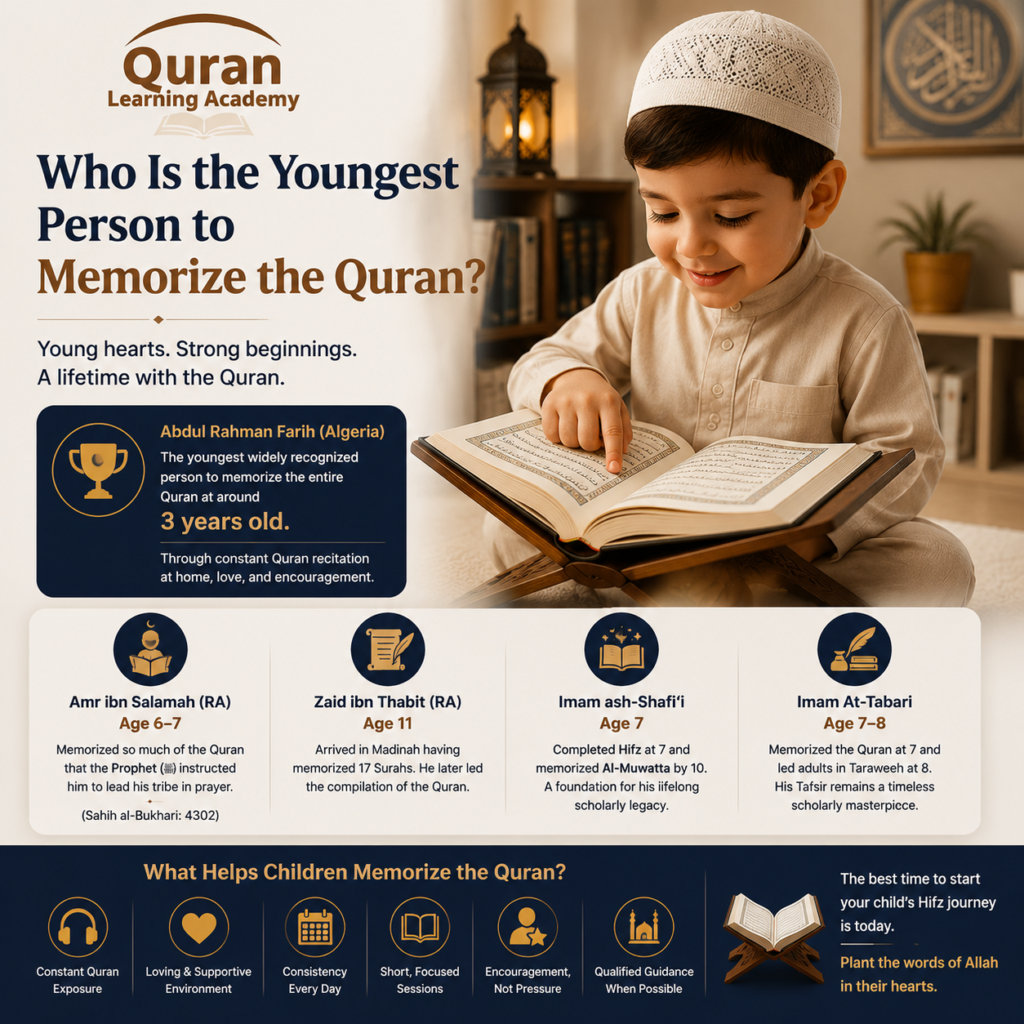
The youngest widely recognized person to memorize the entire Quran is Abdul Rahman Farih from Algeria, who reportedly completed his Hifz at around three years old after growing up in a home filled with constant Quran recitation and daily encouragement.
In early Islamic history, Amr ibn Salamah (RA) memorized so much of the Quran by the age of six or seven that he was chosen to lead his community in prayer, demonstrating the remarkable memorization abilities of young children nurtured in a Quran-centered environment.
Amr ibn Salamah Led Prayer at Age Six or Seven
The earliest documented child Hafiz in Islamic history is not a name from a modern competition or a viral video. He is a Companion of the Prophet whose story was recorded in Sahih al-Bukhari.
Amr ibn Salamah al-Jarmi grew up in a tribe on a trade route. Caravans passed through regularly, and travellers who had accepted Islam would recite Quranic verses. Amr memorised everything he heard. He had no teacher, no formal curriculum, and no Mushaf. He had repetition, attention, and a child’s naturally absorbent memory.
When his tribe embraced Islam and needed someone to lead them in prayer, the Prophet’s instruction was unambiguous:
“لِيَؤُمَّكُمْ أَكْثَرُكُمْ قُرْآنًا”
Liya’ummakum aktharukum Qur’ana
“Let the one among you who knows the most Quran lead you in prayer.”
The tribe looked around and found no one with more Quran than Amr. He was six or seven years old. He led the adults in prayer. His father described the scene in the narration with a matter-of-fact clarity that makes clear this was not treated as a miracle. It was the natural result of a child who had been surrounded by recitation from his earliest years.
Zaid ibn Thabit arrived in Madinah at age eleven having already memorised seventeen Surahs. The Prophet assigned him additional responsibilities precisely because of his demonstrated capacity for memorisation. He later headed the committee that compiled the Quran into the written Mushaf. His childhood Hifz was the foundation of a contribution that shaped Islamic civilisation permanently.
Read also: What Is the Best Age to Memorize the Quran in the UK? A Parent’s Complete Guide
Abdul Rahman Farih Completed the Quran at Age Three
The question of who is the youngest person to memorize the Quran in the modern era returns consistently to one name: Abdul Rahman Farih from Algeria.
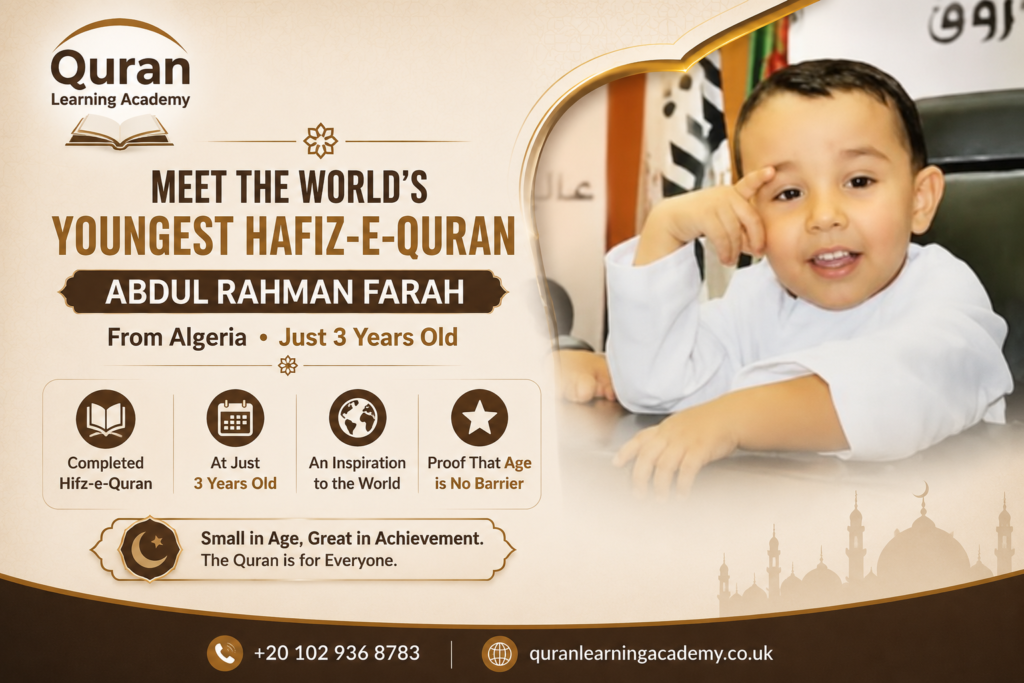
His story begins with a detail that most summaries omit. He experienced a speech delay in his early years. He did not speak normally until age two. When words finally came, they were Quranic verses he had absorbed from listening to recitation at home. By age three and a half, he had completed the memorisation of all thirty Juz with accurate Tajweed.
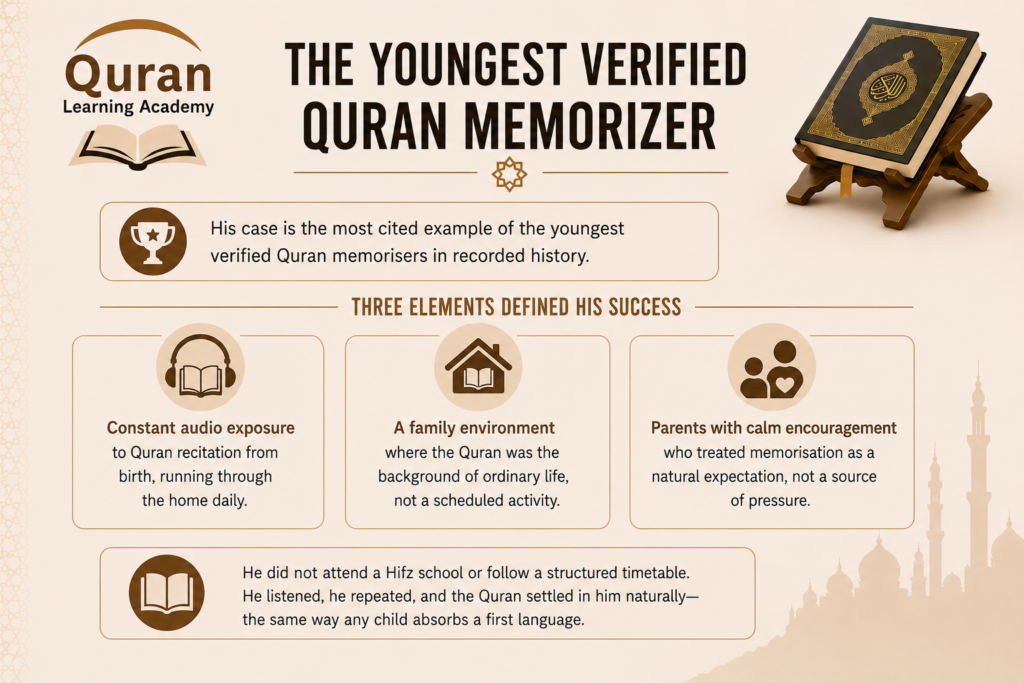
His case attracted international recognition and is the most widely cited example when scholars and educators discuss the youngest verified Quran memorisers in recorded history. Three elements defined his success:
- Constant audio exposure to Quran recitation from birth, running through the home daily
- A family environment where the Quran was not an activity scheduled into the week but the background of ordinary life
- Parents who treated his memorisation as a natural expectation and responded to each accomplishment with calm encouragement rather than performance pressure
He did not attend a formal Hifz school. He did not follow a structured revision timetable. He listened, he repeated, and the Quran settled in him the way a first language does in any child. The mechanism was not supernatural. It was the same mechanism that allows any child to absorb and reproduce thousands of words of spoken language before they can read a single sentence.
Classical Scholars Began Their Hifz Before Age Ten
The pattern of childhood memorisation did not begin with viral videos or modern competitions. The great scholars of Islam’s classical period almost universally completed their Hifz before the age of ten, and that memorisation became the intellectual foundation on which everything else was built.
Imam al-Shafi’i
Imam al-Shafi’i completed his Quran memorisation at age seven. By age ten, he had also memorised the Muwatta of Imam Malik in its entirety. The legal reasoning he developed later, which shaped Islamic jurisprudence across four continents and continues to govern the worship of hundreds of millions of Muslims, was built directly on a Quranic memory so deep that he reportedly completed the entire Quran twice each day during Ramadan.
Imam Ibn Jarir al-Tabari
His Tafsir remains the most comprehensive classical commentary on the Quran, memorised the full Quran at age seven and led adults in Tarawih prayer at age eight. The scholarly output he eventually produced across history, Tafsir, and jurisprudence was inseparable from the depth of memorisation he established in those first years.
Ibn Sina
He is known in the West as Avicenna and recognised as one of the most significant thinkers in the history of medicine and philosophy, completed his Quran memorisation by age ten. In his own autobiographical account, he credits the discipline and structural thinking that Hifz required as foundational to everything that followed in his intellectual life.
The pattern across these scholars is identical to what appears in the modern cases. Early exposure, structured repetition, family encouragement, and qualified teachers. The method has not changed across fourteen centuries. What changes is whether a given family decides to provide those conditions for their child.
Read also: Tips on How to Memorise the Quran?
The Brain Science Behind Early Memorisation Ability
The stories of the youngest Quran memorisers are not miraculous exceptions. They are consistent with what neuroscience has established about how children’s brains develop and function during the earliest years of life.
Between the ages of three and seven, the human brain exhibits neuroplasticity at its highest point. During this window, the brain forms new neural connections at a rate that will never be matched again across a lifetime. The auditory memory system, which processes and stores sounds, rhythmic patterns, and phonetic sequences, is particularly active. This is precisely why children in this age range can absorb recitation they hear repeatedly and reproduce it with an accuracy that adult learners work for years to approximate.
Several cognitive advantages work together in young children to support Quran memorisation:
- Auditory imitation ability is strongest before age seven, allowing children to replicate Tajweed sounds naturally without conscious study
- Pattern recognition is highly developed, which helps children internalise the rhythmic structure of Quranic verses as a felt sequence rather than a memorised list
- Absence of competing information means the memory is clear and receptive in a way that adult memory, filled with years of accumulated knowledge, simply cannot replicate
- Repetition tolerance is far higher in young children than in adults, meaning they can repeat the same passage many more times without mental fatigue
- Emotional encoding means verses learned in warm, encouraging environments are stored more durably in long-term memory than material learned under pressure
This is why Islamic scholars and Hifz educators consistently recommend beginning Quran audio exposure before age four, even when formal memorisation does not begin until five or six. The listening that happens in the early years builds the auditory foundation that structured Hifz later fills. A child who has heard Surah al-Baqarah fifty times before age three will memorise it in a fraction of the time it takes a child encountering it for the first.
The Tajweed accuracy that your child develops in these early years will define the quality of their recitation for the rest of their life. Errors absorbed in childhood become habits that are extremely difficult to correct later. The Tajweed Course for Kids at UK Quran Learning Academy teaches children aged 4 to 14 Makharij al-Huroof, Sifaat, and practical Tajweed application using short Surahs from Juz Amma — building the accurate recitation habits that Hifz demands from the very first lesson. Book a free trial and start correctly.
Book a free trial and build perfect Tajweed from day one.
Step Inside Our Virtual Classrooms
See how our interactive lessons work. Watch these brief highlights of our students engaging with instructors.
Start Your Quranic Journey in the UK
Join our academy for structured online lessons with expert tutors, tailored to fit your schedule.
Book Your Free TrialThe Family Environment That Produces Young Huffaz
Behind every name on the list of the world’s youngest Quran memorisers, there is a family story. The child did not succeed alone. The conditions that produced these achievements were built deliberately by parents who made the Quran the organising principle of their home.
Several consistent patterns appear across every documented case:
- Prenatal and infant audio exposure: Mothers in these families played Quran recitation consistently during pregnancy and through the nursing years, making the sound of Quranic Arabic the first pattern the child’s ears processed
- A single consistent reciter: Families committed to one high-quality reciter — al-Husary, al-Minshawi, or a similar scholar known for Tajweed precision — so the child built one stable auditory template rather than absorbing variations from multiple voices
- The Quran as background, not occasion: Recitation was not reserved for special times. It ran during meals, during travel, during housework. The child’s entire sensory environment was shaped by the sound of the Quran
- Calm consistency over intensity: None of the documented families reported pushing their children through high-pressure drilling sessions. The memorisation happened through relaxed, repeated daily contact with the material
- Immediate qualified correction: Every case involved a parent, grandparent, or teacher who could correct mispronunciation in real time before errors became habits
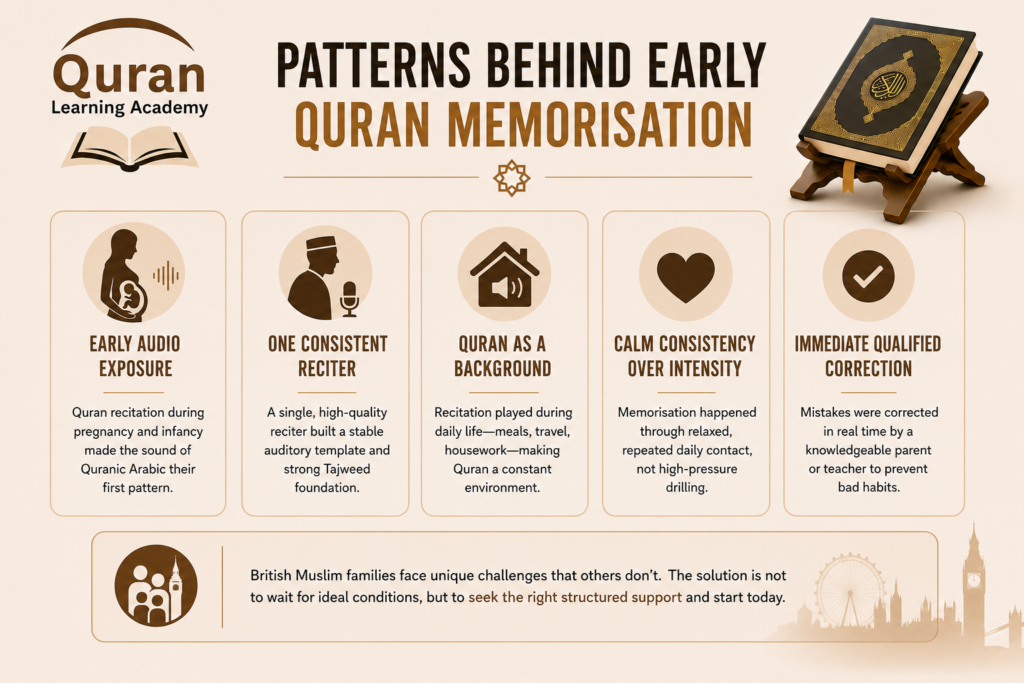
British Muslim families face specific challenges that families in Muslim-majority countries do not. The school system, the social environment, the absence of an extended family network built around Islamic education — all of these create friction that families elsewhere simply do not encounter. That friction is real, but it is not an argument against starting. It is an argument for finding the right structured support.
Proven Methods That Accelerate Hifz in Young Children
The methods used by teachers who have produced young Huffaz across generations are consistent and well-documented. They are also simpler than most parents expect.
Listening before memorising
It is the single most powerful technique for young children. A child who has heard a verse forty times before their first formal memorisation session will retain it in a fraction of the repetitions a child hearing it for the first time requires. Playing the target Surah during car journeys, at mealtimes, and before sleep turns passive listening into active preparation.
Short daily sessions
Short daily sessions outperform long irregular ones by a wide margin. A focused fifteen-minute session at the same time each day produces stronger memory traces than a two-hour session once a week. Consistency builds the neural pathways that make memorisation cumulative. Each session reinforces what came before.
Line-by-line connection
It is the structural method that prevents the most common memorisation failure. Children memorise individual lines but forget the connection between them. The correct method is to memorise line one, then connect it to line two, then recite both together, then add line three and recite all three, continuing this cumulative pattern until the page flows as one unbroken sequence.
Revision before new material
Revision is the discipline that separates children who complete Hifz from those who restart repeatedly. Every session should begin with recitation of recently memorised material before any new verses are introduced. Memory consolidates during the hours and days after initial learning, not during the learning session itself.
Recitation in Salah
Recitation in salah turns five daily prayers into five reinforcement sessions. Rotating recently memorised Surahs across the prayers means each passage receives multiple retrieval opportunities each day without requiring any additional dedicated time.
Qualified teacher correction
Qualified teacher correction remains irreplaceable. The Arabic language contains phonetic distinctions that the untrained ear cannot reliably self-audit. A child who has been reciting a mispronunciation for two weeks has memorised that error, and unlearning it takes significantly longer than learning correctly from the start.
UK Muslim Families Face Specific Hifz Challenges
British Muslim children growing up in the UK face a set of Hifz challenges that are distinct from those faced by children in Muslim-majority countries, and being honest about those challenges is the first step toward addressing them practically.
Arabic is not the language of the school day, the playground, or the media environment that surrounds British children. Every hour of Hifz has to compete with the full weight of an English-language world. This is not a small obstacle. It is the central challenge facing every Muslim family in Britain that wants to raise a Hafiz.
Weekend and evening Islamic school slots are often too short, too irregular, and too inconsistently taught to produce genuine memorisation results. Many British Muslim parents report that their children attend Islamic school for years and emerge with a handful of Surahs memorised imprecisely, without the Tajweed foundation needed to build further.
The solution is not to abandon the British context. It is to add the right structure within it. One-to-one online Hifz instruction with a qualified teacher, scheduled consistently at a fixed time each week, has produced genuine results for British Muslim children across the UK precisely because it is personalised, corrective, and accountable in a way that group classes simply cannot be.
For sisters across Britain who want to pursue Hifz in a comfortable, structured, female-only environment, the Quran Hifz for Ladies programme at UK Quran Learning Academy delivers structured memorisation training with Tajweed-compliant recitation, revision scheduling, and qualified female instructors. Every session strengthens memory pathways while maintaining pronunciation accuracy. Enrol now and begin your Hifz with the right foundation.
Begin your Hifz journey with dedicated female Quran teachers.
Experience the Academy in Action
Curious about our teaching style? Take a quick look inside a live session to see our immersive, supportive learning environment first-hand.
Start Your Quranic Journey in the UK
Join our academy for structured online lessons with expert tutors, tailored to fit your schedule.
Book Your Free TrialStart Your Child’s Hifz Journey with UK Quran Learning Academy
The stories of the youngest Quran memorisers across history share one structural feature that no family should miss: none of them succeeded without a qualified teacher who corrected them in real time. Not Amr ibn Salamah. Not Abdul Rahman Farih. Not Imam al-Shafi’i. The oral transmission of the Quran has always required a human chain of correction, and that requirement has not changed.
UK Quran Learning Academy offers a complete range of online Quran programmes designed specifically for learners across Britain, delivered live by qualified instructors who hold Ijazah and bring the classical methodology to your child’s screen.
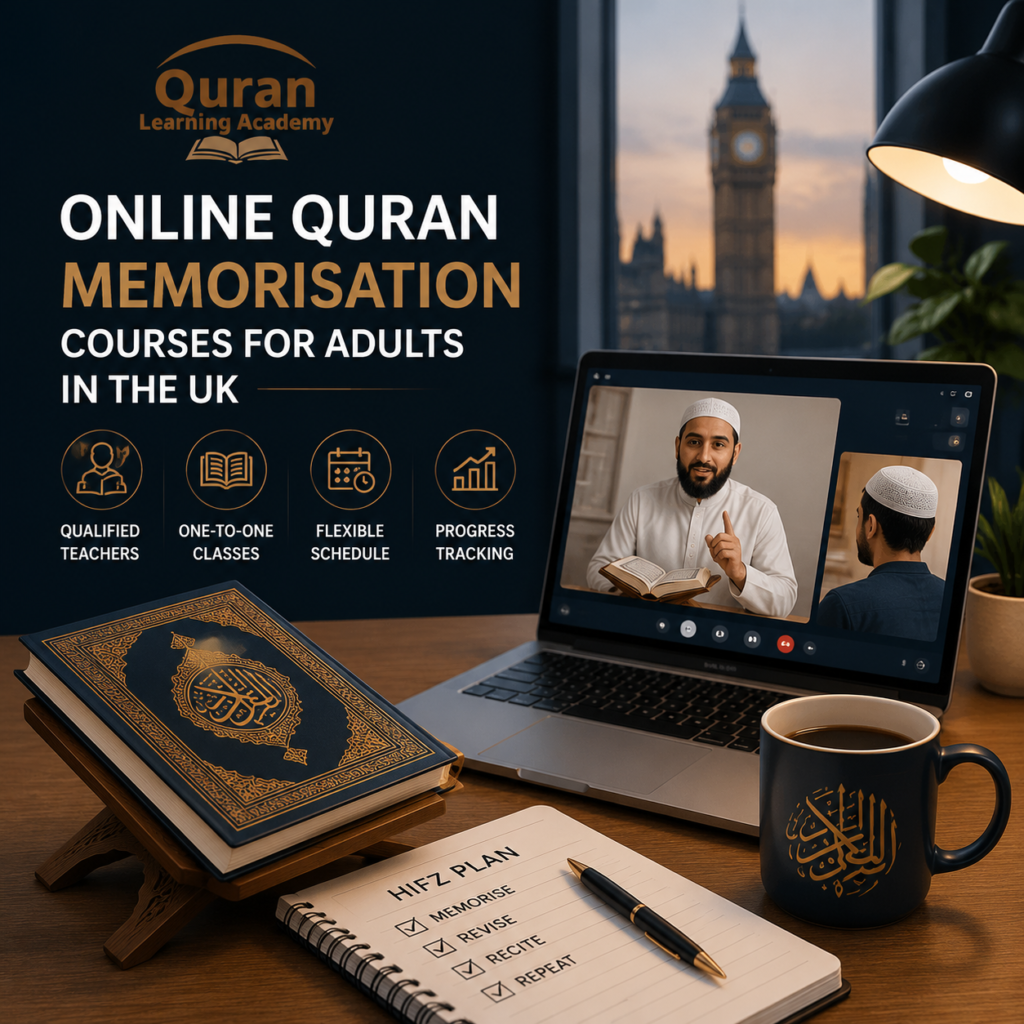
For families beginning the Hifz journey, the Quran Memorisation for Kids programme provides systematic Hifz training rooted in classical pedagogy, with spaced repetition, auditory reinforcement, and structured review cycles tailored to developing minds. For adult learners balancing memorisation with work and family, the Hifz Classes for Adults programme delivers flexible, personalised Hifz training that fits around a British professional’s schedule. For sisters seeking a private, female-only learning environment, the Quran Hifz for Ladies programme provides qualified female instructors, flexible timing, and full Tajweed correction built into every session.
Every programme includes one-to-one sessions, structured revision plans, real-time Tajweed correction, and scheduling that works around UK school and work commitments. The youngest Huffaz in history had structure, guidance, and daily accountability. Your family can have exactly the same, starting today.
Book a free trial session at UK Quran Learning Academy and begin the journey that has shaped the greatest scholars in Islamic history.
Discover Our Quran Courses
- Quran Online Academy
- Quran Recitation Classes
- Quran Reading Classes
- Online Quran Classes for Kids
- Quran Classes for Adults
- Quran Classes for Female / Sisters
- Learn Quran for Beginners
- Quran Memorization (Hifz) Course
- Hifz Classes for Adults
- Quran Memorization and Hifz for Kids
- Quran Hifz for Ladies
- Quran Ijazah Program
- Quran Qirat Learning Course
- Quran Tafsir Course
- Noorani Qaida Course
- Noorani Qaida Course for Kids
- Weekend Quran Classes
- Intensive Quran Course
- Al-Azhar Quran Course
- Online Tajweed Classes
- Tajweed Course for Kids
- Tajweed Course for Adults
- Tajweed Course for Ladies / Sisters
Start Your Quranic Journey in the UK
Join our academy for structured online lessons with expert tutors, tailored to fit your schedule.
Book Your Free TrialConclusion
Who is the youngest person to memorize the Quran is a question that points toward something larger than a name or a record. It points toward a method, a family commitment, and a belief that the Quran is meant to be carried in the hearts of the youngest members of the Ummah. Abdul Rahman Farih at three years old, Amr ibn Salamah leading prayer at six or seven, Imam al-Shafi’i completing memorisation at seven — these are not outliers. They are the product of environments deliberately built around Quranic immersion and qualified guidance. British Muslim families have access to those same conditions through structured online Hifz programmes that bring qualified teachers directly into the home. The youngest Huffaz in history did not wait for the perfect circumstances. They began with what was available and built from there.
Frequently Asked Questions
Who is the youngest person to memorize the Quran in the world?
Abdul Rahman Farih from Algeria is widely recognised as the youngest verified memoriser of the complete Quran in modern history, completing his Hifz at approximately three years old. In the early Islamic period, Amr ibn Salamah memorised enough Quran to lead adults in prayer at age six or seven, as recorded in Sahih al-Bukhari.
At what age should a child start memorizing the Quran?
Scholars and Hifz educators recommend beginning audio exposure to Quranic recitation before age four, with formal memorisation typically starting between five and seven. The listening that happens in the earliest years builds the auditory foundation that structured Hifz later fills.
How did Abdul Rahman Farih memorize the Quran so young?
His memorisation was built entirely on constant audio exposure to Quran recitation from birth, a home environment where recitation was a daily constant rather than a scheduled activity, and family encouragement that treated his progress as natural rather than as a performance. He did not attend a formal Hifz school.
Can children in the UK memorize the Quran at a young age?
Yes. The factors that produced the youngest Huffaz in history — daily listening, consistent structure, qualified teacher correction, and family support — are all available to British Muslim families through online Hifz programmes. Geography is not the limiting factor.
Why is early childhood the best time for Quran memorisation?
Between ages three and seven, the brain exhibits peak neuroplasticity, forming neural connections at a rate that never recurs. Auditory imitation ability is strongest in this window, repetition tolerance is higher than in adults, and the memory has not yet accumulated the competing information that makes adult memorisation slower.





Leave a Reply