 Quran
Quran

Every Muslim parent in Britain carries the same quiet hope: to raise a child who carries the words of Allah in their heart. You watch your four-year-old memorise a nursery rhyme in two days and wonder whether now is the right time. You hear a friend mention their child completed Juz Amma at seven and feel a mix of inspiration and uncertainty.
The question of what is the best age to memorize Quran is one that parents across London, Birmingham, Manchester, and beyond wrestle with constantly, often without a clear answer. There is a body of classical scholarship and practical teaching experience that gives British Muslim parents a very clear and actionable picture, and this guide provides exactly that.
What Is the Best Age to Memorize the Quran in the UK?
The best age to memorize the Quran in the UK is generally between 3 and 10 years old, with ages 3–5 being ideal for introducing short Surahs through gentle repetition and consistent Quran listening, and ages 5–10 being the strongest period for structured Hifz.
During the age between 5-10, children benefit from excellent memory retention, growing attention spans, and fewer academic pressures, making it easier to build a lifelong foundation for Quran memorization.
However, age is only one part of successful Hifz. A child should also show signs of readiness, such as the ability to focus for a few minutes, imitate sounds, and follow simple instructions.
For families in the UK, protecting a fixed daily memorization routine around school, maintaining regular revision, and learning with a qualified teacher are far more important than finding the “perfect” age.
Even children who start later—and adults—can successfully memorize the Quran with a structured, consistent approach.
Read also: Tips on How to Memorise the Quran?
Early Childhood Memory and Hifz Retention
A child’s brain in the first decade of life operates in a fundamentally different mode from an adult’s. Phonological memory, the brain’s ability to hold and repeat sounds, is at its most flexible during these years. Arabic contains articulation points that do not exist in English, and a child who begins hearing Quranic Arabic before age seven builds those pathways naturally.
Classical Islamic scholarship recognised this long before modern science gave it a name. The Arabic proverb that likens learning in childhood to engraving on stone, and learning in old age to writing on water, captures what Hifz teachers have observed across centuries of Quranic education.
Auditory Exposure as the First Foundation
The foundation of Hifz is laid before the child ever sits with a teacher. Families who play Quranic recitation consistently in the home create a child who already recognises Quranic sound patterns before formal sessions begin. When structured memorisation starts, the encoding work required per verse drops significantly because the sounds are already familiar.
Practical ways to build auditory exposure in a British household:
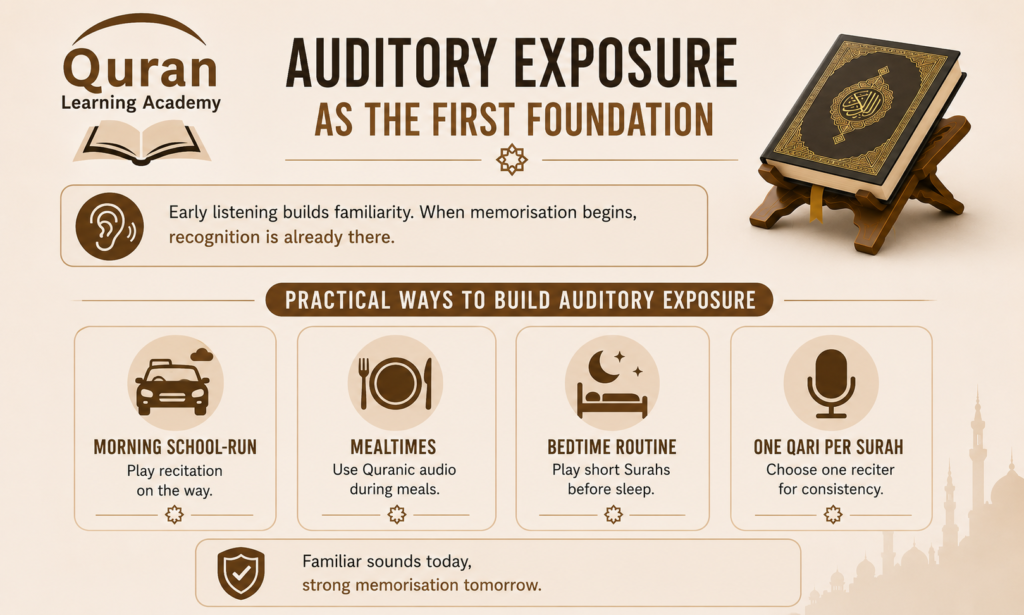
- Play recitation during the morning school-run
- Use Quranic audio as background during mealtimes
- Play short Surahs during the bedtime wind-down routine
- Choose one Qari consistently per Surah to build a stable sound template
Readiness Signs Before Starting Formal Hifz
A child showing the following signs is demonstrating genuine readiness for early memorisation:
- Can focus on a single activity for five to ten consecutive minutes
- Reproduces songs, rhymes, or phrases heard regularly without being prompted
- Shows curiosity about what is being recited during Salah
- Tries to mimic the sound of a reciter during family listening sessions
- Can follow simple multi-step instructions reliably
Most British Muslim children reach these milestones between three and five years old.
The Visual Memory Advantage of a Fixed Mushaf
Children who memorise from a single Mushaf throughout their entire Hifz journey build a visual memory of the page alongside the acoustic memory of the words. This dual-channel storage means that when the acoustic memory wavers, the visual memory of where the verse sits on the page provides a retrieval pathway.
Switching Mushafs mid-journey disrupts this visual map entirely. A child who has memorised thirty pages from one edition and switches to another will experience confusion at verse boundaries, page endings, and the positioning of long verses. Choosing one Mushaf before Day One and protecting that choice throughout is a structural decision that protects years of work.
Read also: Time Management for Hifz Students – 9 Steps
The Three to Five Age Window for Quran Memorisation
This is the age range that scholars and classical Hifz schools consistently identify as the optimal starting point. For children showing readiness, beginning between three and five delivers advantages that no later age group can fully replicate.
Three Distinct Advantages of This Age Group
- Absence of academic pressure. A child in nursery or Reception year has cognitive space for Quran learning that Year 3 students managing literacy, numeracy, and homework simply do not have.
- Absence of self-consciousness. Young children memorise without the fear of being wrong in front of peers that inhibits older learners significantly.
- Maximum time ahead. A child who begins Hifz at four has a realistic pathway to completing the full Quran before secondary school, a transformative achievement for the entire family.
Realistic Daily Targets for Young Beginners
A three-year-old will not sit for forty-five minutes of structured Hifz. What they can realistically achieve:
- Five to ten minutes of joyful repetition once or twice daily
- One short Surah introduced per week through song-like repetition
- Gradual familiarity with Juz Amma Surahs without it feeling like formal study
A five-year-old who has had consistent short sessions since age three will often know the entirety of Juz Amma before they would naturally encounter structured Hifz in a formal programme.
The Correct Surah Sequencing for Young Learners
Sequencing matters more than most parents realise. The recommended order for young beginners in the UK:
- Start with three-verse Surahs: Al-Asr, Al-Kawthar, Al-Ikhlas
- Move to Al-Falaq and An-Nas, then Al-Fil and Al-Quraysh
- Progress through Juz Amma from the shortest Surahs upward
- After completing Juz Amma, move to Surah Al-Mulk, then Surah Al-Kahf
These Surahs are used in daily Salah for life, meaning revision is built into worship automatically.
Before formal Hifz begins, many children need a structured foundation in Arabic letter recognition and pronunciation. If your child is at this stage, the Noorani Qaida Course for Kids in the UK at UK Quran Learning Academy builds the precise phonetic accuracy that memorisation depends on. Enrol your child today and lay the right foundation from the very start.
Give your child the perfect start in Quran learning.
Experience the Academy in Action
Curious about our teaching style? Take a quick look inside a live session to see our immersive, supportive learning environment first-hand.
Start Your Quranic Journey in the UK
Join our academy for structured online lessons with expert tutors, tailored to fit your schedule.
Book Your Free TrialThe Primary School Peak Memorisation Years
If the three to five window is the preparation phase, the primary school years are the peak Hifz years. Children between five and ten have cognitive architecture for memorisation at its most powerful, and British Muslim families who act on this window consistently produce the strongest long-term results.
The Cognitive Advantages of Ages Five to Ten
- Phonological memory is at peak capacity and highly responsive to repetition
- Attention spans are lengthening week by week throughout these years
- The ability to connect sequential information, verse to verse, page to page, is developing rapidly
- Children in this group are not yet carrying the academic load of secondary school
A Practical Hifz Structure for British Primary Schoolchildren
The model that works consistently in the UK context:
- Fix a daily session of twenty to thirty minutes after Fajr or directly after school
- Protect this time from homework, screen time, and extracurricular drift
- Use the school summer holiday for intensive new memorisation
- Use term time to consolidate and review what was memorised over summer
- Maintain a minimum of ten minutes of revision on the heaviest school days
Children in this age range can memorise between five and fifteen lines per day with a qualified teacher. A child memorising ten lines daily with consistent revision can complete the full Quran within three to four years.
Tajweed Accuracy Protects Every Page Memorised
A mistake that costs families significant time is allowing memorisation to proceed without concurrent Tajweed training.
- A child who memorises fifty pages with incorrect pronunciation has memorised fifty pages incorrectly
- Correcting embedded Tajweed errors is significantly harder than building correct pronunciation from the first verse
- The incorrect version competes with the correction at every review session because it was stored first in long-term memory
The Tajweed Course for Kids in the UK at UK Quran Learning Academy teaches children aged four to fourteen the precise rules of Quranic recitation, including Makharij al-Huroof and Sifaat, using short Surahs from Juz Amma as the practical vehicle. Running Tajweed learning alongside Hifz, rather than after it, protects the accuracy of every page memorised from day one. Book your child’s first session today.

Book your child’s first Tajweed lesson today.
Secondary School Hifz Challenges and Solutions
The transition into secondary school is the most common point at which Hifz stalls for British Muslim children. A child who was making steady progress through primary school suddenly faces nine or ten subjects, extracurricular commitments, social pressures, and the physical and emotional changes of adolescence.
Adapted Methods for Secondary School Students
The method must change at this stage. A secondary school student cannot follow the same daily schedule as an eight-year-old.
- Weekend mornings are the most productive Hifz window for this age group
- A forty-five minute session on Saturday morning and the same on Sunday sustains meaningful progress
- A daily ten-minute revision session during the commute or break time prevents loss of previously memorised material
- During exam periods, prioritise revision of existing memorisation over adding new pages
Comprehension as a Memorisation Tool for Teenagers
A fifteen-year-old who reads the translation of the verses they are memorising understands what they are saying. This creates a second layer of memory, semantic memory, that sits alongside acoustic and visual memory and provides an additional retrieval pathway. When acoustic memory falters during Salah, the meaning provides a prompt that pulls the verse back.
Taking fifteen minutes to read a brief Tafseer summary of the passage before memorising it can meaningfully reduce the number of repetitions required to lock the verse in place. For British Muslim teenagers who have grown up reading English as their primary language, this meaning-based approach is not a distraction from Hifz but an accelerator.
Balancing GCSEs and Hifz Progress
A practical framework for GCSE years:
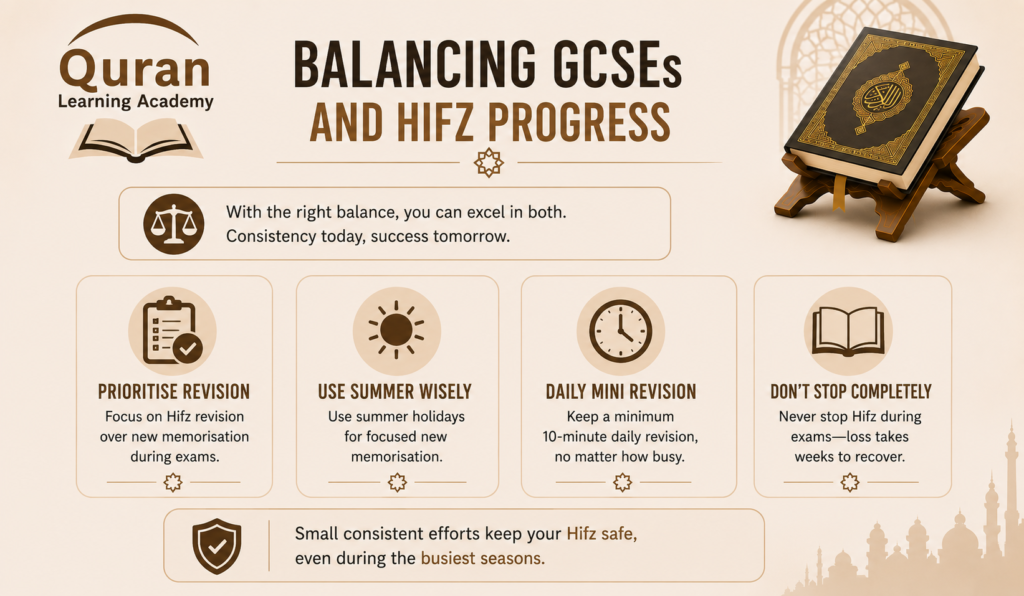
- Prioritise Hifz revision over new memorisation during the exam period
- Use summer holidays for concentrated new memorisation
- Maintain a minimum daily ten-minute revision session even during the heaviest revision periods
- Do not stop Hifz entirely during exams; stopping causes loss that takes weeks to recover
Adult Hifz at Any Stage of Life
The honest answer to whether adults can memorize the Quran is yes. The neurological advantages of childhood diminish but do not disappear. What takes a seven-year-old five repetitions may take a thirty-five-year-old twenty-five repetitions, but twenty-five repetitions are entirely achievable with a consistent daily system.
“إِنَّ الَّذِينَ يَتْلُونَ كِتَابَ اللَّهِ وَأَقَامُوا الصَّلَاةَ وَأَنفَقُوا مِمَّا رَزَقْنَاهُمْ سِرًّا وَعَلَانِيَةً يَرْجُونَ تِجَارَةً لَّن تَبُورَ”
Innal-ladhina yatluna kitabal-lahi wa aqamus-salata wa anfaqu mimma razaqnahum sirran wa ‘alaniyatan yarjuna tijaratan lan tabur.
“Indeed, those who recite the Book of Allah and establish prayer and spend from what We have provided them, secretly and publicly, expect a transaction that will never perish.”
The Primary Barrier for Adult Memorisers in the UK
The most common barrier for adult British Muslims attempting Hifz is not memory capacity. It is the absence of a structured system and qualified correction.
- Adults who attempt Hifz independently, without real-time correction, almost universally stall within the first few months
- Without a scheduled review system, material memorised in week one is gone by week three
- The absence of external accountability means Hifz sessions are the first thing dropped when life gets busy
A Realistic Daily Framework for UK Adults
Working life in Britain does not pause for Hifz. A practical framework for adults:
- Twenty-five focused minutes after Fajr, every single day, produces meaningful progress over months
- Ten minutes of revision during a lunch break or commute maintains previously memorised material
- One longer session on a weekend morning supplements the daily routine without disrupting it
- A qualified online teacher provides the correction and accountability that replaces the institutional structure adults lack
The Hifz Classes for Adults in the UK at UK Quran Learning Academy are designed precisely for this reality: working professionals, parents, and mature learners who need a structured programme that fits around British life. Sessions are one-to-one, flexible in scheduling, and taught by qualified instructors who provide the correction and accountability that makes the difference between sustained progress and repeated restarts. Start your free trial today.

Start your free trial and achieve your Hifz goals.
Common Mistakes That Delay Hifz at Every Age
Regardless of the age at which Hifz begins, certain mistakes appear repeatedly across UK families and consistently slow or derail progress.
| Mistake | Effect on Hifz |
| Starting without a Tajweed foundation | Incorrect pronunciation becomes embedded and very difficult to correct later |
| No fixed daily revision time | Recently memorised material fades within 48 to 72 hours without reinforcement |
| Switching the Mushaf mid-journey | Visual memory of the page layout is disrupted, weakening recall at verse boundaries |
| Memorising new pages without reviewing old ones | Forward progress obscures how much has already been lost |
| No qualified teacher for correction | Errors compound silently until they are deeply embedded in long-term memory |
| Treating Hifz as optional when life gets busy | Even two or three missed days can undo a full week of memorisation work |
The Prophet ﷺ emphasised the fragility of memorisation without consistent maintenance:
“«تَعَاهَدُوا هَذَا الْقُرْآنَ، فَوَالَّذِي نَفْسُ مُحَمَّدٍ بِيَدِهِ لَهُوَ أَشَدُّ تَفَصِّيًا مِنَ الإِبِلِ فِي عُقُلِهَا»”
“Keep on reciting the Quran, for by Him in Whose Hand Muhammad’s soul is, it escapes from memory faster than a camel does from its tying ropes.”
Age-by-Age Hifz Reference for British Muslim Families
| Age Group | Daily Session | Realistic Daily Target | Primary Method | Key Risk |
| 2 to 3 years | Passive listening only | No formal target | Play recitation daily in the home | Rushing into formal memorisation too early |
| 3 to 5 years | 5 to 10 minutes | 2 to 5 lines | Joyful repetition and positive reinforcement | Pressure and drilling causing resistance |
| 5 to 10 years | 20 to 35 minutes | 5 to 15 lines | Line-by-line with sequential layering and daily review | Skipping revision to prioritise new pages |
| 10 to 15 years | 30 to 45 minutes | 5 to 10 lines | Meaning-based memorisation with structured review | School pressure causing Hifz to stop entirely |
| Adults | 20 to 30 minutes | 3 to 7 lines | High repetition with comprehension and teacher correction | Absence of accountability leading to inconsistency |
Step Inside Our Virtual Classrooms
See how our interactive lessons work. Watch these brief highlights of our students engaging with instructors.
Start Your Quranic Journey in the UK
Join our academy for structured online lessons with expert tutors, tailored to fit your schedule.
Book Your Free TrialStart Your Hifz Journey with UK Quran Learning Academy
Many British Muslim families carry the intention to begin Hifz for years without acting on it. Not because of a lack of love for the Quran, but because they are not sure where to start, whether their child is ready, or how to find a programme that fits around school and family life. The result is that children arrive at secondary school age without the foundation that the primary years could have built.
UK Quran Learning Academy provides structured, teacher-led programmes specifically designed for British Muslim families, delivered entirely online with qualified instructors who understand the challenges of Quranic education in a UK context.
Every programme includes one-to-one sessions, real-time Tajweed correction, and scheduling flexible enough to work around the British school timetable and family commitments.

Book your free trial session at UK Quran Learning Academy and begin the journey today.
Discover Our Quran Courses
- Quran Online Academy
- Quran Recitation Classes
- Quran Reading Classes
- Online Quran Classes for Kids
- Quran Classes for Adults
- Quran Classes for Female / Sisters
- Learn Quran for Beginners
- Quran Memorization (Hifz) Course
- Hifz Classes for Adults
- Quran Memorization and Hifz for Kids
- Quran Hifz for Ladies
- Quran Ijazah Program
- Quran Qirat Learning Course
- Quran Tafsir Course
- Noorani Qaida Course
Start Your Quranic Journey in the UK
Join our academy for structured online lessons with expert tutors, tailored to fit your schedule.
Book Your Free TrialConclusion
The question of what is the best age to memorize Quran does not have a single answer, but it has a clear principle: earlier is better, readiness matters, and structure is everything. Children between three and ten have the strongest natural advantages for Hifz, but those advantages mean nothing without consistent daily practice, qualified teacher correction, and a home environment that treats the Quran as a living priority. Secondary school students and adults can absolutely memorise the Quran, but they need a method adapted to their stage of life rather than one copied from a younger child’s routine. For British Muslim families, the most important decision is not settling on the exact right age. It is removing the barriers that keep the intention from becoming action.
Frequently Asked Questions
Is three years old too young for Quran memorisation?
Three is not too young to begin auditory exposure and short repetition sessions of five to ten minutes. At this age, the goal is building familiarity with Quranic sounds and short Surahs through joyful repetition, not formal drilling. Many children who begin this way have a significant foundation before they ever sit with a formal teacher.
What is the best age to memorize Quran for a British child?
The developmental answer applies equally to British children: three to five for initial exposure and short Surah memorisation, five to ten for structured Hifz with a qualified teacher. The UK-specific consideration is planning around school terms, using summer holidays for intensive memorisation, and protecting a fixed daily window that school homework cannot override.
Can a child memorize the full Quran alongside British state school?
Yes, and many British Muslim children achieve this. The key is a fixed daily session outside school hours, typically after Fajr or after school, with a qualified online teacher providing structure and correction. A realistic pace of five to ten lines per day, maintained consistently, produces full Quran memorisation within three to five years alongside full-time schooling.
Is it too late to start Hifz at age ten or older?
The ten to fifteen age range brings comprehension and discipline that younger children lack. The method needs to adapt, incorporating meaning-based learning and flexible scheduling around school demands, but the capacity for memorisation remains strong through the teenage years. Starting at ten is not starting late; it is starting at a different stage with different tools.
Does a child need to read Arabic before starting Hifz?
A child can begin auditory memorisation of short Surahs before they can read Arabic script. For structured Hifz beyond the shortest Surahs, however, the ability to read from the Mushaf is important for building visual page memory and accurate review. A Noorani Qaida foundation before or alongside early Hifz is strongly recommended for all British Muslim children.








Leave a Reply