 Quran
Quran

Many British Muslims start Hifz with sincere intentions, but busy careers, family routines, and long commutes quickly disrupt their progress. Within weeks, the lack of consistency leaves them uncertain about their retention. This is not a failure of memory or faith, but a simple absence of an effective, structured time management system.
Across cities like London, Birmingham, Manchester, and Leeds, balancing life and Quran memorization demands a proven system—not just a wish. Drawing on generations of successful methods, this guide builds that time management system from the ground up, helping you shift from repeated restarts to lasting completion.
1. A Sincere Intention Is The Key Tawfeeq Factor For Hifz Time Management
Before any schedule or technique matters, the Hifz student must be clear on why they are doing this. Scholars consistently identify sincere intention as the foundation of all sustained memorisation effort, because it determines what happens when motivation dips or when a difficult week arrives.
“إِنَّمَا الْأَعْمَالُ بِالنِّيَّاتِ وَإِنَّمَا لِكُلِّ امْرِئٍ مَّا نَوَى”
“The reward of deeds depends upon the intentions, and every person will get the reward according to what he has intended.”
Writing down your Hifz goal before Day One — whether that is Juz Amma, a single Juz per month, or a full Khatm over three years — and returning to it when consistency breaks has a measurable effect on how long students persist. For UK learners who often lack external accountability, a written intention acts as an internal anchor when everything else feels unstable.
Read also: The Best Online Quran Memorisation Courses for Adults in the UK
2. Use The Five Prayer Times As Your Built-In Hifz Schedule
This is the operational engine of every successful Hifz plan. Prayer times are not just spiritual anchors — they are natural memorisation intervals spaced across the entire day, giving your brain recovery time between sessions while keeping the Quran in constant contact with your memory. Every UK Hifz student already has five scheduled breaks in their day. The question is whether those breaks are being used deliberately.
After Fajr: The Primary Memorisation Window
This is your most valuable daily block. The mind is at its sharpest after Fajr, the environment is quiet across every British household, and there are no demands from the day yet. Dedicate 45 to 60 minutes here to new memorisation only.
Read the target pages slowly from the Mushaf three times with full attention. Then begin memorising line by line: read a line, close the Mushaf, repeat it from memory, open and check. Once a full page is memorised, connect it to the previous page and recite both together.
After Dhuhr and Asr: Review and Reinforcement
These two sessions carry your near-past and mid-past review. After Dhuhr, spend 20 minutes on material memorised at Fajr. After Asr — which scholars have also identified as a secondary peak for mental clarity — spend 20 minutes reviewing material from earlier in the week. Reciting aloud during these sessions is essential, particularly by the time Asr arrives and mental fatigue begins to build. Vocal recitation surfaces pronunciation errors and activates a different type of memory encoding than silent reading.
After Maghrib and Isha: Consolidation and Listening
After Maghrib, spend the first ten minutes reciting everything memorised since Fajr from memory. Then add any remaining pages for the day. After Isha, close the day with a complete recitation of the entire day’s portion from memory — all pages, start to finish. If you stumble on any section, return to the Mushaf, fix it, and recite that section again three times before continuing.
| Prayer | Primary Activity | Recommended Duration |
| After Fajr | New memorisation | 45 to 60 minutes |
| After Dhuhr | Review of morning material | 20 minutes |
| After Asr | Mid-past review, recite aloud | 20 minutes |
| After Maghrib | Full-day recitation from memory | 15 minutes |
| After Isha | Complete daily portion from memory | 20 minutes |
Read also: Top Short Surahs to Memorize
3. Setting a Realistic Daily Target and Never Exceeding It
One of the most damaging mistakes in time management for Hifz students is equating speed with volume. Memorising more than your retention capacity can handle in a single session produces results that evaporate within 48 hours. A consistent half-page daily beats an inconsistent two pages every time.
Targets Based on Your Current Level
Experienced teachers recommend these starting amounts based on experience:

- Complete beginners with no prior Hifz experience: 5 to 10 lines daily
- Intermediate students who read Arabic fluently: half a page to one full page daily
- Advanced students with strong Tajweed and prior Hifz experience: one to two pages daily, with full review maintained alongside
The discipline here is restraint, not ambition. A student who memorises half a page every day for three years will outperform a student who memorises two pages some days and zero pages other days by a wide margin.
Choosing a Realistic Hifz Timeline
Different life circumstances call for different timelines. None of them is inferior — consistency is what determines success, not pace.
| Daily Amount | Estimated Completion Time |
| 5 to 10 lines per day | Approximately 4 to 6 years |
| Half a page per day | Approximately 3 to 4 years |
| One full page per day | Approximately 1.5 to 2 years |
| One Juz per day | 30 days (requires full-time dedication) |
For working professionals and parents across Britain who need a structured plan personalised to their actual schedule, the Hifz Classes for Adults in the UK at UK Quran Learning Academy provide exactly this — a realistic daily target, built-in revision cycles, and a qualified teacher tracking your progress every session.

Enrol in Hifz Classes for Adults in the UK
4. Line-by-Line Method That Makes Memorisation Stick
The memorisation technique used inside each session determines whether what you learn stays or disappears overnight. The most reliable method works across five connected phases.
Phase One Through Three — From Reading to Retention
Phase 1 — Reading: Read the full target page from the Mushaf once slowly, paying attention to meaning, pauses, and the visual layout of each line. Understanding what you are reading, even at a basic level, creates multiple memory pathways simultaneously — acoustic, visual, and semantic — which means more routes back to the material when recall is tested.
Phase 2 — Segmenting: Divide the page into three or four small segments of three to four lines each. Take the first segment and read it five times with the Mushaf open.
Phase 3 — Closing: Close the Mushaf and repeat those lines from memory until you can recite the segment three times consecutively without error.
Phase Four and Five — Connection Is Everything
Phase 4 — Connecting: Once each segment is memorised, link it to the one before it. Recite Segment 1 plus Segment 2 together, then 1 plus 2 plus 3, and so on until the full page flows as one connected unit.
Phase 5 — Page-to-Page Connection: After memorising a full page, recite it together with the previous page from today’s session. By the end of each session, all pages memorised that day should flow as one continuous block.
Most memorisation failures happen not because individual verses are forgotten but because the link between them is weak. Students who memorise verses as separate units rather than as connected passages consistently struggle to recall the opening word of a verse when reciting under pressure — during Salah, for example, when the mind is focused on the act of worship rather than mechanical recitation.
Experience the Academy in Action
Curious about our teaching style? Take a quick look inside a live session to see our immersive, supportive learning environment first-hand.
Start Your Quranic Journey in the UK
Join our academy for structured online lessons with expert tutors, tailored to fit your schedule.
Book Your Free Trial5. Building a Daily Review System That Protects Your Progress
New memorisation disappears without near-term review. What you memorised yesterday needs reinforcement today, and what you memorised last week needs reinforcement this week. This is where most Hifz attempts collapse. Students focus entirely on new material and treat review as optional.
Recall strength decays rapidly in the first 24 to 48 hours after initial memorisation, then stabilises if the memory is revisited. Skipping review for even two or three consecutive days can undo an entire week of memorisation work.
The Three-Layer Review Structure
| Review Layer | Definition | Frequency |
| Near-Past Review | Last 5 pages memorised | Daily, non-negotiable |
| Mid-Past Review | Pages 6 to 20 behind current position | Daily, increasing gradually |
| Far-Past Review | Everything memorised before that | Weekly rotation |
On days when time is short — and for UK students, those days come often — experienced teachers advise reviewing existing material rather than adding new verses. Protecting what you already hold is more important than expanding it.
Dedicating One Full Day Per Week to Revision Only
Every seventh day should be a full revision day with zero new material. On this day, recite every page memorised across the previous six days — ideally to a teacher or recitation partner who can correct errors in real time. Many errors are invisible to the student until someone else hears them.
Allah says:
“إِنَّا نَحْنُ نَزَّلْنَا الذِّكْرَ وَإِنَّا لَهُ لَحَافِظُونَ”
Innā nahnu nazzalnā al-dhikra wa innā lahu lahāfiẓūn. “Indeed, it is We who sent down the Reminder, and indeed, We will be its guardian.”
You memorise it; Allah preserves it through those who carry it in their hearts. Your revision day is part of that act of preservation.
For sisters across the UK managing Hifz alongside family responsibilities, the Quran Hifz for Ladies in the UK programme at UK Quran Learning Academy offers structured revision tracking, qualified female teachers, and flexible online sessions built around real British schedules.

Join the Quran Hifz for Ladies Programme
6. Listening to Proficient Reciters Actively Strengthens Retention
Immersing your ears in high-quality recitation trains your tongue to reproduce what your memory cannot yet recall on its own. This is not passive background noise — it is an active memory tool. Playing a recitation of the verses you are currently memorising while commuting on the bus, cooking at home, or walking through your neighbourhood reinforces the same neural patterns being built during your active memorisation sessions.
Scholars recommend reciters known for precise Tajweed — such as al-Husary and al-Minshawi — specifically because precision matters here. If you internalise a slightly incorrect pronunciation or rhythm through repeated listening, it becomes embedded in your memory and harder to correct later.
Practical listening habits for UK Hifz students:
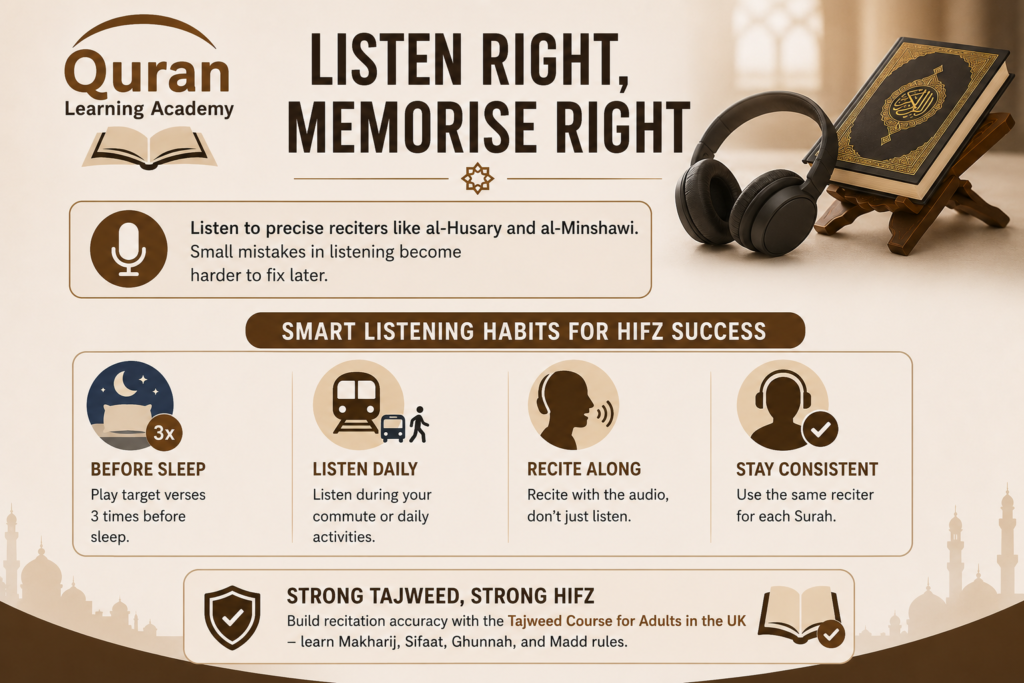
- Play the day’s target verses three times while preparing for sleep the night before memorisation
- Listen to recently memorised material during your daily commute — whether that is the Tube, the bus, or a walk through your neighbourhood
- Recite along with the audio rather than passively listening, turning listening into active rehearsal
- Use the same reciter consistently for a given Surah to build a stable auditory template
Students whose Tajweed accuracy needs strengthening alongside Hifz will find the Tajweed Course for Adults in the UK at UK Quran Learning Academy provides structured instruction in Makharij, Sifaat, Ghunnah rules, and Madd elongation principles — building the recitation accuracy that makes Hifz correct from the very first verse.
Enrol in the Tajweed Course for Adults in the UK
7. Using Voluntary Salah as a Deliberate Hifz Review Tool
Salah is the built-in review system for every Muslim — using it deliberately for time management for Hifz students turns five daily prayers into five reinforcement sessions without requiring any additional dedicated time. Reciting memorised verses in prayer forces recall under mild performance pressure, which strengthens the memory trace more effectively than passive review.
Rotate different recently memorised Surahs across the five prayers. Recite new material in Fajr when memory is freshest, and use Maghrib and Isha for material memorised earlier in the week. This distribution gives each segment of recently memorised Quran multiple retrieval opportunities per day. It also builds the habit of using Hifz functionally — in worship, not just in examination — which is the actual purpose of carrying the Quran in your heart.
8. Sins and Heedlessness Weaken the Capacity for Memorisation
Classical scholarship is consistent on a point that most modern memorisation guides overlook: the state of the heart directly affects the capacity for memorisation. Scholars across generations have noted that consistent sins harden the heart and weaken the faculty of memory. Imam al-Shafi’i famously spoke of this in relation to his own experience of memorisation.
Sincere repentance, maintained prayer, and keeping good company are not tangential to time management for Hifz students — they are part of the method. Students who neglect this dimension often find themselves unable to explain why their memorisation is inconsistent despite following a structured schedule. The answer, according to classical teachers, lies in the condition of the heart.
This does not mean perfection is required before beginning. It means that Hifz and spiritual discipline are not separate tracks — they move together, and neglecting one weakens the other.
Avoiding the Six Mistakes That Destroy Hifz Schedules
Most Hifz students who struggle with consistency are not lacking in motivation. They are making identifiable, preventable structural errors in how they manage their time.
| Mistake | Why It Destroys Progress |
| Skipping revision days | New memorisation overwrites old material without periodic consolidation |
| Changing the Mushaf mid-journey | Visual memory tied to page layout is disrupted entirely |
| Memorising at variable times each day | No habitual cue means no automatic recall trigger |
| Reciting silently without vocalisation | Errors go undetected and pronunciation habits are never built |
| Overloading pages in early days to compensate | Mental exhaustion causes sharp retention drops within two weeks |
| Continuing without a qualified teacher | Mistakes compound silently until they are fully embedded |
The Mushaf point deserves particular emphasis for UK students who use a combination of apps, printed copies, and different digital editions. Pick one physical Mushaf, use it exclusively for memorisation sessions, and never switch mid-programme regardless of convenience.
9. Working with a Qualified Teacher Makes Hifz Accurate
Memorising the Quran without a teacher means almost certainly embedding pronunciation errors, Tajweed mistakes, and incorrect verse boundaries that become extremely difficult to correct later. The oral transmission of the Quran is not incidental — it is the defining feature of how the Quran has been preserved across fourteen centuries.
A qualified teacher catches Makhraj errors, Tajweed violations that change the meaning of verses, incorrect verse boundaries, and memorisation gaps where a student unconsciously fills in a forgotten word with one that sounds similar but is wrong. None of these can be reliably caught by the student alone. Audio recordings cannot respond to what a specific student is actually saying.
For younger learners beginning their Hifz journey, the Quran Memorisation for Kids in the UK programme at UK Quran Learning Academy teaches children aged 5 to 15 systematic memorisation techniques rooted in classical Hifz pedagogy — using spaced repetition, auditory reinforcement, and structured review cycles designed for developing minds.

Enrol in Quran Memorisation for Kids in the UK
Step Inside Our Virtual Classrooms
See how our interactive lessons work. Watch these brief highlights of our students engaging with instructors.
Start Your Quranic Journey in the UK
Join our academy for structured online lessons with expert tutors, tailored to fit your schedule.
Book Your Free TrialBegin Your Structured Hifz Journey with UK Quran Learning Academy
Most students who struggle with time management for Hifz students are not lacking motivation — they are lacking structure, accountability, and qualified guidance built into a consistent daily routine. UK Quran Learning Academy offers a complete range of Hifz and Quran programmes delivered fully online, accessible from anywhere across Britain, with flexible scheduling that fits around work, school, and family commitments.
Every programme includes:
- One-to-one sessions with a qualified, experienced teacher
- Structured daily and weekly revision plans built into the curriculum
- Real-time Tajweed correction so memorisation is accurate from Day One
- Flexible online scheduling suited to British learners across all time zones and work patterns
Whether you are a working professional in London, a student in Manchester, a mother in Birmingham, or a teenager balancing school with Hifz anywhere across the UK — there is a programme built for your specific circumstances. The fastest and most reliable way to memorise the Quran is not a shortcut. It is a system. And the right system starts with the right teacher.

Book Your Free Trial at UK Quran Learning Academy Today
Discover Our Quran Courses
- Quran Online Academy
- Quran Recitation Classes
- Quran Reading Classes
- Online Quran Classes for Kids
- Quran Classes for Adults
- Quran Classes for Female / Sisters
- Learn Quran for Beginners
- Quran Memorization (Hifz) Course
- Hifz Classes for Adults
- Quran Memorization and Hifz for Kids
- Quran Hifz for Ladies
- Quran Ijazah Program
- Quran Qirat Learning Course
- Quran Tafsir Course
- Noorani Qaida Course
- Noorani Qaida Course for Kids
- Weekend Quran Classes
- Intensive Quran Course
- Al-Azhar Quran Course
Start Your Quranic Journey in the UK
Join our academy for structured online lessons with expert tutors, tailored to fit your schedule.
Book Your Free TrialConclusion
Effective time management for Hifz students is not about finding more hours in the day — it is about using the hours already given to you, structured around the five daily prayers, protected by daily review, and guided by a qualified teacher. The methods in this guide address every major failure point: inconsistent timing, skipped revision, wrong targets, missing teacher correction, and the spiritual dimension that classical scholars have always placed at the centre of Hifz.
At UK Quran Learning Academy, every one of these components is built into the curriculum and delivered through live, personalised online instruction accessible to every Muslim across Britain.
Frequently Asked Questions
What is the best time of day for Hifz memorisation in the UK?
After Fajr is the single most effective window for new memorisation. The mind is rested, the environment is quiet, and declarative memory is most accessible immediately after sleep. The period after Asr is the second-best option, particularly for review of material already memorised earlier in the day.
What is a realistic daily Hifz target for busy British adults?
Beginners should start with 5 to 10 lines per day. Intermediate students who read Arabic fluently can aim for half a page to one full page. Advanced students with prior Hifz experience can work with one to two pages daily, provided full review is maintained alongside new memorisation.
Why does review matter more than new memorisation?
Recall strength decays sharply in the first 24 to 48 hours after initial memorisation. Without daily review, newly memorised material does not transfer to long-term storage and is lost within days. Experienced teachers consistently advise protecting existing memorisation over expanding it when time is short.
What should you do after completing a full Quran memorisation?
Transition immediately into a structured monthly revision cycle. A practical approach is to recite 5 Juz per day across six days each week, ensuring the full Quran is covered once weekly. Without a consistent post-completion revision plan, significant portions of memorised material are typically lost within the first three months.
What is the role of sins in weakening Hifz memory?
Classical scholarship is consistent on this point. Consistent sins harden the heart and weaken the faculty of memorisation. Sincere repentance, maintained worship, and good company are considered by classical teachers to be integral to the memorisation process itself, not separate from it.








Leave a Reply