Many Muslims in the UK grew up memorising Surah Al-Ikhlas in Saturday school and never went further. Work schedules, university pressure, and busy family life made returning to the Mushaf feel impossible. The result is a generation of practising Muslims who repeat the same two or three surahs in every prayer, unsure where to begin with anything longer. You do not need months of preparation to begin memorising Quran. The short surahs to memorize listed in this guide start at three verses and progress gradually, giving every learner — from total beginners to adults returning after years — a clear, manageable entry point.
This guide solves that problem directly. It covers the most important short surahs to memorize, ranked by length, with practical memorisation guidance, Tajweed notes, and a structured path forward for British learners at every level.
The Memorisation Method That Works Before Any Surah
Before covering individual surahs, one principle separates learners who retain from those who forget within a week: preparation precedes repetition.
Listening Before Repeating Is Non-Negotiable
Play a recording of the target surah from a qualified reciter ten times before attempting to memorise a single word. Your ear builds an auditory template that makes every subsequent repetition more accurate and faster to lock in.
Segment, Close, Recall Is the Core Technique
Read the first two lines from the Mushaf five times. Close it. Repeat those lines from memory until you can do so three times without error. Only then add the next segment.
Connecting Each Segment Prevents Recall Gaps
Once Segment 1 is memorised, recite Segment 1 and Segment 2 together before moving to Segment 3. This connection step is what most learners skip — and it is exactly where recall breaks down during Salah.
Reviewing Inside Salah Immediately Locks Retention
The same evening you memorise a new surah, recite it in Isha prayer. The next morning, recite it again in Fajr. Real-time retrieval under mild pressure strengthens the memory trace significantly more than passive review.
British learners who struggle with pronunciation before beginning memorisation benefit most from structured recitation training. The Online Tajweed Classes in the UK at UK Quran Learning Academy cover Makharij, Sifaat, and practical articulation rules through live sessions designed for adults balancing work and family commitments across London, Birmingham, and Manchester.
These surahs are the entry point for every new memoriser. Each is under fifteen words in Arabic and can be memorised in a single sitting.
Surah Al-Kawthar Is the Shortest Short Surah to Memorize
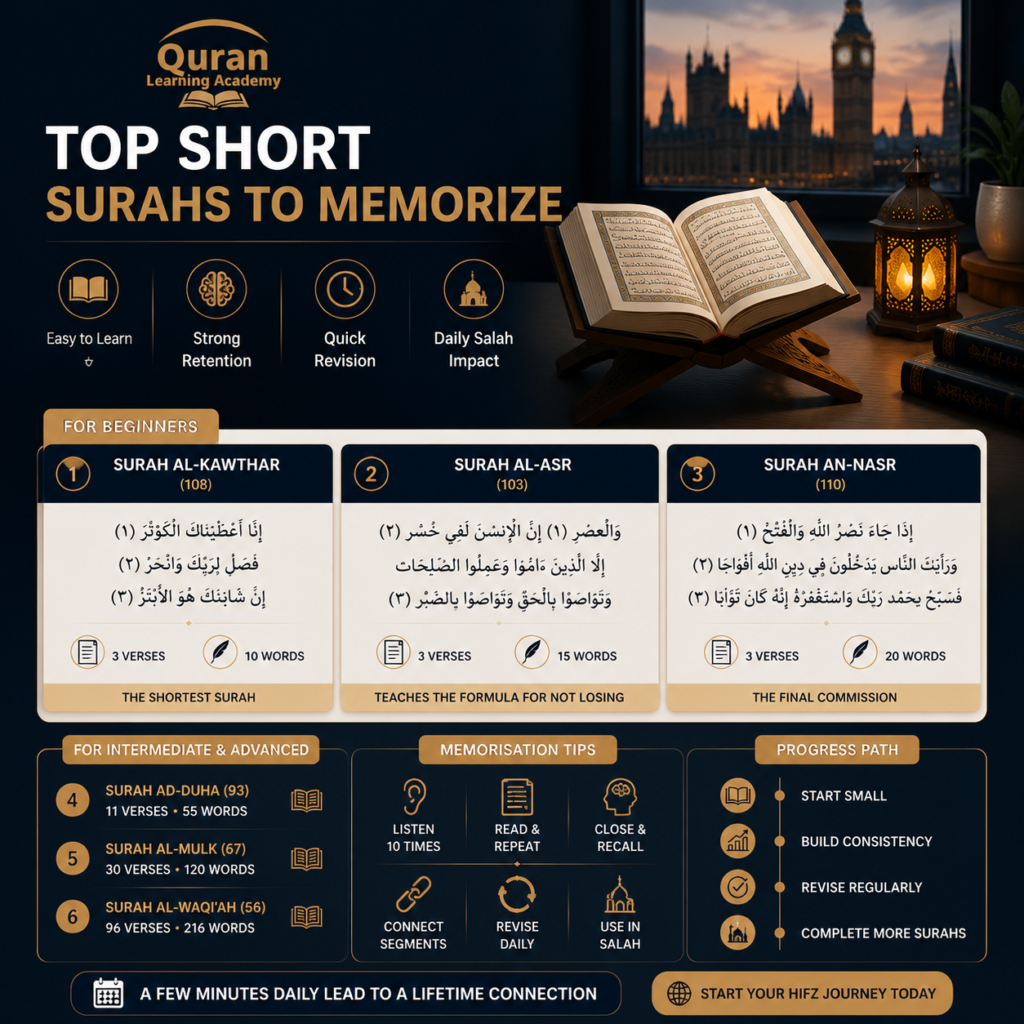
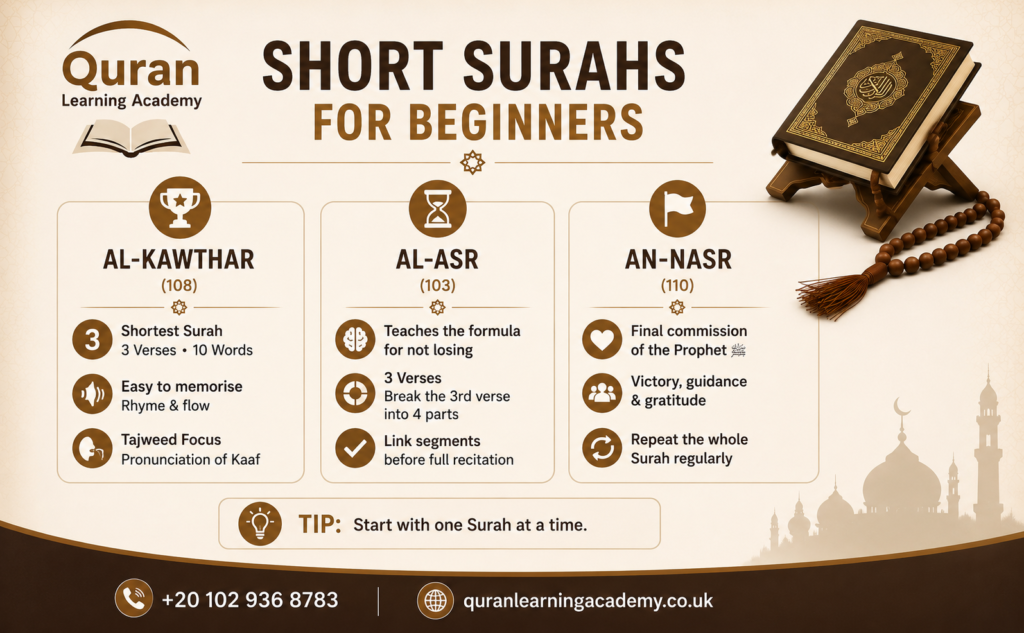
Surah Al-Kawthar (Chapter 108) contains three verses and ten words in total. Its rhyme scheme in Arabic makes it one of the most naturally retained surahs in the entire Quran.
Indeed, We have granted you, [O Muhammad], al-Kawthar. (1) So pray to your Lord and sacrifice [to Him alone]. (2) Indeed, your enemy is the one cut off. (3)
The letter Kaaf in “al-Kawthar” is pronounced from the back of the mouth with the tongue base touching the soft palate. This back-of-throat sound does not exist in English and requires deliberate practice before memorisation begins.
All three verses should be memorised as one unit. The surah is short enough that segmenting creates unnecessary breaks. Repeat the entire surah thirty times across two sessions, then recite it in Isha without looking.
Surah Al-Asr (Chapter 103) contains three verses, with the third being the longest single verse among the beginner-level short surahs to memorize. Imam Al-Shafi’i stated that reflecting on this surah alone would suffice as guidance for mankind.
Wal-‘aṣr. (1) Innal-insāna lafī khusr. (2) Illal-ladhīna āmanū wa ‘amiluṣ-ṣāliḥāti wa tawāṣaw bil-ḥaqqi wa tawāṣaw biṣ-ṣabr. (3)
By time, (1) Indeed, mankind is in loss, (2) Except for those who have believed and done righteous deeds and advised each other to truth and advised each other to patience. (3)
When the victory of Allah has come and the conquest, (1) And you see the people entering into the religion of Allah in multitudes, (2) Then exalt [Him] with praise of your Lord and ask forgiveness of Him. Indeed, He is ever Accepting of repentance. (3)
These surahs are among the 20 short surahs of Quran most used in daily British mosque prayers and form the core of any complete Juz Amma memorisation plan.
Surah Al-Ikhlas Contains One Third of the Quran in Reward
Surah Al-Ikhlas (Chapter 112) is four verses describing the absolute oneness of Allah.
The Saad in “Aṣ-Ṣamad” is a heavy, emphatic letter produced from the tongue edge against the upper teeth ridge. Many British learners soften this sound incorrectly, which changes the quality of the recitation.
Many adults across the UK who memorise Al-Ikhlas correctly still recite it with Tajweed errors that have been embedded since childhood. The Tajweed Course for Adults in the UK at UK Quran Learning Academy addresses exactly this — correcting long-standing pronunciation habits through structured modules covering Makharij, Sifaat, and Ghunnah rules.
Surah Al-Falaq Seeks Refuge in the Lord of Daybreak
Surah Al-Falaq (Chapter 113) is five verses and the first of the two Mu’awwidhatain — the pair of surahs specifically revealed for protection. The opening phrase “Qul a’udhu bi-rabb” creates an immediate recognition anchor that links it naturally to Surah An-Nas.
Qul a’ūdhu bi-rabbil-falaq. (1) Min sharri mā khalaq. (2) Wa min sharri ghāsiqin idhā waqab. (3) Wa min sharrin-naffāthāti fil-‘uqad. (4) Wa min sharri ḥāsidin idhā ḥasad. (5)
Say, “I seek refuge in the Lord of daybreak (1) From the evil of that which He created (2) And from the evil of darkness when it settles (3) And from the evil of the blowers in knots (4) And from the evil of an envier when he envies.” (5) Al-Falaq: 1–5
Verses 2 through 5 all begin with “min sharri” (from the evil of). Use this repetitive structure as a memory anchor. Memorise verses 1 and 2 together, then add verse 3, then 4, then 5, reciting from the beginning each time a new verse is added.
Step Inside Our Virtual Classrooms
See how our interactive lessons work. Watch these brief highlights of our students engaging with instructors.
Start Your Quranic Journey in the UK
Join our academy for structured online lessons with expert tutors, tailored to fit your schedule.
Surah Al-Fil Carries a Narrative That Aids Memorisation
Surah Al-Fil (Chapter 105) is five verses recounting how Allah destroyed the army of Abraha that marched on the Kaaba. Narrative structure dramatically improves retention because the brain is wired to remember sequential events.
Alam tara kayfa fa’ala rabbuka bi-aṣḥābil-fīl. (1) Alam yaj’al kaydahum fī taḍlīl. (2) Wa arsala ‘alayhim ṭayran abābīl. (3) Tarmīhim biḥijāratin min sijjīl. (4) Faja’alahum ka’aṣfin ma’kūl. (5)
Have you not considered, [O Muhammad], how your Lord dealt with the companions of the elephant? (1) Did He not make their plan into misguidance? (2) And He sent against them birds in flocks, (3) Striking them with stones of hard clay, (4) And He made them like eaten straw. (5) Al-Fil: 1–5
Memorisation method: Visualise each verse as a scene in the story — the army approaching, their plan failing, the birds appearing, the stones falling, and the army reduced to ruins. These visual anchors make recall faster and more reliable than pure repetition alone.
Short Surahs to Memorize at Six Verses
These surahs are among the 33 small surah for prayer most recited in British mosques and Islamic schools. They introduce slightly longer verse structures while maintaining strong rhythmic patterns.
Surah An-Nas Completes the Protective Pair
Surah An-Nas (Chapter 114) is six verses and the second of the Mu’awwidhatain. Its triple repetition of “an-nās” (mankind) across the first three verses creates a rhythmic structure that significantly reduces the repetitions needed for memorisation.
Say, “I seek refuge in the Lord of mankind, (1) The Sovereign of mankind. (2) The God of mankind, (3) From the evil of the retreating whisperer – (4) Who whispers [evil] into the breasts of mankind – (5) From among the jinn and mankind.” (6)
Memorisation method: Memorise verses 1 to 3 as a single unit — the triple structure of Lord, Sovereign, God flows naturally. Then memorise verses 4 to 6 as a second unit before combining both halves into the full surah.
Surah Al-Kafirun Establishes the Boundary of Tawhid
Surah Al-Kafirun (Chapter 109) is six verses built on deliberate alternation — a clear declaration that separates the believer’s worship from all others. The Prophet ﷺ recited it regularly in the two sunnah rak’ahs before Fajr.
Qul yā ayyuhal-kāfirūn. (1) Lā a’budu mā ta’budūn. (2) Wa lā antum ‘ābidūna mā a’bud. (3) Wa lā ana ‘ābidum mā ‘abadtum. (4) Wa lā antum ‘ābidūna mā a’bud. (5) Lakum dīnukum wa liya dīn. (6)
Say, “O disbelievers, (1) I do not worship what you worship. (2) Nor are you worshippers of what I worship. (3) Nor will I be a worshipper of what you worship. (4) Nor will you be worshippers of what I worship. (5) For you is your religion, and for me is my religion.” (6)
Common error: Verses 3 and 5 are identical in Arabic. Many learners accidentally merge them or skip one during recitation. Memorise the surah slowly and confirm both verses are present before considering it complete.
Short Surahs to Memorize at Seven to Eight Verses
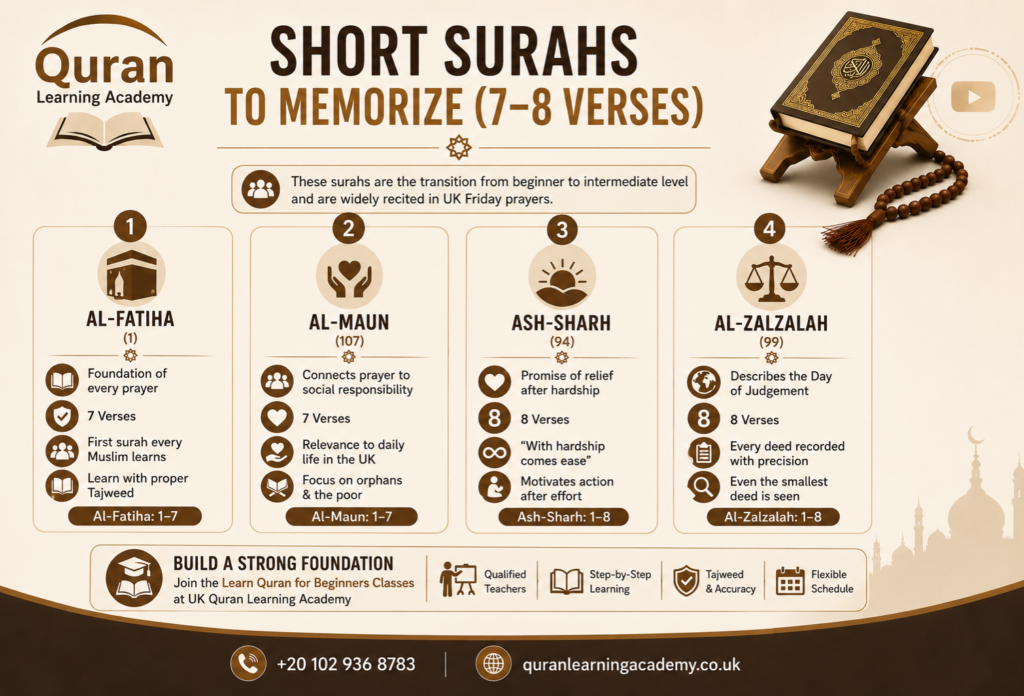
These surahs represent the transition from beginner to intermediate level and make up the bulk of the 30 short surahs of Quran recited across the UK in weekly Friday prayers.
Surah Al-Fatiha Is the Foundation of Every Prayer
Surah Al-Fatiha (Chapter 1) is seven verses and the only surah without which no prayer is valid. The Prophet ﷺ said:
“It will be said to the companion of the Quran on the Day of Resurrection: recite and ascend, and recite carefully as you used to recite carefully in the world, for your rank will be at the last verse you recite.”
In the name of Allah, the Entirely Merciful, the Especially Merciful. (1) [All] praise is [due] to Allah, Lord of the worlds – (2) The Entirely Merciful, the Especially Merciful, (3) Sovereign of the Day of Recompense. (4) It is You we worship and You we ask for help. (5) Guide us to the straight path – (6) The path of those upon whom You have bestowed favor, not of those who have evoked [Your] anger or of those who are astray. (7)
Children across UK Islamic schools learn Al-Fatiha first, but many adults who reverted to Islam or missed formal Quran education find they need to relearn it with proper Tajweed. The Learn Quran for Beginners Classes in the UK at UK Quran Learning Academy provide a structured starting point that covers everything from Arabic letter recognition through to accurate surah recitation.
Surah Al-Maun Connects Prayer to Social Responsibility
Surah Al-Maun (Chapter 107) is seven verses that link the validity of worship to treatment of orphans and the poor. It is among the short surahs to memorize most relevant to everyday Muslim life in Britain.
Have you seen the one who denies the Recompense? (1) For that is the one who drives away the orphan (2) And does not encourage the feeding of the poor. (3) So woe to those who pray (4) [But] who are heedless of their prayer – (5) Those who make show [of their deeds] (6) And withhold [simple] assistance. (7)
Surah Ash-Sharh Carries the Promise of Relief After Hardship
Surah Ash-Sharh (Chapter 94) is eight verses built around the repeated divine promise that difficulty and ease always come together. The phrase “inna ma’al-‘usri yusrā” — with hardship comes ease — appears twice consecutively, making this surah particularly easy to retain.
Alam nashraḥ laka ṣadrak. (1) Wa waḍa’nā ‘anka wizrak. (2) Alladhī anqaḍa ẓahrak. (3) Wa rafa’nā laka dhikrak. (4) Fa-inna ma’al-‘usri yusrā. (5) Inna ma’al-‘usri yusrā. (6) Fa-idhā faraghta fanṣab. (7) Wa ilā rabbika farghab. (8)
Did We not expand for you, [O Muhammad], your breast? (1) And We removed from you your burden (2) Which had weighed upon your back (3) And raised high for you your repute. (4) For indeed, with hardship [will be] ease. (5) Indeed, with hardship [will be] ease. (6) So when you have finished [your duties], then stand up [for worship]. (7) And to your Lord direct [your] longing. (8)
Surah Al-Zalzalah Describes the Precision of Divine Accounting
Surah Al-Zalzalah (Chapter 99) is eight verses describing the earthquake of the Day of Judgement and the exact recording of every deed — no matter how small. Its closing couplet is among the most memorised lines in the 20 short surahs of Quran.
When the earth is shaken with its [final] earthquake (1) And the earth discharges its burdens (2) And man says, “What is [wrong] with it?” – (3) That Day, it will report its news (4) Because your Lord has commanded it. (5) That Day, the people will depart separated [into categories] to be shown [the result of] their deeds. (6) So whoever does an atom’s weight of good will see it, (7) And whoever does an atom’s weight of evil will see it. (8) Al-Zalzalah: 1–8
Experience the Academy in Action
Curious about our teaching style? Take a quick look inside a live session to see our immersive, supportive learning environment first-hand.
Start Your Quranic Journey in the UK
Join our academy for structured online lessons with expert tutors, tailored to fit your schedule.
Begin Your Hifz Journey at UK Quran Learning Academy
Most British Muslims who want to memorise Quran are not lacking motivation. They are lacking a structured system, a qualified teacher, and a programme built around their actual schedule.
UK Quran Learning Academy offers a complete range of Quran memorisation programmes delivered online by certified teachers, one-to-one, with real-time Tajweed correction from the first session.
Quran Memorisation Course in the UK — structured Hifz training built around classical retention techniques and weekly revision cycles
Hifz Classes for Adults in the UK — designed specifically for working professionals and parents who need flexible scheduling without compromising on quality
Quran Hifz for Ladies in the UK — female-led sessions in a private, structured environment with qualified female instructors
Quran Memorisation for Kids in the UK — spaced repetition and auditory reinforcement techniques adapted for learners aged 5 to 15
Online Quran Classes for Kids in the UK — live interactive sessions covering recitation, Tajweed, and early Hifz foundation
Every programme includes daily and weekly revision plans, flexible scheduling, and qualified teachers who correct pronunciation from day one.
The short surahs to memorize in this guide cover every level — from the ten-word Surah Al-Kawthar to the layered eight-verse structure of Al-Zalzalah. Each surah in the 30 short surahs of Quran found in Juz Amma is self-contained, meaningful, and immediately usable in daily prayer.
The method is simple: listen first, segment and close, connect cumulatively, and review inside Salah every single day. What separates British Muslims who build a strong Hifz from those who restart repeatedly is not talent or time — it is consistency and the guidance of a qualified teacher who corrects errors before they become habits.
Whether you are starting with one of the 33 small surah for prayer or working through the full 20 short surahs of Quran in Juz Amma, the path forward is clear. Begin with the shortest short surah to memorize available, recite it tonight in Isha, and take the next step tomorrow.
Frequently Asked Questions
Which short surah to memorize should an absolute beginner start with first?
Surah Al-Kawthar is the recommended starting point. At ten words across three verses, it can be memorised in a single session and recited in the same evening’s prayer. Once retained, move directly to Surah An-Nasr and Surah Al-Asr before progressing to the four and five-verse surahs.
How many of the 30 short surahs of Quran can a British adult realistically memorise in three months?
An adult memorising five to ten lines per day consistently can complete between eight and twelve surahs from Juz Amma in three months. The key variable is daily revision — learners who recite each memorised surah in Salah every day retain at a far higher rate than those who only review before adding new material.
Do the 33 small surah for prayer need to be memorised in order?
No. The 33 small surah for prayer can be memorised in any sequence, though starting from the shortest and working progressively longer is the most effective approach for building confidence and retention capacity. Beginning with the three-verse surahs and moving toward the eight-verse ones creates a natural progression that prevents early discouragement.
Is Tajweed necessary before starting to memorise the 20 short surahs of Quran?
Basic Tajweed — particularly correct Makharij — should be established before memorising extensively. Pronunciation errors embedded during memorisation become extremely difficult to correct later. A short Tajweed foundation course run alongside early memorisation is sufficient for most learners.
What is the best time of day to memorise short surahs to memorize for busy UK adults?
After Fajr is the most effective window. The mind is rested, distractions are minimal, and the spiritual context of having just completed prayer strengthens focus and retention. For adults with early work commitments, a dedicated ten to fifteen-minute slot immediately after Fajr — even on weekdays — produces stronger results than longer irregular sessions at other times.
 Quran
Quran








Leave a Reply