 Quran
Quran

Many Muslims grow up hearing beautiful Quran recitation yet struggle when reading from the Mushaf themselves. Letters may feel difficult, Tajweed rules become forgotten, and busy schedules make consistent learning challenging. This guide explains every step of how to learn Quran recitation, from recognising the first Arabic letters to developing confident, Tajweed-compliant fluency, with a clear path for where to start and what to do next.
1. Master the Arabic Alphabet Before Anything Else
The Arabic script is the non-negotiable entry point for all Quran recitation, and rushing this stage is the most common reason learners plateau early.
Arabic has 29 letters, each with a distinct sound that does not exist in English. Unlike Latin script, Arabic letters change shape depending on their position in a word: initial, medial, final, or standalone. A learner who cannot recognise all four forms fluently will stall the moment they open a full Mushaf page.
The table below shows what the alphabet stage actually covers and the correct learning order:
| Foundation Skill | What It Involves | Why It Cannot Be Skipped |
| Letter recognition | All 29 letters in isolation | Without this, words cannot be decoded |
| Letter forms | Initial, medial, final, standalone shapes | Letters look different mid-word vs. alone |
| Vowel marks (Harakat) | Fatha, Kasra, Damma, Sukoon | These determine how every syllable sounds |
| Joining rules | How letters connect within words | Incorrect joining produces unrecognisable sounds |
| Tanween | Double vowel markers at word endings | Extremely common in Quranic text |
The most widely used tool for this stage is the Noorani Qaida, a structured phonetic primer that takes learners from individual letters through joining rules to short Quranic passages. It does not teach Tajweed rules formally; it teaches the reading mechanics that make Tajweed possible.
For learners who have never studied Arabic script at all, UK Quran Learning Academy’s Noorani Qaida Course in the UK provides structured phonetic instruction from qualified teachers, building letter recognition and joining accuracy before any recitation begins.

Enrol in the Noorani Qaida Course in the UK
2. Learn Makharij Before Studying Any Tajweed Rule
Makharij al-Huruf (مخارج الحروف) are the precise physical locations in the mouth and throat from which each Arabic letter originates. Every Tajweed rule you will ever study sits on top of Makharij. If a letter comes from the wrong articulation point, applying the correct rule to it still produces the wrong sound.
Classical Tajweed scholarship identifies 17 Makharij organised across five primary zones:
| Articulation Zone | Letters Produced | Common Difficulty for English Speakers |
| Al-Jawf (oral cavity) | ا و ي (long vowels) | Correct elongation duration |
| Al-Halq (throat) | ء ه ع ح غ خ | Throat constriction vs. English “h” |
| Al-Lisan (tongue) | Most Arabic letters | Precise tongue placement |
| Al-Shafatan (lips) | ب م و ف | Distinguishing ب from ف |
| Al-Khayshum (nasal cavity) | Ghunnah (nasal resonance) | Sustaining nasal sound correctly |
The throat letters (ء ه ع ح غ خ) are consistently the most challenging for native English speakers because English does not use throat constriction as a phonemic feature. Attempting Tajweed rules before these letters are correctly articulated produces errors that become embedded in memory and extremely difficult to correct later.
Practical Makharij training involves three habits:
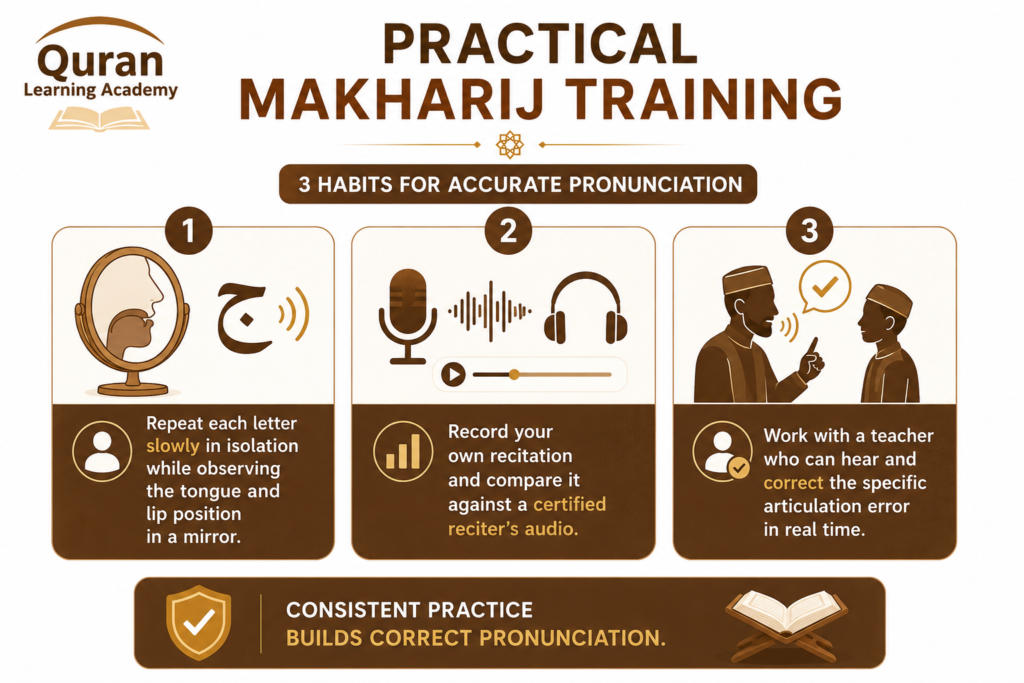
- Repeating each letter slowly in isolation while observing the tongue and lip position in a mirror.
- Recording your own recitation and comparing it against a certified reciter’s audio.
- Working with a teacher who can hear and correct the specific articulation error in real time.
Read also: How to Read the Quran with a Beautiful Voice: 8 Proven Steps
3. Study the Core Tajweed Rules in Sequence
Tajweed is not a single rule but a system of interconnected chapters. Studying them out of sequence creates gaps that show up as inconsistent errors during Salah recitation.
The correct learning sequence moves from the most frequently encountered rules to the more conditional ones:
| Tajweed Chapter | What It Governs | Frequency in Quran |
| Noon Sakinah and Tanween | How ن and tanween are pronounced before 28 different letters | Extremely high, every page |
| Meem Sakinah | How مْ is pronounced before all other letters | Very high |
| Madd (Elongation) | Duration of vowel extension: 2, 4, or 6 counts | Every page |
| Qalqalah | Echo sound on ق ط ب ج د when unvowelled | High |
| Ghunnah | Nasal resonance on doubled ن and م | Very high |
| Tafkheem and Tarqeeq | Heavy vs. light pronunciation of specific letters | Moderate, context-dependent |
| Waqf rules | Where to stop and where stopping is prohibited | Every passage |
Noon Sakinah and Tanween alone cover four distinct rulings: Izhar (clear pronunciation), Idgham (merging), Iqlab (conversion), and Ikhfa (concealment). Each applies depending on which letter follows the Noon or Tanween. This chapter is not optional background knowledge; it governs recitation on nearly every page of the Quran.
Sisters who want structured Tajweed instruction in a comfortable, female-only setting will find UK Quran Learning Academy’s Tajweed Course for Ladies in the UK covers all of these chapters sequentially, with qualified female teachers correcting Ghunnah duration, Qalqalah mechanics, and Madd extensions from the first lesson.

Join the Tajweed Course for Ladies in the UK
4. Build Recitation Fluency Through Daily Repetition
Knowing Tajweed rules and applying them fluently during live recitation are two different skills. The gap between them is closed only through structured, daily repetition at the page level.
The most effective method for building fluency works in five phases:
- Phase 1: Reading. Read the target page slowly from the Mushaf once, paying attention to pauses, visual layout, and meaning.
- Phase 2: Segmenting. Divide the page into three or four small segments of three to four lines each. Read the first segment five times with the Mushaf open.
- Phase 3: Closing. Close the Mushaf and repeat those lines from memory until you can recite the segment three times consecutively without error.
- Phase 4: Connecting. Link each segment to the one before it. Recite Segment 1 plus Segment 2 together, then 1 plus 2 plus 3, until the full page flows as one connected unit.
- Phase 5: Page-to-page connection. After completing a full page, recite it together with the previous page from that session. By the end of the session, all pages covered that day should flow as one continuous block.
The connecting phase is what most self-taught learners skip. Reciting segments in isolation produces readers who stall at every new verse because they memorised pieces rather than connected passages.
A practical daily fluency schedule looks like this:
| Time of Day | Session Focus | Duration |
| After Fajr | New material, primary practice window | 30–45 minutes |
| After Asr | Recite aloud to counter fatigue, apply Tajweed rules actively | 15–20 minutes |
| After Isha | Light review, listen to reciter audio for next session | 10–15 minutes |
Read also: Common Mistakes When Reading the Quran and How to Correct Them
Step Inside Our Virtual Classrooms
See how our interactive lessons work. Watch these brief highlights of our students engaging with instructors.
Start Your Quranic Journey in the UK
Join our academy for structured online lessons with expert tutors, tailored to fit your schedule.
Book Your Free Trial5. Listen to Proficient Reciters as a Daily Habit
Immersing the ear in high-quality recitation trains the tongue to reproduce what active practice has not yet made automatic. Listening is not a passive supplement to learning how to learn Quran recitation online; it is a distinct memory pathway that reinforces accurate pronunciation between active sessions.
Auditory memory and active recall memory operate differently and reinforce each other when both are engaged consistently. Playing recitation of the verses you are currently practising while commuting, cooking, or walking strengthens the same neural patterns built during your practice sessions.
The following habits build the most effective listening practice:
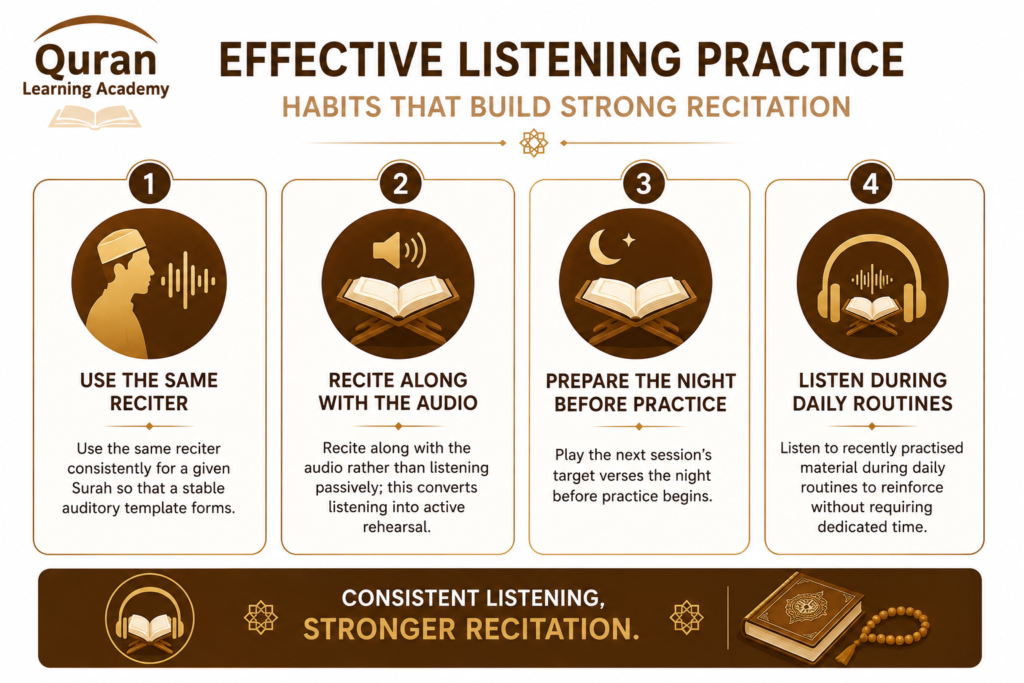
- Use the same reciter consistently for a given Surah so that a stable auditory template forms.
- Recite along with the audio rather than listening passively; this converts listening into active rehearsal.
- Play the next session’s target verses the night before practice begins.
- Listen to recently practised material during daily routines to reinforce without requiring dedicated time.
Scholars recommend reciters known for precise, slow-paced Tajweed such as Sheikh Mahmoud Khalil al-Husary specifically because accuracy matters more than melodic performance at the learning stage. An incorrectly pronounced sound heard repeatedly becomes embedded in memory and progressively harder to correct.
Read also: How to Memorise Quran in 6 Months?
6. Recite to a Qualified Teacher for Live Correction
The oral transmission of the Quran is not incidental; it is how the Quran has been preserved across fourteen centuries. Every word in the Mushaf today exists exactly as it does because of an unbroken chain of teachers correcting students in real time.
Self-study and audio recordings cannot replicate this function. A recording cannot hear what you are saying. It cannot distinguish between your pronunciation and the correct one. A qualified teacher can.
The errors that go undetected without a teacher include:
- Makhraj errors: producing a letter from the wrong articulation point, which changes meaning.
- Madd duration mistakes: extending a vowel for two counts when six are required, or vice versa.
- Incorrect Noon Sakinah ruling: applying Izhar where Ikhfa is required.
- Subtle Ghunnah omissions: dropping the nasal resonance that should accompany doubled letters.
- False stops: pausing at a point where the Waqf sign prohibits stopping.
None of these can be reliably self-detected. The ear trained by its own incorrect habit cannot hear its own errors.
Allah commands in the Quran:
“وَرَتِّلِ الْقُرْآنَ تَرْتِيلًا”
Wa rattili l-Qur’āna tartīlā
“and recite the Qur’an with measured recitation.”
For adults who want this level of correction structured around a working schedule, UK Quran Learning Academy’s Tajweed Course for Adults in the UK delivers live one-to-one sessions covering Makharij, Sifaat, Ghunnah, Qalqalah, and Madd with direct teacher feedback at every session.

Enrol in the Tajweed Course for Adults in the UK
7. Use Salah as a Daily Recitation Practice Session
The five daily prayers are the most underused recitation practice tool available. Every Muslim already performs them; the question is whether they are being used deliberately.
Reciting memorised verses in Salah forces recall under mild performance pressure, which strengthens the memory trace more than passive review does. It also builds the habit of using recitation functionally, which is the actual purpose of learning how to learn Quran recitation: to recite in worship, not to perform in examinations.
A deliberate Salah-based recitation system works as follows:
| Prayer | Recitation Focus |
| Fajr | New or recently practised material, memory is freshest |
| Dhuhr | Material practised two to three days ago |
| Asr | Verses where Tajweed application felt uncertain |
| Maghrib | Material from the current week’s practice |
| Isha | Older material to prevent long-term forgetting |
Distributing recently practised passages across the five prayers gives each segment multiple retrieval opportunities daily without requiring additional dedicated time. If a verse stumbles during Salah, that is precise diagnostic information about where the next practice session should focus.
The Prophet ﷺ said:
” مَثَلُ الَّذِي يَقْرَأُ الْقُرْآنَ وَهْوَ حَافِظٌ لَهُ مَعَ السَّفَرَةِ الْكِرَامِ الْبَرَرَةِ، وَمَثَلُ الَّذِي يَقْرَأُ الْقُرْآنَ وَهْوَ يَتَعَاهَدُهُ وَهْوَ عَلَيْهِ شَدِيدٌ، فَلَهُ أَجْرَانِ ”.
“Such a person as recites the Qur’an and masters it by heart, will be with the noble righteous scribes (in Heaven). And such a person exerts himself to learn the Qur’an by heart, and recites it with great difficulty, will have a double reward.”
Read also: Does Memorising the Quran Improve Memory?
8. Track Progress and Correct Weak Points Systematically
Learning how to learn Quran recitation with Tajweed requires knowing precisely where your recitation stands at any given point. Progress without tracking produces the illusion of improvement while the same errors repeat across every session.
A simple self-audit system for tracking recitation progress:
- Record one page of recitation per week and listen back for specific rule errors, not general impressions.
- Keep a written list of recurring errors with the specific rule they violate.
- Bring that list to your teacher session and ask for targeted correction on those exact points.
- Practise the problematic passage in isolation ten times before incorporating it into a full page read.
The difference between a learner who plateaus at intermediate level and one who reaches genuine fluency is almost always systematic error correction rather than natural talent. Fluency is built error by error, not in one continuous improvement curve.
Children learning alongside parents benefit especially from this approach. Structured tracking gives young learners a clear sense of progress, which sustains motivation during the stages where improvement feels slow.
UK Quran Learning Academy’s Online Quran Classes for Kids in the UK builds structured progress tracking into every session, with qualified instructors monitoring Makharij accuracy, Tajweed application, and recitation confidence across each lesson.

Explore Online Quran Classes for Kids in the UK
9. Maintain Recitation Fluency Through Consistent Review
Recitation skill decays without consistent use. A learner who completes the Tajweed rules but stops practising regularly will find that accuracy deteriorates within weeks, and errors that were corrected months ago quietly return.
Review is not the same as learning new material. It is the practice of reciting already-covered passages with full Tajweed application, catching drift before it becomes an embedded error again.
An effective weekly review structure for intermediate learners:
| Day | Review Focus |
| Saturday | Surahs practised in the past two weeks |
| Sunday | Surahs from one to three months ago |
| Daily (any prayer) | One Surah from the past month, recited in Salah |
The most dangerous period for skill decay is immediately after completing a structured course. Learners who finish their Tajweed programme without an ongoing review plan lose measurable accuracy within the first three months. Review must be treated as a permanent weekly commitment, not a temporary revision phase.
Experience the Academy in Action
Curious about our teaching style? Take a quick look inside a live session to see our immersive, supportive learning environment first-hand.
Start Your Quranic Journey in the UK
Join our academy for structured online lessons with expert tutors, tailored to fit your schedule.
Book Your Free TrialStart Learning Quran Recitation with UK Quran Learning Academy
Most learners who struggle with Quran recitation are not lacking dedication. They are lacking a structured environment where qualified teachers correct errors in real time, progress is tracked systematically, and the curriculum follows the correct sequence from Makharij to fluency.
UK Quran Learning Academy connects learners across Britain with qualified Azhari instructors who deliver live, one-to-one sessions entirely online. Every programme is built around the learner’s actual schedule, whether that means early morning sessions before work, weekend classes, or weekday slots around school commitments.
What sets the academy apart is the combination of classical methodology and modern flexibility: Al-Azhar-trained teachers, real-time Tajweed correction from the very first lesson, structured progression that never skips stages, and scheduling that fits around the demands of daily life. No commuting to a masjid class. No fixed group pace that leaves some learners behind.
The fastest path from where your recitation is now to where you want it to be is a qualified teacher who hears every session, corrects every error, and builds a programme around your specific starting point.
Discover Our Quran Courses
- Quran Online Academy
- Quran Recitation Classes
- Quran Reading Classes
- Online Quran Classes for Kids
- Quran Classes for Adults
- Quran Classes for Female / Sisters
- Learn Quran Course for Beginners
- Quran Memorization (Hifz) Course
- Hifz Classes for Adults
- Quran Memorization and Hifz Course for Kids
- Quran Hifz Course for Ladies
- Quran Ijazah Program
- Quran Qirat Learning Course
- Quran Tafsir Course
- Noorani Qaida Course
- Noorani Qaida Course for Kids
- Weekend Quran Classes
- Intensive Quran Course
- Al-Azhar Quran Course
- Online Tajweed Classes
- Tajweed Course for Kids
- Tajweed Course for Adults
- Tajweed Course for Ladies

Book Your Free Trial Session with UK Quran Learning Academy
Start Your Quranic Journey in the UK
Join our academy for structured online lessons with expert tutors, tailored to fit your schedule.
Book Your Free TrialConclusion
Learning how to learn Quran recitation is a structured journey that begins with Arabic letter recognition, progresses through Makharij and Tajweed, and develops into fluency through daily practice, listening, and teacher correction. Following each stage in sequence prevents the gaps that often slow self-guided learners. Consistent practice, deliberate recitation in Salah, and guidance from a qualified teacher are essential for achieving accurate Quran recitation.
Frequently Asked Questions
Is it possible to learn Quran recitation online with proper Tajweed?
Yes. Online instruction with a qualified teacher delivers the same live correction and structured progression as in-person classes. The critical factor is teacher qualification and live interaction, not the physical setting. Pre-recorded video courses cannot correct your specific errors; live sessions can.
How long does it take to learn Quran recitation with Tajweed?
With consistent daily practice of 20 to 30 minutes and regular teacher sessions, a learner can build solid foundational recitation accuracy within three to six months. Full Tajweed fluency across the entire Quran takes longer and depends on starting level, daily commitment, and how systematically errors are corrected.
Can adults learn Quran recitation from scratch?
Absolutely. Adults bring advantages that children do not: stronger comprehension, clearer motivation, and better discipline. The challenge for adult learners is typically time management rather than capacity. Structured online programmes with flexible scheduling address this directly.
What is the difference between Quran reading and Quran recitation?
Reading refers to decoding Arabic text accurately. Recitation refers to reading with correct Tajweed application: proper articulation, accurate rule application, appropriate rhythm, and correct stopping. A learner can read the Quran without reciting it correctly. The goal of Tajweed study is to close that gap.
Do I need to understand Arabic to learn Quran recitation?
No. Tajweed and Arabic comprehension are separate skills. Many learners develop accurate recitation fluency without Arabic language knowledge. Understanding meaning enriches the experience and strengthens memory, but it is not a prerequisite for correct pronunciation and Tajweed application.








Leave a Reply