 Quran
Quran
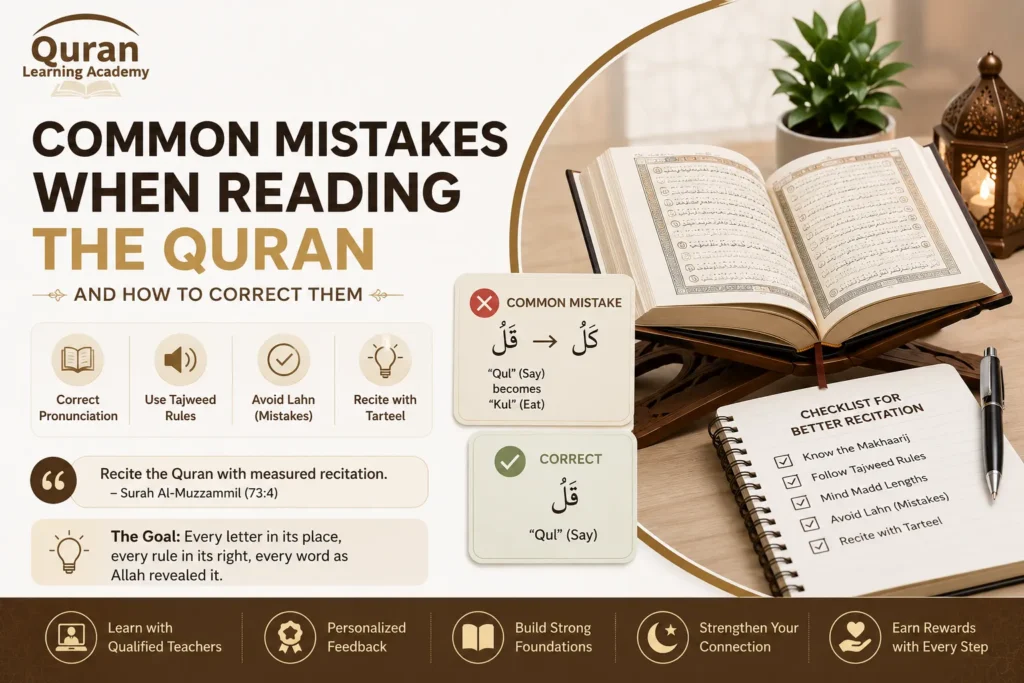
Many Muslims have read the Quran since childhood yet still make errors that were never corrected. Arabic contains sounds and articulation patterns unfamiliar to native English speakers, allowing small mispronunciations to become lasting habits that may affect meaning. This guide covers the main categories of common Quran reading mistakes, explains their significance in Islamic scholarship, and shows how they can be corrected.
Lahn Jali and Lahn Khafi: The Two Categories of Quran Reading Errors
Every mistake in Quran reading falls under the Arabic term Lahn (لحن), meaning any deviation from correct Quranic pronunciation. Islamic scholars divide Lahn into two distinct categories, and understanding this distinction shapes how urgently each error must be addressed.
| Category | Arabic | Effect on Recitation | Ruling |
| Major Mistake | Lahn Jali (لحن جلي) | Changes word meaning or grammatical structure | Forbidden; sinful if deliberate |
| Minor Mistake | Lahn Khafi (لحن خفي) | Reduces beauty and precision without changing meaning | Disliked (Makruh); must still be corrected |
Lahn Jali is always the priority. It includes errors such as replacing one letter with another, applying the wrong vowel mark, or stopping at a point that reverses a verse’s intended meaning. Lahn Khafi covers subtler issues such as weak Ghunnah duration or inconsistent Madd lengths. Both categories require correction, but Lahn Jali carries the greater legal weight and must be addressed first.
The Prophet ﷺ addressed the reward for those who struggle sincerely through recitation:
” مَثَلُ الَّذِي يَقْرَأُ الْقُرْآنَ وَهْوَ حَافِظٌ لَهُ مَعَ السَّفَرَةِ الْكِرَامِ الْبَرَرَةِ، وَمَثَلُ الَّذِي يَقْرَأُ الْقُرْآنَ وَهْوَ يَتَعَاهَدُهُ وَهْوَ عَلَيْهِ شَدِيدٌ، فَلَهُ أَجْرَانِ ”.
“Such a person as recites the Qur’an and masters it by heart, will be with the noble righteous scribes (in Heaven). And such a person exerts himself to learn the Qur’an by heart, and recites it with great difficulty, will have a double reward.”
The struggle carries reward. But the obligation to correct remains.
1. Arabic Letters Produced from the Wrong Articulation Point
Every Arabic letter originates from a specific location in the mouth or throat, known as its Makhraj (مخرج). When a letter is produced from the wrong point, it becomes a different letter, the word changes, and so does its meaning. This is the most foundational of all common Quran reading mistakes, and it is one that learners cannot reliably self-detect without a qualified teacher confirming correct articulation in real time.
Non-Arabic speakers naturally default to the nearest sound in their native language. The letter ق softens into a plain “k,” ع flattens into a simple vowel, and ح merges into ه. Each substitution is a Lahn Jali error because each one produces a different word with a different meaning.
The most frequently confused letter pairs and their consequences:
| Confused Pair | Letters | Consequence of Error |
| ق and ك | Qaf / Kaf | “Qul” (Say) becomes “Kul” (Eat) in Surah Al-Ikhlas |
| ص and س | Saad / Seen | Key words in Surah Al-Fatihah are altered |
| ح and ه | Ha (throat) / Ha (chest) | Two distinct letters collapse into one sound |
| ض and ظ | Dad / Dha | Separate letters with separate meanings merge |
| ث and س | Tha / Seen | “Thalatha” (three) becomes “Salasa” (a different word) |
Correcting Makhraj errors requires working on one letter at a time, practising in front of a mirror to observe tongue and lip placement, and reciting regularly to a teacher who can confirm the correct articulation point.
If your foundational letter articulation needs rebuilding from the ground up, the Noorani Qaida Course in the UK at UK Quran Learning Academy teaches each letter’s Makhraj systematically through structured phonetic drills before moving to full Quranic recitation.

Start the Noorani Qaida Course in the UK
Read also: How to Memorise Quran in 6 Months?
2. Incorrect Madd Lengths Across All Types of Elongation
Madd refers to the lengthening of vowel sounds on the letters ا، و، ي. Each type of Madd carries a prescribed duration measured in beats (harakaat), and getting that duration wrong — whether too short or too long — is among the most widespread Quran reading mistakes at every level of learning.
Shortening a Madd that requires six beats down to one or two fundamentally alters the phonetic shape of the word. Extending a Madd that requires only two beats into four or five is equally an error, falling under Lahn Khafi. Inconsistent application, sometimes correct and sometimes not, is the most common pattern among learners who have partially studied Tajweed without structured reinforcement.
| Madd Type | Required Duration | Most Common Error |
| Madd Tabee’i (Natural) | 2 beats | Shortened to 1 beat or skipped entirely |
| Madd Muttasil (Connected) | 4–5 beats | Treated as Natural Madd at 2 beats |
| Madd Munfasil (Separated) | 4–5 beats | Often ignored completely |
| Madd Lazim (Obligatory) | 6 beats | Significantly shortened |
Finger-tapping while practising each Madd type helps build consistent beat awareness before the lengths become automatic. Practising one Madd type at a time, rather than all simultaneously, produces more durable correction.
Step Inside Our Virtual Classrooms
See how our interactive lessons work. Watch these brief highlights of our students engaging with instructors.
Start Your Quranic Journey in the UK
Join our academy for structured online lessons with expert tutors, tailored to fit your schedule.
Book Your Free Trial3. Weak or Absent Ghunnah on Noon and Meem
Ghunnah is the nasal resonance required on ن (Noon) and م (Meem) in specific positions, particularly when they carry a Shaddah (ّ) or appear in rules such as Idgham and Ikhfa. It must last exactly two counts — not shorter, which removes the quality entirely, and not longer, which is an exaggeration that itself constitutes an error.
Skipping Ghunnah entirely is a Lahn Khafi error in most positions, but it can rise to Lahn Jali when it causes the letter to be misread. The nasal resonance is produced through the nose, not the mouth, and many learners produce a flat, closed sound instead.
Ghunnah applies in four main positions:
- Noon or Meem with Shaddah (Mushaddad), where the nasal tone must be held for two full counts.
- Idgham with Ghunnah, where Noon Sakinah or Tanween merges into certain following letters with the nasal sound maintained.
- Ikhfa, where Noon Sakinah or Tanween is hidden with a nasal tone between Izhar and Idgham.
- Iqlab, where Noon Sakinah or Tanween converts to a Meem sound with Ghunnah before the letter ب.
Listening to precise reciters while following along in the Mushaf, and focusing specifically on the nasal resonance duration, is the most effective way to internalise correct Ghunnah before applying it independently.
Read also: Is It Possible to Memorise the Whole Quran? And How?
4. Missing the Qalqalah Echo on Its Letters
Qalqalah is the slight echoing bounce produced by the letters ق، ط، ب، ج، د when they appear with Sukoon (no vowel). Many readers produce a flat, stopped sound on these letters instead of the required resonance, making recitation sound incomplete and technically incorrect.
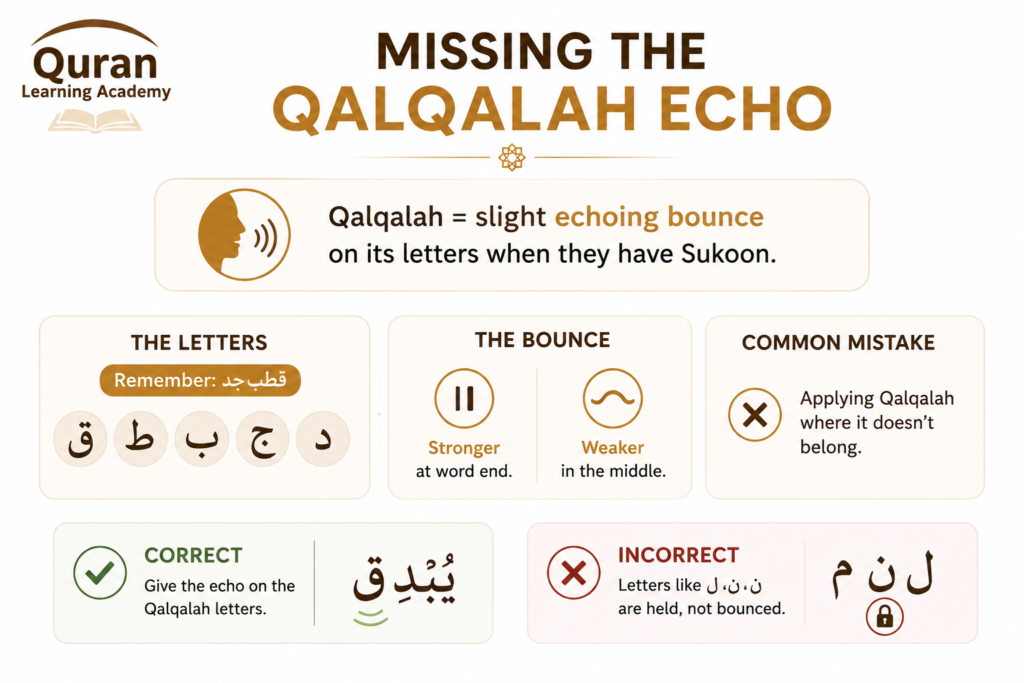
The Qalqalah letters can be remembered through the phrase “قطب جد”. The bounce is most noticeable when stopping on a word ending in one of these letters, and least noticeable when the letter appears in the middle of a word. Both positions require the echo, though its intensity varies.
Applying Qalqalah where it does not belong is an equally common error. Letters that do not carry this characteristic — such as ل، ن، م — should be held against their articulation point until the next letter is ready, rather than released with a bounce.
5. Tafkheem and Tarqeeq Errors on Heavy and Light Letters
Arabic letters are divided into heavy letters (Tafkheem, full mouth) and light letters (Tarqeeq, thin mouth). Applying the wrong weight to a letter changes its sound character, and consistently mispronouncing the distinction falls under Lahn Khafi.
The seven letters that permanently carry Tafkheem are: خ، ص، ض، غ، ط، ق، ظ. The letter ر and the letter ل (specifically in the word Allah) shift between Tafkheem and Tarqeeq depending on context. All other letters carry Tarqeeq.
The most common error is treating all letters with the same weight, producing a recitation that sounds flat and loses the richness that distinguishes correct Tajweed from approximate recitation. Learners who have studied Arabic for general communication often import habits from Modern Standard Arabic, where these distinctions are less strictly observed.
Many readers who want to address Tafkheem and Tarqeeq alongside other Tajweed rules benefit from structured instruction in the Tajweed Course for Adults in the UK at UK Quran Learning Academy, which covers letter characteristics including Sifaat and Tafkheem principles through guided modules with real-time correction.

Join the Tajweed Course for Adults in the UK
6. Errors in Noon Sakinah and Tanween Rules
Noon Sakinah (نْ) and Tanween (ً ٍ ٌ) are governed by four rules depending on the letter that follows them: Izhar, Idgham, Iqlab, and Ikhfa. Applying the wrong rule, or applying no rule at all, is one of the most widespread Quran reading mistakes among learners who have memorised Surahs without structured Tajweed study.
| Rule | Letters That Follow | Correct Application |
| Izhar (Clear) | ء ه ع ح غ خ | Noon/Tanween pronounced clearly with no merging |
| Idgham (Merging) | ي ر م ل و ن | Noon/Tanween merges into the following letter |
| Iqlab (Conversion) | ب only | Noon/Tanween converts to Meem sound with Ghunnah |
| Ikhfa (Concealment) | Remaining 15 letters | Noon/Tanween hidden between Izhar and Idgham with nasal tone |
The most common error is applying Izhar everywhere, pronouncing Noon Sakinah clearly before every letter regardless of which rule applies. This produces a technically incorrect recitation even when every individual letter is otherwise correct.
7. Stopping at the Wrong Place in a Verse
Waqf rules govern where a reciter may pause during recitation, and incorrect stopping is among the most consequential of all common Quran reading mistakes. Pausing in the wrong place can completely reverse the meaning of a verse, even when every letter and Tajweed rule has been applied correctly up to that point.
Allah commands measured, deliberate recitation:
“وَرَتِّلِ الْقُرْآنَ تَرْتِيلًا”
Wa-rattili al-Qur’āna tartīlā.
“and recite the Qur’an with measured recitation.”
Waqf positions are not personal choices or breath management decisions. Islamic scholars identified grammatically and semantically valid stopping points because pausing mid-phrase breaks grammar, disrupts meaning structure, and can make a verse appear to say something it does not. Stopping after لا in a construction where it negates the following phrase, for example, makes the verse appear to affirm rather than deny.
Common Waqf errors include:
- Stopping at the end of a Mushaf line that does not correspond to a valid pause point.
- Pausing mid-phrase because of running out of breath rather than at a permissible stopping sign.
- Resuming recitation from the wrong word after a pause, breaking the grammatical connection of the verse.
- Ignoring mandatory continuation signs (لا) that prohibit stopping at that position.
Read also: How to Memorise Quran in Old Age
8. Rushing Through Recitation Without Tarteel
Reciting at a pace that compresses Madd durations, collapses spacing between rule applications, and produces a hurried rhythm undermines every other Tajweed skill simultaneously. Speed was sometimes equated with proficiency in childhood learning environments, and that association often persists into adult recitation without the reader realising.
Rushing does not produce one error — it produces all of them at once:
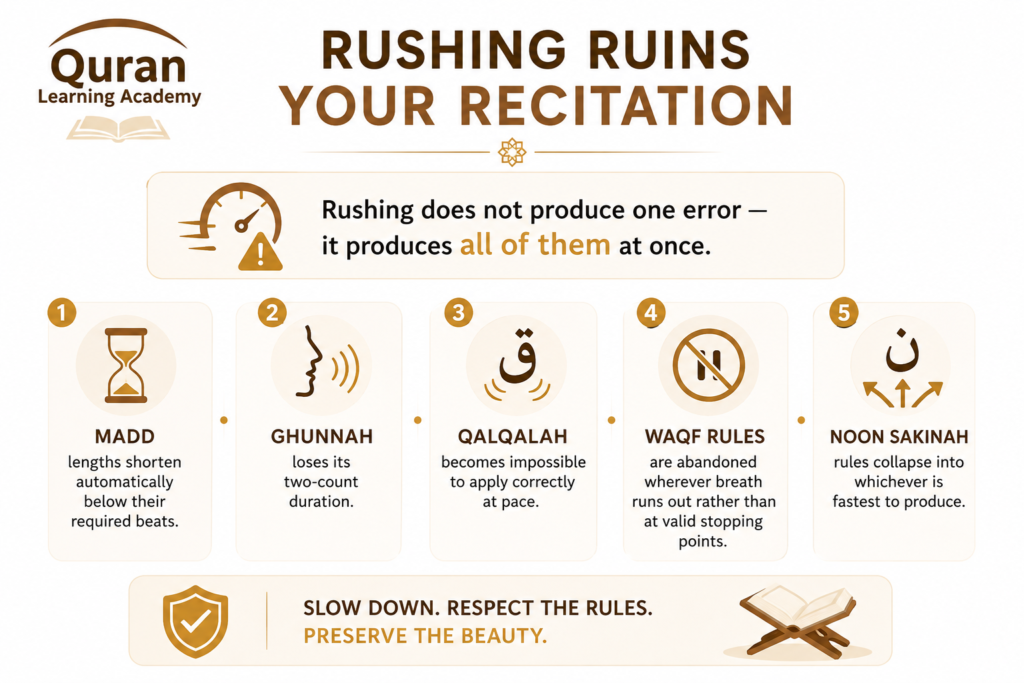
- Madd lengths shorten automatically below their required beats.
- Ghunnah loses its two-count duration.
- Qalqalah becomes impossible to apply correctly at pace.
- Waqf rules are abandoned wherever breath runs out rather than at valid stopping points.
- Noon Sakinah rules collapse into whichever is fastest to produce.
The command is explicit:
“وَرَتِّلِ الْقُرْآنَ تَرْتِيلًا”
Wa-rattili al-Qur’āna tartīlā.
“and recite the Qur’an with measured recitation.”
Tarteel is not a beginner’s pace or a sign of slow learning. It is the divinely commanded speed for all recitation at every level of ability. Setting a deliberate, measured pace before beginning each session — and committing to accuracy over page count — is the single most effective adjustment a reader can make across all error categories simultaneously.
Read also: Does Memorising the Quran Improve Memory?
9. Confusing Hamzat Al-Wasl and Hamzat Al-Qat’
Arabic Hamzah appears in two distinct forms with different pronunciation rules: Hamzat Al-Qat’ (ء), which is always pronounced regardless of position, and Hamzat Al-Wasl (ٱ), which is pronounced only when beginning recitation and dropped when joining to the word before it.
Confusing these two — pronouncing Hamzat Al-Wasl when it should be dropped, or dropping Hamzat Al-Qat’ when it must be sounded — produces a clear Lahn Jali error that alters the phonetic structure of words.
This mistake is particularly common at the junction between verses and within longer phrases where the Hamzah appears mid-recitation rather than at the opening of a new reading. Learners who begin recitation at the start of a Surah often pronounce correctly there, then make the error mid-verse where the rule applies differently.
Read also: The Most Powerful Duas for Studying, Fast Memorisation, And Memory
10. Ignoring Shaddah and Reading Double Letters as Single
Shaddah (ّ) indicates that a letter is doubled — one silent and one vowelled. The letter must be held at its articulation point for a noticeable extra duration before releasing into the vowelled version. Readers who treat Shaddah as a decorative mark rather than a functional rule produce a single, shortened sound where a doubled one is required.
This error is particularly damaging because Shaddah frequently appears on letters that also carry Ghunnah. On ن and م with Shaddah, the reader must both double the letter and sustain the nasal resonance for two counts simultaneously. Missing either component is a separate error within the same letter.
Shaddah appears throughout Surah Al-Fatihah and across the most-recited Surahs. A reader who ignores it consistently alters the phonetic shape of words they recite in every prayer.
For those who want to address all these rules in a structured sequence under qualified supervision, the Online Tajweed Classes in the UK at UK Quran Learning Academy progress from foundational articulation through all Tajweed rules with live correction that catches both Lahn Jali and Lahn Khafi errors in real time.

Enrol in the Online Tajweed Classes in the UK
11. Reading Quran Without a Qualified Teacher
Self-study using books, recordings, and apps alone produces one specific and persistent problem: errors the learner cannot hear in themselves. The human ear adapts to whatever it hears repeatedly, and a mispronunciation that has been practised for years begins to sound correct to the person making it.
A qualified teacher catches what self-study cannot:
- Makhraj errors so habitual they feel completely natural to the reader.
- Insufficient Ghunnah duration that falls just below the correct two counts.
- Madd inconsistencies that vary between correct and incorrect within the same recitation session.
- Habitual letter substitutions that the learner has genuinely stopped hearing as errors.
The oral transmission of the Quran is not incidental. It is the defining mechanism through which the Quran has been preserved across fourteen centuries.
Every word in the Mushaf exists as it does because of an unbroken chain of teachers correcting students in real time. Memorising from recordings or studying from text alone removes that error-correction mechanism entirely.
For sisters who want to learn in a private, structured environment with qualified female instructors, the Quran Classes for Sisters in the UK at UK Quran Learning Academy provide one-to-one Tajweed correction and recitation guidance through dedicated female-only sessions.

Join the Quran Classes for Sisters in the UK
Experience the Academy in Action
Curious about our teaching style? Take a quick look inside a live session to see our immersive, supportive learning environment first-hand.
Start Your Quranic Journey in the UK
Join our academy for structured online lessons with expert tutors, tailored to fit your schedule.
Book Your Free TrialStart Correcting Your Recitation at UK Quran Learning Academy
Most readers do not have a motivation problem. They have a correction problem — no one has ever systematically identified every error and given structured, consistent feedback across all Tajweed rules simultaneously.
UK Quran Learning Academy connects learners across Britain with qualified Azhari instructors who hold Ijazah and specialise in identifying and correcting both Lahn Jali and Lahn Khafi errors through live, one-to-one sessions.
Every programme includes real-time pronunciation correction, structured Tajweed progression, and flexible scheduling designed around work, school, and family commitments. Whether you are beginning from Noorani Qaida or refining an existing recitation that has carried uncorrected errors for years, the right guidance makes the difference.
Discover Our Quran Courses
- Quran Online Academy
- Quran Recitation Classes
- Quran Reading Classes
- Online Quran Classes for Kids
- Quran Classes for Adults
- Quran Classes for Female / Sisters
- Learn Quran Course for Beginners
- Quran Memorization (Hifz) Course
- Hifz Classes for Adults
- Quran Memorization and Hifz Course for Kids
- Quran Hifz Course for Ladies
- Quran Ijazah Program
- Quran Qirat Learning Course
- Quran Tafsir Course
- Noorani Qaida Course
- Noorani Qaida Course for Kids
- Weekend Quran Classes
- Intensive Quran Course
- Al-Azhar Quran Course
- Online Tajweed Classes
- Tajweed Course for Kids
- Tajweed Course for Adults
- Tajweed Course for Ladies
Book a Free Trial Session at UK Quran Learning Academy
Start Your Quranic Journey in the UK
Join our academy for structured online lessons with expert tutors, tailored to fit your schedule.
Book Your Free TrialConclusion
Common Quran reading mistakes range from Makhraj errors that can change word meanings to inconsistencies in Ghunnah and Madd that affect the accuracy and beauty of recitation. These mistakes can be corrected through structured learning and qualified guidance. By maintaining the right pace, learning Tajweed rules gradually, and practising regularly with correction, every Muslim can develop accurate Quran recitation, regardless of whether they grew up speaking Arabic.
Frequently Asked Questions
What is the difference between Lahn Jali and Lahn Khafi in Quran reading?
Lahn Jali refers to major errors that may alter meaning, while Lahn Khafi refers to subtle pronunciation or Tajweed errors that do not change the meaning.
Can Quran reading mistakes affect the validity of prayer?
Certain Lahn Jali errors in Surah Al-Fatihah may affect Salah validity according to scholarly opinion, making correction of major pronunciation errors especially important.
Are Quran reading mistakes correctable for adults who have read incorrectly for years?
Yes. Adults can correct long-standing mistakes through qualified guidance, focusing first on Makhraj and then systematically improving Tajweed through consistent practice.
Does learning Tajweed require knowledge of Arabic language?
No. Tajweed focuses on Quranic pronunciation and can be learned without knowledge of Arabic grammar or vocabulary.
What is the best way to identify Quran reading mistakes in my own recitation?
Reciting to a qualified teacher is the most reliable method. Recording yourself and comparing your recitation with a precise reciter can provide useful additional practice.






Leave a Reply