 Quran
Quran

You have started more than once. You memorised a few pages, felt momentum building, then life in Britain returned with its full weight — work shifts, school runs, commutes across London or Birmingham, and the quiet exhaustion that follows a long day.
The Mushaf sits on the shelf, and the guilt quietly grows. You wonder whether you simply do not have the memory for this, or whether the timing is wrong, or whether you need to wait until life is less busy.
The truth is that the Quran memorisation journey does not fail because of weak memory or bad timing. It fails because the method is missing. When a clear, structured system is in place, the journey becomes manageable for any British Muslim, at any age, at any stage of life.
This guide covers every phase of that journey — from the first intention to long-term retention — using proven approaches that have worked for learners across generations.
1. Sincere Intention Comes Before Every Method
The single biggest predictor of long-term Hifz success is not memory strength. It is the clarity and sincerity of the intention before the journey begins.
Memorising the Quran is an act of worship. Before any technique or schedule matters, the person sitting down with the Mushaf needs to be clear on why they are doing this. Scholars consistently point to sincere intention as the foundation because it shapes every decision that follows — how long you sit, how seriously you take review, whether you return after a difficult day.
Writing the Intention Down Matters
Practically, this step means stating your goal clearly — whether you are aiming for Juz Amma first, a full Khatm over several years, or consistent daily memorisation without a fixed endpoint. Writing this intention down and revisiting it when motivation dips has a measurable effect on how long students persist in their programmes.
Renewing the Intention Every Single Day
Making it a daily habit to renew your intention before sitting with the Mushaf keeps the purpose of the journey alive. One scholar described it simply: the intention is not a one-time statement, it is a daily act of recommitment that realigns the heart before the mind begins its work.
The State of the Heart Affects Memorisation Directly
Scholars across generations have noted that consistent sins harden the heart and weaken the faculty of memorisation. Sincere repentance, maintained prayer, and keeping good company are not tangential to the Quran memorisation journey — they are part of the method itself.
Read also: Quran Memorization Dua
2. Choosing One Mushaf Protects Visual Memory
Quran memorisation is partly a visual process. The brain stores the position of every verse on every page of the specific Mushaf being used. Switching editions mid-journey disrupts this visual memory and weakens recall at exactly the moments when recall needs to be strongest.

Committing to One Edition Throughout
Choose one Mushaf before Day One and commit to it for the entire journey. Students who switch Mushafs mid-plan — even between two different prints of the same recitation — consistently report increased confusion at verse transitions and weakened connection between pages.
Using a Fixed Copy for Active Sessions
The copy used for active memorisation sessions should be the same copy used for review. Using one copy for memorisation and a phone app for review introduces visual inconsistency that undermines the spatial memory your brain is building around that specific layout.
Writing as a Supplementary Tool
Some learners find that writing the verses they are memorising — in addition to reading from the Mushaf — activates an additional sensory pathway that strengthens retention. If this approach is used, the visual layout of the written verses should mirror the Mushaf as closely as possible.
Read also: Quran Memorization Certificate in the UK
3. Preparing the Verse Before Memorising It Reduces Repetitions Needed
Reading a verse before attempting to memorise it — listening to it, understanding its meaning, and seeing it on the page — reduces the number of repetitions needed to retain it.
When the brain encounters a verse for the first time during active memorisation, it is doing two jobs simultaneously: decoding the Arabic text and trying to store it. If the verse has already been heard from a proficient reciter and its basic meaning is understood, the memorisation session does only one job — retention.
Listening the Night Before
Play the target verses from a certified reciter three times the night before the memorisation session. This pre-loads the sound pattern into auditory memory before active work begins.
Reading Through Without Memorising First
Read through the target verses from the Mushaf three to five times without attempting to memorise them. This familiarises the eye with the layout and the tongue with the sounds before the pressure of retention is added.
Reading a Brief Translation
Read a brief translation or Tafseer summary of the passage before beginning. When you understand what an ayah means, the brain creates multiple memory pathways rather than one.
“أَفَلَا يَتَدَبَّرُونَ الْقُرْآنَ أَمْ عَلَىٰ قُلُوبٍ أَقْفَالُهَا”
Afalā yatadabbarūna al-Qur’āna am ʿalā qulūbin aqfāluhā.
“Then do they not reflect upon the Qur’an, or are there locks upon [their] hearts? (24)” [Surah Muhammad: 24]
Students who memorise with no understanding of meaning use only acoustic and visual memory. This makes them more vulnerable to forgetting under pressure — during Salah, for example, when the mind is focused on worship rather than on reciting mechanically.
Many British Muslims find that understanding the Quran’s language deepens their connection to what they are memorising. The Quranic Arabic Course in the UK at UK Quran Learning Academy is built for learners who want to understand the Quran in its original language — not just recite it — covering Classical Arabic grammar, Quranic vocabulary, and direct Quranic text analysis.

Start the Quranic Arabic Course at UK Quran Learning Academy
4. The Sequential Layered Method Builds Connection Between Verses
Repeat each verse a minimum of twenty times before moving to the next one — then combine verses cumulatively rather than memorising them in isolation. This is the core of the Sequential Memorisation method used by scholars across the Arab world.
The Repetition Threshold Is Not Arbitrary
The threshold of twenty repetitions per verse reflects the number of exposures typically needed for information to move from working memory into long-term storage for an average adult learner. Children often need fewer repetitions; adults working with Arabic as a second language typically need more.
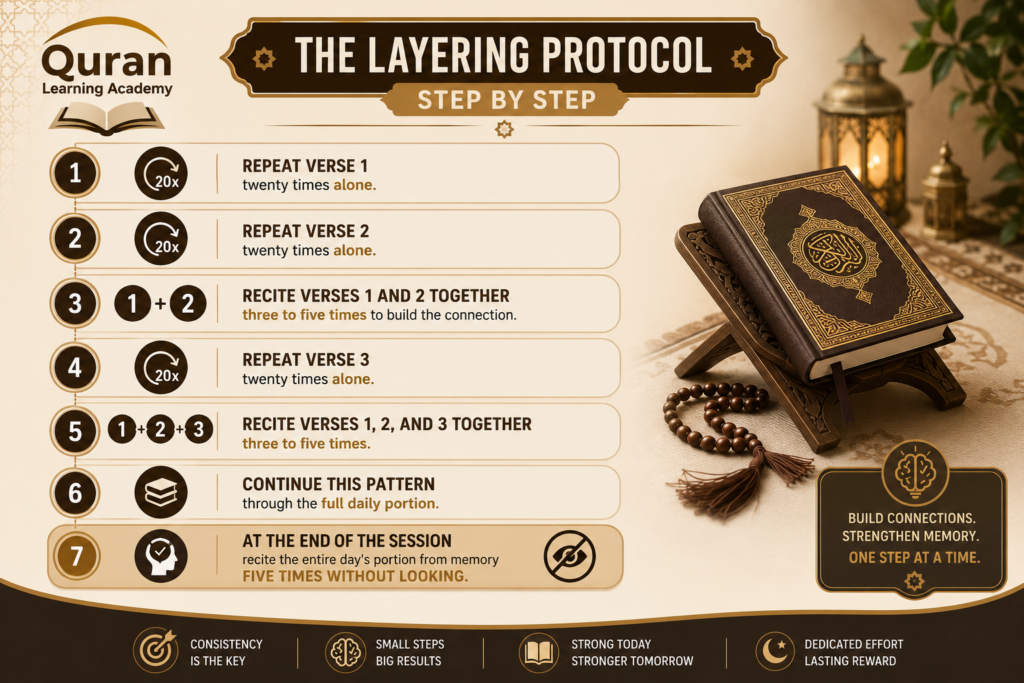
The Layering Protocol Step by Step
- Repeat Verse 1 twenty times alone.
- Repeat Verse 2 twenty times alone.
- Recite Verses 1 and 2 together three to five times to build the connection between them.
- Repeat Verse 3 twenty times alone.
- Recite Verses 1, 2, and 3 together three to five times.
- Continue this pattern through the full daily portion.
- At the end of the session, recite the entire day’s portion from memory five times without looking.
The Combination Step Is the Most Critical
Most memorisation failures happen not because individual verses are forgotten, but because the link between them is weak. When a student forgets the opening word of a verse, it is usually because verses were memorised as separate units rather than as a connected passage. The combination step is what builds the passage, not just the individual verses within it.
Experience the Academy in Action
Curious about our teaching style? Take a quick look inside a live session to see our immersive, supportive learning environment first-hand.
Start Your Quranic Journey in the UK
Join our academy for structured online lessons with expert tutors, tailored to fit your schedule.
Book Your Free Trial5. Structuring the Day Around the Five Prayer Times
Prayer times are not just spiritual anchors. They are built-in memorisation intervals spaced across the entire day, giving the brain recovery time between sessions while keeping the Quran in constant contact with memory.
After Fajr — The Primary Memorisation Window
This is the most effective memorisation window. The mind is at its sharpest after Fajr, the environment is quiet across British homes before the day begins, and there are no demands yet. Dedicate 45 to 60 minutes here to new memorisation. Read the target pages slowly from the Mushaf three times with full attention, then begin memorising line by line.
After Dhuhr and Asr — Review and Continuation
The Dhuhr session covers review of the Fajr material before moving to new pages. By Asr, mental fatigue may begin. Counter it by reciting aloud rather than silently. Vocal recitation keeps focus engaged, surfaces pronunciation errors, and activates a different type of memory encoding than silent reading.
After Maghrib and Isha — Consolidation
The Maghrib session is for cumulative review of everything memorised since Fajr. The Isha session closes with a complete recitation of the day’s full portion from memory. If there are stumbles, return to the Mushaf, correct the error, and recite that section three more times before continuing
| Prayer Time | Session Purpose | Duration |
| After Fajr | New memorisation — primary window | 45 to 60 minutes |
| After Dhuhr | Quick review of Fajr material, then new pages | 20 to 30 minutes |
| After Asr | Vocal recitation, pronunciation work | 20 minutes |
| After Maghrib | Cumulative review of full day’s material | 10 to 15 minutes |
| After Isha | Full day’s portion from memory, Salah recitation | 15 to 20 minutes |
6. Listening to Proficient Reciters Strengthens the Memory Pattern
Immersing the ears in high-quality recitation trains the tongue to reproduce what memory cannot yet recall on its own. Listening is not passive activity when used deliberately for Hifz. Playing a recitation of the verses currently being memorised while commuting, cooking, or walking reinforces the same patterns being built during active memorisation sessions.
Using the Same Reciter Consistently
Use the same reciter consistently for a given Surah to build a stable auditory template. If you internalise a slightly incorrect pronunciation or rhythm through repeated listening, it becomes embedded in memory and harder to correct later. Scholars recommend reciters known for precise Tajweed — precisely because the accuracy of what is built through listening matters as much as what is built through active repetition.
Reciting Along Rather Than Just Listening
Recite along with the audio rather than passively listening. This turns a listening session into active rehearsal. The combination of hearing and producing simultaneously reinforces the neural patterns more deeply than either activity alone.
Using the Commute and Transition Times
British Muslim learners spend significant time commuting. Listening to recently memorised material during the commute to work or school turns otherwise idle time into reinforcement sessions without requiring any additional dedicated time in the day.
If the foundation of Tajweed is shaky, listening sessions can embed errors rather than reinforce accuracy. The Tajweed Course for Adults in the UK at UK Quran Learning Academy teaches correct Quranic pronunciation through structured modules covering Makharij, Sifaat, Ghunnah rules, and Madd elongation — building the recitation accuracy that makes every listening session productive.

Enrol in the Tajweed Course for Adults at UK Quran Learning Academy
7. Daily Review Without Exception Protects Everything Memorised
New memorisation disappears without near-term review. What was memorised yesterday needs reinforcement today, and what was memorised last week needs reinforcement this week. This is where most Quran memorisation journeys collapse.
How Memory Decay Works
Recall strength decays rapidly in the first 24 to 48 hours after initial memorisation, then stabilises if the memory is revisited. Skipping review for even two or three consecutive days can undo an entire week of memorisation work. Students who focus entirely on new material and treat review as optional consistently find that their earlier memorisation becomes unreliable within weeks.
The Three-Tier Review System
| Review Category | Definition | Recommended Daily Amount |
| Near-Past Review | Last 5 pages memorised | Daily, non-negotiable |
| Mid-Past Review | Pages 6 to 20 behind current position | Daily, increasing gradually |
| Far-Past Review | Everything memorised before that | Weekly rotation covering all prior material |
Prioritising Review Over New Memorisation on Difficult Days
On days when time is short, experienced teachers advise reviewing existing material rather than adding new verses. Protecting what has already been memorised is more important than expanding it. A student who arrives at the end of a year with 50 pages memorised solidly outperforms one who has touched 100 pages but cannot recite half of them from memory.
8. Weekly Revision Days Prevent Cumulative Loss
Every seventh day should be dedicated entirely to revision with zero new memorisation. This is the weekly reset that prevents the most common Hifz failure: memorising forward while losing what was already learned.
What a Full Revision Day Looks Like
On a revision day, recite every page memorised across the previous six days — ideally to a teacher or recitation partner who can correct errors in real time. Errors that have gone unnoticed during solo sessions become visible when recitation is heard by a qualified listener.
The Monthly Revision Framework After Completing Hifz
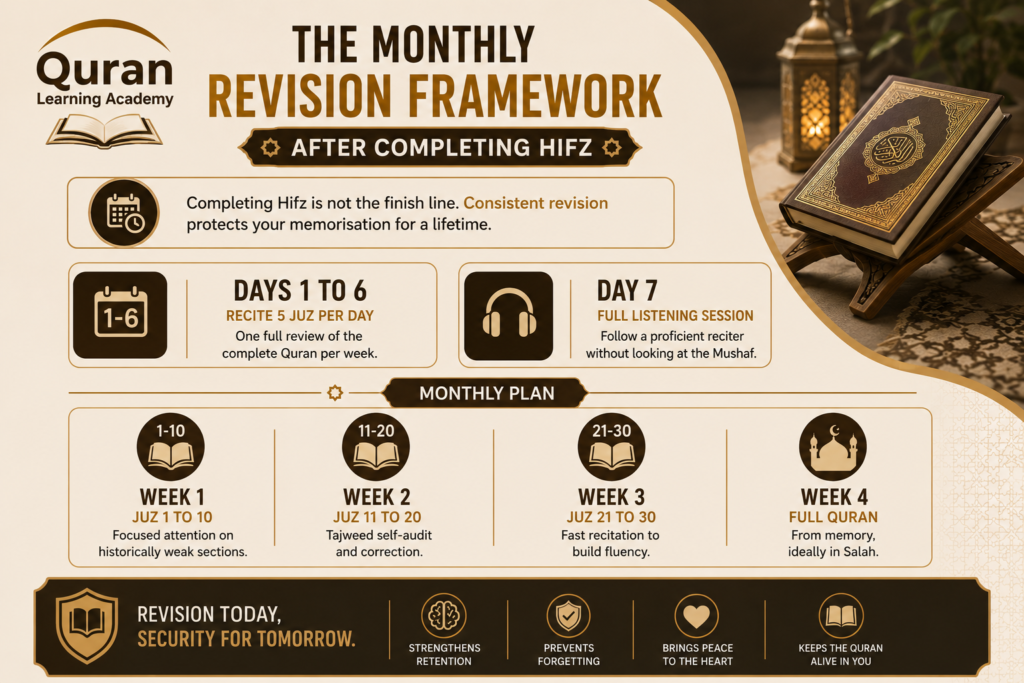
Completing memorisation is not the finish line. Many students who complete Hifz in a short period lose significant portions within months because they do not transition immediately into a systematic revision routine. A practical monthly framework:
- Days 1 to 6: Recite 5 Juz per day from memory — one full review of the complete Quran per week.
- Day 7: Full listening session, following a proficient reciter without looking at the Mushaf.
- Week 1 of each month: Juz 1 to 10 with focused attention on historically weak sections.
- Week 2: Juz 11 to 20 with Tajweed self-audit.
- Week 3: Juz 21 to 30 with fast recitation to build fluency.
- Week 4: Full Quran from memory, ideally in Salah.
“إِنَّا نَحْنُ نَزَّلْنَا الذِّكْرَ وَإِنَّا لَهُ لَحَافِظُونَ”
Innā nahnu nazzalnā adh-dhikra wa innā lahū lahāfizūn.
“Indeed, it is We who sent down the Quran and indeed, We will be its guardian.” [Surah Al-Hijr: 9]
9. A Qualified Teacher Is Not Optional — It Is the Method
Memorising without a teacher means embedding pronunciation errors, Tajweed mistakes, and incorrect verse boundaries that become extremely difficult to correct later. The oral transmission of the Quran is not incidental — it is the defining feature of how the Quran has been preserved across fourteen centuries.
What a Teacher Catches That Self-Study Cannot
- Makhraj errors — incorrect articulation points for Arabic letters.
- Tajweed rule violations that sound minor but change the meaning of verses.
- Incorrect verse boundaries that cause students to pause in the wrong place during recitation.
- Memorisation gaps where a student fills in a forgotten word with one that sounds similar but is incorrect.
None of these can be reliably caught by the student themselves, and audio recordings cannot respond to what a specific student is producing.
The Sunnah Foundation of Teacher-to-Student Transmission
Jibreel would review the Quran with the Prophet (peace be upon him) once every year, and in the year of his passing, they reviewed it twice. The principle of reciting to a qualified listener is not a modern pedagogical invention — it is the original Sunnah method of Quranic transmission.
Every word in the Mushaf today exists exactly as it does because of an unbroken chain of teachers and students transmitting it orally, with each student corrected by their teacher in real time.
“يُقَالُ لِصَاحِبِ الْقُرْآنِ يَوْمَ الْقِيَامَةِ: اقْرَأْ وَارْتَقِ وَرَتِّلْ كَمَا كُنْتَ تُرَتِّلُ فِي الدُّنْيَا، فَإِنَّ مَنْزِلَتَكَ عِنْدَ آخِرِ آيَةٍ تَقْرَأُهَا”
“One who was devoted to the Qur’an will be told to recite, ascend and recite carefully as he recited carefully when he was in the world, for he will reach his abode when he comes to the last verse he recites.” [Sunan Abi Dawud: 1464]
Sisters across Britain who want structured, teacher-supervised Hifz in a comfortable environment will find the Quran Hifz for Ladies in the UK at UK Quran Learning Academy designed specifically for them — with qualified female instructors, flexible scheduling, and revision plans built into every session.

Enrol in Quran Hifz for Ladies at UK Quran Learning Academy
10. Setting a Realistic Daily Target Protects Long-Term Progress
Memorising more than retention capacity can handle on a given day produces memorisation that evaporates within 48 hours. A consistent half-page daily beats an inconsistent two pages.
The brain’s capacity to consolidate new declarative memories in a single session is limited. Exceeding that limit means the material enters working memory but does not transfer to long-term storage before the next session overwrites it.
Starting Targets Based on Experience Level
| Experience Level | Recommended Daily Target |
| Complete beginners with no prior Hifz experience | 5 to 10 lines daily |
| Intermediate students who read Arabic fluently | Half a page to one full page daily |
| Advanced students with strong Tajweed and prior Hifz experience | One to two pages daily, with full review maintained |
The Discipline of Not Exceeding the Target
A student who memorises half a page every day for three years will outperform a student who memorises two pages some days and zero pages other days by a wide margin.
The discipline here is restraint, not ambition. The most common reason adult learners in the UK abandon their Quran memorisation journey is not a lack of motivation — it is overloading in early sessions that produces rapid burnout by week two.
Step Inside Our Virtual Classrooms
See how our interactive lessons work. Watch these brief highlights of our students engaging with instructors.
Start Your Quranic Journey in the UK
Join our academy for structured online lessons with expert tutors, tailored to fit your schedule.
Book Your Free TrialStart Your Quran Memorisation Journey With UK Quran Learning Academy
Most students who struggle with Hifz are not lacking motivation. They are lacking structure, accountability, and qualified guidance. UK Quran Learning Academy offers a complete range of programmes designed for every type of British Muslim learner, delivered one-to-one with certified teachers online.
The Quran Memorisation Course in the UK provides a fully structured Hifz pathway from the first verse to the final page, with personalised pacing, systematic revision cycles, and direct teacher feedback built into every session. For working professionals and parents managing full British schedules, the Hifz Classes for Adults in the UK are built around real-life commitments — with flexible timing that fits around work, school, and family responsibilities without compromise.
Children aged 5 to 15 have a purpose-built system in the Quran Memorisation for Kids in the UK programme — using spaced repetition, auditory reinforcement, and structured review cycles tailored to developing minds. Sisters looking for a private, structured environment will find the Quran Hifz for Ladies in the UK delivered by qualified female instructors who track memorisation and revision simultaneously.

Every programme at UK Quran Learning Academy includes:
- One-to-one sessions with a qualified, experienced teacher.
- Structured daily and weekly review plans built into the curriculum.
- Real-time Tajweed correction so memorisation is accurate from day one.
- Flexible scheduling that fits around work, school, and family commitments across the UK.
Enrol in UK Quran Learning Academy’s Hifz Programmes Today
Discover Our Quran Courses
- Quran Online Academy
- Quran Recitation Classes
- Quran Reading Classes
- Online Quran Classes for Kids
- Quran Classes for Adults
- Quran Classes for Female / Sisters
- Learn Quran Course for Beginners
- Quran Memorization (Hifz) Course
- Hifz Classes for Adults
- Quran Memorization and Hifz Course for Kids
- Quran Hifz Course for Ladies
- Quran Ijazah Program
- Quran Qirat Learning Course
- Quran Tafsir Course
- Noorani Qaida Course
- Noorani Qaida Course for Kids
- Weekend Quran Classes
- Intensive Quran Course
Start Your Quranic Journey in the UK
Join our academy for structured online lessons with expert tutors, tailored to fit your schedule.
Book Your Free TrialConclusion
The Quran memorisation journey is not about exceptional talent or unlimited free time. It is about a clear system applied consistently over time. The steps above cover every stage of that system: sincere intention, one Mushaf, preparation before memorisation, layered repetition, daily scheduling around prayer times, constant listening, non-negotiable daily review, weekly revision days, realistic targets, and teacher-supervised correction.
British Muslim learners face real challenges that most classical Hifz frameworks do not account for — full working weeks, family commitments, and the particular pace of life in cities like London, Birmingham, and Manchester.
The right programme accounts for all of this and builds the Quran memorisation journey around your actual life, not an idealised one. At UK Quran Learning Academy, every one of those components is built into the curriculum and delivered through live, personalised online instruction.
FAQs
What is the best time to memorise the Quran?
The best time to memorise the Quran is after Fajr because the mind is well-rested, distractions are minimal, and concentration is naturally stronger. If memorising after Fajr is not possible, the period after Asr is another effective time for learning new verses.
Can adults memorise the Quran successfully?
Yes. Adults can memorise the Quran at any age through consistency, discipline, and regular revision. Understanding the meanings of the verses and learning with a qualified teacher also make the memorisation process more effective and sustainable.
Should I use the same Mushaf throughout Hifz?
Yes. Using the same Mushaf throughout your Hifz journey strengthens visual memory, helping you remember verse locations and page layouts. Changing Mushafs during memorisation can interrupt this mental pattern and make recalling verses more difficult.
Do I need a teacher to memorise the Quran?
Yes. A qualified teacher helps you memorise the Quran correctly by correcting Tajweed mistakes, improving pronunciation, monitoring your progress, and providing the guidance and accountability needed to maintain consistent memorisation.
What should I do after completing Hifz?
After completing Hifz, begin a structured revision schedule immediately. Regular review is essential to retain your memorisation, and many students recite several Juz daily to ensure the entire Quran is revised consistently each week.








Leave a Reply