 Quran
Quran
Many British Muslims carry a quiet, unspoken guilt about this question. You see someone at the masjid complete a full Juz recitation from memory, and you wonder whether your faith is somehow incomplete because you have not done the same. Some were told growing up that Hifz is obligatory for every Muslim. Others assume it is entirely optional. Neither assumption is fully accurate, and the difference matters — spiritually, practically, and in how you approach your relationship with the Quran.
This article gives you the clear Islamic ruling on whether memorising the Quran is mandatory, what every Muslim is actually required to know by heart, the rewards that await those who pursue Hifz, and the structured path available to British Muslims who want to begin or complete their memorisation journey with qualified guidance.
Is It Mandatory to Memorise the Quran?
Memorising the full Quran is not individually obligatory for every Muslim. Scholars classify it as fard kifayah — a collective obligation fulfilled when a sufficient number of Huffaz exist within a community.
The one portion every individual Muslim is personally obligated to memorise is Surah Al-Fatiha, as no prayer is valid without it. Everything beyond that carries immense reward but remains a collective rather than personal obligation.
Al-Fatiha Is the Only Surah That Requires Memorization
The one part of the Quran that every Muslim, without exception, is individually obligated to memorise is Surah Al-Fatiha.
The Prophet Muhammad ﷺ made this explicit:
“لَا صَلَاةَ لِمَنْ لَمْ يَقْرَأْ بِفَاتِحَةِ الْكِتَابِ”
Lā ṣalāta liman lam yaqraʾ bi-fātiḥati al-kitāb.
“There is no prayer for the one who does not recite the Opening of the Book (Al-Fatiha).”
Every rak’ah — obligatory or voluntary — requires Al-Fatiha. A Muslim who prays five daily prayers recites it a minimum of seventeen times each day. This is not optional. It is fard ayn: a personal, individual obligation that cannot be fulfilled by anyone else on your behalf.
Most scholars also recommend memorising additional short verses or a brief Surah to recite after Al-Fatiha in the first two rak’ahs of each prayer, as this reflects the consistent Sunnah practice of the Prophet ﷺ.
Many British Muslims either over-extend the obligation (believing the full Quran must be memorised by everyone) or under-extend it (assuming memorisation of any kind is purely optional). The truth is that the obligation exists, is specific, and is attainable by any Muslim who can learn to recite.
If you currently struggle to recite Al-Fatiha with correct pronunciation, the Learn Quran for Beginners Classes in the UK at UK Quran Learning Academy builds the precise reading foundation that every Muslim’s daily prayer depends on, with qualified Azhari teachers guiding you from the first letter to confident, accurate recitation.
Memorising the Full Quran Is a Collective Obligation
When scholars discuss whether it is mandatory to memorize the Quran in its entirety, they classify it as fard kifayah: an obligation that rests on the Muslim community as a whole.
Islamic scholars across all major schools of jurisprudence have agreed on this. As stated by Ibn Muflihin Al-Adab Al-Shariah: “They have unanimously agreed on the recommendation of memorising all of it.”
The principle of fard kifayah works as follows:
| Scenario | Ruling |
| Enough members of a community memorise the full Quran | The obligation is fulfilled for all remaining members |
| No one in a community memorises the full Quran | Every capable member of that community bears sin |
| An individual beyond the minimum wishes to memorise more | Strongly recommended; carries immense personal reward |
Al-Juwayni explained the wisdom behind this collective obligation clearly: the purpose is to ensure the Quran is transmitted through a sufficient number of memorisers that no tampering or distortion can occur, generation after generation. The preservation of the Quran through the hearts of the Huffaz is the mechanism Allah has chosen.
Read also: The 8 Best Online Quran Memorization Courses in the UK, Reviewed and Compared
Step Inside Our Virtual Classrooms
See how our interactive lessons work. Watch these brief highlights of our students engaging with instructors.
Start Your Quranic Journey in the UK
Join our academy for structured online lessons with expert tutors, tailored to fit your schedule.
Book Your Free TrialMemorisation Beyond Fard Is Strongly Recommended
Do you have to memorize the Quran beyond Al-Fatiha? No. Does doing so carry extraordinary reward? Yes — and the evidence for this from the Quran and Sunnah is extensive.
Allah Made the Quran Accessible to Every Seeker
“وَلَقَدْ يَسَّرْنَا الْقُرْآنَ لِلذِّكْرِ فَهَلْ مِن مُّدَّكِرٍ ﴿١٧﴾ “
Wa laqad yassarnā al-Qurʾāna li-dhdhikri fahal min muddakir.
“And We have certainly made the Qur’an easy for remembrance, so is there any who will remember? (17) “
This verse is repeated four times within the same Surah — a deliberate divine emphasis that the Quran is not beyond the reach of those who sincerely seek to carry it. Imam Al-Razi stated in his Tafsir that one of the meanings of “easy for remembrance” is specifically ease of memorisation, noting that no previous scripture was preserved through the hearts of its memorisers the way the Quran has been.
The Huffaz Stand With the Noble Scribes
“ مَثَلُ الَّذِي يَقْرَأُ الْقُرْآنَ وَهْوَ حَافِظٌ لَهُ مَعَ السَّفَرَةِ الْكِرَامِ الْبَرَرَةِ، وَمَثَلُ الَّذِي يَقْرَأُ الْقُرْآنَ وَهْوَ يَتَعَاهَدُهُ وَهْوَ عَلَيْهِ شَدِيدٌ، فَلَهُ أَجْرَانِ ”
“Such a person as recites the Qur’an and masters it by heart, will be with the noble righteous scribes (in Heaven). And such a person exerts himself to learn the Qur’an by heart, and recites it with great difficulty, will have a double reward.”
This hadith addresses every type of learner: those who memorise with ease are raised to the station of the noble scribes; those who struggle and persist receive double reward. Neither group is left without honour.
Your Rank in Jannah Rises With Every Verse
” يُقَالُ لِصَاحِبِ الْقُرْآنِ اقْرَأْ وَارْتَقِ وَرَتِّلْ كَمَا كُنْتَ تُرَتِّلُ فِي الدُّنْيَا فَإِنَّ مَنْزِلَكَ عِنْدَ آخِرِ آيَةٍ تَقْرَؤُهَا ”
“the Qur’an will be told to recite, ascend and recite carefully as he recited carefully when he was in the world, for he will reach his abode when he comes to the last verse he recites.”
Every verse memorised and maintained is a step upward in Jannah. The ceiling of your station in the hereafter is determined by how much of the Quran you carry and sustain in this life.
Sisters across Britain who want structured guidance to begin building that station can join the Quran Hifz for Ladies in the UK at UK Quran Learning Academy, where qualified female instructors deliver private online sessions with personalised revision schedules and real-time Tajweed correction.
Memorisation Without Tajweed Produces Embedded Errors
One of the most serious yet overlooked problems British Muslims face is attempting to memorise the Quran before establishing correct pronunciation. If your Tajweed is inaccurate when you begin memorising, you are not memorising the Quran — you are memorising a version of it with errors locked in.
These errors are far harder to remove later than they are to prevent from the start.
Read also: Memorizing Quran by Listening – The Complete Guide for UK Muslims
The Errors Most Common Among British Learners
British Muslims learning Quran recitation face a specific set of phonetic challenges that arise from the differences between English and Arabic sound systems:
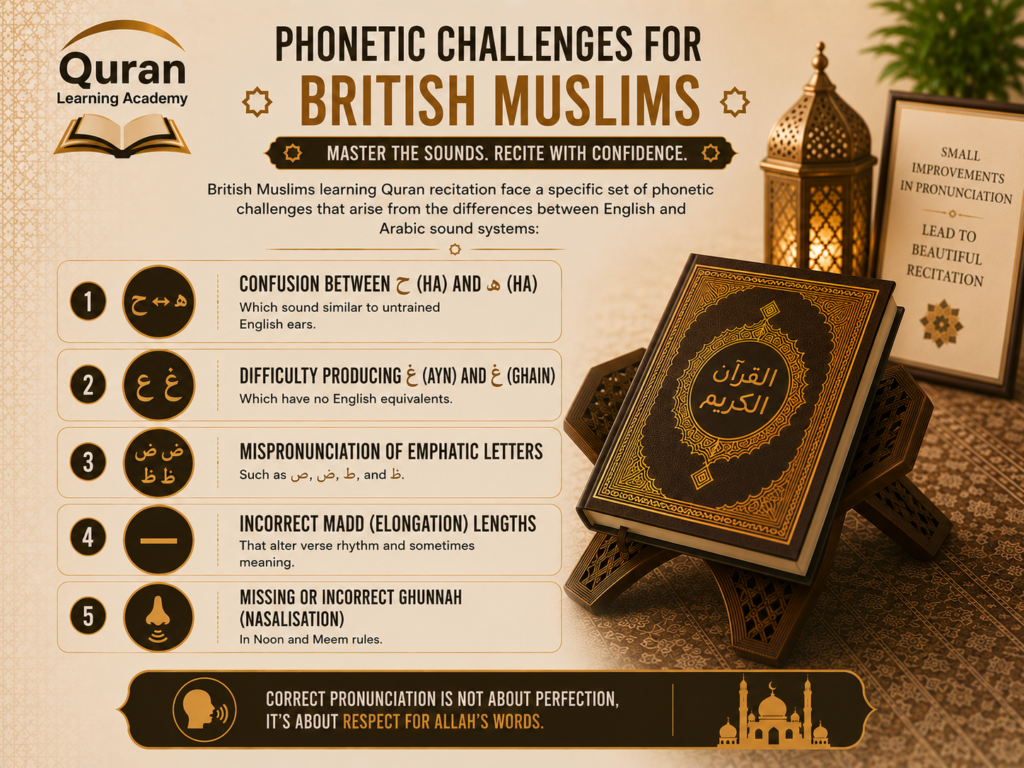
- Confusion between ح (Ha) and ه (Ha), which sound similar to untrained English ears
- Difficulty producing ع (Ayn) and غ (Ghain), which have no English equivalents.
- Mispronunciation of emphatic letters such as ص, ض, ط, and ظ.
- Incorrect Madd (elongation) lengths that alter verse rhythm and sometimes meaning.
- Missing or incorrect Ghunnah (nasalisation) in Noon and Meem rules.
Memorising with any of these errors produces a Hifz that cannot be considered accurate and that may require extensive re-learning later.
If your Tajweed foundation is not yet solid, the Tajweed Course for Adults in the UK at UK Quran Learning Academy covers Makharij, Sifaat, Ghunnah rules, Qalqalah, and Madd principles in a structured sequence — building the recitation accuracy that memorisation then locks in permanently.
Children in the UK Benefit from Early Hifz
Scholars have long recognised that memorisation is more accessible in youth than in adulthood. Ibn Abbas reported that he had memorised the Muhkam portion of the Quran before the Prophet ﷺ passed away — and Ibn Abbas was ten years old at the time. Ibn Kathir commented on this: “It indicates the permissibility of teaching the Quran in childhood — indeed it may be recommended or even obligatory.”
The reason is straightforward. A child’s memory is not yet burdened by the accumulation of daily information that adults carry. Material memorised young is retained longer, recalled more automatically, and woven more deeply into identity and worship.
British Muslim families face a specific challenge: children carry the weight of a full school curriculum alongside their Quranic learning. Sustainable progress requires:
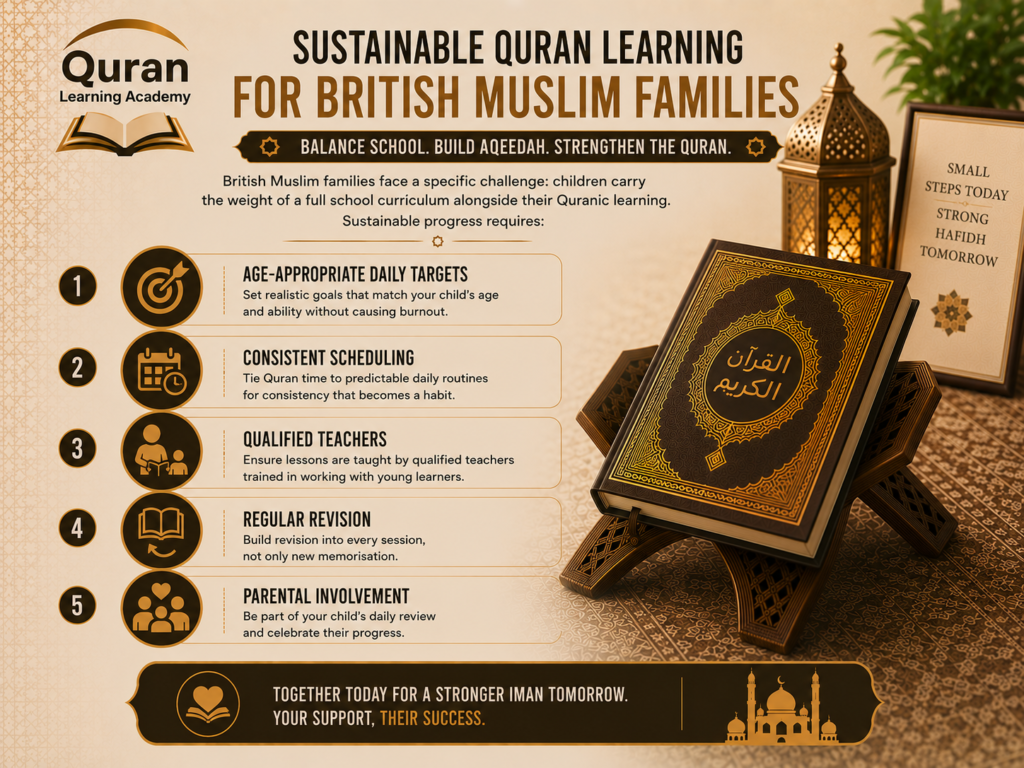
- Age-appropriate daily targets that do not cause burnout.
- Consistent scheduling tied to predictable daily routines.
- Qualified teachers trained in working with young learners.
- Regular revision built into every session, not only new memorisation.
- Parental involvement in daily home review.
The Quran Memorisation for Kids in the UK at UK Quran Learning Academy teaches children aged 5 to 15 systematic Hifz techniques rooted in classical pedagogy, using spaced repetition, auditory reinforcement, and structured revision cycles matched to developing minds.
Read Also: The Most Powerful Duas for Studying, Fast Memorisation, And Memory
Adults in Britain Can Achieve Hifz at Any Age
A persistent and damaging myth in British Muslim communities is that Hifz is only for children. This is not supported by Islamic scholarship. Adults possess significant advantages over children in the memorisation process:
- Stronger comprehension of meaning, which creates multiple memory pathways for each verse.
- Greater discipline and ability to maintain consistent daily schedules.
- Deeper motivation rooted in conscious spiritual commitment rather than parental instruction.
- Better capacity to understand Tajweed rules and apply them analytically.
The Specific Challenges Adults Face
| Challenge | Why It Affects Adults |
| Competing time demands | Work, family, and social commitments reduce available memorisation windows |
| Slower initial retention | Adults typically need more repetitions than children for new material to consolidate |
| Mental fatigue | Cognitive load from professional and domestic responsibilities affects focus quality |
| Discouragement after gaps | Adults are more likely to abandon Hifz after interruptions without external accountability |
These challenges are real — but none of them make Hifz impossible. They make structure and qualified guidance more important, not less. The Hifz Classes for Adults in the UK at UK Quran Learning Academy are built precisely around the reality of British adult life: flexible scheduling, personalised pacing, and qualified teachers who provide the external accountability that makes the difference between a Hifz that stalls and one that reaches completion.
Read Also: The 11 Best Reciters to Memorize Quran, Ranked from Most to Least Precise
The Quran Intercedes on Behalf of Those Who Carry It
Beyond the station in Jannah and the honour among the angels, the Quran performs a unique act for those who memorise and preserve it: it intercedes for them on the Day of Judgement.
“الصِّيَامُ وَالْقُرْآنُ يَشْفَعَانِ لِلْعَبْدِ يَوْمَ الْقِيَامَةِ يَقُولُ الصِّيَامُ أَيْ رَبِّ مَنَعْتُهُ الطَّعَامَ وَالشَّهَوَاتِ بِالنَّهَارِ فَشَفِّعْنِي فِيهِ وَيَقُولُ الْقُرْآنُ مَنَعْتُهُ النَّوْمَ بِاللَّيْلِ فَشَفِّعْنِي فِيهِ فَيُشَفَّعَانِ”
“Fasting and the Qur’an intercede for a man. Fasting says, ‘O my Lord, I have kept him away from his food and his passions by day, so accept my intercession for him.’ The Qur’an says, ‘I have kept him away from sleep by night, so accept my intercession for him.’ Then their intercession is accepted.”
The verses you stayed up reviewing, the mornings you spent repeating — they are not forgotten. They stand for you on the day when nothing else can.
Scholars across generations have also noted that the state of the heart directly affects the capacity for memorisation. Consistent acts of worship, sincere repentance, and keeping wholesome company are not separate from Hifz — they are part of the environment that allows it to flourish. This is a principle scholars have documented and transmitted alongside the memorisation methods themselves.
Experience the Academy in Action
Curious about our teaching style? Take a quick look inside a live session to see our immersive, supportive learning environment first-hand.
Start Your Quranic Journey in the UK
Join our academy for structured online lessons with expert tutors, tailored to fit your schedule.
Book Your Free TrialRead Also: The 8 Best Online Quran Memorization Courses in the UK.
Start Your Hifz Journey With UK Quran Learning Academy
Most British Muslims who want to memorise the Quran are not held back by lack of motivation. They are held back by lack of structure, lack of qualified correction, and lack of a realistic path that fits around a British life.
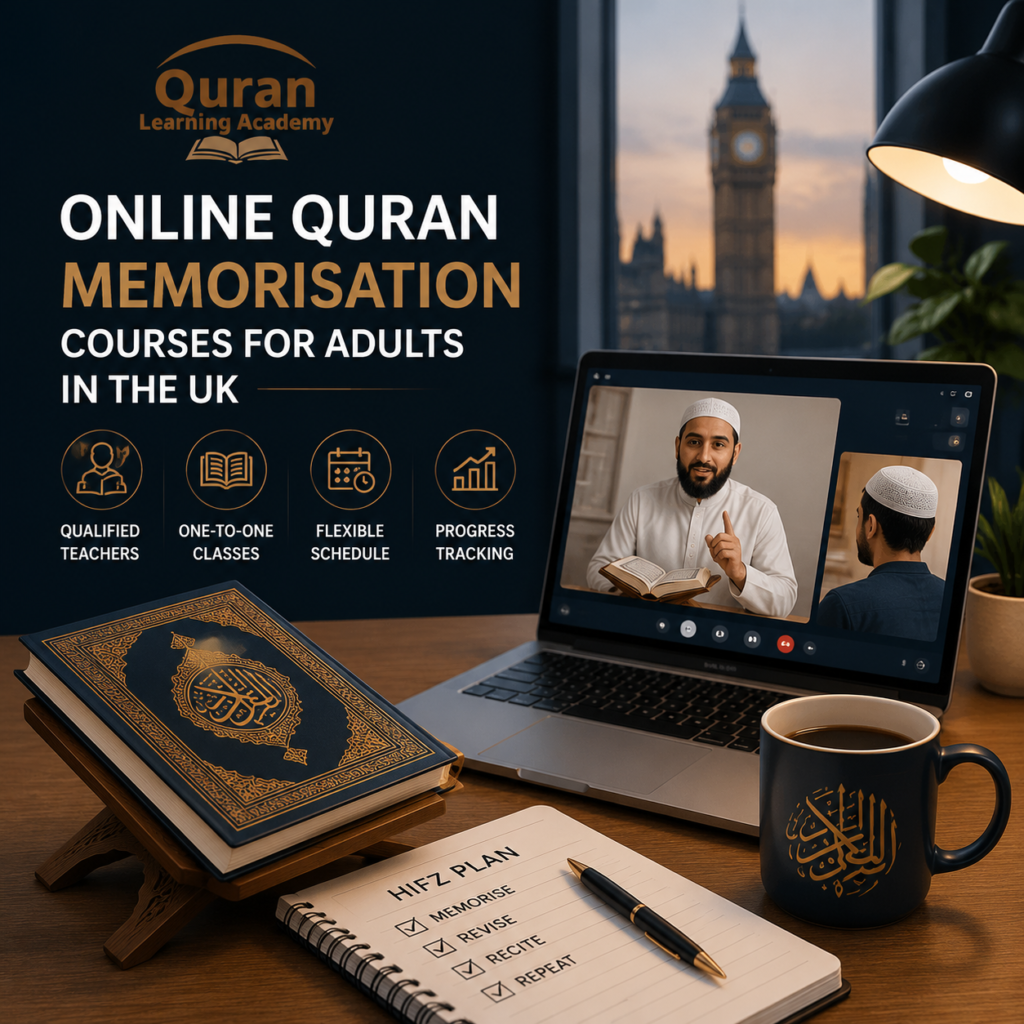
UK Quran Learning Academy delivers live, one-to-one online Quran instruction from qualified Azhari teachers, available from anywhere across the UK — London, Birmingham, Manchester, and beyond — at times that fit around work, school, and family commitments.
Every programme at UK Quran Learning Academy includes:
- One-to-one sessions with a qualified, Ijazah-holding teacher.
- Real-time Tajweed correction from your very first session.
- Structured weekly and daily revision plans built into the curriculum.
- Flexible scheduling designed around British working hours and school timetables.
- A personalised pace that moves with you, not against your life.
Whether you are beginning with your first Surah, building accurate pronunciation before memorisation, or resuming a Hifz journey that was interrupted, the right guidance makes the difference between stalling and completing.
Discover Our Arabic Courses
- Online Arabic Academy
- Online Arabic Course
- Classical Arabic Course
- Arabic Course for Beginners
- Advanced Arabic Course
- Quranic Arabic Course
- Arabic Grammar Course
- Modern Standard Arabic Course
- Arabic Conversation / Speaking Course
- Intensive Arabic Course
- Online Arabic Classes for Kids
- Arabic Classes for Adults
- Arabic Classes for Ladies
- Fusha Arabic Course
- Business Arabic Course
- Al Azhar Arabic Course
- Madinah Arabic Course
- Learning Arabic for Non-Arabic Speakers
- Arabic Elementary School
- Arabic Intermediate School
- Arabic Lessons for Kindergarten
Book your free trial session today at quranlearningacademy.co.uk
Conclusion
Is it mandatory to memorise the Quran in full? No — and no individual bears sin for not completing all 30 Juz. Scholars classify the full Quran as a collective obligation, fulfilled when sufficient Huffaz exist within a community. Every individual Muslim is personally obligated to memorise Surah Al-Fatiha alone, as no prayer is valid without it. Everything beyond that is strongly recommended and carries immense reward, with every verse memorised raising your station in Jannah.
Frequently Asked Questions
Is It Mandatory to Memorise the Quran for every Muslim?
No. Memorising the full Quran is fard kifayah — a collective obligation that is fulfilled for the community when a sufficient number of Huffaz exist within it. Every individual is obligated to memorise Surah Al-Fatiha, as no prayer is valid without it. All memorisation beyond that is strongly recommended and carries immense reward, but it is not individually obligatory.
Do you have to memorize the Quran to pray correctly?
You must be able to recite Surah Al-Fatiha from memory to pray correctly, as no rak’ah is valid without it. Most scholars also recommend memorising a short additional Surah or verses to recite after Al-Fatiha in the first two rak’ahs of each prayer.
Will I sin if I never memorize the full Quran?
Not as an individual. The sin for a community that has no Huffaz falls collectively, not on any single person who did not memorise the full Quran. Your personal obligation extends only to what is needed for valid prayer.
Is Hifz possible as an adult in the UK?
Absolutely. Adults in Britain have completed Hifz while balancing full-time employment, family life, and other commitments. Adults possess advantages in comprehension, discipline, and motivation that compensate for any difference in raw retention speed. Qualified guidance and a consistent daily structure make the difference.
How long does it take to memorize the Quran in Britain?
It depends on daily pace and consistency. A student who memorises half a page daily will complete the Quran in approximately three to four years. One page daily takes around one and a half to two years. Consistency and accurate Tajweed matter far more than speed.





Leave a Reply