 Quran
Quran

You repeat lines from the Mushaf only to forget, abandoning your Hifz goals like thousands of British Muslims—not from a lack of willpower, but a flaw in method. Quranic memorization by listening is the original method used by the Companions learning from the Prophet ﷺ, enabling a young child in Cairo to memorize the entire Quran through Sheikh al-Husary before even learning to write. The brain processes language through sound first, and this guide shows how to apply this method to your busy life.
1. Active Listening Builds Real Memorization
Most British Muslims who try memorizing Quran by listening play a recitation in the background while cooking or commuting — and then wonder why nothing sticks. The problem is not the method. The problem is treating listening as a passive activity.
Hearing is passive. Listening is active. The difference determines everything in Hifz.
Active listening means sitting with full attention on the reciter, following every elongation, every articulation point, every pause — with no other task running simultaneously. This is the condition under which the brain completes its full processing chain: sound reception, language analysis, higher cognitive processing, and finally transfer to long-term memory storage.
When distraction breaks any point in that chain, the verse does not move past short-term storage. It fades within hours.
| Listening Type | What Happens in the Brain | Effect on Memorization |
| Passive (background only) | Sound received but not processed | Near-zero retention |
| Semi-active (occasional attention) | Patchy processing, no consolidation | Weak and unreliable |
| Active (full focus, repeating aloud) | Complete processing chain activated | Strong, durable retention |
The practical method for every session:
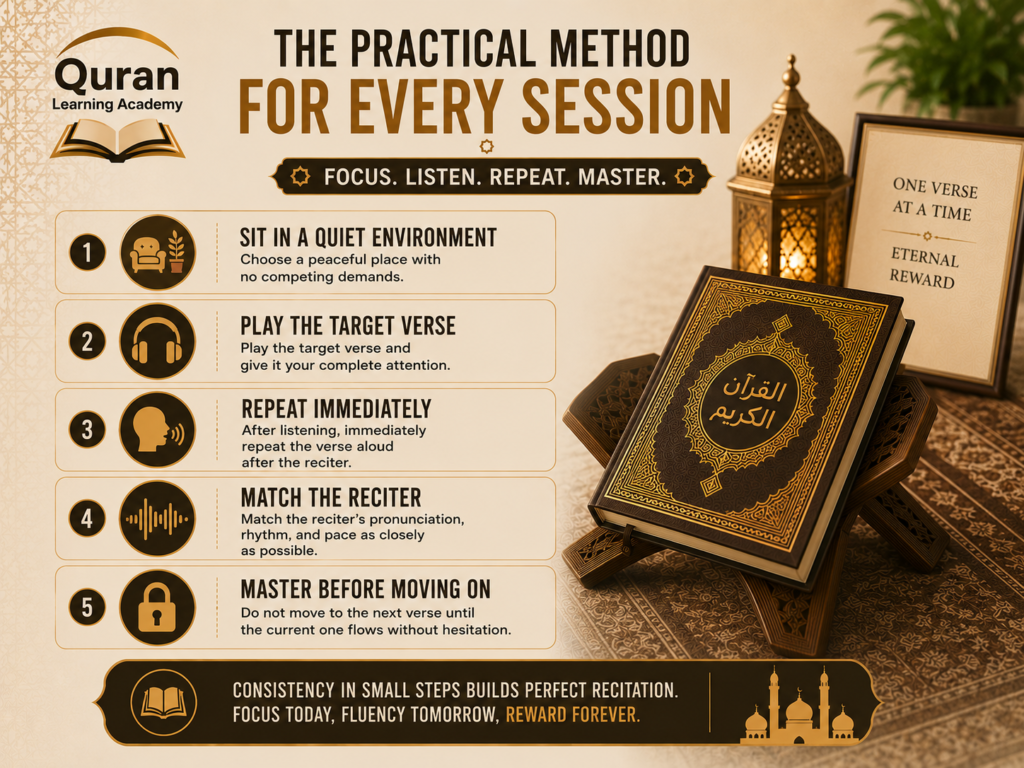
- Sit in a quiet environment with no competing demands
- Play the target verse and give it your complete attention
- After listening, immediately repeat the verse aloud after the reciter
- Match the reciter’s pronunciation, rhythm, and pace as closely as possible
- Do not move to the next verse until the current one flows without hesitation
Many British learners discover they have been skipping this repetition step entirely — listening but never reciting back. That single change produces an immediate and significant improvement in retention.
Active Listening Engages Multiple Memory Systems
When a learner listens with full focus and repeats aloud, the brain engages auditory memory, motor memory of the tongue, and emotional memory simultaneously. Each system creates an independent storage pathway for the same verse.
If one pathway weakens under pressure — during Salah for example, when the mind is on worship rather than mechanical recall — the other pathways compensate. This is why active memorizing Quran by listening produces retention that silent reading alone cannot match.
Read also: How Many Sahaba Memorised the Quran?
Reciting Aloud Builds Tongue Muscle Memory
Repeating verses aloud after the reciter does more than reinforce auditory memory. It builds the automatic physical sequencing of Arabic sounds that allows a Hafiz to recite without consciously thinking about each word.
Reciting aloud also surfaces pronunciation errors that silent repetition misses entirely. A learner can believe they have memorized a verse correctly while mispronouncing key letters every single time.
Listening at Night Prepares the Brain for Morning Memorization
Playing the target verses three times while preparing for sleep the night before a memorization session dramatically reduces the repetitions needed the following morning. Sleep consolidates declarative memory. Waking up to material the brain has already been exposed to gives the memorization session a head start that silent preparation cannot replicate.
Many learners in the UK want to pair their listening practice with structured Tajweed correction from day one. The Online Tajweed Classes in the UK at UK Quran Learning Academy teach Makharij, Sifaat, and pronunciation rules through live online sessions.

Enrol in the Online Tajweed Classes in the UK today.
2. Choosing the Right Reciter Changes Everything
The choice of reciter is not a matter of personal taste alone. It directly determines how accurately the learner builds their auditory memorization template — and errors embedded through repeated listening to an imprecise recitation are extremely difficult to correct later.
The brain records an auditory memory tied to a specific voice, pace, and style. Switching reciters mid-memorization produces two conflicting versions of the same verse in memory, and recall becomes confused and unreliable.
The rule is simple: choose one reciter and stay with them for the entire memorization of a given Surah.
| Quality to Look For | Why It Matters |
| Clear articulation of every letter | Builds accurate Makhraj habits from listening alone |
| Moderate to slow pace | Allows the learner to repeat comfortably without falling behind |
| Precise Tajweed application | Elongations, stops, and Ghunnah must be accurate and consistent |
| A voice sustainable for long sessions | The learner must be able to listen for 30 to 60 minutes without fatigue |
Recommended Reciters for Memorization
Reciters consistently recommended across classical and contemporary Hifz frameworks include:
- Sheikh Mahmoud Khalil al-Husary — particularly the Mu’allim (teaching) style, which is slower and designed specifically for learners
- Sheikh Muhammad Siddiq al-Minshawi — a composed voice and moderate pace that suits learners who find al-Husary’s rhythm difficult to follow
A learner who struggles with one reciter’s pace may find retention improves significantly when switching to a different style. Experimenting with two or three reciters at the start — before committing to one — is worth the time investment.
Just as experienced Hifz teachers advise using a single Mushaf throughout memorization — because the brain stores the visual position of every verse on every page — the same principle applies to the reciter.
The brain stores an acoustic version of every verse linked to a specific voice. Changing either the Mushaf layout or the reciter disrupts these stored templates and weakens recall.
Step Inside Our Virtual Classrooms
See how our interactive lessons work. Watch these brief highlights of our students engaging with instructors.
Start Your Quranic Journey in the UK
Join our academy for structured online lessons with expert tutors, tailored to fit your schedule.
Book Your Free Trial3. The Verse-by-Verse Repetition Method Builds Lasting Memory
Reading a full page repeatedly is the most common and least effective memorization habit among British Muslims attempting Hifz. It produces familiarity — the learner recognizes verses when they see them — but not genuine memorization. The test is simple: close the Mushaf and recite. If that is not possible fluently, the verse is not memorized.
The reliable method works verse by verse, with cumulative connection:

- Listen to the target verse a minimum of five times with full attention on the Mushaf
- Repeat the verse aloud after the reciter three to four times without looking
- Attempt to recite the verse entirely from memory
- If gaps appear, listen twice more and attempt again
- Do not move forward until the verse can be recited three consecutive times without error
Combining Verses After Individual Mastery
Memorizing verses in isolation creates a fragile chain. Most Hifz failures happen not because individual verses are forgotten, but because the link between them is weak. When a learner forgets the opening word of a verse mid-recitation, it is because they memorized verses as separate units rather than as a connected passage.
The cumulative protocol:
- Memorize verse 1 individually to the three-consecutive standard.
- Memorize verse 2 individually.
- Recite verses 1 and 2 together from memory three to five times.
- Memorize verse 3 individually.
- Recite verses 1, 2, and 3 together.
- Continue this pattern through the full daily portion.
- At the end of the session, recite the entire day’s portion from memory five times without looking.
British learners who want to apply the verse-by-verse method with structured teacher guidance rather than attempting it alone will find that the Quran Memorisation Course in the UK at UK Quran Learning Academy builds exactly this system into the curriculum.

Start the Quran Memorisation Course in the UK today.
4. Daily Revision Through Listening Protects Your Progress
New memorization fades rapidly in the first 24 to 48 hours without reinforcement. This is where most Hifz journeys collapse — not because the learner stops memorizing, but because they stop revising.
Adding new verses while old ones fade produces a net result of zero progress over weeks and months.
Listening-based revision is the most practical revision tool available to British Muslims with demanding schedules, because it can be incorporated into daily activities that are already happening.
| Revision Category | Definition | Recommended Method |
| Near-past review | Last 5 pages memorized | Active listening and reciting aloud — daily, non-negotiable |
| Mid-past review | Pages 6 to 20 behind current position | Listening while following the Mushaf — daily |
| Far-past review | All earlier memorized material | Listening at 1.5x speed, reciting from memory in Salah — weekly rotation |
Using Salah as a Built-In Revision System
The five daily prayers are a revision structure that every Muslim already has. Using them deliberately for memorizing the Quran by listening turns Fajr, Dhuhr, Asr, Maghrib, and Isha into five daily retrieval opportunities without requiring any additional time.
The distribution that works best:

- Fajr: recite the newest material when memory is freshest after sleep
- Dhuhr and Asr: material memorized earlier in the week
- Maghrib and Isha: material from the previous week requiring reinforcement
Skipping Revision: The Most Destructive Habit in Hifz
Skipping revision even for two or three consecutive days can undo an entire week of memorization work. On days when time is short, experienced teachers consistently advise revising existing material rather than adding new verses. Protecting what is already memorized is always more important than expanding it.
5. Meaning Comprehension Makes Sound-Based Memorization Stronger
Memorizing without any understanding of meaning creates a single, fragile memory pathway. The learner relies entirely on acoustic memory — and when that pathway weakens under pressure, the verse slips away with nothing to compensate.
Understanding what an ayah means creates multiple independent retrieval routes simultaneously:
- The sound of the words as heard from the reciter
- The visual image of the Arabic text on the Mushaf page
- The conceptual meaning and context of the passage
If one route becomes temporarily inaccessible, the other two compensate. This is why learners who read even a brief translation before each session consistently report needing fewer repetitions to reach confident memorization.
“وَإِذَا قُرِئَ الْقُرْآنُ فَاسْتَمِعُوا لَهُ وَأَنصِتُوا لَعَلَّكُمْ تُرْحَمُونَ ﴿٢٠٤﴾”
Wa idhā quri’al-Qur’ānu fastami’ū lahu wa anṣitū la’allakum turḥamūn.
So when the Qur’an is recited, then listen to it and pay attention that you may receive mercy. (204).”
Understanding this verse before memorizing it creates an emotional and conceptual anchor. The instruction to listen with full attention is itself an ayah about listening — and knowing that meaning makes the verse far harder to forget.
A learner who does not understand the meaning of a verse is more likely to substitute a forgotten word with one that sounds similar but is wrong. Understanding what the verse is saying makes substitution errors immediately obvious — the replacement word does not fit the meaning, and the learner catches the error before it becomes embedded.
For British Muslims who want to deepen their understanding of Quranic meanings alongside their memorization practice, consistent recitation without comprehension leaves the spiritual dimension of Hifz incomplete.
The Quran Tafsir Course in the UK at UK Quran Learning Academy teaches students how to interpret Quranic verses through classical Tafsir scholarship, helping Hifz students connect what they are memorizing to what Allah is actually saying.

Enrol in the Quran Tafsir Course in the UK today.
6. Listening Combined With Other Methods Produces Stronger Results
Memorizing Quran by listening is powerful as a primary method. It becomes significantly more effective when combined with complementary techniques that engage additional memory systems alongside the auditory pathway.
Listening Combined With Writing
After memorizing a passage through active listening, closing all audio and attempting to write the verses from memory — without looking at the Mushaf — engages a completely different memory system. Writing combines physical hand movement with the auditory and visual elements of the passage, creating a third independent retrieval route.
This technique is particularly effective for distinguishing between similar verses that sound alike. The process of writing forces attention to each individual letter, reducing the substitution errors that often affect similar passages.
Listening Combined With Reading Aloud
Reciting aloud while following the Mushaf simultaneously engages:
- Auditory memory through hearing one’s own voice.
- Visual memory through seeing the text on the page.
- Motor memory through the physical movements of articulation.
This triple engagement during a single session consolidates the verse more deeply than any single-sense approach.
Listening Before Sleep and Reviewing After Fajr
Playing the target portion before sleep and then testing recall immediately after Fajr — before looking at the Mushaf — is one of the most effective two-stage protocols for memorizing Quran by listening. The sleep period between the two sessions allows memory consolidation to occur, and the Fajr recall test reveals exactly which verses need additional work that day.
7. Teacher Correction Keeps Listening-Based Memorization Accurate
Memorizing Quran by listening without a teacher is the fastest route to embedding errors permanently. The Arabic language contains sounds, Tajweed rules, and letter distinctions that the untrained ear cannot reliably self-audit — and a learner who has been reciting an incorrect pronunciation for two weeks has memorized that mistake.
A qualified teacher catches what self-recording cannot:

- Makhraj errors — incorrect articulation points for Arabic letters that sound similar to the untrained ear.
- Tajweed rule violations that appear minor but change the meaning of verses.
- Incorrect verse boundaries that cause pausing in the wrong position during recitation.
- Memorization gaps where a forgotten word is replaced with one that sounds similar but is wrong.
” مَثَلُ الَّذِي يَقْرَأُ الْقُرْآنَ وَهْوَ حَافِظٌ لَهُ مَعَ السَّفَرَةِ الْكِرَامِ الْبَرَرَةِ، وَمَثَلُ الَّذِي يَقْرَأُ الْقُرْآنَ وَهْوَ يَتَعَاهَدُهُ وَهْوَ عَلَيْهِ شَدِيدٌ، فَلَهُ أَجْرَانِ ”.
“Such a person as recites the Qur’an and masters it by heart, will be with the noble righteous scribes (in Heaven). And such a person exerts himself to learn the Qur’an by heart, and recites it with great difficulty, will have a double reward.”
The learner who struggles receives a double reward. The struggle should be the honest difficulty of memorization — not the preventable difficulty of correcting mistakes that a qualified teacher would have caught on day one.
The Sunnah Model of Teacher-Student Recitation
The principle of reciting to a qualified teacher is not a modern pedagogical invention. Jibreel would review the Quran with the Prophet ﷺ once every year, and in the year of his passing, they reviewed it twice.
Every word in the Mushaf today exists as it does because of an unbroken chain of teachers and students transmitting it orally, with each student being corrected in real time.
Memorizing from recordings or text alone breaks this chain and removes the error-correction mechanism that is central to authentic Hifz.
What Daily Teacher Sessions Provide Beyond Correction
The daily recitation session with a qualified teacher serves three distinct purposes beyond catching errors:
- Pronunciation correction in real time before mistakes become habit.
- Pacing accountability so the learner does not fall behind or rush beyond their capacity.
- Motivation continuity through external commitment that is significantly harder to abandon than private resolve.
Read Also: Can I Memorise Quran During Periods?
8. Six Mistakes That Collapse Listening-Based Hifz Plans
Most learners who begin memorizing Quran by listening do not stop because the method fails. They stop because of specific, preventable errors that compound over weeks until the effort feels unsustainable. Recognizing them before they take hold protects the entire journey.
| Mistake | Why It Destroys Progress |
| Passive background listening only | Verses pass through the ear without entering memory |
| Switching reciters mid-memorization | Conflicting auditory templates cause recall confusion |
| Skipping daily revision | New material overwrites old material without consolidation |
| Memorizing without understanding meaning | Single fragile memory pathway with no backup |
| Reciting silently without vocalizing | Pronunciation errors go undetected and become embedded |
| Continuing without teacher correction | Mistakes compound silently until they are permanent |
The Heart’s Condition Affects Memorization Capacity
Classical Hifz scholarship is consistent on one additional point that falls outside technique: the state of the heart affects the capacity for memorization. Scholars across generations have noted that maintained prayer, sincere repentance, and keeping good company are not tangential to Hifz — they are part of the method.
A learner who is disciplined in their listening sessions but neglecting their relationship with Allah will find their capacity for retention limited in ways that no technique can compensate for.
Read Also: Memorising Quran Without Understanding
Experience the Academy in Action
Curious about our teaching style? Take a quick look inside a live session to see our immersive, supportive learning environment first-hand.
Start Your Quranic Journey in the UK
Join our academy for structured online lessons with expert tutors, tailored to fit your schedule.
Book Your Free TrialRead Also: Does Memorising the Quran Improve Memory?
Start Memorizing Quran by Listening With Qualified Teachers at UK Quran Learning Academy
The biggest obstacle British Muslims face in memorizing Quran by listening is not access to audio — it is access to structure, accountability, and qualified correction. Playing a recitation alone produces familiarity. A qualified teacher turns that listening into accurate, lasting Hifz.
UK Quran Learning Academy delivers live online Quran programmes built specifically for British learners, with certified teachers who supervise every session, correct Tajweed in real time, and build revision schedules that protect your memorization week by week. Every programme runs fully online, fitting around work, family, and school commitments across the UK.
Discover Our Arabic Courses
- Online Arabic Academy
- Online Arabic Course
- Classical Arabic Course
- Arabic Course for Beginners
- Advanced Arabic Course
- Quranic Arabic Course
- Arabic Grammar Course
- Modern Standard Arabic Course
- Arabic Conversation / Speaking Course
- Intensive Arabic Course
- Online Arabic Classes for Kids
- Arabic Classes for Adults
- Arabic Classes for Ladies
- Fusha Arabic Course
- Business Arabic Course
- Al Azhar Arabic Course
- Madinah Arabic Course
- Learning Arabic for Non-Arabic Speakers
- Arabic Elementary School
- Arabic Intermediate School
- Arabic Lessons for Kindergarten
Book your free trial session today
Conclusion
Memorizing Quran by listening is not a shortcut — it is the original method, and it works because it is built around how the brain actually stores language. The steps are clear: listen actively, not passively; choose one consistent reciter; work verse by verse with cumulative connection; revise daily without exception; understand the meaning of what you are memorizing; combine listening with additional memory channels; and memorize under qualified teacher supervision from the beginning.
For British Muslims in London, Birmingham, Manchester, and beyond, the practical challenge is not motivation — it is structure. The right listening method, paired with a qualified teacher who corrects your Tajweed in real time, is what separates the Hifz journeys that complete from the ones that restart every Ramadan.
FAQ
Can I memorize the Quran by listening only?
Yes. It is possible to memorize the Quran through listening alone. However, combining listening with reading from the Mushaf provides stronger and more accurate long-term memorization by engaging both auditory and visual memory.
Which Quran reciters are best for beginners who memorize by listening?
For beginners, Sheikh Mahmoud Khalil Al-Husary (Mu’allim style) is widely recommended because of his slow, clear recitation. Sheikh Muhammad Siddiq Al-Minshawi is another excellent choice for learners who prefer a slightly faster pace while maintaining accurate Tajweed.
What is the best daily listening schedule for Quran memorization?
A practical schedule is to memorize new verses after Fajr, review recent memorization around Dhuhr and Asr, and revise older portions after Maghrib and Isha while also reciting them in Salah.
Can children memorize the Quran effectively through listening?
Yes. Listening is one of the most effective ways for children to memorize the Quran because their auditory memory develops early. Regular exposure to clear Quran recitation helps build a strong foundation for future Hifz.
Do I still need a teacher if I memorize the Quran by listening?
Yes. A qualified Quran teacher is essential to correct Tajweed, pronunciation, and recitation mistakes, monitor your progress, and help you maintain a consistent memorization plan.








Leave a Reply