 Quran
Quran

Many British Muslims grew up reciting the Quran throughout childhood without understanding Arabic, often attending local madrasas across London, Birmingham, and Manchester. As adults, many carry a quiet unease regarding whether memorising Quran without understanding is spiritually complete, or if their childhood efforts hold full reward despite the language barrier.
Classical Islamic scholarship provides a clear, comforting answer that honours pure recitation whilst encouraging deeper reflection. Memorising the divine words remains immensely rewarding on its own, but pairing your Hifz with translation and study unlocks true spiritual transformation for busy Muslims living across the UK.
Memorising Quran Without Understanding Carries Real Reward
The first concern for most people asking this question is whether their memorisation is spiritually valid. The scholarly answer, drawn from authenticated hadith and classical commentary, is unambiguous: it is.
“مَثَلُ الَّذِي يَقْرَأُ الْقُرْآنَ وَهْوَ حَافِظٌ لَهُ مَعَ السَّفَرَةِ الْكِرَامِ الْبَرَرَةِ، وَمَثَلُ الَّذِي يَقْرَأُ الْقُرْآنَ وَهْوَ يَتَعَاهَدُهُ وَهْوَ عَلَيْهِ شَدِيدٌ، فَلَهُ أَجْرَانِ ”.
“Such a person as recites the Qur’an and masters it by heart, will be with the noble righteous scribes (in Heaven). And such a person exerts himself to learn the Qur’an by heart, and recites it with great difficulty, will have a double reward.”
This hadith establishes a critical principle. The one who struggles with recitation receives double reward. Struggle implies incomplete mastery — including incomplete comprehension — yet the reward is greater, not absent. For British Muslims who recite without fluent Arabic understanding, this is a direct scholarly foundation for the validity of their worship.
Every Letter Carries Independent Reward
The scholarly tradition confirms that individual letters of recitation carry their own reward, entirely independent of whether the reciter understands their meaning. This reward structure contains no comprehension condition.
A Muslim in Manchester or Leeds reciting Surah Al-Baqarah from memory without knowing its Arabic vocabulary accumulates reward with every letter. This is not a secondary or lesser form of worship — it is an established, rewarded act confirmed by the Prophetic tradition.
Classical Scholars Confirmed Acceptance Across Generations
Classical scholarship addressed this question directly. As established through centuries of Islamic commentary, recitation of Quran without full understanding of Arabic is both raised to Allah and accepted. The acceptance is not contingent on comprehension.
The analogy used in classical scholarship is instructive: a person who makes grammatical errors in their recitation while striving honestly is still rewarded. If even linguistic error does not disqualify recitation, then lack of comprehension of meaning certainly does not.
British Muslims who grew up reciting Quran in Madrasa settings without Arabic instruction can take genuine reassurance from this established position. Their years of recitation were not spiritually hollow. They carried real weight — and that weight compounds with every sincere repetition.
Many UK Muslims who have been through this journey find that the next step is strengthening the recitation itself before adding comprehension. If your pronunciation and Tajweed need attention, the Online Tajweed Classes in the UK at UK Quran Learning Academy give British adult learners structured, teacher-led correction in Makharij and recitation rules — the same foundation the companions built their understanding upon.

The Quran Commands Reflection as a Separate Obligation
Accepting that memorisation without understanding is valid does not end the matter. The Quran itself establishes a direct, separate command to reflect on its meanings. This command does not disappear because recitation is accepted.
“كِتَابٌ أَنزَلْنَاهُ إِلَيْكَ مُبَارَكٌ لِّيَدَّبَّرُوا آيَاتِهِ وَلِيَتَذَكَّرَ أُولُو الْأَلْبَابِ ﴿٢٩﴾”
Kitābun anzalnāhu ilayka mubārakun liyaddabbarū āyātihī wa liyatadhakkara ulul-albāb
“[This is] a blessed Book which We have revealed to you, [O Muhammad], that they might reflect upon its verses and that those of understanding would be reminded. (29).”
This verse names the purpose of revelation explicitly: tadabbur (reflection). The Quran was not sent merely to be recited correctly. It was sent to be engaged with, reflected upon, and allowed to reshape the heart and conduct of the believer. Classical scholarship consistently held that this command creates a distinct responsibility alongside recitation.
Read also: Memorizing Quran by Listening – The Complete Guide for UK Muslims
The Warning Against Recitation That Does Not Reach the Heart
The Quran addresses the risk of recitation that remains at the level of sound without entering the heart through understanding.
“أَفَلَا يَتَدَبَّرُونَ الْقُرْآنَ أَمْ عَلَىٰ قُلُوبٍ أَقْفَالُهَا ﴿٢٤﴾ “
Afalā yatadabbarūna al-Qur’āna am ʿalā qulūbin aqfāluhā
“Then do they not reflect upon the Qur’an, or are there locks upon [their] hearts? (24)”
Classical commentators understood this verse as a direct challenge to the believer. Recitation without any engagement with meaning risks producing exactly the condition described: a heart that the Quran passes over without entry. The recitation is not invalidated — but something important is missing that must be actively sought.
Start Your Quranic Journey in the UK
Join our academy for structured online lessons with expert tutors, tailored to fit your schedule.
Book Your Free TrialThe Distinction Between Qira’ah and Tilawah
Classical scholarship drew a precise distinction between two terms that are often used interchangeably by British Muslims:
| Term | Definition | What It Requires |
| Qira’ah | Recitation of Quranic text | Correct pronunciation and Tajweed |
| Tilawah | Recitation followed by engagement | Pronunciation plus basic comprehension and response |
Tilawah, in its fullest scholarly sense, implies that the reciter follows the meaning and responds to it inwardly. The weekend Madrasa model that many British Muslims experienced typically produced strong Qira’ah but limited Tilawah. What is needed is not to replace what was built, but to complete it.
The first step toward Tilawah for most UK Muslims is understanding what they already recite. The Quran Tafsir Course in the UK at UK Quran Learning Academy provides structured access to Quranic meanings through classical Tafsir methodology — moving British learners from recitation toward the full engagement the Quran calls for.
Enrol in the Quran Tafsir Course at UK Quran Learning Academy
Recitation, Tajweed, memorisation and Understanding Form One System
The most important clarification in the scholarly tradition is that memorisation and understanding are not competing choices. They are consecutive stages in a single, connected journey — and breaking any link in that chain weakens the entire structure.
Classical scholarship describes this relationship using the image of interconnected components in a machine. One part must move for the next to function. Recitation enables Tajweed. Tajweed enables accurate memorisation. Memorisation through repetition creates familiarity.
Familiarity, when paired with translation or Arabic study, deepens into understanding. Understanding then transforms recitation into full worship with spiritual engagement.
Read also: How to Help the Kids to Hifz Quran in the UK?
The Five Stages of Complete Quran Learning
The Quran itself, in Surah Al Imran (3:164), outlines the stages through which the Prophet guided the companions. Classical scholars derived from this verse five elements of complete Quranic engagement:
| Stage | Arabic Term | Function in Learning |
| Recitation of verses | Tilawah | The light enters — first contact with the Quran |
| Purification of the self | Tazkiyah | The heart prepares to receive what is being recited |
| Knowledge of the Book | Ta’lim | memorisation becomes spiritually rooted |
| Wisdom and application | Hikmah | Understanding produces action and character |
| Guided learning | Following a teacher | The chain of transmission is preserved and corrected |
The problem identified in classical pedagogical analysis is that most learners stop the machine before it completes its cycle. They develop strong recitation or strong memorisation but never arrive at the understanding that makes those earlier stages fully functional.
Understanding Strengthens What Has Already Been memorised
There is a practical dimension to this that matters directly for British Muslims who have memorised Quran without understanding. Adding comprehension does not start the process over — it strengthens what already exists.
When a student understands the meaning of an ayah they have already memorised:
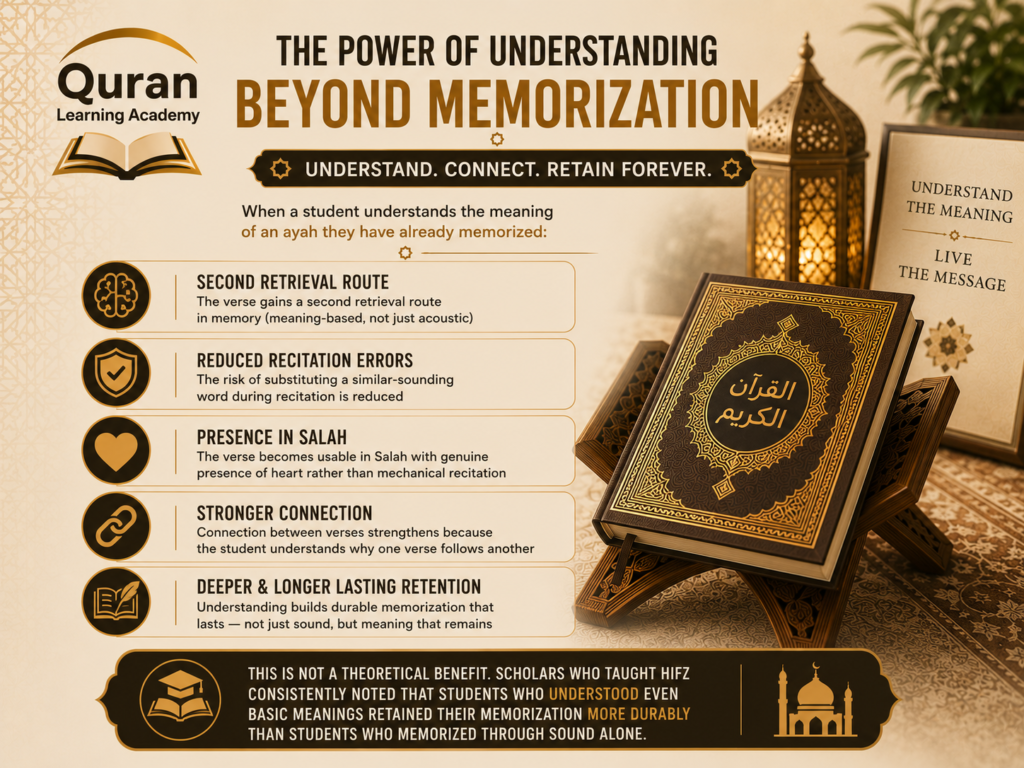
- The verse gains a second retrieval route in memory (meaning-based, not just acoustic).
- The risk of substituting a similar-sounding word during recitation is reduced.
- The verse becomes usable in Salah with genuine presence of heart rather than mechanical recitation.
- Connection between verses strengthens because the student understands why one verse follows another.
This is not a theoretical benefit. Scholars who taught Hifz consistently noted that students who understood even basic meanings retained their memorisation more durably than students who memorised through sound alone.
Step Inside Our Virtual Classrooms
See how our interactive lessons work. Watch these brief highlights of our students engaging with instructors.
Start Your Quranic Journey in the UK
Join our academy for structured online lessons with expert tutors, tailored to fit your schedule.
Book Your Free TrialThe Scholarly Position on memorising During Ramadan
One of the most practically useful pieces of classical guidance on this topic addresses Ramadan specifically — a period when British Muslims across the country significantly increase their Quran recitation.
Classical scholarship offers a direct ruling: during Ramadan, increase recitation even without tadabbur. Outside of Ramadan, prioritise reading with reflection.
This ruling is significant because it is not a vague encouragement toward one or the other. It is a context-sensitive, practical guideline that:
- Validates high-volume recitation during Ramadan regardless of comprehension.
- Establishes reflection-centred reading as the default mode outside of Ramadan.
- Confirms that both modes are accepted and produce reward.
For UK Muslims managing busy professional lives in London, Birmingham, or Manchester, this ruling offers a realistic framework. Ramadan is the time to maximise recitation volume. The eleven months that follow are the time to build the comprehension layer that makes that recitation more complete.
The Mistakes That Prevent British Muslims From Moving Forward
Most UK Muslims who memorised Quran without understanding do not lack motivation to go further. They lack a clear picture of what “going further” actually looks like. The following patterns consistently block progress:
| Mistake | Why It Stalls Development |
| Treating memorisation and understanding as mutually exclusive | Creates paralysis — learners feel they must choose one path and abandon the other |
| Waiting until Arabic is fluent before seeking meaning | Arabic fluency takes years; basic comprehension can begin immediately through translation study |
| Assuming the Madrasa model was complete | The Madrasa model built Qira’ah well; it was not designed to build Tilawah |
| Memorising new material without reviewing old material | Recall of existing memorisation weakens without consistent revision regardless of comprehension level |
| Reciting silently without teacher correction | Pronunciation errors become embedded in memory and are harder to correct the longer they persist |
Correcting the fifth mistake — pronunciation errors from years of uncorrected recitation — is often the most urgent step for adult British Muslims. If your Tajweed was never formally taught, errors have likely settled into your recitation without your awareness.
The Tajweed Course for Adults in the UK at UK Quran Learning Academy covers Makharij, Sifaat, Ghunnah, and Madd rules in a structured programme built specifically for adult learners with no prior formal Tajweed training.
Read Also: Can I Memorise Quran During Periods?
Start the Tajweed Course for Adults at UK Quran Learning Academy
Adding Understanding Practically to Existing Memorisation
For British Muslims who have already memorised portions of the Quran and want to begin adding comprehension without disrupting their existing practice, the scholarly framework suggests a progressive approach:
- Read a brief, trustworthy translation of each passage before the memorisation session — this activates meaning-based memory pathways before recitation begins.
- Note the theme of each surah rather than attempting to memorise every word’s meaning — thematic understanding provides context for individual verses.
- Connect understanding to Salah — when reciting memorised material in prayer, focus on the theme of the surah being recited to move from mechanical recitation toward present-hearted worship.
- Study Arabic vocabulary progressively — even twenty Quranic root words provide access to the meanings of hundreds of verses and begin to dissolve the language barrier graduall.
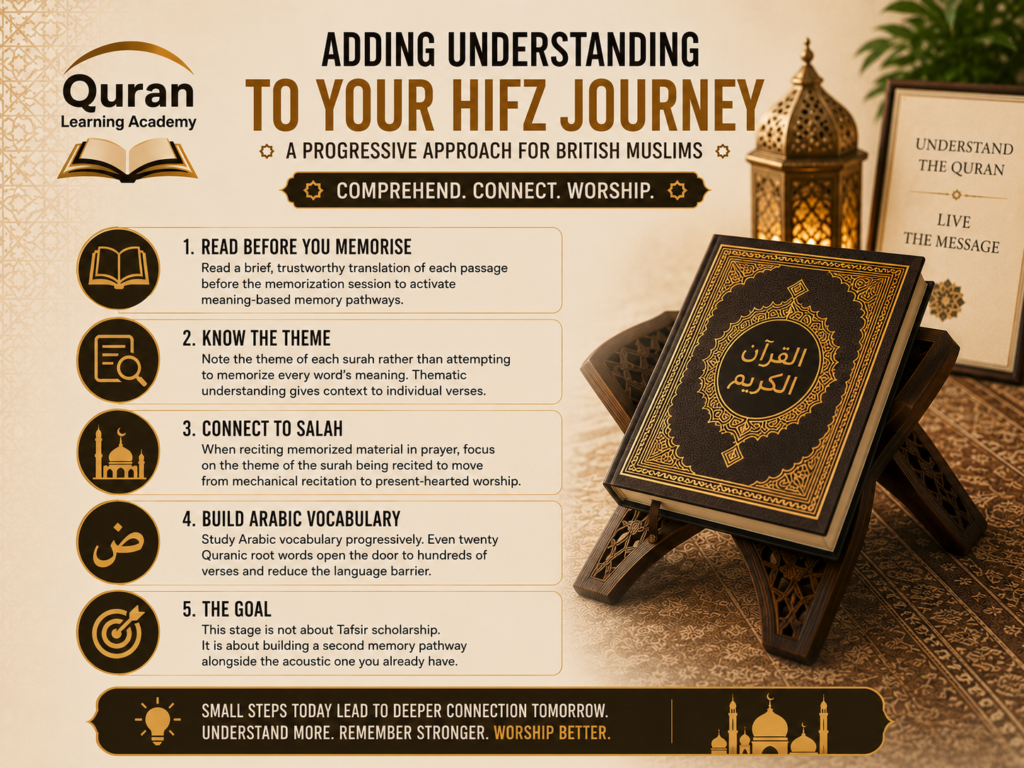
The goal at this stage is not Tafsir scholarship. It is sufficient comprehension to create a second memory pathway alongside the acoustic one that memorisation already built.
For British Muslim sisters who want to pursue this process in a structured, female-only environment, the Quran Classes for Sisters in the UK at UK Quran Learning Academy provide qualified female instructors who combine recitation accuracy with Quranic comprehension in flexible online sessions designed around UK schedules.
Read Also: Does Memorising the Quran Improve Memory?
Experience the Academy in Action
Curious about our teaching style? Take a quick look inside a live session to see our immersive, supportive learning environment first-hand.v
Start Your Quranic Journey in the UK
Join our academy for structured online lessons with expert tutors, tailored to fit your schedule.
Book Your Free TrialRead Also: Memorizing Quran by Listening
Hifz Without Understanding Versus Hifz With Understanding
For British Muslims currently in active Hifz programmes — or considering beginning one — the practical question is how understanding and memorisation interact during the process itself.
| Aspect | Hifz Without Understanding | Hifz With Understanding |
| Retention speed | Slower — acoustic memory only | Faster — multiple memory pathways |
| Retention durability | More vulnerable to forgetting under pressure | More stable — meaning provides a second anchor |
| Use in Salah | Mechanical recitation possible | Present-hearted recitation more achievable |
| Error risk | Higher — similar-sounding words substituted unconsciously | Lower — meaning context flags incorrect substitutions |
| Spiritual engagement | Limited to the act of recitation | Extended into reflection and application |
This comparison does not render Hifz without understanding invalid — it has already been established that such memorisation is accepted and rewarded. What it shows is that adding comprehension to an existing or ongoing Hifz programme produces measurable improvements across every dimension of the process.
British Muslims who have already memorised portions of the Quran and want to strengthen both retention and comprehension in one structured programme will find the Quran Memorisation Course in the UK at UK Quran Learning Academy addresses both dimensions — pairing systematic Hifz methodology with the meaning-based support that makes memorisation durable.
Start the Complete Journey at UK Quran Learning Academy
Many British Muslims who memorised Quran without understanding are not at the beginning of their journey — they are partway through it. The recitation is built. The memorisation is there. What is missing is the comprehension layer that completes the machine and allows the Quran to function as the guidance it was sent to be.
UK Quran Learning Academy offers structured programmes that meet British Muslims exactly where they are. Every programme is delivered live, one-to-one, by qualified instructors — with scheduling built around the realities of British professional and family life.
Discover Our Arabic Courses
- Online Arabic Academy
- Online Arabic Course
- Classical Arabic Course
- Arabic Course for Beginners
- Advanced Arabic Course
- Quranic Arabic Course
- Arabic Grammar Course
- Modern Standard Arabic Course
- Arabic Conversation / Speaking Course
- Intensive Arabic Course
- Online Arabic Classes for Kids
- Arabic Classes for Adults
- Arabic Classes for Ladies
- Fusha Arabic Course
- Business Arabic Course
- Al Azhar Arabic Course
- Madinah Arabic Course
- Learning Arabic for Non-Arabic Speakers
- Arabic Elementary School
- Arabic Intermediate School
- Arabic Lessons for Kindergarten
Book a Free Trial at UK Quran Learning Academy
Conclusion
Classical Islamic scholarship firmly establishes that memorising Quran without understanding is valid, accepted, and immensely rewarded. Every single letter recited carries divine weight, meaning childhood madrasa years across the UK were never wasted, but rather laid an enduring spiritual foundation for a lifelong journey with the Book of Allah.
Yet, the Quran commands reflection, making comprehension the natural next step rather than a separate path. By adding translation and study to existing memorisation, British Muslims can deepen their connection to the divine text, allowing the verses they carry to transform into a guide they truly understand and live by daily.
Frequently Asked Questions
Is memorising the Quran without understanding Arabic valid?
Yes. memorising and reciting the Quran without understanding Arabic is completely valid and rewarded. Islamic scholarship teaches that sincere recitation is accepted, and those who struggle with recitation receive additional reward.
Does understanding the meaning of the Quran help with memorisation?
Yes. Understanding the meaning of the verses makes memorisation easier and improves long-term retention by helping learners connect the words with their meanings rather than relying on repetition alone.
Can I start learning the meanings of the Quran without restarting my Hifz?
Yes. You can continue your current memorisation while gradually building your understanding by reading translations, learning the themes of each surah, and studying basic Quranic vocabulary.
Should I learn Tajweed before studying the meanings of the Quran?
Yes. Learning Tajweed alongside memorisation is highly recommended because it ensures correct pronunciation from the beginning and prevents mistakes that are difficult to correct later.
Is Ramadan the best time to increase Quran recitation?
Yes. Ramadan is the ideal time to increase the amount of Quran you recite. Many scholars encouraged completing more recitation during Ramadan while continuing to study the meanings and reflect on the Quran throughout the rest of the year.







Leave a Reply