 Quran

For British Muslims planning their Hifz journey, learning how to memorise Quran in 1 year requires a structured programme that fits around work, children, and everyday responsibilities.
A one-year plan typically requires two pages daily, leaving little room for missed days. This guide focuses on maintaining that pace consistently while managing setbacks and avoiding burnout throughout the year.
1. Understand Exactly What Two Pages Per Day Means
The Quran contains 604 pages. To complete it in one year, you need 302 active memorisation days at two pages per day. The remaining 63 days of the year are your buffer for illness, travel, and the three mandatory consolidation pauses built into a one-year programme.
That buffer of 63 days sounds generous. It is not. Here is what it actually looks like across twelve months:
| Period | Days Available | Purpose |
| Months 1 to 4 | 14 days buffer | Illness, travel, emergencies |
| After Juz 10 completion | 14 days | Mandatory consolidation pause |
| After Juz 20 completion | 21 days | Mandatory consolidation pause |
| Final month | 14 days | Full Quran review before Khatm |
This means a British Muslim following a one-year programme has roughly three to four days of genuine flexibility per month before the plan breaks down. Anyone who treats this as a loose target rather than a fixed daily obligation will not finish in twelve months.
Those who are not yet reading Arabic fluently enough to cover two pages per day will find the pace doubles in difficulty. The Quran Reading Classes at UK Quran Learning Academy build the reading accuracy that makes a one-year timeline realistic before it begins.

2. Map the 12-Month Schedule Before Day One
A one-year Hifz plan that is not divided into monthly milestones collapses by month three. When you cannot see where you should be at the end of each month, you cannot tell whether you are on track or quietly falling behind.
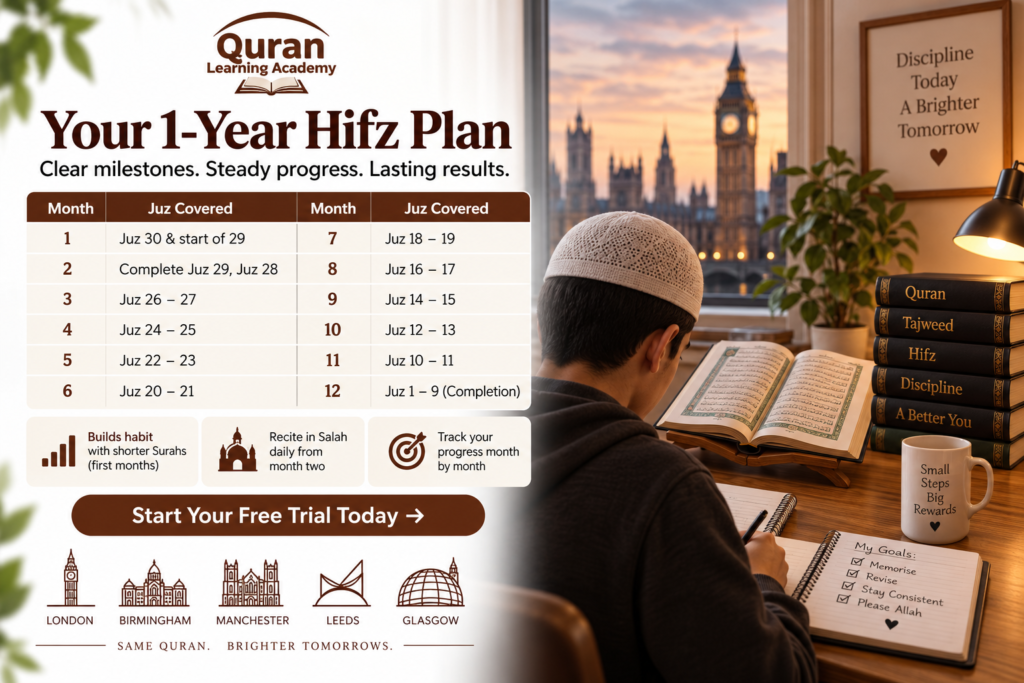
The standard division for a one-year programme, beginning from Juz 30 and working backward, looks like this:
| Month | Juz Covered |
| 1 | Juz 30 and start of 29 |
| 2 | Juz 28 to 29 completion |
| 3 | Juz 26 to 27 |
| 4 | Juz 24 to 25 |
| 5 | Juz 22 to 23 |
| 6 | Juz 20 to 21 |
| 7 | Juz 18 to 19 |
| 8 | Juz 16 to 17 |
| 9 | Juz 14 to 15 |
| 10 | Juz 12 to 13 |
| 11 | Juz 10 to 11 |
| 12 | Juz 1 to 9 completion |
Starting from Juz 30 is not arbitrary. The shorter Surahs of the final Juz build the memorisation habit at a manageable pace before the longer Surahs of the middle Juz arrive. By month two, you are reciting your memorised material in every Salah daily, creating a natural revision cycle that requires no additional scheduling.
3. Build the Daily Session Around UK Working Hours
A one-year programme at two pages per day requires roughly 90 minutes of active work daily, split across two sessions. For a British adult managing a full-time job or school run, those 90 minutes must be scheduled around fixed points in the day or they disappear.
The two-session structure that works within UK working hours:
Session One, after Fajr, 45 to 60 minutes
This is reserved for the first new page only. The mind is rested, the house is quiet before the day begins, and there are no competing demands. This session must not be used for revision. Its only function is new memorisation.
Session Two, after Maghrib or Isha, 30 to 45 minutes
This is reserved for the second new page plus a review of the four pages memorised across the two preceding days. For parents, this window typically opens after children are in bed, between 9pm and 10pm.
The structure matters because at a two-page daily pace, mixing new memorisation with heavy revision in the same session overloads consolidation capacity. The brain needs the gap between Fajr and Maghrib to process the first page before the second is added.
Step Inside Our Virtual Classrooms
See how our interactive lessons work. Watch these brief highlights of our students engaging with instructors.
Start Your Quranic Journey in the UK
Join our academy for structured online lessons with expert tutors, tailored to fit your schedule.
Book Your Free Trial4. Recognise the Three Crisis Points in a One-Year Programme
Every student following a one-year Hifz programme encounters three predictable crisis points. Knowing when they arrive and why they happen is what separates those who finish from those who quietly abandon the plan.

Crisis Point One: Month Four
By month four, the student has memorised roughly 200 pages. The early momentum of Juz 30 is gone, the Surahs are now longer and more complex, and the daily revision load has grown to the point where it competes with new memorisation for time.
This is the month where most one-year programmes collapse. The solution is not motivation. It is reducing new memorisation to one and a half pages per day for two weeks and using the recovered time to consolidate months one to three before resuming the two-page target.
Crisis Point Two: Month Eight
At month eight, the student is inside the longer Surahs of the middle Juz, where consecutive pages share similar vocabulary and verse structure.
This similarity creates confusion, where a verse memorised on Tuesday gets mixed with a nearly identical verse from the previous week. A qualified teacher catches these confusions in real time. A student working alone embeds them permanently.
Crisis Point Three: The Final Month
By month twelve, the student holds 550 or more pages in memory. The final 50 pages of new memorisation are being added on top of a revision load that now spans the entire Quran.
This is not a memorisation challenge. It is a time management challenge, and students who have not built a consistent daily revision habit by this point will find the final month overwhelming.
5. Apply the 6:1 Weekly Revision Cycle
At a two-page daily pace, skipping revision for three consecutive days undoes an entire week of memorisation work. The weekly structure that prevents this is a fixed 6:1 ratio: six days of new memorisation with rolling review, and one full day of revision with zero new material.
The weekly breakdown:
- Days 1 to 6: Two new pages daily, plus a review of the four pages from the two preceding days before beginning each session.
- Day 7: No new memorisation. Recite every page from the past six days as one continuous block to a teacher or recitation partner.
For British Muslims, Day 7 works naturally on a Sunday when the weekday schedule eases. The non-negotiable element is that Day 7 produces nothing new. Its only function is to convert the week’s memorisation from short-term retention into something durable enough to survive month four.
Allah SWT says in the Quran, establishing the relationship between consistent effort and Quranic preservation:
” إِنَّا نَحْنُ نَزَّلْنَا الذِّكْرَ وَإِنَّا لَهُ لَحَافِظُونَ “
Inna nahnu nazzalna al-dhikra wa inna lahu lahafizoon.
“Indeed, it is We who sent down the Qur’an and indeed, We will be its guardian.”
Your revision is your participation in that preservation.
Read more: Memorise Quran in 30 Days.
6. Pause After Every Ten Juz for Consolidation
Continuous forward memorisation without a structured mid-programme pause produces a well-documented failure pattern: the student reaches Juz 20 and discovers that Juz 1 through 10 have faded to near-total loss. In a two-year programme, there is time to recover. In a one-year programme, there is not.
The three mandatory consolidation pauses in a one-year schedule:
- After Juz 1 to 10: Stop all new memorisation for 14 days. Review those ten Juz daily, eight pages per day. Return to new memorisation only after completing this period.
- After Juz 11 to 20: Stop for 21 days. Review all twenty Juz daily, eight pages per day. This is the longest pause in the programme and the one most students resist because they feel they are losing time. They are not. They are preventing the collapse of the first half.
- After Juz 21 to 30: The full Quran is now in memory. Spend the remaining buffer days on a final three-stage review before Khatm.
These pauses are built into the 63-day buffer calculated in the monthly schedule above. They are not extras. They are the reason the programme produces a complete, retained Quran rather than a partially memorised one.
Students who want structured support through these consolidation pauses, with a teacher managing the review schedule, can join the Quran Memorisation Course at UK Quran Learning Academy, designed specifically for learners balancing Hifz with work and family commitments across Britain.

Enrol and start your free trial
7. Correct Tajweed Errors Daily, Not Weekly
At a two-page daily pace, a Tajweed error left uncorrected for one week has been rehearsed fourteen times across two pages. After two weeks, it has been rehearsed twenty-eight times.
An error repeated that many times is not a mistake. It is a habit, and unlearning it at this pace is harder than the original memorisation.
The Prophet, peace be upon him, established the standard through his own practice. Jibreel reviewed the Quran with him once every year, and twice in the year of his passing. Reciting to a qualified listener is the original method of Quranic transmission, not a modern addition.
مَثَلُ الَّذِي يَقْرَأُ الْقُرْآنَ وَهْوَ حَافِظٌ لَهُ مَعَ السَّفَرَةِ الْكِرَامِ الْبَرَرَةِ، وَمَثَلُ الَّذِي يَقْرَأُ الْقُرْآنَ وَهْوَ يَتَعَاهَدُهُ وَهْوَ عَلَيْهِ شَدِيدٌ، فَلَهُ أَجْرَانِ
“Such a person as recites the Qur’an and masters it by heart, will be with the noble righteous scribes (in Heaven). And such a person exerts himself to learn the Qur’an by heart, and recites it with great difficulty, will have a double reward.”
The struggle in a one-year programme is not a sign that you are failing. It is a sign that you are earning double reward.
Experience the Academy in Action
Curious about our teaching style? Take a quick look inside a live session to see our immersive, supportive learning environment first-hand.
Start Your Quranic Journey in the UK
Join our academy for structured online lessons with expert tutors, tailored to fit your schedule.
Book Your Free Trial8. Understand the Revision Load That Builds by Month Six
This is the element that catches most students in a one-year programme completely unprepared. By month six, you hold approximately 300 pages in memory.
Your daily revision obligation, using the 6:1 weekly cycle and the rolling four-page review, now consumes roughly the same amount of time as your two pages of new memorisation.
By month nine, your daily revision load exceeds your new memorisation session in time if it is being done correctly. This is not a problem. It is the design. A Hifz programme that does not produce this pattern by month eight is a programme where the early Juz are being quietly forgotten.
British students who have not planned for this shift run out of time in months seven and eight and begin skipping revision to keep up with new memorisation.
That is the exact moment the programme begins to unravel. The solution is to extend the Day 7 revision session and, when necessary, use the Dhuhr or Asr window for cumulative review of older Juz.
For sisters seeking structured Hifz support in a female-only environment with flexible scheduling designed around UK home and work commitments, the Quran Hifz for Ladies programme at UK Quran Learning Academy provides exactly that.

9. Build a Post-Khatm Maintenance Plan Before You Finish
Completing the memorisation in month twelve is not the finish line. Students who treat it as one lose significant portions within three months. The maintenance plan must be in place before the thirtieth Juz is complete, not after.
A practical weekly maintenance routine after Khatm:
- Days 1 to 6: Recite five Juz per day from memory, completing a full review of the entire Quran each week.
- Day 7: Listen to a proficient reciter covering the same five Juz without following along in the Mushaf.
For children starting their Hifz journey early, the advantage of building this lifelong maintenance habit from a young age is enormous.
The Quran Memorisation for Kids programme at UK Quran Learning Academy gives children aged 5 to 15 a purpose-built system with structured review cycles matched to developing minds.

Enrol your child and start a free trial
UK Quran Learning Academy: Built for British Muslim Schedules
Completing Hifz in one year in the UK means memorising through term times, Ramadan, working weeks, and school holidays. It means finding 90 minutes daily inside a schedule that was not designed with Hifz in mind.
That is where structure and accountability from a qualified teacher make the difference between finishing and stopping at Juz 15.
UK Quran Learning Academy connects British learners with qualified Azhari instructors who hold Ijazah, teach with real-time Tajweed correction from the first session, and offer scheduling flexible enough to fit around UK working and family life.
Every programme is delivered one-to-one online, with revision plans built into the curriculum so students are not managing the schedule alone.
Discover Our Quran Courses
- Quran Recitation Classes
- Quran Reading Classes
- Online Quran Classes for Kids
- Quran Classes for Adults
- Quran Classes for Female / Sisters
- Learn Quran Course for Beginners

Book your free trial at UK Quran Learning Academy
Conclusion
Memorising the Quran in 1 year in the UK is a precision commitment, not a general intention. It is two pages daily across 302 active days, a 6:1 weekly revision cycle, three mandatory consolidation pauses, and a daily Tajweed correction session with a qualified teacher. Remove any one of those components and the twelve-month deadline becomes a fifteen or eighteen-month reality.
The plan works when all its parts work together. The arithmetic is fixed. The only variable is whether the structure around it holds.
Read more: Quran Memorisation Partners Online in the UK.
Frequently Asked Questions
What happens if I miss several days during my one-year plan?
Missing one or two days can be recovered gradually. Avoid memorising four pages in one day, as overloading yourself can weaken retention and make recovery harder.
Why does the one-year plan start from Juz 30 instead of the beginning?
Juz 30 contains shorter Surahs with familiar vocabulary and passages many students already know from Salah, reducing cognitive load while establishing consistent memorisation habits.
How much daily revision is required by month six of a one-year plan?
By month six, expect roughly 60 to 80 pages of weekly revision alongside new memorisation, requiring approximately 45 to 60 additional minutes daily.
Is a one-year Hifz plan realistic for adults working full-time in the UK?
Yes, with a protected 90-minute daily study period and qualified teacher support to manage new memorisation, revision, consolidation, and the overall schedule.








[…] Read more: Memorise Quran in 1 Year. […]
[…] Read more: Memorise Quran in 1 Year. […]