 Quran
Memorising the Quran alone in the UK is harder than it sounds. Between full-time work, university deadlines, and family life in cities like London, Birmingham, and Manchester, most British Muslims who attempt solo Hifz quietly abandon it within months. No accountability, no correction, no one to recite to.
Finding a Quran memorisation partner online in the UK solves that directly. This guide gives you the exact steps to find the right partner, structure the partnership, and keep it running long-term.
1. Identify the Platforms Where UK Hifz Partners Actually Gather
The most practical starting point is knowing which platforms host active UK-based communities, rather than spending time on international forums where time zones and recitation traditions differ from the British Muslim experience.
Before searching any platform, the foundation is non-negotiable: brothers seek male partners exclusively, and sisters seek female partners exclusively. Three platforms consistently produce the best results for UK learners:
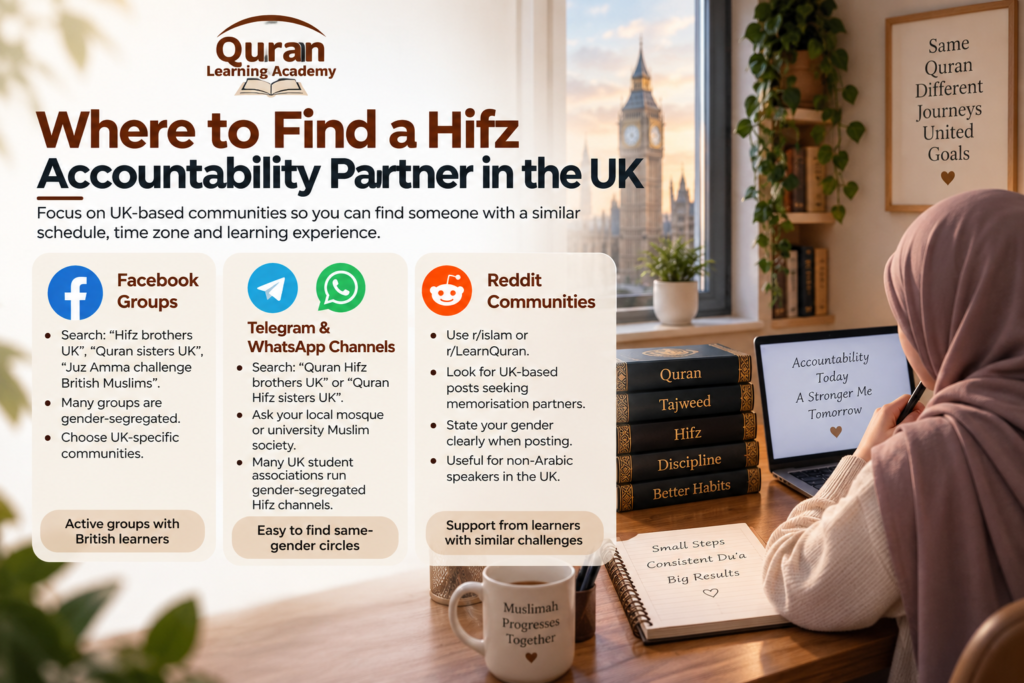
a. Facebook Groups
Search terms such as “Hifz accountability brothers UK,” “Quran sisters memorisation group UK,” or “Juz Amma challenge British Muslims” surface dozens of active groups.
Many groups are already gender-segregated, which makes finding a same-gender partner straightforward. Narrow your search to UK-specific communities where members share broadly similar schedules and the pressures of balancing deen with daily life in Britain.
b. Telegram and WhatsApp Channels
Search “Quran Hifz brothers group UK” or “Quran Hifz sisters group UK” on Telegram, or ask within your local mosque’s WhatsApp network for active same-gender memorisation circles.
British Muslim student associations at universities across London, Leeds, and Birmingham frequently run gender-segregated Hifz channels where members check in daily with their completed portion.
c. Reddit Communities
The r/islam and r/LearnQuran communities host recurring threads where UK-based students seek memorisation partners. When posting, state your gender clearly so that responses come only from appropriate candidates.
This is particularly useful for British Muslims who are non-Arabic speakers sharing the specific challenge of memorising in a language that is not their mother tongue.
2. Write a Partnership Post That Filters the Right Candidates
A vague post attracts vague responses. Every partnership request you publish should function as a concise profile that allows the right person to self-select and the wrong person to scroll past. A post that reads “anyone want to do Hifz together?” will be ignored by serious learners.
A strong partnership post includes six specific details:
- Your gender, stated clearly at the start so only same-gender candidates respond.
- Your current memorisation level, specifying which Juz you have completed and where you are now.
- Your daily target in lines or pages of new memorisation.
- Your revision load per session, so your partner knows the time commitment required.
- Your availability in specific hours using GMT or BST, not vague terms like “mornings.”
- Your preferred session format, whether voice call, video, or text-based recitation check.
A sample post that works: “Brother looking for a Hifz partner. Currently in Juz 28, memorising 5 lines daily with 1-page revision. Available weekday evenings 8–9pm GMT. WhatsApp voice call preferred.”
Many British Muslims find that pairing a peer partnership with structured instruction removes the pressure of building accountability entirely from scratch.
The UK Quran Learning Academy’s Quran Memorisation Course in the UK provides qualified Azhari instructors who design your revision schedule and correct your Tajweed in real time, complementing any peer partnership you build alongside it.

3. Vet Your Potential Partner Before Committing
Finding a candidate is step one. Choosing the right candidate requires a brief but deliberate vetting process before any long-term arrangement begins.
One trial session reveals more than ten introductory messages, so propose a single trial covering new memorisation recitation, revision recitation, and a brief discussion of Tajweed standards.
Three questions must be asked and answered before finalising any partnership:
- What is your current Tajweed standard? A partner who recites without applying basic Tajweed rules will embed errors into your memorisation rather than correct them.
- What happens if you miss a session? A reliable partner will have a clear make-up protocol ready, whether that is a voice note recitation or a rescheduled call within 24 hours.
- How do you prefer to handle corrections? Some learners want every error flagged immediately; others prefer fluency first. Mismatched correction styles create tension quickly.
Read more: Memorise Quran in 1 Year.
4. Establish a Structured Partnership Agreement From Day One
A Hifz partnership without a clear structure is a conversation, not an accountability system. The agreement does not need to be elaborate. A simple shared understanding covering session format, daily targets, and communication expectations is enough to keep both partners aligned for months.
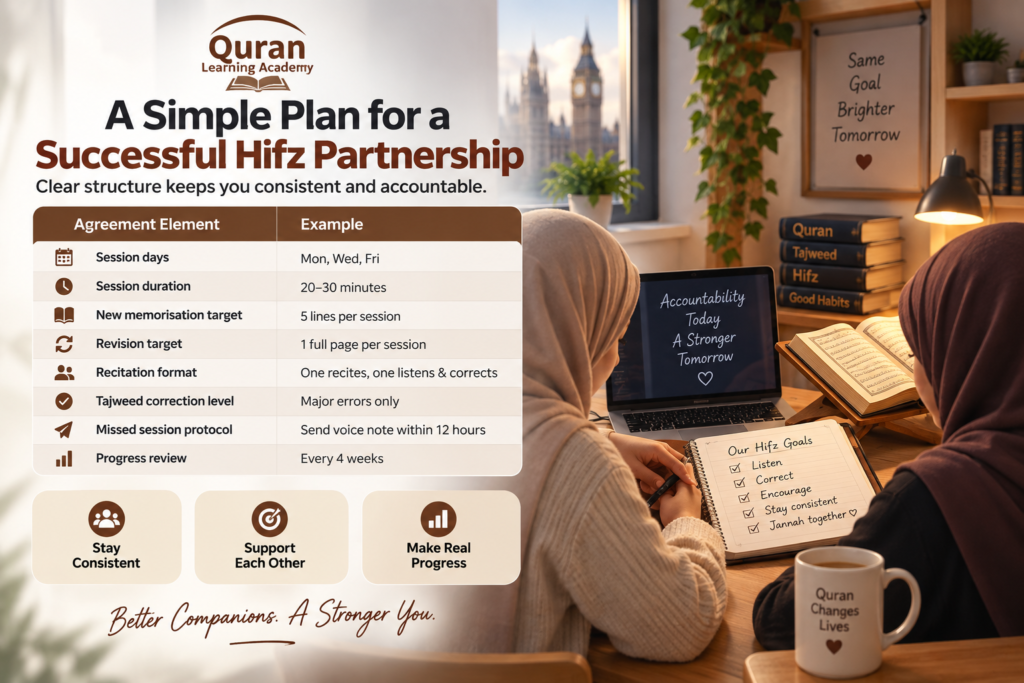
The following framework covers every element a functional UK Hifz partnership needs:
| Agreement Element | Example Specification |
| Session days | Monday, Wednesday, Friday |
| Session duration | 20 to 30 minutes |
| New memorisation target | 5 lines per session day |
| Revision target | 1 full page per session |
| Recitation format | Each partner recites; the other listens and corrects |
| Tajweed correction level | All major errors flagged; minor errors noted only |
| Missed session protocol | Voice note recitation sent within 12 hours |
| Monthly progress review | Overall Hifz progress discussed every four weeks |
Review the agreement after the first month. Realistic daily capacity only becomes clear after four weeks of actual sessions, and targets set on day one rarely survive contact with a full British work week or university term unchanged.
Step Inside Our Virtual Classrooms
See how our interactive lessons work. Watch these brief highlights of our students engaging with instructors.
Start Your Quranic Journey in the UK
Join our academy for structured online lessons with expert tutors, tailored to fit your schedule.
Book Your Free Trial5. Apply the Right Memorisation Method in Every Session
Accountability without the correct memorisation technique produces inconsistent retention. Every session should follow a format that actively strengthens memory, not simply verifies that memorisation happened.
A session structure that builds layered retention works as follows: recite the new portion first, then revise the most recently memorised material, then spot-check an older section from further back. This three-part sequence is the difference between a Hifz that holds and one that requires constant re-memorisation of the same pages.
Allah addresses the importance of holding firmly to revealed knowledge in Surah Al-Isra, reminding believers of the guiding nature of the Quran itself:
“إِنَّ هَٰذَا الْقُرْآنَ يَهْدِي لِلَّتِي هِيَ أَقْوَمُ”
Inna hādhā al-Qur’āna yahdī lillatī hiya aqwam
“Indeed, this Qur’an guides to that which is most suitable.”
The Prophet ﷺ specifically warned against neglecting revision, making it clear that memorisation without consistent review is temporary. This hadith establishes why the revision portion of every session is not optional:
“تَعَاهَدُوا الْقُرْآنَ فَوَالَّذِي نَفْسِي بِيَدِهِ لَهُوَ أَشَدُّ تَفَصِّيًا مِنَ الإِبِلِ فِي عُقُلِهَا”
“Commit yourself to the Qur’an, for by Him in whose Hand is my soul, it is surely more prone to break away than a camel in its bind.”
For British Muslims who struggle to maintain consistent revision alongside work and family life, the UK Quran Learning Academy’s Hifz Classes for Adults in the UK builds personalised revision schedules around your actual weekly capacity, managed by qualified instructors rather than left to self-discipline alone.

6. Maintain the Partnership Over the Long Term
The most common reason solid Hifz partnerships dissolve is neglect of the relationship itself. Both partners focus entirely on the Quran work and forget that the partnership itself needs maintenance to survive the pressures of British daily life.
Schedule a monthly review outside your regular sessions. Ten minutes to discuss what is working, what needs adjusting, and whether targets should be revised.
Celebrating milestones together also sustains motivation through the difficult middle sections of Hifz: completing a Juz, reaching 100 consecutive days of sessions, or finishing a long Surah are all worth acknowledging.
The Prophet ﷺ established the highest status for those who engage with the Quran as both learners and teachers, which is precisely what a Hifz partnership embodies:
“خَيْرُكُمْ مَنْ تَعَلَّمَ الْقُرْآنَ وَعَلَّمَهُ “
“The best among you (Muslims) are those who learn the Qur’an and teach it.”
Treating your partnership as an act of mutual teaching rather than mutual monitoring shifts the entire dynamic toward something spiritually sustaining rather than transactional.
Experience the Academy in Action
Curious about our teaching style? Take a quick look inside a live session to see our immersive, supportive learning environment first-hand.
Start Your Quranic Journey in the UK
Join our academy for structured online lessons with expert tutors, tailored to fit your schedule.
Book Your Free Trial7. Recognise When a Partner Alone Is Not Enough
Online partnerships are powerful, but they have clear limitations. A peer partner provides accountability. They cannot provide expert Tajweed correction, progressive curriculum design, or the certified chain of transmission required for Ijazah.
The signs that a partnership needs professional supplementation are clear:
- Tajweed errors are accumulating uncorrected because neither partner can identify them.
- Memorisation pace has stalled despite consistent sessions.
- Revision is falling behind new memorisation, which is a dangerous imbalance.
- You are memorising past Juz 20 without a certified instructor’s oversight.
Sisters across Britain managing these challenges will find the UK Quran Learning Academy’s Quran Hifz for Ladies in the UK particularly suited to their needs, with qualified female instructors providing structured memorisation training, revision scheduling, and real-time Tajweed correction in a private, supportive environment.

8. Build a Support System Beyond a Single Partnership
Relying on a single partner creates a single point of failure. When that partner’s schedule changes, moves city, or faces a life event, the entire accountability structure collapses. British Muslims who sustain Hifz long-term typically build a layered support system rather than depending on one arrangement alone.
A sustainable support system for UK learners combines three elements:
- A primary same-gender accountability partner for daily or alternate-day recitation checks.
- A secondary community, such as a mosque Hifz circle or an online gender-segregated group, for weekly group sessions.
- A qualified instructor providing fortnightly correction sessions and curriculum oversight.
This layered structure means that if one element weakens, the others hold. For younger learners, the UK Quran Learning Academy’s Quran Memorisation for Kids in the UK provides children aged 5 to 15 with exactly this kind of structured community environment, combining spaced repetition, auditory reinforcement, and qualified instruction within a safe, monitored setting.

Book a free trial for your child.
Build Your Hifz on a Foundation That Lasts
A peer partnership gets you started. A qualified programme gets you to the end. The UK Quran Learning Academy connects British learners with qualified Azhari instructors who hold Ijazah and specialise in Hifz across the UK.
Every programme is built around flexible online scheduling, real-time Tajweed correction, and personalised revision plans that fit around British working and family life.
Lessons run entirely online, meaning learners in London, Glasgow, Cardiff, and Belfast access the same quality of instruction with no commute and no compromise on schedule flexibility.
Instructors are trained to work specifically with non-Arabic speaking British Muslims, understanding the linguistic and cultural challenges that make Hifz outside a traditional setting uniquely demanding.
Discover Our Quran Courses
- Quran Reading Classes
- Online Quran Classes for Kids
- Quran Classes for Adults
- Quran Memorization (Hifz) Course
- Hifz Classes for Adults
- Quran Memorization and Hifz Course for Kids
- Quran Hifz Course for Ladies

Conclusion
Finding a Quran memorisation partner online can make Hifz more consistent, accountable, and manageable alongside life in the UK. The right partner provides regular recitation, encouragement, and a reason to keep going when motivation drops.
Choose someone with similar goals, agree on a clear routine, and keep revision at the centre of your partnership. With the right support and steady effort, each memorised verse becomes another step toward a stronger and lasting relationship with the Quran.
Read more: How Much Quran Should I Memorise Daily?
Frequently Asked Questions
How do I find a same-gender Quran memorisation partner online in the UK?
Add “brothers only” or “sisters only” to your post and search gender-specific groups on Facebook and Telegram. State your gender at the start of every partnership request without exception.
How often should Hifz accountability partners meet online?
Three to five times per week works best. Daily sessions suit active memorisation phases; alternate days work during heavy revision periods. Consistency matters more than frequency.
What should I do if my Hifz partner stops showing up?
Send one follow-up within 48 hours. If there is no response, begin searching for a replacement immediately and continue your revision independently without pausing.
Is an online Hifz partner enough without a teacher?
For the first few Juz, a strong partnership sustains good progress. Beyond that, qualified instruction becomes essential to prevent Tajweed errors from embedding into long-term memorisation.
Can children benefit from online Quran memorisation partners?
Children benefit most from supervised group settings or parent-supervised sibling arrangements, not unsupervised one-on-one online partnerships.







[…] Read more: Quran Memorisation Partners Online in the UK […]