 Quran

Many students who have memorised individual surahs still freeze when asked: what comes after Surah Al-Fil? They know the text, but the sequence escapes them. This is one of the most common and frustrating gaps in Hifz, and it is rarely addressed directly. Knowing how to memorise the order of surahs is a separate skill from memorising the surahs themselves.
Without it, revision becomes unreliable, recitation in salah becomes hesitant, and the journey toward complete Hifz loses its structure. British Muslims juggling work, family, and worship need a method that embeds surah order into daily routine, not one that demands additional hours of isolated study.
1. Begin Sequential Memorisation from Juz Amma
The most reliable entry point for learning surah order is Juz Amma, which contains the final 37 surahs of the Quran. These surahs are short, rhythmically consistent, and already encountered frequently in daily salah. Beginning here allows the student to build a clear, sequential mental map from Surah An-Naba (78) through to Surah An-Nas (114).
The key is to memorise each surah while consciously naming the one before and after it. This habit, practised consistently from the start, means the student is not just learning text but encoding position. A student who says “I am memorising Surah Al-Ghashiyah, which comes after Al-A’la and before Al-Fajr” is building a sequential index alongside the memorisation itself.
Within Juz Amma, the following ordering is worth noting:
| Surah | Number | Frequently Recited In |
| Al-Ikhlas | 112 | Daily salah, du’a |
| Al-Falaq | 113 | Morning and evening adhkar |
| An-Nas | 114 | Morning and evening adhkar |
| Al-Kawthar | 108 | Short salah |
| Al-Asr | 103 | Daily reminders |
Once Juz Amma is complete in order, the student has a working sequential model to extend forward into Juz 29 and beyond.
Enrolling in the UK Quran Learning Academy’s Quran Memorisation Course in the UK gives students a structured framework that begins exactly here, with qualified instructors who ensure surah order is embedded from the first session.

2. Use the First-Letter List to Lock in Sequence
One of the most effective techniques specifically for order retention is writing the first one or two letters of each surah name in sequence. This is not a mnemonic in the traditional sense. It is a compression method that forces the brain to recall position without relying on the full name.
For Juz Amma, the list looks like this:
- Na (An-Naba).
- Nazi (An-Nazi’at).
- ‘Ab (Abasa).
- Ta (At-Takwir).
- In (Al-Infitar).
Writing this list repeatedly, then testing yourself by recalling the full surah name from each abbreviation, trains positional memory. The moment a student hesitates at “Ta,” they know immediately that the weak point is Surah At-Takwir, and they can target that position specifically.
This method is particularly useful for students who confuse surahs with similar names or similar opening verses, as it separates the question of “what is the text” from “what is the position.”
3. Integrate Surah Order into Your Salah Cycle
The most powerful revision tool for surah order is salah itself. Every prayer is an opportunity to practise sequence without creating extra study time. A student who recites surahs consecutively across five daily prayers, moving forward through the surah order rather than returning to the same two or three chapters, is constantly reinforcing position.
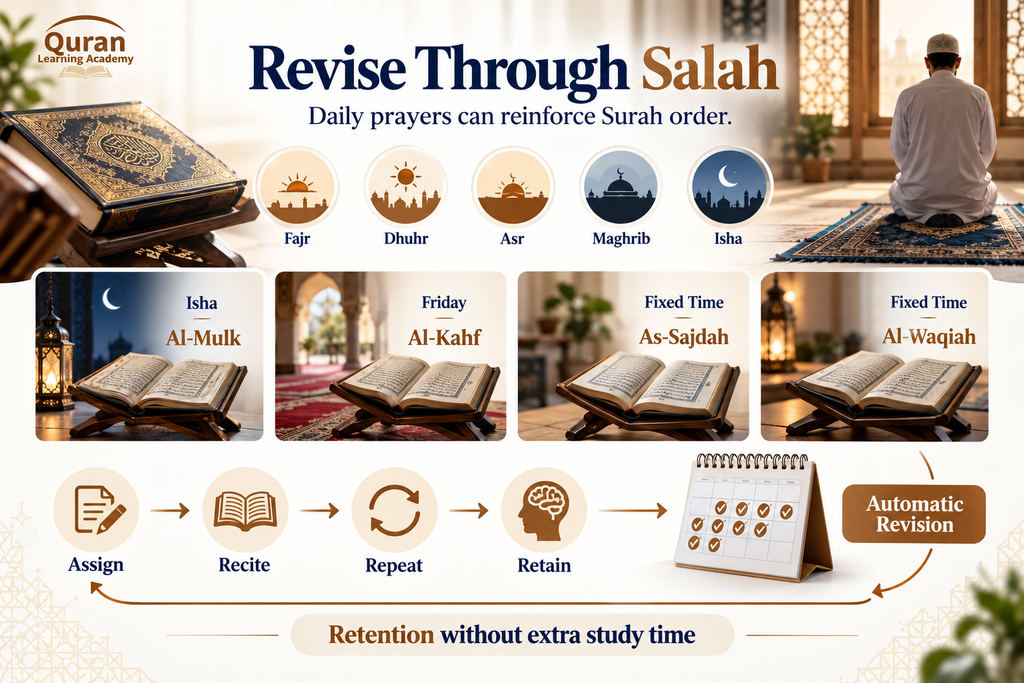
The practical approach is as follows. After completing Juz Amma, add Surah Al-Mulk to the nightly ‘Isha recitation. Add Surah Al-Kahf to the Friday routine.
As surahs like As-Sajdah and Al-Waqiah are memorised, assign each a fixed time. This creates what might be called automatic revision, where the sequence is maintained not through dedicated study sessions but through daily religious practice.
The benefit of this method is retention without extra effort. A surah recited in every Fajr prayer for three months does not need to be revised separately.
Step Inside Our Virtual Classrooms
See how our interactive lessons work. Watch these brief highlights of our students engaging with instructors.
Start Your Quranic Journey in the UK
Join our academy for structured online lessons with expert tutors, tailored to fit your schedule.
Book Your Free Trial4. Apply Story Association to Fix Difficult Sequences
Story association is a classical technique used across the Islamic world to help students remember surah order, particularly for the longer middle sections of the Quran where names are less familiar to British learners. The method involves constructing a narrative that links surah names in sequence, so that recalling one name automatically triggers the next.
A simple example for the early surahs:
A man recited Al-Fatiha before slaughtering a cow (Al-Baqarah). He followed the example of the family of Imran and sought to provide for the women in his household (An-Nisa). At the table (Al-Ma’idah), he gave thanks, then looked after his cattle (Al-An’am).
The story does not need to be sophisticated. It needs to be memorable and sequential. For British learners, constructing a story using familiar British settings, a family home, a journey from London to Manchester, a Friday gathering at the local masjid, can make the associations more durable.
Students of the UK Quran Learning Academy’s Online Tajweed Classes in the UK often find that this technique works especially well when combined with accurate pronunciation work, as the surah names themselves become more distinct and harder to confuse.

5. Build a Progress Chart Organised by Surah Number
Tracking memorised surahs by their Mushaf number, rather than by the order in which they were memorised, creates a visual representation of sequential progress. A chart running from Surah 1 to Surah 114, with each position marked as memorised or not, immediately shows which numbers are missing.
This matters because many students memorise surahs out of sequence and then struggle to identify the gaps. A numbered chart makes the gaps visible.
It also reinforces the understanding that surah order is fixed and standardised, which is itself an important piece of knowledge for anyone serious about Hifz.
The chart can be divided as follows:
| Section | Surah Range | Priority Level |
| Juz Amma | 78-114 | First |
| Commonly Recited | Al-Mulk, Al-Kahf, Yasin | Second |
| Juz 29 | 67-77 | Third |
| Al-Baqarah onwards | 2-66 | Fourth |
Working through this sequence systematically, rather than jumping based on familiarity, is the most reliable path to knowing the full surah order without gaps.
The UK Quran Learning Academy’s Quran Memorisation Course in the UK structures its curriculum exactly this way, using numbered checkpoints to ensure no surah position is skipped or left unrevised.
6. Use Thematic Groupings to Reinforce Adjacent Surahs
Some surahs are positioned together in the Mushaf because of shared themes, and understanding these connections makes their sequential order easier to retain. This is not Tafsir study as a separate activity. It is using thematic awareness as a memory anchor.
Several groupings are worth knowing:
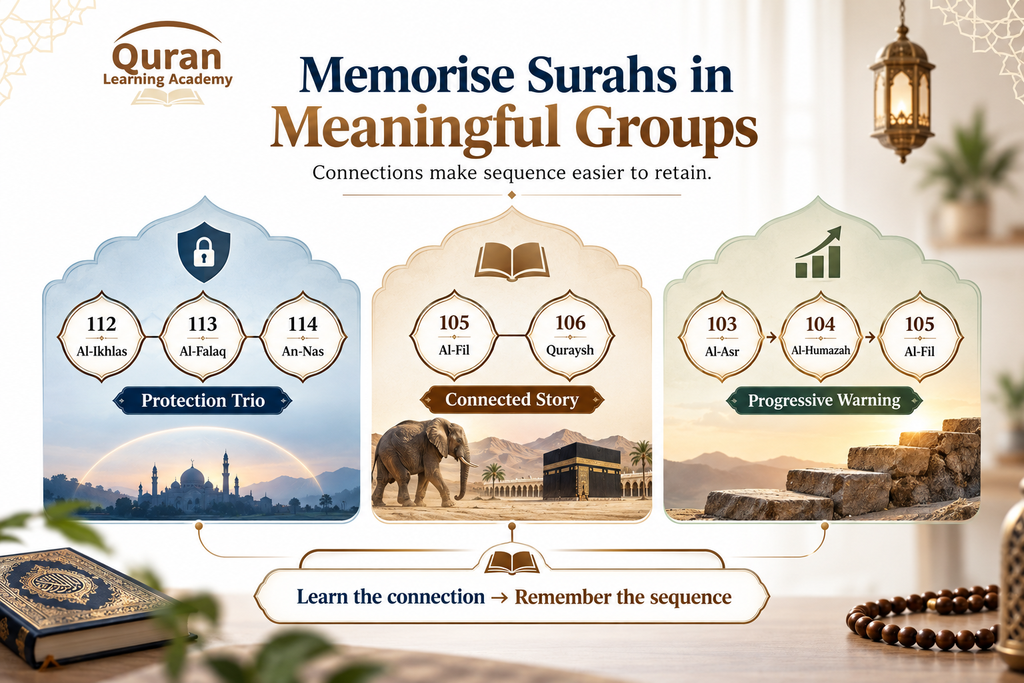
- Al-Ikhlas (112), Al-Falaq (113), and An-Nas (114) form a trio of protection and are memorised and retained together naturally.
- Al-Fil (105) and Quraysh (106) are narratively connected, with the first describing Allah’s protection of the Kaaba and the second describing the blessing this brought to the Quraysh.
- Al-Asr (103), Al-Humazah (104), and Al-Fil (105) each address consequences of disbelief in a progressively sharpened tone.
Recognising these connections means that knowing one surah’s position gives the student a reliable anchor for the surrounding surahs. This reduces the number of positions that must be memorised independently.
Experience the Academy in Action
Curious about our teaching style? Take a quick look inside a live session to see our immersive, supportive learning environment first-hand.
Start Your Quranic Journey in the UK
Join our academy for structured online lessons with expert tutors, tailored to fit your schedule.
Book Your Free Trial7. Set a Weekly Surah Order Review Session
Sequential memorisation deteriorates without dedicated review of the sequence itself, separate from revision of the text. A fifteen-minute weekly session focused exclusively on recalling surah names in order, without looking at the Mushaf, identifies weaknesses before they become gaps.
The session should follow a consistent structure:
- Recite all memorised surah names in order from memory.
- Note any hesitation points by surah number.
- Spend five minutes specifically on the two or three positions that caused hesitation.
This is distinct from text revision. The student is not reciting the surah itself but practising the retrieval of its name and position. Over time, this builds a reliable mental index that makes full Quran recitation and revision far more fluid.
Read more: How to Memorise the Quran in 3 Years in the UK? Schedule and Study Plan.
8. Strengthen Retention Through Peer Revision
Revising surah order with another student adds an accountability layer that solo study cannot replicate. When two students take turns naming surahs in sequence and correcting each other, errors in order are caught immediately rather than becoming embedded.
This is a method used in traditional Hifz circles across the Muslim world, and it works precisely because it creates a social consequence for hesitation.
In British Muslim communities, this can be structured through weekend Quran circles, family revision sessions after ‘Isha, or online revision pairs. A student who knows they will be tested on surah order by a peer on Friday has a concrete reason to practise the sequence throughout the week.
The UK Quran Learning Academy’s Weekend Quran Classes in the UK offer this kind of structured peer environment, where students revise together under qualified guidance rather than in isolation.

UK Quran Learning Academy: Structured Hifz Support for British Learners
British Muslims face specific challenges when it comes to Quran memorisation. Irregular schedules, weekend-only availability, and the absence of a traditional Hifz school environment mean that most learners in the UK need a programme built around their actual lives, not around an ideal that does not exist here.
The UK Quran Learning Academy works with qualified Azhari instructors who understand how to structure sequential memorisation for adult learners, working parents, and students in full-time education. Lessons are live, interactive, and scheduled around British working patterns. Every student receives a personalised revision plan that keeps surah order at the centre of the learning process.
Discover Our Quran Courses
- Quran Memorisation Course in the UK
- Online Tajweed Classes in the UK
- Weekend Quran Classes in the UK
- Quran Classes for Female / Sisters
- Learn Quran Course for Beginners
- Quran Memorization and Hifz Course for Kids

Conclusion
Knowing how to memorise the order of surahs is not a secondary concern in Hifz. It is foundational to the coherence of everything else. A student who knows the text of 60 surahs but cannot place them in sequence will struggle during revision, recitation, and any serious Hifz review.
The methods covered here, starting with Juz Amma, using letter-list compression, integrating surahs into salah, applying story association, and maintaining a numbered progress chart, each target surah order specifically and build on one another progressively.
Read more: Quran Memorisation Partners Online in the UK
Frequently Asked Questions
Should I memorise surahs in Mushaf order or start with the easiest ones?
Starting with Juz Amma is recommended for most learners because those surahs are short and already familiar from salah. However, following the Mushaf order within whichever section you are studying is essential for building a reliable sequential memory.
How do I stop confusing surahs with similar names or openings?
Using the first-letter list technique, where you reduce each surah name to its first two letters and practise recall by position, directly addresses this confusion. Combined with thematic grouping, it creates distinct anchors for each surah.
How long does it take to know the full surah order from memory?
With daily practise of fifteen to twenty minutes focused specifically on order recall, most students can reliably recall the full surah sequence within six to twelve months of consistent Hifz work, depending on their starting point.
Is it necessary to know surah order for everyday salah?
Knowing surah order matters significantly for anyone aiming at complete Hifz, as recitation out of sequence is disliked. For general salah, knowing the position of commonly recited surahs is sufficient.
Can I learn surah order without memorising the full text first?
Yes. The letter-list technique and story association methods work on surah names and positions independently of text memorisation. Many students find it helpful to learn the full sequential map of surah names before or alongside their Hifz work.








[…] Read more:How to Memorise the Order of Surahs: A Tested Method […]