 Quran

Starting Hifz without a clear target can lead to inconsistent progress and fading older portions. For UK learners balancing work, family, and other responsibilities, How Much Quran Should I Memorise Daily? depends on individual capacity and routine.
A sustainable daily target should reflect your available time, cognitive load, and ability to maintain revision. Rather than copying someone else’s pace, assess your capacity and build a consistent plan with proper guidance.
For most non-Arabic speaking learners, 3 to 7 lines per day is the recommended starting point. This range protects retention quality without overwhelming your memory before revision habits are firmly established.
The Quran contains approximately 604 pages across 30 Juz, and your daily portion must account for new memorisation and for protecting everything already learned.
The table below gives a clear starting point based on your current level:
| Level | Daily New Memorisation | Estimated Completion |
| Beginner | 3 to 5 lines | 6 to 8 years |
| Intermediate | Half a page | 3 to 4 years |
| Advanced | 1 full page | Around 2 years |
These figures assume consistent daily practice including revision days. What matters far more than the timeline is that the portion you memorise today can be recalled accurately tomorrow without rebuilding it from scratch. If you find yourself relearning yesterday’s verses every morning, your daily target is too large.
Read more: Memorise Quran in 1 Year.
Your Daily Study Time Sets Your Memorisation Limit
Available study time is the single most honest measure of how much Quran you should memorise daily. An ambitious target that only survives on free weekends is not a sustainable Hifz plan.
The following breakdown shows realistic targets based on how much time you can genuinely protect each day:
| Daily Study Time | Recommended Daily Amount | Best Suited For |
| 30 minutes | 3 to 4 lines | Working professionals and parents |
| 60 minutes | 5 to 7 lines | Students with flexible schedules |
| 90 minutes or more | Half a page to 1 page | Dedicated full-time learners |
A 30-minute daily session is not a compromise. It is a sustainable commitment that, maintained without interruption across months, produces far stronger long-term retention than two-hour sessions attempted sporadically.
Many learners find that protecting a fixed slot after Fajr, even a short one, is more achievable than longer evening sessions after a full working day.
If you want structured support to identify your correct daily target, the Quran Memorisation Course at UK Quran Learning Academy is built specifically for learners who need a personalised Hifz plan that fits around real schedules.

Enrol in the Quran Memorisation Course
The 60/40 Revision Rule Every Hifz Student Must Follow
One of the most damaging mistakes in Hifz is treating new memorisation as the only measure of progress. A student who memorises one new page daily while neglecting revision will find, within weeks, that the first Juz has disappeared while the fourth is being added. The solution is a fixed ratio that protects both old and new material.
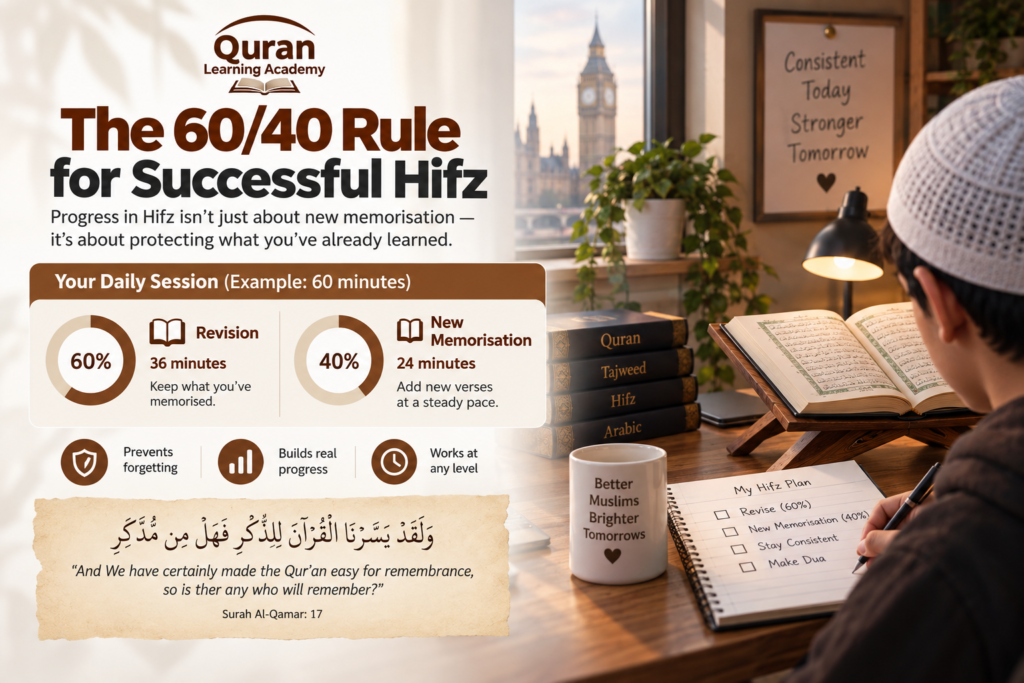
The 60/40 rule means 60% of your daily session goes to revising previously memorised material, and 40% goes to new memorisation.
For a student with a 60-minute daily session, that means 36 minutes of revision and 24 minutes of new learning. This balance is non-negotiable at any level.
Allah reminds us of the ease He has placed in the Quran, and of the active effort required to preserve it. Before beginning any new portion, it is worth reflecting on this verse from Surah Al-Qamar, which scholars of Hifz have long cited as the foundation for consistent daily revision:
“وَلَقَدْ يَسَّرْنَا الْقُرْآنَ لِلذِّكْرِ فَهَلْ مِن مُّدَّكِرٍ”
Wa laqad yassarnal-Qur’āna lidh-dhikri fahal min muddakir.
“And We have certainly made the Qur’an easy for remembrance, so is there any who will remember?”
The ease promised in this verse is realised through structured daily effort, not through sporadic intensive sessions followed by long gaps.
Step Inside Our Virtual Classrooms
See how our interactive lessons work. Watch these brief highlights of our students engaging with instructors.
Start Your Quranic Journey in the UK
Join our academy for structured online lessons with expert tutors, tailored to fit your schedule.
Book Your Free TrialHow Much Quran to Memorise Daily Based on Your Age
Age directly shapes how much new material the brain can absorb and retain each day. Children encode information faster but need lighter daily loads to avoid fatigue. Adults memorise more slowly but bring stronger discipline and the ability to manage longer revision sessions.
The following gives a practical breakdown by age group:
- Children aged 7 to 14: 3 to 5 lines daily, with completion expected over 5 to 7 years.
- Teenagers aged 15 to 20: 5 to 7 lines daily, balancing school and memorisation commitments.
- Working adults aged 21 and above: 5 to 7 lines daily, with 60% of session time dedicated to revision.
- Advanced learners returning to Hifz: half a page to one full page, with a strict 5:1 revision ratio.
For younger learners, the Quran Memorisation for Kids programme at UK Quran Learning Academy uses age-appropriate pacing with qualified instructors who understand how children’s memory develops at each stage.

Start your child’s Hifz journey
How to Structure a Daily Hifz Session for Maximum Retention
Knowing how much Quran you should memorise daily is only half the answer. The other half is how you structure the time you have. A session with no clear sequence produces weak retention even when the daily amount is appropriate. A well-structured daily Hifz session follows three distinct phases, each serving a different function in the memory process:
1. Revising Recent Material First
Open every session by reciting the last 5 to 10 pages from memory before touching the Mushaf. This active recall, rather than passive rereading, is what transfers verses into long-term memory. Students who skip this step and jump straight to new memorisation consistently show weaker retention of both old and new material within weeks.
2. Memorising New Verses With Repetition
Read the new portion carefully from the Mushaf, ensuring correct pronunciation before attempting to memorise. Repeat each verse aloud 7 to 10 times while looking, then close the Mushaf and recite from memory.
Connect each new verse to the previous one before moving forward to the next. Never move to a new verse until the current one can be recited without any visual aid.
3. Reciting to a Qualified Teacher
You cannot accurately assess your own pronunciation errors. Reciting daily to a teacher catches Makharij mistakes before they become permanent habits.
This is the step most self-study learners skip, and it is the step that costs them the most over time. The Online Tajweed Classes at UK Quran Learning Academy pair every student with a qualified instructor who listens to daily recitation and corrects errors in real time.

Completion Timelines Based on Daily Memorisation Amount
Understanding how long full Hifz takes at different daily rates helps set realistic expectations and prevents the discouragement that comes from comparing yourself to others on faster tracks. The Quran contains 604 pages, and the following timelines are based on consistent daily practice including revision:
| Daily Amount | Estimated Completion | Most Suitable For |
| 3 to 4 lines | 7 to 10 years | Busy professionals and parents |
| Half a page | 3 to 4 years | Intermediate learners with steady routines |
| 1 full page | Around 2 years | Dedicated students with significant daily time |
| 2 full pages | Around 10 months | Full-time Hifz students only |
Completing Hifz in 10 years with permanent retention is a far greater achievement than completing it in 2 years and forgetting the first Juz by the time the last is reached. The Prophet, peace be upon him, made this principle the foundation of every act of worship when he said:
“أَنَّ أَحَبَّ الأَعْمَالِ أَدْوَمُهَا إِلَى اللَّهِ، وَإِنْ قَلَّ”
“the most beloved deed to Allah is the most regular and constant even if it were little.”
Experience the Academy in Action
Curious about our teaching style? Take a quick look inside a live session to see our immersive, supportive learning environment first-hand.
Start Your Quranic Journey in the UK
Join our academy for structured online lessons with expert tutors, tailored to fit your schedule.
Book Your Free TrialBegin Your Hifz Journey With UK Quran Learning Academy
Deciding how much Quran to memorise daily is the first step. Having a qualified teacher, a structured revision system, and a programme built around your real schedule is what keeps you on the path long enough to reach your goal.
UK Quran Learning Academy connects learners across London, Birmingham, Manchester, and beyond with qualified Azhari instructors who specialise in Hifz methodology. Every student receives a personalised daily target based on their reading level, available time, and revision capacity, not a one-size-fits-all page count.
The academy’s programmes cover every stage of the Hifz journey, from foundational recitation to certified completion. Whether you are an adult returning to memorisation after years away, a parent looking for a structured programme for your child, or a sister seeking female-only instruction, there is a course designed specifically for your situation.
Discover Our Quran Courses
- Quran Recitation Classes
- Quran Reading Classes
- Online Quran Classes for Kids
- Online Tajweed Classes
- Quran Memorisation for Kids
- Quran Memorisation Course

Conclusion
There is no single daily amount that works for every Hifz student. The right target is the amount you can memorise accurately, revise consistently, and maintain alongside your daily responsibilities.
Starting with a manageable portion and protecting time for revision allows your memorisation to grow without sacrificing what you have already learned. A small amount memorised consistently can become a lifelong connection with the Quran.
Read more: Country With Most Quran Memorizers.
Frequently Asked Questions
Is 3 lines of Quran per day enough to make real progress?
Yes. Three lines per day, memorised accurately and revised consistently, produces stronger long-term retention than 10 lines memorised carelessly. The completion timeline is longer, but the Hifz that results is far more durable. Many learners who start with 3 lines gradually increase their daily amount as their reading fluency and revision habits strengthen.
What happens if I miss a day of Hifz?
Do not attempt to double the next day’s target to compensate. Resume your normal daily amount and focus on revising the material from the day you missed. Forcing extra memorisation after a gap creates rushed retention and increases the risk of errors becoming permanent.
Can adults memorise the Quran with a full-time job?
Yes, provided the daily target is realistic. A 30-minute protected session each morning, combined with passive listening during a commute, is enough to maintain steady Hifz progress alongside full-time work. The key is protecting the session time consistently rather than memorising large amounts on occasional free days.
Do I need a teacher to memorise the Quran?
Self-study produces Hifz with pronunciation errors that become increasingly difficult to correct the longer they are left. A qualified teacher identifies Makharij mistakes in real time, monitors your revision, and adjusts your daily target as your capacity changes. Learning without a teacher is possible, but the risk of accumulating uncorrected errors is significant.
How do I know when to increase my daily memorisation amount?
Increase only when the current amount passes three tests consistently: yesterday’s portion can be recalled accurately without the Mushaf, recent pages remain solid under revision, and older Juz have not weakened. If all three conditions are met for at least one full week, a small increase is appropriate.







[…] Read more: How Much Quran Should I Memorise Daily? […]
[…] Read more: How Much Quran Should I Memorise Daily? […]
[…] Read more: How Much Quran Should I Memorise Daily? […]