 Quran

Even experienced Quran readers can struggle with subtle pronunciation errors and advanced Tajweed rules. Learning advanced quran recitation with tajweed rules helps improve articulation, correct long-standing mistakes, and develop more accurate recitation through structured learning and expert guidance.
1. Madd Counts Under Hafs ‘an ‘Asim and Where Inconsistency Breaks Recitation
Most advanced learners know the Madd types exist. The consistent failure is in applying fixed counts without drift across an entire recitation session. Under Hafs ‘an ‘Asim:
| Madd Type | Trigger | Count | Ruling |
| Madd Tabi’i | Madd letter, no Hamza or Sukoon following | 2 harakaat | Fixed, no variation |
| Madd Wajib Muttasil | Madd letter followed by Hamza within the same word | 4 to 5 harakaat | Obligatory minimum 4 |
| Madd Ja’iz Munfasil | Madd letter ends a word, next word begins with Hamza | 4 to 5 harakaat | Chosen count must stay fixed throughout |
| Madd ‘Arid Lissukun | Stopping on a word ending with a Madd letter | 2, 4, or 6 harakaat | Chosen count fixed for the session |
| Madd Lazim | Madd letter followed by permanent Sukoon in the same word | 6 harakaat | Absolutely fixed, zero flexibility |
The most consequential error is choosing 4 harakaat for Madd Munfasil at the start of a session, then drifting to 2 or 3 mid-recitation without noticing. That drift is a Tajweed violation regardless of which count was originally chosen.
Madd Lazim demands specific attention in the Muqatta’at letters opening certain Surahs: الم، حم، يس، طه. The Lam in الم carries Madd Lazim Harfi Muthaqqal, requiring 6 harakaat with a Shaddah-bearing merge into the following letter.
Most advanced learners undercount these positions by 1 or 2 harakaat habitually, because no one has ever timed them with a qualified teacher present.
The Online Tajweed Classes in the UK at UK Quran Learning Academy address Madd consistency through live recitation monitoring by Azhari-certified instructors who catch count drift the moment it occurs.

Start improving your recitation today
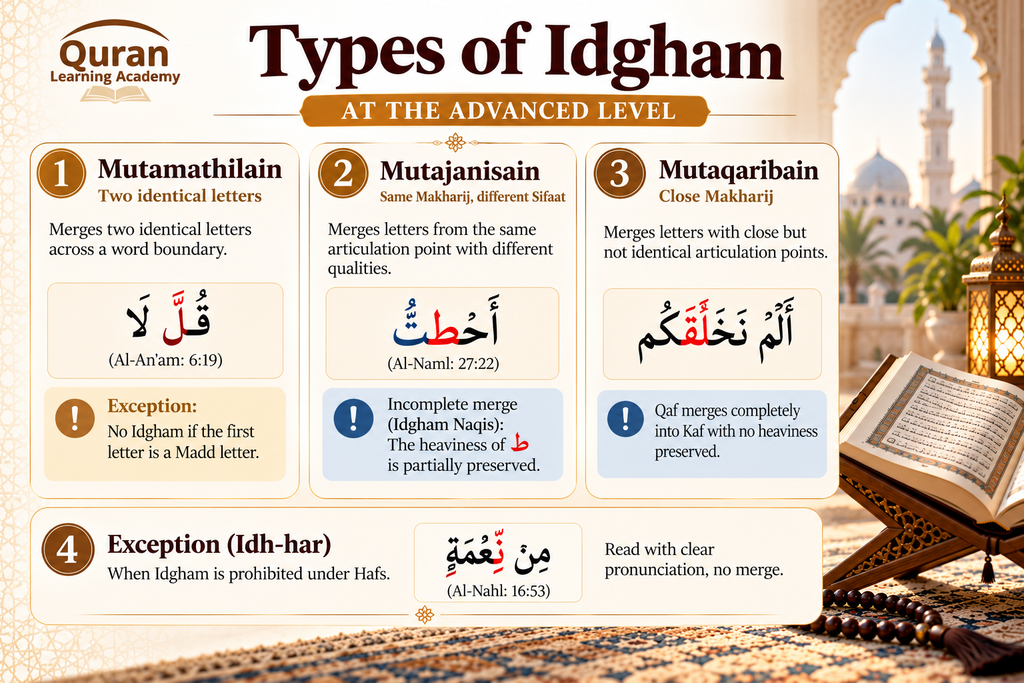
2. Idgham Types and the Positions Where Merging Changes Meaning
Idgham at the advanced level goes far beyond Noon Sakinah basics. The three types of Idgham Sagheer contain position-specific rulings that most learners have never encountered in structured teaching.
Idgham Mutamathilain
Idgham Mutamathilain merges two identical letters across a word boundary when the first carries Sukoon. In “قُلْ لَّا” (Al-An’am: 6:19), the Lam of “قُلْ” merges into the Lam of “لَّا” producing a single Shaddah-bearing Lam.
The critical exception: if the first of the two identical letters is a Madd letter, Idgham does not apply and the letter is pronounced clearly.
Idgham Mutajanisain
Idgham Mutajanisain merges letters sharing the same Makharij but differing in Sifaat. The fixed pairs under Hafs ‘an ‘Asim:
- ت merging into ط in “هَمَّت طَّائِفَةٌ” (Al Imran: 3:122).
- ط merging into ت in “أَحَطتُّ” (Al-Naml: 27:22), producing Idgham Naqis: an incomplete merge where the Isti’la of the ط is partially preserved inside the merge.
- د merging into ت in “قَد تَّبَيَّنَ” (Al-Baqarah: 2:256).
The “أَحَطتُّ” position is where advanced learners fail consistently. The ط does not vanish entirely into the ت. Its heaviness must survive the merge. This distinction cannot be derived from the general Idgham rules. It must be transmitted.
Idgham Mutaqaribain
Idgham Mutaqaribain merges letters with close but not identical Makharij. Under Hafs ‘an ‘Asim: Lam into Ra in “وَقُلْ رَّبِّ,” and Qaf into Kaf in “أَلَمْ نَخْلُقكُّم.”
The Qaf-into-Kaf position is where errors concentrate: learners attempt to preserve the Qaf’s Isti’la inside the merge, which is incorrect. The Qaf merges completely with no heaviness preserved.
Additionally, there are positions where Idgham would normally apply but is explicitly prohibited under Hafs.
In “مِن نِّعْمَةٍ” (Al-Nahl: 16:53), the general rule would merge the Noon of “مِن” into the following Noon. Hafs reads it with Idh-har: clear pronunciation, no merge. This exception exists to prevent complete loss of the Noon and is specific to the Hafs transmission.
Step Inside Our Virtual Classrooms
See how our interactive lessons work. Watch these brief highlights of our students engaging with instructors.
Start Your Quranic Journey in the UK
Join our academy for structured online lessons with expert tutors, tailored to fit your schedule.
Book Your Free Trial3. Qalqalah Grading and the Third Level Most Learners Were Never Taught
The five Qalqalah letters (ق ط ب ج د, mnemonic: QutbJad) are known by most advanced learners. What is not known by most is that Qalqalah has three grades, not two.
- Qalqalah Sughra: Qalqalah Sughra occurs when one of the five letters carries an original Sukoon mid-word during continued recitation. The echo is small and contained. The most common error here is over-echoing into Kubra territory.
- Qalqalah Kubra: Qalqalah Kubra occurs when stopping on a word ending with one of the five letters. The letter acquires Sukoon through the stop, and two causes combine: the inherent Qalqalah quality and the silence of stopping. The echo is significantly stronger than Sughra.
- Qalqalah Akbar al-Kubra: Qalqalah Akbar al-Kubra occurs when a Qalqalah letter carries a Shaddah at a stopping point. Three factors now combine simultaneously: the Shaddah, the Qalqalah quality, and the Sukoon of stopping.
The echo is the strongest of all three grades. Stopping on “الْحَقُّ” when it closes a verse is the most accessible example: the ق is Shaddah-bearing, and the stop produces Akbar al-Kubra.
The widespread advanced-level error is applying uniform Kubra strength to every stopped position without distinguishing whether the Qalqalah letter carries a Shaddah. That distinction is Akbar al-Kubra, and it separates competent from precise recitation.
The Tajweed Course for Adults in the UK at UK Quran Learning Academy drills all three Qalqalah grades through live recitation correction, including Akbar al-Kubra positions that structured teaching rarely reaches.

Join your first free trial now
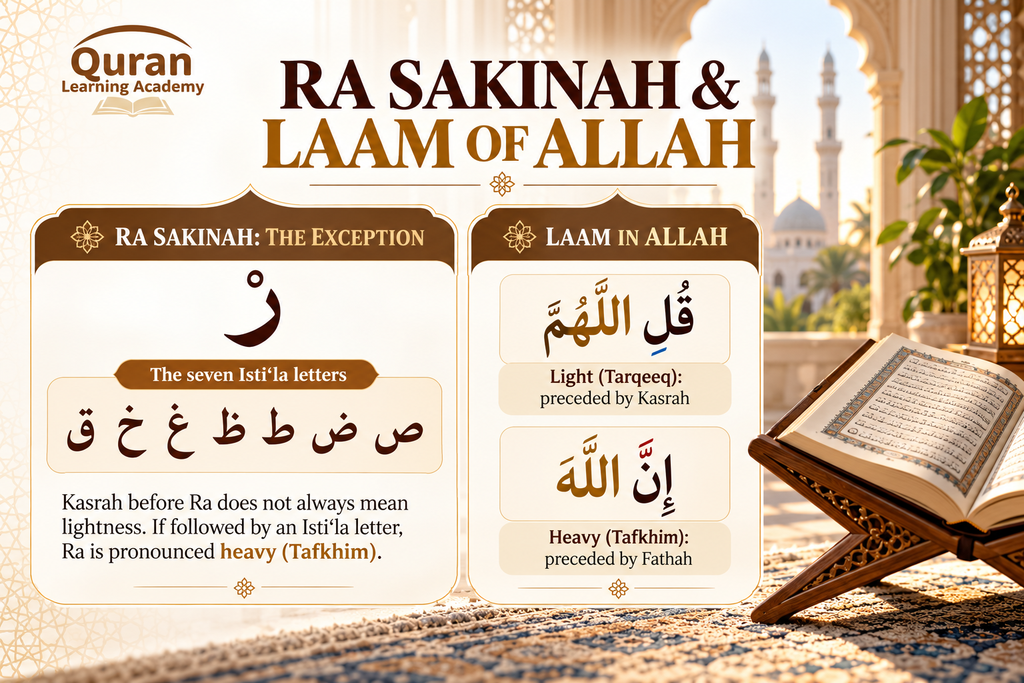
4. Ra Rules: The Letter With More Conditions Than Any Other in the Mushaf
The letter ر (Ra) carries more context-dependent Tafkhim and Tarqeeq conditions than any other letter in advanced Quran recitation with Tajweed rules. The common shortcut “Ra after Kasra is light” is incomplete, and relying on it produces consistent errors.
| Condition of Ra | Rule | Example |
| Ra with Fatha or Damma | Tafkhim (heavy) | رَبِّ، رُزِقُوا |
| Ra with Kasra | Tarqeeq (light) | رِجَالٌ |
| Ra Sakinah, preceded by Kasra, followed by non-Isti’la letter | Tarqeeq | فِرْعَوْنَ |
| Ra Sakinah, preceded by Kasra, followed by Isti’la letter | Tafkhim | فِرْقَةٌ |
| Ra Sakinah, preceded by Fatha or Damma | Tafkhim | الْقُرْآنَ |
The position that consistently fails is Ra Sakinah preceded by Kasra but followed by one of the seven Isti’la letters (ص ض ط ظ غ خ ق).
The preceding Kasra creates a default expectation of lightness, but the Isti’la letter overrides it and pulls the Ra into Tafkhim. Learners who have memorised the Kasra shortcut apply Tarqeeq in every case and miss this override entirely.
The Laam of the divine name Allah carries its own separate rule. Preceded by Fatha or Damma: Tafkhim. Preceded by Kasra: Tarqeeq. In “قُلِ اللَّهُمَّ” (Al Imran: 3:26), the Kasra before the Laam makes it light.
In “إِنَّ اللَّهَ,” the Fatha makes it heavy. Applying uniform weight to the name of Allah across different positions is one of the most common uncorrected errors in UK recitation.
Experience the Academy in Action
Curious about our teaching style? Take a quick look inside a live session to see our immersive, supportive learning environment first-hand.
Start Your Quranic Journey in the UK
Join our academy for structured online lessons with expert tutors, tailored to fit your schedule.
Book Your Free Trial5. Waqf Signs and Stopping Errors That Alter the Meaning of Verses
Waqf in advanced Quran recitation with Tajweed rules is a science that directly affects the meaning the listener receives. Stopping in the wrong position does not create a minor recitation imperfection. It creates a misrepresentation of the divine text.
The six standard Mushaf stopping signs and their rulings:
| Sign | Name | Ruling |
| م | Waqf Lazim | Obligatory stop. Continuing distorts meaning. |
| لا | Prohibited stop | Stopping here is impermissible. Sentence is incomplete. |
| صلى | Permissible, continuation preferred | Stopping allowed but continuing is stronger. |
| قلى | Permissible, stopping preferred | Continuing allowed but stopping is stronger. |
| ج | Permissible, both equal | No preference either way. |
| (. .) Paired dots | Mu’anaqah | Stop at one position only. Stopping at both is an error. |
The Mu’anaqah sign is the most misunderstood. It does not mark two equally valid stopping points. It marks a choice: stop at the first dot and do not stop at the second, or pass the first and stop at the second. Stopping at both fragments the verse into three units where the text intends two.
The Waqf Lazim (م) in Surah Al-Baqarah (2:2) illustrates the stakes. Stopping after “لَا رَيْبَ” without reaching “فِيهِ” produces “there is no doubt” as a standalone statement, detached from “in it.” The Waqf Lazim sign exists specifically to prevent this fragmentation.
The Quran Ijazah Program in the UK at UK Quran Learning Academy includes full Waqf science evaluation as part of the Ijazah assessment, because demonstrating correct stopping across the complete Mushaf is a condition of certification.

6. Ghunna Duration: Why Uniform Nasal Resonance Is an Advanced-Level Error
Ghunna is produced from Al-Khayshum (the nasal passage). Advanced Quran recitation with Tajweed rules requires the reciter to distinguish between positions where Ghunna is exactly 2 harakaat and positions where it is Mushaddadah (strong), which carries no fixed count but is described by classical scholars as “complete” Ghunna.
The two positions of Mushaddadah Ghunna are Noon Mushaddadah (نّ) and Meem Mushaddadah (مّ). Both occur when either letter carries a Shaddah. The Ghunna here is stronger than the 2-count Ghunna of Idgham with Ghunna.
British learners who produce uniform Ghunna across all positions are flattening a distinction the tradition preserves carefully.
The 2-count Ghunna appears in four positions:
- Idgham with Ghunna: Noon Sakinah before ي ن م و.
- Iqlab: Noon Sakinah before ب, converted to Meem with 2-count Ghunna.
- Ikhfa: Noon Sakinah before the fifteen Ikhfa letters, with a concealed Noon and nasal resonance.
- Ikhfa Shafawi: Meem Sakinah before ب.
The error in Ikhfa specifically is applying either full Idh-har (clear Noon) or full Idgham (merged Noon). Ikhfa is neither.
The Noon is concealed, the oral articulation point is not completed, and a 2-count nasal resonance fills the space. It sits between two other sounds, and it requires specific drilling to produce correctly.
The Online Tajweed Classes in the UK at UK Quran Learning Academy dedicate structured sessions to Ghunna calibration, using live audio feedback from Azhari-certified instructors to distinguish Mushaddadah from standard 2-count Ghunna across every position.

Start Your Advanced Recitation at UK Quran Learning Academy Today
If you have recited the Quran for years and are now serious about correcting what fluency has hidden, UK Quran Learning Academy is built for exactly this stage.
Every instructor holds Ijazah in Hafs ‘an ‘Asim through verified chains connected to Al-Azhar. Teaching is live, one-to-one, and structured around your specific errors, not a generic curriculum. Sessions are scheduled around UK working hours, school runs, and the realities of British professional life.
Advanced Quran recitation with Tajweed rules is not a destination you reach alone. It is transmitted, scholar to student, through a living chain that UK Quran Learning Academy makes available to every serious learner in Britain.
Discover Our Quran Courses
- Online Tajweed Classes in the UK
- Tajweed Course for Adults in the UK
- Quran Ijazah Program in the UK
- Online Tajweed Classes in the UK
- Quran Ijazah Program
- Quran Qirat Learning Course
- Quran Tafsir Course

Join UK Quran Learning Academy and recite with confidence
Conclusion
Mastering advanced quran recitation with tajweed rules requires consistent practice, careful attention to pronunciation, and guidance from qualified teachers.
By identifying recurring mistakes and refining articulation and pauses, experienced readers can improve their accuracy and strengthen their recitation. Regular feedback helps maintain progress and develop a deeper understanding of Tajweed principles.
Read more: Reading Quran Without Understanding: What Islam Actually Says.
FAQs
What separates Madd Muttasil from Madd Munfasil in practical recitation?
Madd Muttasil occurs when Madd and Hamza are in the same word, requiring at least 4 harakaat. Madd Munfasil occurs across two words and allows 2, 4, or 5 harakaat consistently.
Why does Idgham Naqis occur in “أَحَطتُّ” rather than complete Idgham?
The letter ط has Isti’la, giving it a heavy quality partially preserved when merging into ت. This produces Idgham Naqis according to the Hafs transmission.
What makes Qalqalah Akbar al-Kubra different from standard Qalqalah Kubra?
Qalqalah Akbar al-Kubra occurs when stopping on a Qalqalah letter with Shaddah, producing a stronger echo than Qalqalah Kubra on an unshaddah letter.
What does the Ijazah assessment actually test in recitation?
The assessment tests complete Quran recitation from memory before a qualified scholar, evaluating Tajweed accuracy. Successful candidates receive authorisation to teach through a documented chain of transmission.
Why is the Waqf Lazim sign obligatory rather than advisory?
The Waqf Lazim sign (م) marks places where continuing may distort the verse’s meaning, so stopping is required to preserve the intended Quranic meaning.







Leave a Reply