 Quran
Many British Muslims recite the same two or three surahs in every prayer for years. The problem is rarely commitment. It is the absence of a clear, sequenced starting point.
Without structure, memorisation feels overwhelming before it even begins, and the result is prayers that feel disconnected from the words being recited.
The easiest Quran verses to memorise are also the most used in daily life. Juz 30 provides the natural starting point, but the journey does not stop there. Passages from Al-Baqarah, Al-Imran, and Ibrahim carry profound meaning and are used by British Muslims in Taraweeh, voluntary prayers, and daily dhikr.
This guide gives learners a practical, sequenced path through the most accessible and rewarding verses across the entire Quran.
1. Al-Fatiha Is the Foundation of Every Prayer
Surah Al-Fatiha contains 7 verses recited in every unit of every prayer. A Muslim praying the five obligatory prayers recites it at least 17 times daily, which makes it the undisputed first priority before any other memorisation begins.
Its rhythmic structure makes it naturally accessible, and most students retain it fully within two to three focused sessions.
The challenge is not length but precision. The heavy and light letters in verse 7 are the sounds that English speakers most commonly mispronounce, and embedding the correct articulation from the very first session ensures every prayer that follows is recited accurately.
“وَلَا الضَّالِّينَ”
Wa lā d-ḍāllīn
“anger or of those who are astray.”
The Online Tajweed Classes in the UK at UK Quran Learning Academy cover Makharij al-Huroof with qualified Azhari instructors who specialise in correcting these exact patterns for English speakers.
2. Al-Ikhlas Carries Maximum Reward in Four Verses
Surah Al-Ikhlas contains only 4 verses yet carries the reward of reciting one-third of the Quran, as established in an authentic narration:
“«مَنْ قَرَأَ فِي لَيْلَةٍ قُلْ هُوَ اللَّهُ أَحَدٌ فَقَدْ قَرَأَ ثُلُثَ الْقُرْآنِ»”
“Whoever recites Qul Huwa Allahu Ahad in a night has recited one-third of the Quran.”
Sunan an-Nasa’i al-Kubra: 10047
The vocabulary is simple, the rhythm is consistent, and most beginners memorise it correctly within a single 15-minute session. For British Muslims learning Quran from scratch, Al-Ikhlas is the ideal first complete memorisation because it is short enough to finish in one sitting yet spiritually rich enough to recite in every prayer.
“قُلْ هُوَ اللَّهُ أَحَدٌ”
Qul huwa llāhu aḥad
“Say, “He is Allah, [who is] One.”
The Learn Quran for Beginners Classes in the UK at UK Quran Learning Academy use Al-Ikhlas as a structured entry point, building correct recitation habits before progressing to longer material.
Book your free trial session here.
3. Al-Asr Summarises the Purpose of Human Life in Three Verses
Surah Al-Asr contains only 3 verses yet outlines the four conditions for human success: faith, righteous deeds, enjoining truth, and enjoining patience.
Its direct sentence structure and simple vocabulary make it among the easiest surahs to retain, even for students with no prior Arabic exposure.
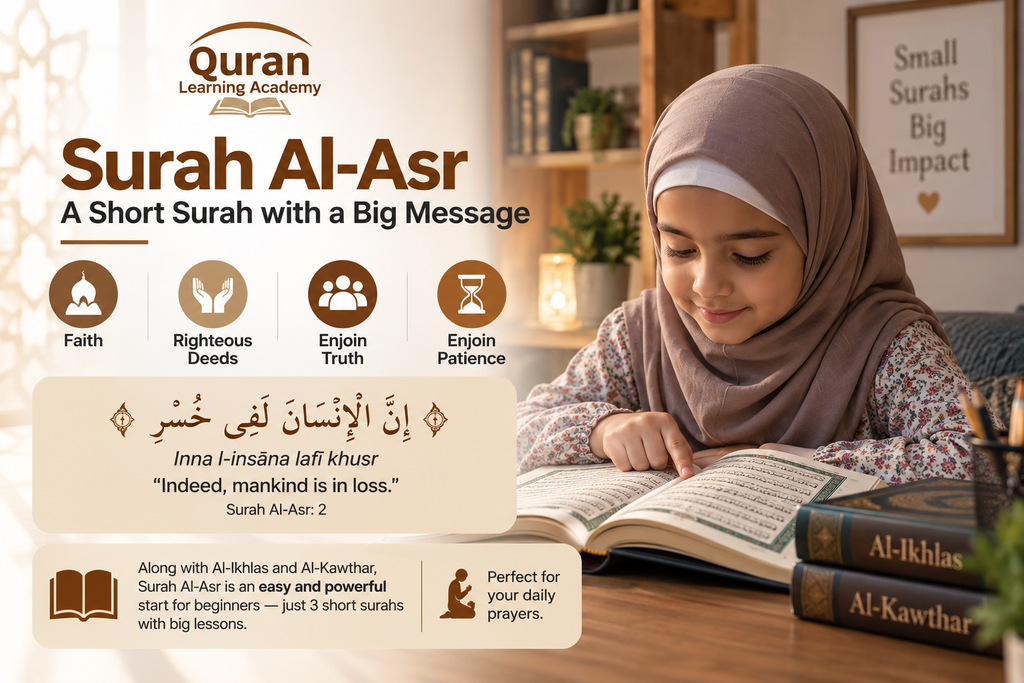
“إِنَّ الْإِنسَانَ لَفِي خُسْرٍ”
Inna l-insāna lafī khusr
“Indeed, mankind is in loss.”
Memorising Al-Asr alongside Al-Ikhlas and Al-Kawthar gives a beginner three complete surahs covering the core of Islamic belief in under 10 combined verses. This early cluster provides immediately usable material for every prayer from the very first week of study.
4. Al-Falaq and An-Nas Provide Daily Spiritual Protection
Al-Falaq and An-Nas are the Mu’awwidhatayn, the two surahs of seeking refuge. The Prophet Muhammad, peace be upon him, recommended their recitation for morning and evening protection:
كانَ رَسُولُ اللَّهِ صلى الله عليه وسلم إِذَا أَوَى إِلَى فِرَاشِهِ نَفَثَ فِي كَفَّيْهِ بِقُلْ هُوَ اللَّهُ أَحَدٌ وَبِالْمُعَوِّذَتَيْنِ جَمِيعًا، ثُمَّ يَمْسَحُ بِهِمَا وَجْهَهُ، وَمَا بَلَغَتْ يَدَاهُ مِنْ جَسَدِهِ
“Whenever Allah’s Messenger (ﷺ) went to bed, he used to recite Surat-al-Ikhlas, Surat-al-Falaq and Surat-an- Nas and then blow on his palms and pass them over his face and those parts of his body that his hands could reach.”
These two surahs share overlapping rhythm and vocabulary, which means memorising one immediately reinforces the other.
Al-Falaq contains 5 verses and An-Nas contains 6, and most students who study them together in the same week retain both with noticeably less effort than memorising either individually.
The Online Quran Classes for Kids in the UK at UK Quran Learning Academy introduce these as a paired unit because of how effectively they reinforce one another.
Register your child for a free trial today.
5. Az-Zalzalah Teaches Accountability Through Eight Precise Verses
Surah Az-Zalzalah contains 8 verses describing the Day of Judgement, and its final two verses are among the most cited in Islamic ethics discourse:
“فَمَن يَعْمَلْ مِثْقَالَ ذَرَّةٍ خَيْرًا يَرَهُ ﴿٧﴾ وَمَن يَعْمَلْ مِثْقَالَ ذَرَّةٍ شَرًّا يَرَهُ ﴿٨﴾”
Fa-man yaʿmal mithqāla dharratin khayran yarah. Wa-man yaʿmal mithqāla dharratin sharran yarah
“So whoever does an atom’s weight of good will see it, (7) And whoever does an atom’s weight of evil will see it. (8).”
The 8 verses break naturally into two thematic halves. The first four describe the shaking of the earth, and the last four describe the accountability that follows.
This natural division makes sequential memorisation straightforward because the learner is effectively memorising two scenes of four verses each rather than a single continuous block.
Step Inside Our Virtual Classrooms
See how our interactive lessons work. Watch these brief highlights of our students engaging with instructors.
Start Your Quranic Journey in the UK
Join our academy for structured online lessons with expert tutors, tailored to fit your schedule.
Book Your Free Trial6. Ayat al-Kursi Is the Most Powerful Verse in the Quran
Ayat al-Kursi is a single verse from Surah Al-Baqarah, one of the longest surahs in the Quran, yet it stands as one of the most memorised verses among Muslims globally. The Prophet Muhammad, peace be upon him, described it as the greatest verse in the Quran:
“لِكُلِّ شَيْءٍ سَنَامٌ وَإِنَّ سَنَامَ الْقُرْآنِ سُورَةُ الْبَقَرَةِ وَفِيهَا آيَةٌ هِيَ سَيِّدَةُ آىِ الْقُرْآنِ هِيَ آيَةُ الْكُرْسِيِّ”
“For everything there is a hump (pinnacle) and the hump (pinnacle) of the Qur’an is Surat Al-Baqarah, in it there is an Ayah which is the master of the Ayat in the Qur’an; [it is] Ayat Al-Kursi.”
Despite coming from a long surah, Ayat al-Kursi is a single self-contained verse of moderate length.
British Muslims who recite it after every obligatory prayer, as established in authentic prophetic practice, find that daily repetition alone builds memorisation within two to three weeks without any dedicated study session.
7. Surah Al-Baqarah 153 Strengthens Patience During Hardship
Verse 153 of Surah Al-Baqarah is a short, direct command that British Muslims find deeply applicable to the pressures of daily life. It appears in the middle of a long surah yet stands entirely on its own as a complete and memorisable statement:
“يَا أَيُّهَا الَّذِينَ آمَنُوا اسْتَعِينُوا بِالصَّبْرِ وَالصَّلَاةِ ۚ”
Yā ayyuhā lladhīna āmanū sta’īnū bi-ṣ-ṣabri wa-ṣ-ṣalāh
“O you who have believed, seek help through patience and prayer.”
For British Muslims navigating the pressures of work, family, and community life, this verse carries an immediate and personal relevance that makes it easier to retain emotionally.
When a verse speaks directly to a lived experience, the memory holds it with less effort than abstract theological content requires.
Experience the Academy in Action
Curious about our teaching style? Take a quick look inside a live session to see our immersive, supportive learning environment first-hand.
Start Your Quranic Journey in the UK
Join our academy for structured online lessons with expert tutors, tailored to fit your schedule.
Book Your Free Trial8. Surah Ibrahim Verse 7 Anchors the Habit of Daily Gratitude
Verse 7 of Surah Ibrahim is among the most cited verses on the theme of gratitude in the Quran. It is short, structurally simple, and carries a conditional promise that is directly applicable to any believer:
“لَئِن شَكَرْتُمْ لَأَزِيدَنَّكُمْ”
La’in shakartum la’azīdannakum
“If you are grateful, I will surely increase you [in favor].”
This is a single clause from a longer verse, yet it functions as a complete and independently meaningful statement.
Many British Muslims commit this passage to memory specifically because it reframes the practice of gratitude from a moral obligation into a direct divine promise with a clear outcome.
The Quran Tafsir Course in the UK at UK Quran Learning Academy teaches students to read verses like this one in their full linguistic and contextual depth, covering classical Tafsir methodology through scholars including Ibn Kathir and Al-Tabari.
Explore the course and book your trial session here.
9. Ash-Sharh Speaks Directly to the Pressures of Modern British Life
Surah Ash-Sharh contains 8 verses revealed as a direct reassurance during a period of difficulty, and its central promise has sustained Muslims across every generation.
For British Muslims managing work pressures, family demands, and community responsibilities, this surah carries an immediate personal relevance that makes it one of the easiest to retain emotionally.
“فَإِنَّ مَعَ الْعُسْرِ يُسْرًا ﴿٥﴾ إِنَّ مَعَ الْعُسْرِ يُسْرًا ﴿٦﴾”
Fa-inna maʿa l-ʿusri yusrā. Inna maʿa l-ʿusri yusrā
“For indeed, with hardship [will be] ease. (5) Indeed, with hardship [will be] ease. (6).”
The repetition of verses 5 and 6 creates a natural memory anchor. Once a student learns verse 5, verse 6 is retained almost automatically because it is structurally identical. This makes Ash-Sharh one of the most time-efficient memorisation targets in the entire Juz 30 sequence.
The Weekend Quran Classes in the UK at UK Quran Learning Academy run structured Saturday and Sunday sessions covering surahs like Ash-Sharh for British Muslims managing weekday commitments.
Begin Your Memorisation With Qualified Support
Memorising the Quran alone is possible for short verses. But pronunciation errors embedded in the early stages compound over time and become significantly harder to correct.
Even a single session with a qualified instructor to verify articulation protects the quality of everything memorised afterward.
UK Quran Learning Academy connects British learners with Azhari-trained instructors who hold verified Ijazah credentials and understand the specific challenges English speakers face with Arabic phonetics.
Sessions are fully online, scheduled flexibly around work and family commitments, and available for adults, children, and sisters in female-only environments.
The academy offers courses across every level and need. Whether you are a complete beginner starting with Al-Fatiha, a parent looking to enrol your child in structured Hifz training, or an adult who wants to move beyond Juz 30 into the longer surahs of the Quran, there is a programme built around your specific goal.
Discover Our Quran Courses
- Online Tajweed Classes in the UK
- Learn Quran for Beginners Classes in the UK
- Online Quran Classes for Kids in the UK
- Quran Tafsir Course in the UK
- Weekend Quran Classes in the UK
- Quran Online Academy
- Quran Recitation Classes
- Quran Reading Classes
- Online Quran Classes for Kids
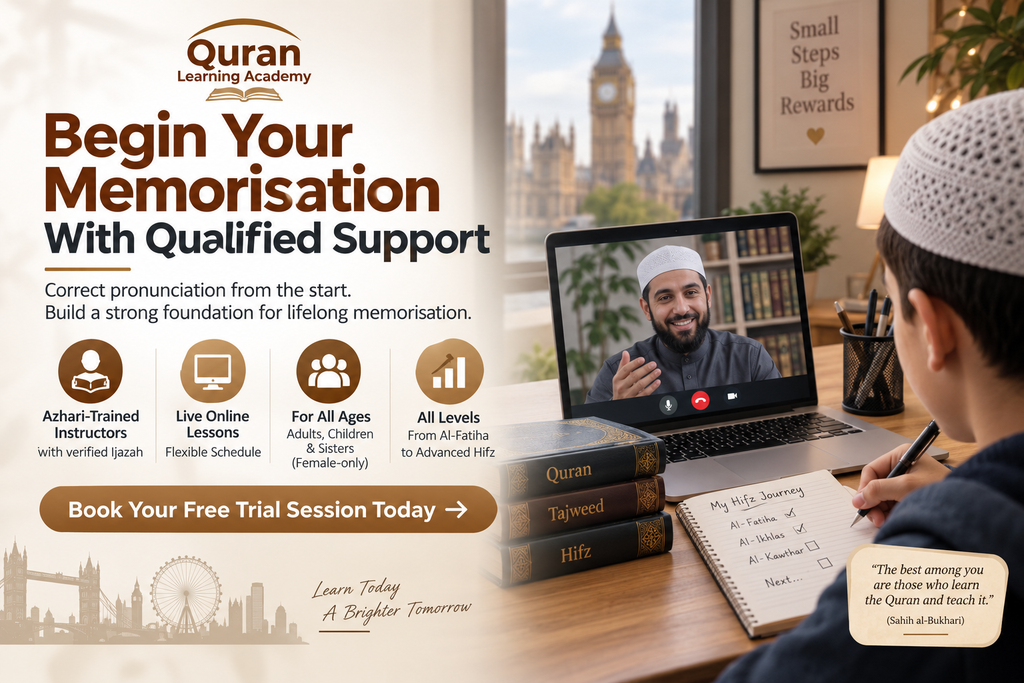
Book your free trial session with UK Quran Learning Academy today.
Conclusion
The easiest Quran verses to memorise are often the ones you encounter most frequently in prayer and daily worship. Starting with short surahs such as Al-Ikhlas, Al-Asr, Al-Falaq, and An-Nas gives beginners an achievable foundation, while verses such as Ayat al-Kursi and selected passages from longer surahs allow memorisation to progress naturally.
There is no need to rush through the Quran or measure progress by the number of verses memorised each day. Consistent repetition, accurate recitation, and regular revision are what turn newly learned verses into lasting memory. With a clear sequence and a manageable routine, Quran memorisation can gradually become a natural part of everyday life.
Frequently Asked Questions
What are the easiest Quran verses to memorise for a complete beginner?
The easiest verses for a complete beginner are Al-Ikhlas (4 verses), Al-Kawthar (3 verses), and Al-Asr (3 verses). Their short length, consistent rhythm, and simple vocabulary allow most beginners to achieve full memorisation within one or two focused 20-minute sessions, providing immediate motivation to continue.
Do I need to understand Arabic to memorise Quran verses?
Understanding Arabic deepens retention significantly but is not a prerequisite for memorisation. Non-Arabic speaking British Muslims regularly memorise surahs through phonetic repetition alone. Working with a qualified instructor who explains the meaning of each verse alongside the recitation accelerates both memorisation and comprehension simultaneously.
How long does it take to memorise Ayat al-Kursi?
Most adult learners who recite Ayat al-Kursi daily after every obligatory prayer, as established in prophetic practice, find that they have memorised it naturally within two to three weeks without any dedicated study sessions. Adding one focused 20-minute session per week with a qualified instructor to verify pronunciation accelerates that timeline further.
Can I memorise verses from long surahs without memorising the whole surah?
Yes. Verses like Ayat al-Kursi from Al-Baqarah and verse 153 from the same surah are self-contained passages that function independently in prayer and daily recitation. The Quran contains numerous such passages that British Muslims can memorise individually and use immediately without committing to memorising entire long surahs.
Is there a best time of day to memorise Quran verses?
The time immediately after Fajr prayer is the most consistently recommended period in classical Islamic scholarship for Quran memorisation. The mind is rested, distractions are minimal, and the blessed time of the early morning creates a strong associative link between the verses and a spiritually grounded state that aids long-term retention.





[…] Read more: Easy Quran Verses To Memorise For Daily Life. […]