 Quran

Most people starting Hifz hit the same wall within the first two weeks: they sit down with genuine intention, spend an hour on a single page, and walk away unsure whether anything actually stuck. The frustration rarely comes from lack of effort. It comes from not knowing which variables are actually controlling the clock.
One page of the standard Madinah Mushaf contains 15 lines. To memorise one page of Quran, a fluent Arabic reader using a focused, distraction-free method needs between 15 and 30 minutes. Remove any one of those conditions, and that number can double or triple.
How Long One Page of Quran Actually Takes to Memorise
The honest answer breaks down by learner type. There is no single number that applies universally, and any source that gives you one without qualification is oversimplifying. The table below reflects what structured Hifz programmes consistently report:
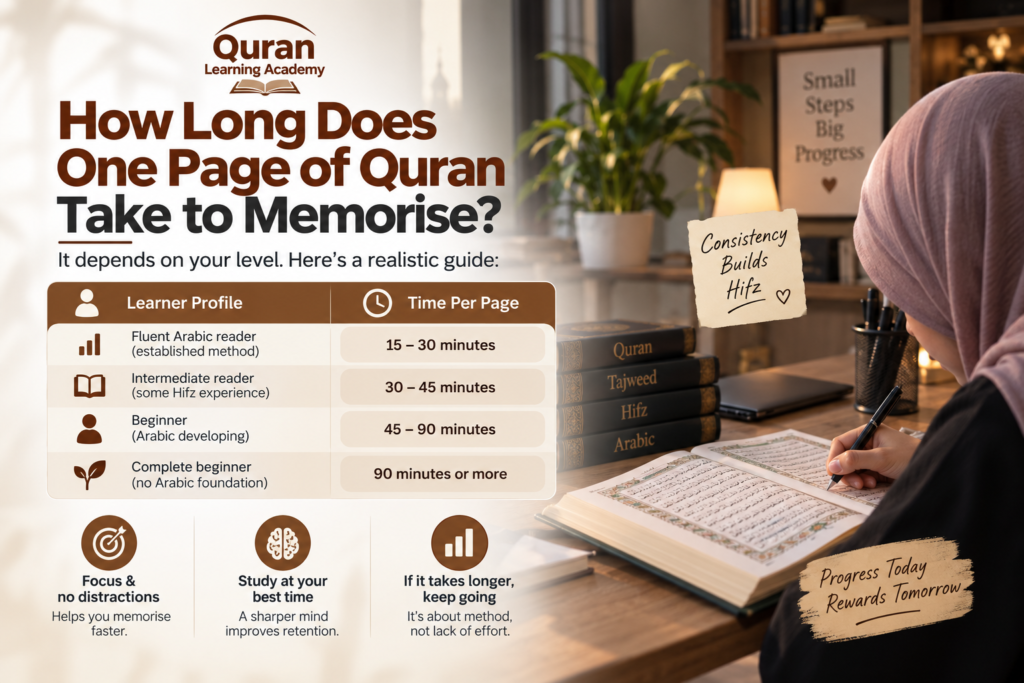
| Learner Profile | Time Per Page |
| Fluent Arabic reader, established method | 15–30 minutes |
| Intermediate reader, some Hifz experience | 30–45 minutes |
| Beginner, Arabic still developing | 45–90 minutes |
| Complete beginner, no Arabic foundation | 90 minutes or more |
These figures assume a distraction-free session timed to a sharp mental state. Miss that condition, and students reliably report taking two to three times as long for the same material, with noticeably weaker retention to show for it.
If you find yourself consistently at the upper end of these ranges, the problem is almost never effort. It is one of the specific variables covered below.
Arabic Reading Fluency Controls More Than You Think
A student who reads Arabic by sight moves through a page with mental energy freed up entirely for retention. The eye scans, the mouth follows, and the memory does its actual work.
A student still building foundational reading skills spends most of the session decoding, leaving very little cognitive capacity for memorisation itself. The words go in, but they do not stay, because the brain was already at full load just producing the sounds.
This does not mean waiting until Arabic is fluent before beginning Hifz. Many programmes run both tracks in parallel with strong results. But students who underestimate this connection often wonder why their sessions run long despite genuine commitment.
Many British Muslims face this exact challenge: strong Islamic identity, real motivation, but Arabic that was never formally developed beyond basic recitation. Addressing reading fluency directly, rather than pushing harder on memorisation, is what actually moves the clock.
The Quran Memorisation Course in the UK at UK Quran Learning Academy is built around this reality. It pairs retention technique with Tajweed-accurate recitation, so students are not spending weeks cementing errors they will later have to unlearn.

Start your free trial at UK Quran Learning Academy
Not All Pages in the Mushaf Are Equal
Open to Surah Al-Baqarah and you find long, flowing verses where the narrative meaning carries you through the length. Open to Surah Al-Mursalat and you find short, rhythmically similar verses that blur together under careless review. Both types are genuinely difficult. They are just difficult in different ways.
The key differences between page types:
- Long verses are easier to anchor because the logic of the verse itself acts as a scaffold for memory.
- Short repetitive verses demand more precision: a single word or vowel marks the difference between adjacent verses, and confusion between them compounds over time if not caught early.
- Pages with heavy Makharij demands (letters like ض, ظ, ع, غ) take longer for non-Arab learners because the pronunciation load is higher.
Students who arrive at a difficult page with their method intact and timing right and still run long are often simply encountering a page that demands more. Adjusting daily expectations by page type is not weakness. It is accurate self-assessment.
Step Inside Our Virtual Classrooms
See how our interactive lessons work. Watch these brief highlights of our students engaging with instructors.
Start Your Quranic Journey in the UK
Join our academy for structured online lessons with expert tutors, tailored to fit your schedule.
Book Your Free TrialSession Timing Has a Measurable Effect on Retention
The post-Fajr window is the most consistently recommended memorisation slot across established Hifz programmes. The mind is rested, the house is quiet, and the day’s accumulated decisions and distractions have not yet arrived. New information encodes most deeply when competing demands on attention are lowest.
The Maghrib-to-Isha window works well as a secondary slot, particularly for revision. Afternoon sessions after Asr carry more variability depending on how the day has run.
For British learners balancing school runs, work, and evening responsibilities, the Fajr slot is often the only genuinely protected time available.
Students who memorise in snatched minutes during a chaotic day consistently take two to three times as long for the same material compared to their focused sessions, with noticeably weaker retention. The session length matters. The session quality matters more.
The Memorisation Method You Choose Changes Everything
There is no single correct method for Hifz. What exists is a range of approaches suited to different learner types, and the one that costs students the most time is switching between methods week to week.
The most widely used structured approaches are:

- Sequential method: Build each verse fully before moving to the next, then chain them together. Slower per session, but retention holds firmly under long review gaps.
- Sheikh Abdul Mohsin Al-Qasim method: Read each verse 20 times individually, then combine every four verses with another 20 repetitions for linkage. Produces deeply rooted retention.
- The 5-5-Link technique: Read each verse aloud five times looking, then five times from memory, then immediately link it to the previous verse before moving forward. The linking step prevents the most common failure point: losing the thread between adjacent ayahs during recitation.
- Cumulative rolling review: After memorising verses one through three, recite all three before moving to verse four. This “rolling snowball” ensures the top of the page does not fade while you work on the bottom.
Building fluency within a single method is where both speed and confidence come from. Students who commit to one approach for six to eight weeks consistently report session times dropping as the method itself becomes automatic.
Understanding Meaning Compresses Session Time
Memorising words in a language you do not understand is possible. It takes longer and fades faster. When meaning is present, the brain builds multiple retrieval paths to the same material: phonetic, sequential, and semantic. Losing the thread during recitation triggers the meaning-based system as a backup.
Reading a brief Tafsir passage for the day’s verses before beginning, even three to four minutes of preparation, can reduce memorisation time and strengthen retention in the weeks that follow. Students who connect words with their meaning consistently report shorter session times and more stable pages during later review.
Allah addresses this directly. Those who reflect on the Quran find the words more accessible, not because memorisation becomes effortless, but because the meaning provides an architecture that raw phonetic repetition cannot replicate.
Revision Load Is the Variable Most Students Underweight
A student who has memorised 80 pages without consistent revision will find new memorisation progressively harder. Not because memory has weakened, but because poorly secured earlier material creates interference. The brain spends effort managing half-forgotten pages rather than cleanly encoding new ones.
Structured Hifz programmes address this with tiered review systems. A well-established approach dedicates the session as follows:
- First 15 minutes: new memorisation.
- Next 20 minutes: most recent 20 pages.
- Separate weekly block: older material beyond the recent 20.
Students who push only toward new pages and skip structured revision may appear to be making progress. They are also quietly losing what they have already done. When old material becomes insecure, session times for new pages start rising because the memory system itself is under strain.
The Quran Memorisation for Kids in the UK programme at UK Quran Learning Academy builds this revision structure directly into the curriculum, using spaced repetition and structured review cycles tailored specifically to younger learners.

Book your child’s free trial today
A Qualified Teacher Prevents Compounding Errors
A recurring pattern in Hifz programmes: a student spends 35 minutes memorising a page, delivers it confidently to a teacher, and learns that a pronunciation error has been compounding across two weeks of sessions. Correcting a deeply grooved mistake takes three times the effort of preventing it.
The compounded time loss from a single uncorrected error, repeated daily across weeks, is considerable. A teacher who listens in real time catches those errors before they settle into long-term memory.
Beyond accuracy, a qualified instructor can identify when the recitation style a student is using creates unnecessary confusion for a particular section.
For British Muslim families where parents did not themselves receive formal Hifz training, having a qualified instructor is not a luxury. It is the primary safeguard against the most time-expensive mistake in the entire process.
The Hifz Classes for Adults in the UK at UK Quran Learning Academy connects students with qualified Azhari instructors who provide real-time correction, tailored pacing, and ongoing accountability through live interactive sessions.

Enrol in Hifz Classes for Adults today
One Mushaf Edition, Used Consistently, Matters More Than It Seems
Mushaf editions differ in layout. The Madinah print places verse breaks and line endings differently from the Indo-Pakistani print. Digital Quran apps often use yet another layout entirely.
Many students do not notice this until they review material from one edition while looking at another, and the visual memory that most memorisers rely on unconsciously suddenly does not match.
This disruption is small on any given day. It compounds: every review session from that point carries a small additional orientation cost. The rule is straightforward. Choose one physical Mushaf before beginning. Use it for all memorisation and all review. Do not rotate between it and phone apps or other editions with different layouts.
Students who enforce this single discipline from the start report meaningfully cleaner review sessions, and cleaner reviews translate directly to shorter session times.
Read more: Memorise The Quran In 4 Years.
How Daily Page Targets Translate to Full Quran Completion
For British learners planning their Hifz journey, the numbers are worth knowing clearly:
| Daily Target | Estimated Completion |
| Half a page per day | Approximately 5 years |
| 1 page per day | Approximately 2 to 2.5 years |
| 2 pages per day | Approximately 10 to 12 months |
| 3 pages per day | Approximately 7 months (intensive only) |
These estimates assume consistent daily revision running in parallel with new memorisation. Without structured revision, the timeline does not shorten. It simply produces pages that fade.
One page per day, held consistently with a proper revision structure, puts complete Hifz within reach in two to two and a half years for most adult learners in the UK balancing work and family commitments.
Experience the Academy in Action
Curious about our teaching style? Take a quick look inside a live session to see our immersive, supportive learning environment first-hand.
Start Your Quranic Journey in the UK
Join our academy for structured online lessons with expert tutors, tailored to fit your schedule.
Book Your Free TrialWhy UK Quran Learning Academy Is Built for British Learners
British Muslims face a specific combination of challenges that generic Hifz programmes are not designed around: school timetables, shift work, weekend commitments at the masjid, and Arabic that was often never formally taught. A programme that ignores those realities does not survive contact with actual British life.
UK Quran Learning Academy was built around this context. Every course connects students with qualified Azhari instructors who provide live, interactive sessions scheduled around British time zones and British schedules. The methodology is classical. The delivery is designed for the UK.
Discover Our Quran Courses
- Quran Classes for Adults
- Quran Classes for Female / Sisters
- Learn Quran Course for Beginners
- Hifz Classes for Adults in the UK
- Quran Memorisation for Kids in the UK
- Quran Memorisation Course in the UK

Start your free trial at UK Quran Learning Academy
Conclusion
The time to memorise one page of Quran lands between 15 and 30 minutes for most consistent students with fluent Arabic reading and an established method. That number is a product of conditions, not a fixed property of the task.
Arabic reading fluency, page complexity, session timing, memorisation method, meaning comprehension, revision discipline, teacher feedback, Mushaf consistency, and environment all pull the clock in different directions.
Identify which of those variables is working against you, address it directly, and session times move. The daily page count matters less than the quality of what stays. Get the conditions right, and the clock takes care of itself.
Read more: Memorise The Quran In The UK.
Frequently Asked Questions
How long does it take to memorise one page of Quran for a complete beginner?
A complete beginner typically needs between 45 minutes and an hour per page, and sometimes longer if Arabic reading is still in early development. This range drops considerably after the first few months as pattern recognition builds and the chosen method becomes second nature.
Is 15 minutes really enough to memorise one page of Quran?
For a fluent Arabic reader with an established Hifz routine and a protected session time, 15 minutes can be sufficient for initial memorisation of one page. Most teachers recommend not treating the session as complete until the student has recited the page from memory without looking, which typically adds another 10 to 15 minutes and is where the memorisation is actually confirmed.
What time of day produces the most efficient Quran memorisation?
The post-Fajr window is the most consistently recommended slot across Hifz programmes and scholarly tradition. The mind is rested, external noise is minimal, and the day’s accumulated demands have not yet arrived. The Maghrib-to-Isha window works well as a secondary slot, particularly for revision.
Does understanding the meaning of verses shorten memorisation time?
Yes, measurably. When you understand what you are memorising, the brain builds multiple retrieval paths: phonetic, sequential, and semantic. Losing the thread during recitation triggers the meaning-based system as a backup. Students who spend three to four minutes reading Tafsir before each session consistently report shorter session times and stronger retention in subsequent weeks.
How many pages per day are realistic for a working adult in the UK?
One page per day, protected consistently, is the sweet spot for most working adults. It allows enough room for life’s natural interruptions, exams, work projects, and family commitments, without creating the burnout that comes with more aggressive targets. At this pace, full Hifz completion falls within two to two and a half years.








Leave a Reply