 Quran
Quran
Many British Muslims carry a sincere desire to memorise the Quran but face an immediate problem: which surah comes first? With 114 surahs and 30 juz, opening the Mushaf without a clear starting point often leads to stalling before the first verse is committed to memory. The result is good intention trapped inside an undefined plan — and weeks pass without real progress.
The scholars of Islam resolved this question through authentic narrations and established practice. Certain surahs carry confirmed virtues, appear repeatedly in daily Salah, or address specific needs in a Muslim’s daily life.
This guide draws exclusively on those narrations and classical scholarly guidance to identify the most important surahs in the Quran to memorise, with structured practical guidance for British Muslim learners across England, Scotland, Wales, and Northern Ireland.
1- Surah Al-Fatiha Is the Foundation of Every Salah
Surah Al-Fatiha is recited a minimum of seventeen times across the five daily prayers. No other surah in the Quran occupies this position. Scholars reached unanimous consensus that Salah without Al-Fatiha is invalid — making it the single non-negotiable starting point for every Muslim’s memorisation journey, regardless of age, background, or level.
The Prophet ﷺ described Al-Fatiha in terms reserved for no other surah:
“الْحَمْدُ لِلَّهِ رَبِّ الْعَالَمِينَ هِيَ السَّبْعُ الْمَثَانِي وَالْقُرْآنُ الْعَظِيمُ الَّذِي أُوتِيتُهُ”
“Al hamdu-li l-lahi Rabbil-`alamin (Surat-al-fatiha)’ which is the seven oft repeated verses (Al-Mathani) and the Grand Qur’an which has been given to me.”
Al-Fatiha Covers the Core of Islamic Theology in Seven Verses
Each verse of Al-Fatiha addresses a distinct theological pillar that a Muslim returns to throughout their life:
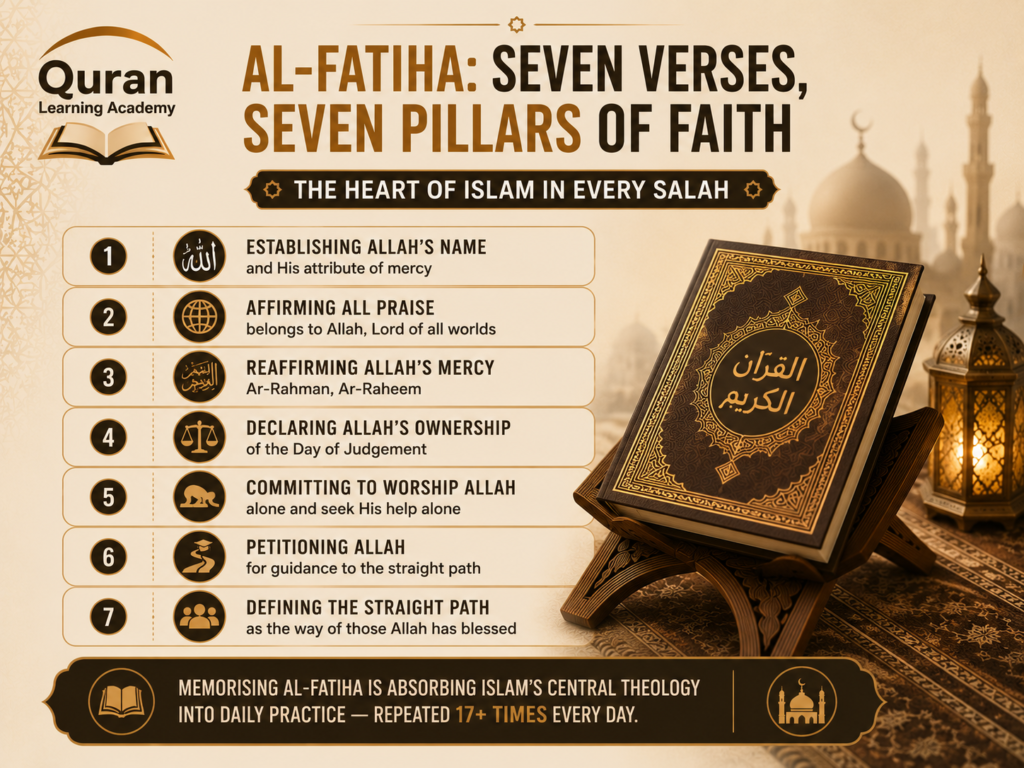
- Verse 1: Establishing the name of Allah and His attributes of mercy.
- Verse 2: Affirming that all praise belongs to Allah, Lord of all worlds.
- Verse 3: Reaffirming the attributes of Ar-Rahman and Ar-Raheem.
- Verse 4: Declaring Allah’s sole ownership of the Day of Judgement.
- Verse 5: Committing to worship Allah alone and seek His help alone.
- Verse 6: Petitioning for guidance to the straight path.
- Verse 7: Defining the straight path as the way of those Allah has blessed.
Memorising Al-Fatiha is therefore not only a prerequisite for valid Salah — it is the absorption of Islam’s central theology into daily spoken practice, repeated seventeen or more times every single day.
Al-Fatiha Appears in Every Form of Prayer Across Britain
| Prayer | Minimum Recitations of Al-Fatiha |
| Fajr | 2 |
| Dhuhr | 4 |
| Asr | 4 |
| Maghrib | 3 |
| Isha | 4 |
| Daily Total | 17 |
For British Muslims attending Tarawih prayers during Ramadan, this number increases significantly. Any Muslim in London, Birmingham, Manchester, Leeds, or Bradford attending congregational prayers will hear Al-Fatiha recited multiple times per gathering. Familiarity with its correct pronunciation is the baseline expectation of Muslim communal life in the UK.
If your reading of Al-Fatiha still involves hesitation or pronunciation uncertainty, the Quran Reading Classes in the UK at UK Quran Learning Academy build the foundational reading accuracy that memorisation depends on — covering Noorani Qaida fundamentals, letter recognition, and vowel application from the ground up.
Enroll in Quran Reading Classes at quranlearningacademy.co.uk
2- Surah Al-Ikhlas Carries the Reward of One Third of the Quran
Surah Al-Ikhlas is four verses and fifteen words in total. Its reward, confirmed in Sahih al-Bukhari, equals reciting one third of the entire Quran. Scholars across generations agreed this indicates exceptional standing for a surah that takes minutes to memorise. Its brevity, theological depth, and frequency in daily worship make it among the most important surahs in the Quran to memorise.
“أَيَعْجِزُ أَحَدُكُمْ أَنْ يَقْرَأَ ثُلُثَ الْقُرْآنِ فِي لَيْلَةٍ ”. فَشَقَّ ذَلِكَ عَلَيْهِمْ وَقَالُوا أَيُّنَا يُطِيقُ ذَلِكَ يَا رَسُولَ اللَّهِ فَقَالَ ” اللَّهُ الْوَاحِدُ الصَّمَدُ ثُلُثُ الْقُرْآنِ”
“Is it difficult for any of you to recite one third of the Qur’an in one night?” This suggestion was difficult for them so they said, “Who among us has the power to do so, O Allah’s Messenger (ﷺ)?” Allah Apostle replied: ” Allah (the) One, the Self-Sufficient Master Whom all creatures need.’ (Surat Al-Ikhlas 112.1–to the End) is equal to one third of the Qur’an.”
Al-Ikhlas Establishes Tawheed in Four Precise Statements
| Verse | Arabic | Theological Meaning |
| 1 | قُلْ هُوَ اللَّهُ أَحَدٌ | Allah is One — absolute, undivided unity |
| 2 | اللَّهُ الصَّمَدُ | Allah is Eternal and Self-Sufficient — all creation depends on Him |
| 3 | لَمْ يَلِدْ وَلَمْ يُولَدْ | He neither begets nor was begotten — rejecting false theological claims |
| 4 | وَلَمْ يَكُن لَّهُ كُفُوًا أَحَدٌ | No one is equal or comparable to Him |
Memorising Al-Ikhlas means carrying the clearest expression of Islamic monotheism at all times — available in Salah, in morning and evening adhkar, before sleep, and at any moment a Muslim needs to affirm their belief.
Al-Ikhlas Is Recited Daily Across British Muslim Households
Imams across British mosques rotate Al-Ikhlas frequently in the second rak’ah of daily prayers. It is also commonly heard in Tarawih during Ramadan, when Muslim communities across East London, Bradford, Leicester, and Cardiff gather nightly for congregational worship. Memorising Al-Ikhlas ensures a Muslim is never without a confident recitation when standing in Salah.
Step Inside Our Virtual Classrooms
See how our interactive lessons work. Watch these brief highlights of our students engaging with instructors.
Start Your Quranic Journey in the UK
Join our academy for structured online lessons with expert tutors, tailored to fit your schedule.
Book Your Free Trial3- Surah Al-Mulk Protects from the Punishment of the Grave
Surah Al-Mulk is thirty verses — longer than the surahs covered so far — but it stands among the most important surahs to memorise because of the specific protection it carries. Authentic narrations establish that it intercedes for its reciter and protects from the punishment of the grave.
The Prophet PBUH said about Surah Al-Mulk:
“هيَ الْمَانِعَةُ هِيَ الْمُنْجِيَةُ تُنْجِيهِ مِنْ عَذَابِ الْقَبْرِ”
“It is the defender, it is the deliverer – it delivers from the punishment of the grave.”
Al-Mulk Progresses Through Three Distinct Themes
Understanding the structure of Al-Mulk makes memorisation significantly easier, because each section follows its own clear theme:
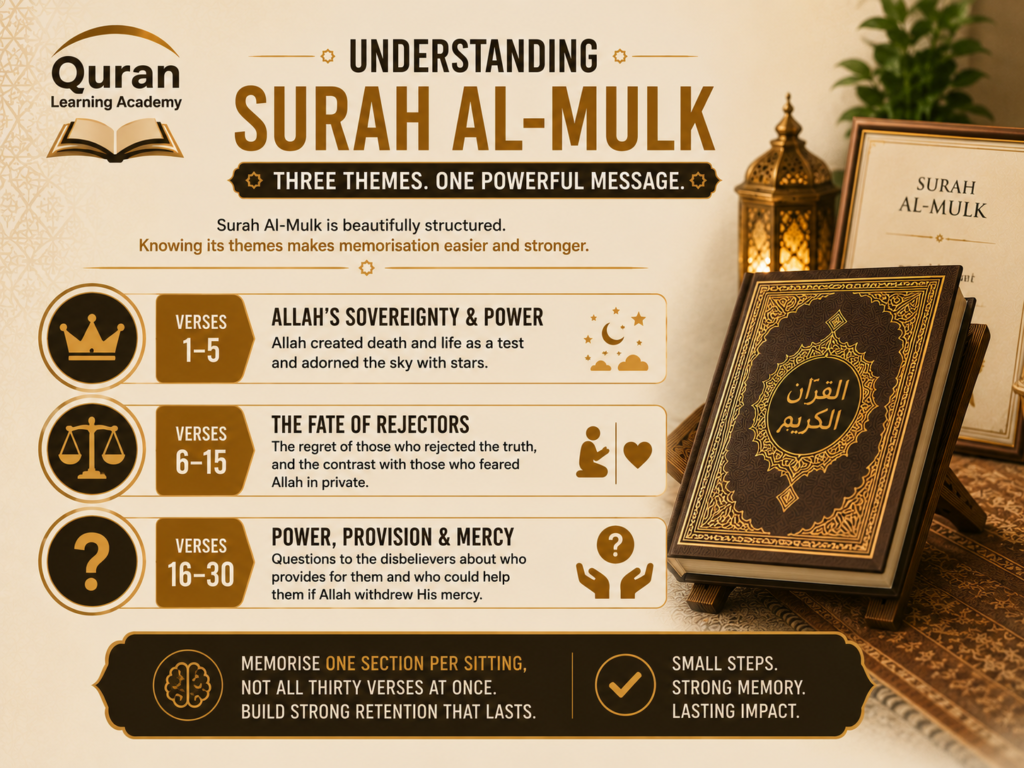
- Verses 1–5: The sovereignty and power of Allah who created death and life as a test, and adorned the sky with stars.
- Verses 6–15: The fate of those who rejected the truth — their regret and the contrast with those who feared Allah in private.
- Verses 16–30: Questions directed at the disbelievers about who provides for them and who could help them if Allah withdrew His mercy.
Each section forms a self-contained unit. Memorising one section per sitting — rather than treating all thirty verses as one block — significantly reduces the cognitive load and builds retention that holds across weeks.
The Nightly Recitation Habit Reinforces Memorisation Automatically
Scholars recommend reciting Surah Al-Mulk every night before sleep. For a student memorising it, this habit serves a dual purpose:
- It fulfils the established Sunnah of nightly recitation.
- It reinforces memorisation through daily repetition without requiring additional dedicated Hifz time.
British Muslim professionals who struggle to protect daily Hifz time find that the nightly recitation routine becomes a natural anchor. The Hifz Classes for Adults in the UK at UK Quran Learning Academy are structured specifically around the realities of working life in Britain, with flexible scheduling that fits around professional, family, and community commitments.
Enroll in Hifz Classes for Adults at quranlearningacademy.co.uk
4- Surah Al-Baqarah and Surah Al-Imran Intercede on the Day of Judgement
The Prophet ﷺ described these two surahs together using imagery that communicates their standing in a way no abstract description can match. They are long — Al-Baqarah is 286 verses and Al-Imran is 200 — but their reward justifies the long-term commitment for any Muslim dedicated to Hifz.
” يُؤْتَى بِالْقُرْآنِ يَوْمَ الْقِيَامَةِ وَأَهْلِهِ الَّذِينَ كَانُوا يَعْمَلُونَ بِهِ تَقْدُمُهُ سُورَةُ الْبَقَرَةِ وَآلُ عِمْرَانَ ”
“the Qur’an and those who acted according to it will be brought with Surah al-Baqara and AI ‘Imran preceding them.”
The Narration Links Memorisation to Action
The reward described in the narration belongs specifically to those who acted by these surahs — not merely those who memorised the words. This distinction matters for British Muslim learners:
- Memorisation is the first step, not the endpoint
- Acting by the Quran’s guidance is the condition for the intercession promised
- Combining memorisation with Tafsir study deepens understanding and strengthens the act
The Quran Tafsir Course in the UK at UK Quran Learning Academy gives British learners structured access to the meanings of Quranic verses through classical Tafsir works, including Ibn Kathir, Al-Tabari, and Al-Qurtubi — connecting memorisation directly to comprehension.
Enroll in the Quran Tafsir Course at quranlearningacademy.co.uk
Ayat Al-Kursi Is the Greatest Single Verse in Al-Baqarah
Embedded within Surah Al-Baqarah is Ayat Al-Kursi — confirmed by the Prophet ﷺ as the greatest verse in the entire Quran. It is among the most recited verses in daily Islamic practice across British Muslim households, used in morning and evening adhkar, after every prayer, and before sleep.
“اللَّهُ لَا إِلَٰهَ إِلَّا هُوَ الْحَيُّ الْقَيُّومُ ۚ لَا تَأْخُذُهُ سِنَةٌ وَلَا نَوْمٌ ۚ”
Allahu la ilaha illa huwa al-hayyul-qayyoom, la ta’khudhihu sinatun wa la nawm
“Allah – there is no deity except Him, the Ever-Living, the Sustainer of [all] existence. Neither drowsiness overtakes Him nor sleep.”
5- Surah Al-Kahf Provides Light Between Two Fridays
Surah Al-Kahf holds a specific weekly virtue confirmed in authentic narrations. Its recitation on Friday provides light — described as stretching from the reciter to the House of Allah — and its first ten verses protect from the trial of the Dajjal.
“من قَرَأَ سُورَة الْكَهْف فِي يَوْم الْجُمُعَة أَضَاء لَهُ النُّور مَا بَيْنَ الْجُمْعَتَيْنِ”
“If anyone recites sūra al-Kahf (Qur’ān, 18) on Friday, light will shine brightly for him till the next Friday.”
Mishkat al-Masabih: Hadith 2175
Al-Kahf Covers Four Major Stories of Trial and Faith
| Story | Verses | Core Lesson |
| The Companions of the Cave | 9–26 | Steadfastness in faith against persecution |
| The Owner of Two Gardens | 32–44 | Wealth and arrogance versus gratitude to Allah |
| Musa and Al-Khidr | 60–82 | Patience and submission to divine wisdom |
| Dhul-Qarnayn | 83–98 | Power used in justice and service to Allah |
Memorising Al-Kahf in thematic sections — one story at a time — is the most effective approach. Each story has its own beginning, middle, and end, which means a student can memorise one complete narrative unit before moving to the next, building both retention and comprehension simultaneously.
Friday Recitation Provides Built-In Weekly Review
The Sunnah of reciting Al-Kahf every Friday creates a natural weekly review cycle for anyone memorising it. A student who has memorised ten verses recites those ten every Friday. A student who has completed the full surah recites it entirely. This built-in review schedule means memorisation of Al-Kahf is maintained through worship itself, without requiring additional dedicated revision time.
Sisters looking for structured guidance through longer surahs like Al-Kahf can progress in a comfortable and private environment through the Quran Hifz for Ladies in the UK at UK Quran Learning Academy — with qualified female instructors who understand the specific challenges British Muslim women face in building consistent Hifz habits.
Enroll in Quran Hifz for Ladies at quranlearningacademy.co.uk
The Most Important Short Surahs to Memorise for Daily Prayer
Beyond the longer surahs discussed above, Juz Amma — the thirtieth and final juz — contains the short surahs that form the backbone of daily Salah recitation across British mosques. These are the best surahs to memorise for prayer because they are short, rhythmic, and immediately applicable to every rak’ah a Muslim prays.
| Surah | Verses | Primary Virtue | Best Used In |
| Al-Ikhlas (112) | 4 | Equals one third of the Quran in reward | Daily Salah, adhkar |
| Al-Falaq (113) | 5 | Protection from external harm | Morning and evening adhkar |
| An-Nas (114) | 6 | Protection from internal whispers | Before sleep, adhkar |
| Al-Kawthar (108) | 3 | Shortest complete surah — immediate memorisation | Salah |
| Al-Asr (103) | 3 | Encompasses the entire message of Islam | Daily reflection |
| Al-Fil (105) | 5 | Narrative structure aids retention | Salah |
| Al-Maun (107) | 7 | Teaches practical application of faith | Salah, reflection |
| Al-Kafiroon (109) | 6 | Recommended in Fajr Sunnah prayers | Fajr Sunnah, Salah |
The Correct Order for Memorising Juz Amma
Scholars and experienced Hifz teachers recommend the following sequencing for British learners approaching Juz Amma:
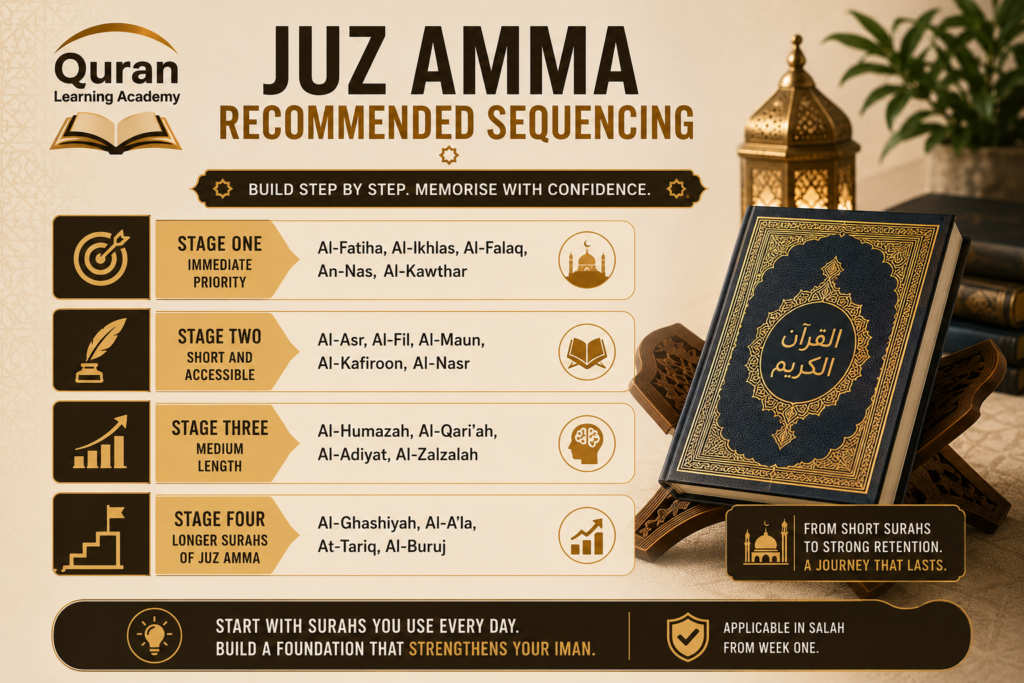
- Stage One — Immediate Priority: Al-Fatiha, Al-Ikhlas, Al-Falaq, An-Nas, Al-Kawthar.
- Stage Two — Short and Accessible: Al-Asr, Al-Fil, Al-Maun, Al-Kafiroon, Al-Nasr.
- Stage Three — Medium Length: Al-Humazah, Al-Qari’ah, Al-Adiyat, Al-Zalzalah.
- Stage Four — Longer Surahs of Juz Amma: Al-Ghashiyah, Al-A’la, At-Tariq, Al-Buruj.
This progression ensures that a student builds immediately usable memorisation — applicable in Salah from week one — before moving to material that requires longer retention effort.
Read Also: The Best Time to Memorise Quran for British Muslims
The Most Important Surahs Compared by Priority and Purpos
| Surah | Length | Memorisation Priority | Specific Virtue |
| Al-Fatiha | 7 verses | Highest — Salah invalid without it | Repeated 17+ times daily in prayer |
| Al-Ikhlas | 4 verses | Highest — fastest return on effort | Equals one third of the Quran in reward |
| Ayat Al-Kursi | 1 verse | High — daily protection practice | Greatest verse in the Quran |
| Al-Mulk | 30 verses | High — nightly Sunnah | Protection from punishment of the grave |
| Al-Kahf | 110 verses | Medium-High — weekly Sunnah | Light between two Fridays, protection from Dajjal |
| Al-Baqarah | 286 verses | Advanced — long-term goal | Intercession on the Day of Judgement |
| Al-Imran | 200 verses | Advanced — long-term goal | Intercession alongside Al-Baqarah |
Read Also: How to Start Reading and Memorising Quran in the UK
Experience the Academy in Action
Curious about our teaching style? Take a quick look inside a live session to see our immersive, supportive learning environment first-hand.
Start Your Quranic Journey in the UK
Join our academy for structured online lessons with expert tutors, tailored to fit your schedule.
Book Your Free TrialRead Also: How to Memorize Surah Fast?
Tajweed Accuracy Is Inseparable from Memorisation
Memorising a surah with Tajweed errors does not produce authentic Hifz — it produces an approximate version of the Quran that becomes harder to correct with every repetition. The oral transmission of the Quran is not incidental; it is the defining feature of how the Quran has been preserved across fourteen centuries.
A qualified teacher catches errors that a student cannot hear in their own recitation:
- Makhraj errors — incorrect articulation points for Arabic letters that do not exist in English.
- Sifaat violations — missing letter characteristics such as Qalqalah, Tafkheem, and Tarqeeq.
- Madd length errors — elongating or shortening vowels incorrectly, which changes the meaning of words.
- Ghunnah duration — the nasal sound required on certain letters that most English speakers under-emphasise.
- Verse boundary errors — pausing in the wrong place during recitation, which alters the meaning.
The Online Tajweed Classes in the UK at UK Quran Learning Academy teach authentic Quranic recitation through structured lessons in Makharij, Sifaat, and pronunciation rules — progressing from foundational articulation points to advanced recitation fluency across all surah types.
Read Also: How to Help the Kids to Hifz Quran in the UK?
Enroll in Online Tajweed Classes at quranlearningacademy.co.uk
Start Your Hifz Journey with UK Quran Learning Academy
Most British Muslims who struggle to begin memorising the Quran are not lacking motivation — they are lacking structure, qualified guidance, and a system that fits their actual life. UK Quran Learning Academy offers a complete range of programmes designed for every type of learner across Britain, delivered one-to-one with certified teachers online.
Every programme at UK Quran Learning Academy includes:
- One-to-one sessions with a qualified, experienced Azhari instructor.
- Structured daily and weekly review plans built into the curriculum.
- Real-time Tajweed correction so memorisation is accurate from day one.
- Flexible scheduling that fits around work, school, and family commitments across the UK.
Discover Our Quran Courses
- Quran Online Academy
- Quran Recitation Classes
- Quran Reading Classes
- Online Quran Classes for Kids
- Quran Classes for Adults
- Quran Classes for Female / Sisters
- Learn Quran Course for Beginners
- Quran Memorization (Hifz) Course
- Hifz Classes for Adults
- Quran Memorization and Hifz Course for Kids
- Quran Hifz Course for Ladies
- Quran Ijazah Program
- Quran Qirat Learning Course
- Quran Tafsir Course
- Noorani Qaida Course
- Noorani Qaida Course for Kids
- Weekend Quran Classes
- Intensive Quran Course
- Al-Azhar Quran Course
- Online Tajweed Classes
- Tajweed Course for Kids
- Tajweed Course for Adults
- Tajweed Course for Ladies
Book a Free Trial at quranlearningacademy.co.uk
Conclusion
Identifying the most important surahs to memorise is essential, yet many British Muslims lack clear direction. Grounded in authentic narrations, key chapters offer immense blessings—Al-Fatiha forms the foundation, Al-Mulk grants protection, and Juz Amma provides the most important surahs to memorise for prayer during daily worship.
Following a structured system makes this goal achievable alongside a busy UK lifestyle. Starting with shorter chapters and progressing with qualified teachers ensures accurate Tajweed and steady growth, transforming your daily Salah into a deeply personal, lifelong connection with the Quran through dedicated support.
FAQ
Which surah should I memorise first?
You should memorise Surah Al-Fatiha first. It is an essential part of every Salah, recited at least seventeen times a day, and no prayer is valid without it.
What are the best surahs to memorise for prayer?
After Surah Al-Fatiha, the best surahs to memorise are Al-Ikhlas, Al-Falaq, An-Nas, Al-Kawthar, Al-Asr, and Al-Kafiroon. These short surahs are commonly recited in daily prayers and are frequently heard in congregational Salah.
Can adults memorise Quran surahs without previous Hifz experience?
Yes. Adults can successfully memorise Quran surahs by following a structured plan that includes daily practice, regular revision, repeated recitation, and guidance from a qualified Quran teacher.
What are the 10 most important surahs to memorise?
The ten most important surahs to memorise are Al-Fatiha, Al-Ikhlas, Al-Mulk, Al-Kahf, Al-Baqarah, Aal Imran, Al-Falaq, An-Nas, Al-Asr, and Al-Kawthar because of their virtues and importance in daily worship and Islamic practice.
Why is learning with a qualified Quran teacher important?
A qualified Quran teacher corrects Tajweed mistakes, pronunciation, Makharij, Madd, Ghunnah, and recitation errors as they occur, helping students build accurate memorisation from the beginning and avoid mistakes that become difficult to correct later.




Leave a Reply