 Learn Arabic

| Key Takeaways |
| Learning conversational and written Arabic in 6 months is achievable with 45–60 minutes of focused daily study structured across all four language skills. |
| British learners must build reading, writing, listening, and speaking simultaneously from week one. |
| The 6-month window requires a phased plan: script foundations in weeks 1–3, then integrated grammar, vocabulary, and speaking practice through month 6. |
| Structured input — graded audio, short video content, and live conversation practice — accelerates progress faster than self-study alone for UK-based learners. |
| One-to-one online tuition with a qualified Arabic instructor is the most time-efficient route for busy adults in the UK with no prior Arabic background. |
The students we work with across the UK regularly reach that threshold: reading short texts, holding basic conversations, understanding spoken Arabic in context, and writing independently.
To learn Arabic in 6 months in the UK, you need a phased plan that integrates reading, writing, listening, and speaking from the first week — with the Arabic script acquired as a tool for language use, not treated as the entire first phase.
Roughly 45–60 minutes of daily study, divided intelligently across skills, is sufficient. The learners who fall behind are almost always those who spend months perfecting the alphabet before they have heard a single Arabic sentence spoken naturally.
1. Learn the Arabic Script Alongside Real Words and Sounds (Weeks 1–3)
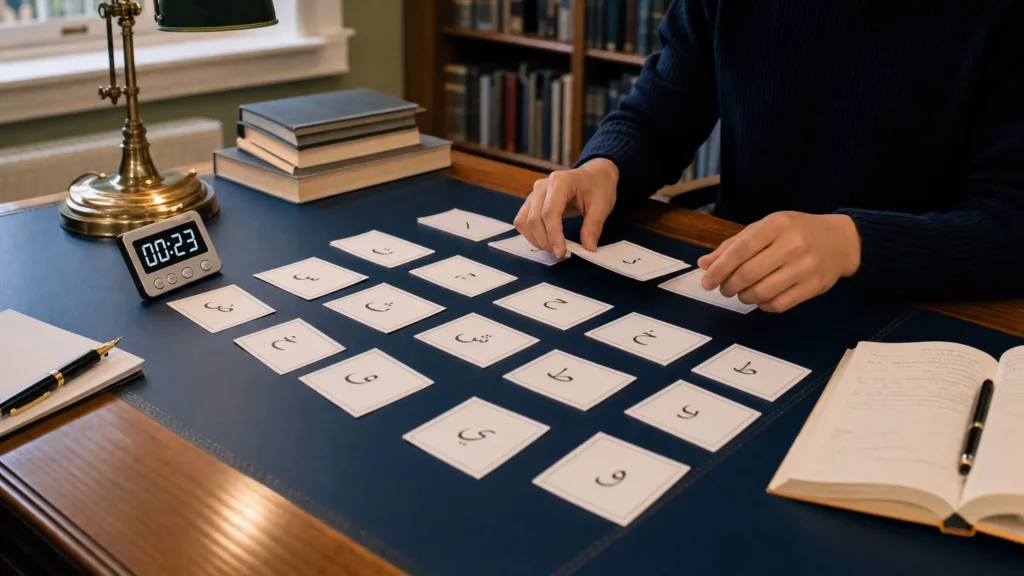
Gaining confidence with the Arabic script takes most British learners two to three weeks — not two to three months. The key is to learn each letter in the context of real Arabic words from the outset, rather than drilling isolated letter forms on a worksheet until they feel perfect.
In our sessions with adult beginners across the UK, we introduce every new letter group alongside two or three high-frequency Arabic words that use it.
That means within 72 hours of starting, a new learner can read the word كتاب (kitāb — book) or باب (bāb — door) even while they are still learning the full alphabet.
This is not rushed — it is efficient, because the brain retains letter forms far more reliably when they carry meaning.
During these first three weeks, divide your daily study roughly as follows:
- 20 minutes — Arabic letter recognition, handwriting, and connecting letters in words
- 15 minutes — Listening to native-speed Arabic audio (graded podcasts or short YouTube content in Modern Standard Arabic or Levantine dialect, depending on your goal)
- 10 minutes — Repeating and recording your own pronunciation of the words you are learning to read
Do not wait until you know all 28 letters before you begin listening. Passive exposure to Arabic sounds from week one calibrates your ear to the phonetic distinctions — like ع and غ — that British English speakers find most difficult.
Most adult learners we work with mispronounce ع as a plain vowel sound initially; the sooner the ear hears the correct pharyngeal quality, the sooner it registers.
By the end of week three, you should be able to read short Arabic words phonetically and recognise the core letter forms in both printed and handwritten contexts.
Shots Videos from Our Courses
Start Your Quranic Journey in the UK
Join our academy for structured online lessons with expert tutors, tailored to fit your schedule.
Book Your Free Trial2. Build Your First Layer of Grammar and Vocabulary Together (Weeks 4–8)
Arabic grammar is not something you learn before you speak — it is something you absorb through speaking, reading, and then understanding why the language works the way it does.
This phase introduces the foundational structures of Modern Standard Arabic (MSA) — the variety used in media, formal writing, and education across the Arab world — while your vocabulary grows steadily alongside it.
The most important structures to internalise in this phase are:
| Grammar Structure | What It Enables |
| Nominal sentence (jumlah ismiyyah) | Describing things: “The student is hardworking.” |
| Definite and indefinite articles (ال) | Specifying nouns in reading and speech |
| Masculine and feminine noun agreement | Correct adjective use in writing and speaking |
| Basic verb conjugation (present tense) | Talking about actions happening now |
| Simple question forms | Asking and answering in conversation |
Aim to add 8–10 new Arabic words per day during this phase — not through random vocabulary lists, but through themed sets tied to grammar structures you are practising. Learn the word for “student,” “teacher,” “book,” and “classroom” in the same week you learn nominal sentences, and you will use them immediately in real phrases.
For British learners whose lives do not fit into a classroom timetable, this phase is where structured online tuition pays off most clearly.
The UK Quran Learning Academy’s Arabic language course covers MSA grammar and vocabulary in a one-to-one format — which means the pace adapts to what you specifically need to consolidate, rather than a group moving at a fixed rate.
Divide your daily 45–60 minutes roughly as follows in this phase:
- 20 minutes — Grammar study and written exercises
- 15 minutes — Reading a short Arabic text (a news headline, a simple paragraph)
- 15 minutes — Speaking practice — narrating simple sentences aloud or with a tutor
- 10 minutes — Listening to a short Arabic audio clip and noting words you recognise
Book a FREE trial class in our Arabic Course in the UK

3. Shift the Balance Toward Active Speaking and Reading (Weeks 9–14)
By the end of month two, you have a working grammar foundation and a vocabulary base of roughly 200–300 words. From here, the fastest gains come from shifting your study balance — spending more time producing language and less time studying it passively.
This phase is where British learners who studied with a tutor visibly overtake those who studied independently.
The reason is simple: you cannot correct your own Arabic accent, your own grammatical errors in speech, or your own reading rhythm without someone who knows the language responding to you.
In our experience, learners who have had consistent one-to-one correction in this phase reach conversational comfort six to eight weeks faster than those relying on apps and passive video content alone.
The goals for this phase are:
- Holding a structured 5–10 minute conversation in Arabic on familiar topics (daily routine, family, work, preferences)
- Reading a short Arabic paragraph without relying on full vocalisation marks (harakat)
- Writing 5–8 sentences independently from memory
- Recognising at least 40–50% of words in slow-to-medium-speed spoken Arabic content
For learners specifically interested in developing conversational fluency, The UK Quran Learning Academy’s Arabic conversation and speaking course targets exactly this stage — building the confidence to produce, not just recognise.
Book a FREE trial class in our Speaking Arabic Course in the UK
4. Consolidate Grammar Through Writing and Expand Listening Input (Weeks 15–18)
Arabic grammar has layers. The foundational structures from phase two are now working in your speaking, but writing consistently without errors requires reinforcing those patterns under the slower, more deliberate conditions of written composition.
This phase dedicates specific time to written grammar — not worksheets, but actual composition of short texts you care about.
Practical writing tasks for this phase:
- Write a short paragraph about yourself, your daily routine, or your interests — entirely in Arabic, without translation tools
- Write a brief message or email in Arabic (to a tutor or a language partner)
- Summarise in Arabic a short news article you have read in the language
Simultaneously, expand your listening input. By week 15, you should be moving beyond beginner-graded content and exposing yourself to authentic Arabic media — Al Jazeera short news reports, Arabic YouTube content with subtitles, or Arabic podcasts designed for intermediate learners. Do not aim to understand everything; aim to identify sentence structures and vocabulary you recognise.
The Arabic grammar course at The UK Quran Learning Academy gives learners the systematic grammatical scaffolding that makes writing accurately a reachable target rather than an overwhelming one — covering the structures that actually appear in real Arabic texts.
Book a FREE trial class in our Arabic grammar Course in the UK
5. Reach Functional Proficiency Across All Four Skills (Weeks 19–24)
The final six weeks are about consolidation and honest self-assessment. Functional proficiency — the ability to read a real Arabic text, write independently, speak about familiar topics, and understand spoken Arabic in context — is achievable by the end of month six for learners who have followed a structured plan. It is not advanced fluency, but it is genuinely useful Arabic.
A practical self-assessment at the six-month mark should look like this:
| Skill | Functional Proficiency Benchmark |
| Reading | Can read an unvocalised Arabic text on a familiar topic with a dictionary |
| Writing | Can produce a paragraph of 8–10 sentences with correct basic grammar |
| Speaking | Can hold a 10-minute conversation on familiar topics without long pauses |
| Listening | Can follow a slow-to-medium-speed Arabic news report with some comprehension |
For learners who want to accelerate the final phase or recover lost time, The UK Quran Learning Academy’s Arabic intensive course compresses a higher volume of structured input into a shorter period — useful for anyone who knows they have the motivation but needs the accountability to match it.
Insha’Allah, by the end of month six, Arabic will no longer feel like a foreign language you are memorising — it will feel like a language you are beginning to think in.
Our Students Reviews
Start Your Quranic Journey in the UK
Join our academy for structured online lessons with expert tutors, tailored to fit your schedule.
Book Your Free TrialBook a FREE trial class in our intensive Arabic Course in the UK
Read Also: How to Learn Arabic in One Month in the UK?
Begin Your Arabic Learning at The UK Quran Learning Academy
Six months of structured Arabic study can take you from zero to functional proficiency — if the plan is right and the instruction is personalised to you.
At The UK Quran Learning Academy, we offer exactly that:
- Qualified instructors with experience teaching British adults with no Arabic background
- One-to-one sessions — no group class format, no one-size-fits-all pace
- Flexible scheduling designed for UK life — evenings, weekends, and split sessions
- Courses covering reading, writing, speaking, listening, and grammar at every level
- Free trial lesson — no commitment required
Book your free trial Arabic lesson and begin with a plan built around your schedule, your starting point, and your goals.
Check out our top Arabic courses for UK students:
- Intensive Arabic course
- Arabic grammar course
- Arabic conversation and speaking course
- Arabic language course
Book your FREE trial session today

Conclusion
The six-month window works because it is long enough to build real linguistic foundations and short enough to maintain momentum. British adults who commit to 45–60 minutes daily — spread intelligently across reading, writing, speaking, and listening — consistently reach a point where Arabic begins to feel natural rather than effortful.
The learners who struggle are not those with less ability — they are almost always those who spent the first weeks or months in a single skill, usually reading the alphabet in isolation, before returning to start the language itself. Treating Arabic as four integrated skills from day one changes the trajectory entirely.
Read Also: How to Learn Arabic in 5 Minutes in the UK?
Frequently Asked Questions About Learning Arabic in 6 Months in the UK
Is 6 months enough time to learn Arabic as a complete beginner in the UK?
Six months is enough to reach functional proficiency — not fluency — for most British adult beginners who study 45–60 minutes daily with a structured plan. By month six, learners typically can read simple unvocalised texts, hold a basic conversation, write short paragraphs, and follow slow-speed spoken Arabic with reasonable comprehension.
Should I learn Modern Standard Arabic or a dialect if I want to learn quickly?
For a six-month plan, Modern Standard Arabic is the stronger foundation. It is used in formal writing, media, and education across the Arab world, and it gives you the grammatical framework to then pick up a spoken dialect far more quickly. Most learners pursuing a dialect alongside MSA find it manageable from month three onwards once core grammar is in place.
How many hours per week do I need to study Arabic to make real progress in 6 months?
Roughly five to seven hours per week — around 45–60 minutes daily — is sufficient for most British learners following a structured programme. The distribution matters as much as the total: spreading that time across reading, writing, listening, and speaking each session consistently outperforms longer weekly cramming sessions in a single skill.
Can I learn Arabic online in the UK without attending a physical class?
As of 2025, online one-to-one Arabic tuition is the primary route for British adults learning Arabic, and for most learners it outperforms in-person group classes in terms of pace and personalisation. One-to-one online lessons allow real-time correction of pronunciation and grammar, flexible scheduling around UK working hours, and a pace that reflects where you actually are — not where a class average sits.
What is the hardest part of learning Arabic for British English speakers?
The phonetic system is the most immediately challenging aspect for British learners. Sounds like ع (ayn), غ (ghayn), خ (kha), and ح (ha) have no English equivalents and require conscious practice to produce and distinguish correctly. Grammatical gender — Arabic assigns masculine or feminine gender to every noun — is the other common stumbling point, particularly in writing. Both improve significantly with regular one-to-one feedback from a qualified Arabic instructor.






Leave a Reply