 Learn Arabic
| Key Takeaways |
| Self-directed Arabic learners in the UK can reach conversational competency faster by studying structured Modern Standard Arabic before any dialect. |
| Consistent daily practice of 20–30 minutes outperforms irregular longer sessions for building and retaining Arabic vocabulary and grammar. |
| The Arabic script must be mastered before any other skill — learners who skip this step plateau quickly and struggle to self-correct. |
| UK-based learners benefit from combining self-study tools with structured online courses to avoid developing uncorrected pronunciation errors. |
| Free resources alone rarely build fluency; pairing self-study with qualified instruction closes the gap between recognition and real usage. |
Learning Arabic on your own in the UK is entirely achievable — but it requires a clear plan, not just enthusiasm. The learners who make consistent progress are not the ones with the most apps or the most free time. They are the ones who treat Arabic as a structured skill rather than a subject to browse through casually when motivation strikes.
Arabic is a structured, rule-governed language. Once you understand how its root system works, how verbs conjugate, and how sentences are built, the language becomes logical in a way that genuinely rewards focused study.
1. Decide Which Arabic You Are Learning
The single most common mistake among UK self-learners is starting without deciding which Arabic they are targeting. Modern Standard Arabic (MSA) — known in Arabic as Fusha — is the formal, written, and broadcast Arabic used across the Arab world. It is the Arabic of news media, literature, formal speech, and education. Colloquial Arabic refers to the regional spoken dialects — Egyptian, Levantine, Gulf, Moroccan — which vary significantly from one another and from MSA.
For most UK learners who want a general Arabic skill that transfers across contexts, MSA is the right starting point.
It gives you a foundation that is universally understood across the Arab-speaking world and directly applicable to reading, writing, and formal comprehension. Dialects are best added later, once you have structural fluency beneath them.
If your goal is specific — Egyptian friends and family, for example — a dialect-first approach has merit. But without MSA structure underneath it, dialectal learning tends to plateau into survival phrases rather than genuine language skill.
Book your free trial lesson at The UK Quran Learning Academy’s Arabic course and start learning Arabic.
Book a FREE trial class in our Arabic Course in the UK

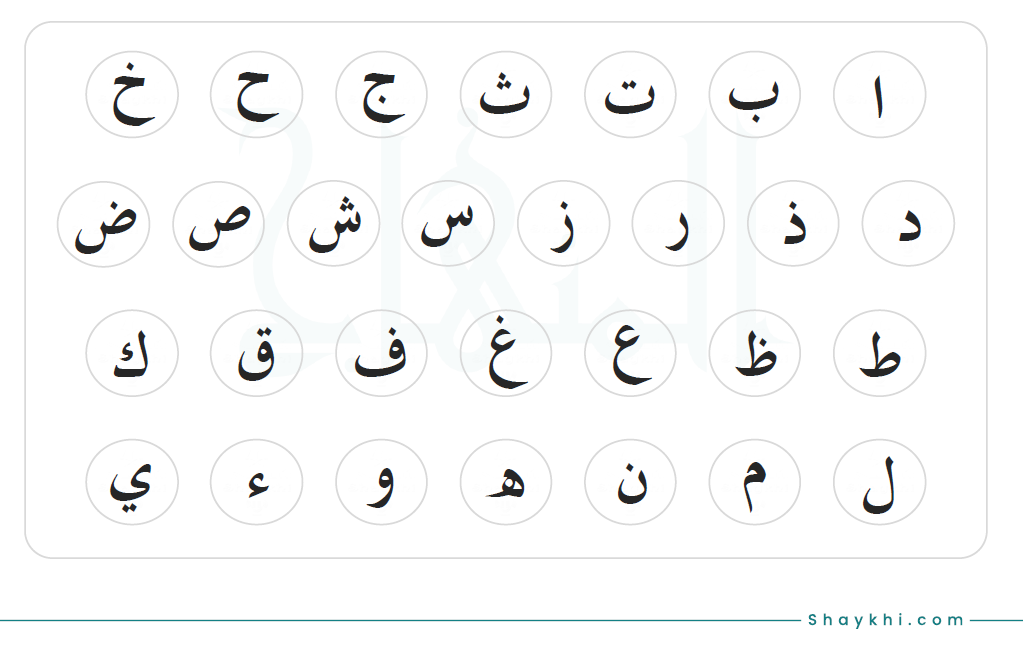
2. Master the Arabic Script
To learn Arabic on your own in the UK, the Arabic script is your non-negotiable foundation — and it must come before vocabulary lists, grammar books, or language apps.
Learners who try to build vocabulary through romanised transliteration (writing Arabic words in Latin letters) create a ceiling for themselves that is extremely hard to break through later.
The Arabic alphabet has 28 letters. Most are written in four forms depending on their position in a word — standalone, initial, medial, final. The script runs right to left.
Short vowels are usually omitted from standard written Arabic, which means you need to know words well enough to read them correctly without diacritical marks.
Most learners can read and recognise the full Arabic script within four to six weeks of consistent daily practice — not months. Dedicate 15–20 minutes daily specifically to letter recognition, handwriting practice, and connecting letters.
3. Build Your Arabic Vocabulary With a Root-System Approach
Arabic is built on a root system (called جذر, jithr) — most Arabic words are derived from three-letter (or occasionally four-letter) roots that carry a core meaning.
Understanding this system transforms vocabulary learning from rote memorisation into genuine pattern recognition.
The root ك-ت-ب (k-t-b), for example, relates to writing. From it come: kataba (he wrote), kitaab (book), maktab (office or desk), maktaba (library), kaatib (writer). Learn the root, and you unlock a family of words rather than a single entry.
| Arabic Root | Core Meaning | Derived Words |
| ك-ت-ب (k-t-b) | Writing | kitaab (book), maktaba (library), kaatib (writer) |
| د-ر-س (d-r-s) | Study / learning | darasa (he studied), madrasa (school), droos (lessons) |
| ع-ل-م (ʿ-l-m) | Knowledge | ʿilm (knowledge), ʿaalim (scholar), muʿallim (teacher) |
| ف-ه-م (f-h-m) | Understanding | fahima (he understood), fahm (comprehension), mafhoom (concept) |
| س-ف-ر (s-f-r) | Travel | safar (travel), musaafir (traveller), sifaara (embassy) |
Shots Videos from Our Courses
Start Your Quranic Journey in the UK
Join our academy for structured online lessons with expert tutors, tailored to fit your schedule.
Book Your Free Trial4. Learn Arabic Grammar as a Tool
Arabic grammar should be learned in service of production — speaking and writing real sentences — not as an academic exercise in memorising tables. For independent learners in the UK, the key early grammar priorities are: the dual form, basic إعراب (iʿraab — grammatical case endings), the idaafa (possessive construction), definite and indefinite articles, and verb conjugation in the present and past tenses.
Do not attempt to master the entire Arabic grammar system before using the language. Learn a grammar point, immediately apply it to sentences you construct yourself, then move to the next. Students we work with who spend months on grammar theory without output practice consistently find that their comprehension outpaces their ability to produce even basic sentences.
A structured grammar foundation can be built through The UK Quran Learning Academy’s Arabic Grammar course, which takes British learners through core grammatical structures in a progressive, applied sequence — not isolated theory.
Book a FREE trial class in our Arabic grammar Course in the UK
5. Develop Your Listening Skill Deliberately
Listening is the most neglected Arabic skill among UK self-learners, and the gap it creates becomes obvious the moment you encounter real spoken Arabic. Passive exposure — having Arabic TV on in the background — builds very little actual comprehension. Deliberate listening is a different discipline.
Deliberate listening practice means: selecting audio or video at a level just above your current comprehension, listening actively without transcripts first, then reviewing with a transcript, then listening again without it.
Arabic news channels like Al Jazeera, Arabic YouTube educational content, and graded listening resources provide structured material at multiple levels.
Aim for a minimum of 20 minutes of deliberate listening per day once you are past the script-learning stage.
British learners who neglect listening until their reading is advanced typically find that real spoken Arabic — even MSA — sounds nothing like what they expected. The earlier you train your ear, the faster your overall progress.
6. Build Arabic Speaking Confidence Without a Classroom
Speaking Arabic on your own in the UK presents a genuine logistical challenge — there is no immersive Arabic-speaking environment built into daily life for most British learners. The solution is to create speaking practice deliberately rather than waiting for the conditions to appear.
Three practical approaches work well for UK self-learners:
A. Self-narration practice:
Narrate what you are doing in Arabic as you go through daily tasks — making tea, commuting, preparing a meal. This sounds modest but trains the retrieval-to-production pathway that speaking requires.
B. Language exchange partners:
Platforms like Tandem and HelloTalk connect you with native Arabic speakers who want to learn English, allowing structured conversation exchange.
C. Online tutored speaking sessions:
Structured conversation practice with a qualified instructor catches pronunciation errors before they become permanent habits.
The UK Quran Learning Academy’s Arabic Conversation and Speaking course offers one-to-one speaking sessions specifically designed for British learners developing spoken Arabic from a reading foundation — a more efficient route than self-directed conversation practice alone for building accurate pronunciation early.
Book a FREE trial class in our Speaking Arabic Course in the UK
7. Create a Sustainable Weekly Arabic Study Structure
Learning Arabic on your own in the UK requires structure that survives a real British life — full-time work, family responsibilities, shift patterns, and the frequent interruptions that derail the best intentions. The study plan that works is the one you will actually follow for twelve months, not the one that looks optimal on paper.
A realistic and effective weekly structure for a UK self-learner in the beginner-to-intermediate phase:
| Day | Focus | Duration |
| Monday | New vocabulary (root-based learning) | 25 mins |
| Tuesday | Grammar point + applied sentences | 25 mins |
| Wednesday | Deliberate listening + transcript review | 30 mins |
| Thursday | Vocabulary revision (spaced repetition) | 20 mins |
| Friday | Speaking practice (self-narration or exchange) | 25 mins |
| Saturday | Reading practice (graded texts or news) | 30 mins |
| Sunday | Review week’s material, identify gaps | 20 mins |
Spaced repetition software — Anki is the most widely used, with pre-built Arabic vocabulary decks available — dramatically improves long-term retention compared to linear review. Build your vocabulary deck as you go, adding new root families weekly.
Our Students Reviews
Start Your Quranic Journey in the UK
Join our academy for structured online lessons with expert tutors, tailored to fit your schedule.
Book Your Free Trial8. Track Your Progress in Learning Arabic Against Measurable Milestones
Self-study without accountability drifts. One of the most effective things an independent learner can do is define what progress looks like at each stage — not vaguely (“I want to get better at Arabic”) but specifically.
Meaningful milestones for UK Arabic self-learners:
- Month 1: Read any Arabic text letter by letter without help, recognise all 28 letters in all four forms
- Month 3: Read short texts with vowel diacritics (harakat) and understand 60–70% of content
- Month 6: Read simple unvocalised Arabic texts (news headlines, basic articles), construct 20-word sentences in speech and writing
- Month 12: Sustain a 10-minute spoken conversation in MSA on familiar topics, read a graded Arabic news article with minimal dictionary use
If you reach month six without hitting the month-three milestones, the issue is usually one of two things: inconsistent practice, or uncorrected errors that have become habits.
This is where structured support, even occasional, is far more valuable than additional self-study resources.
The UK Quran Learning Academy’s Intensive Arabic course is designed specifically for learners who want to compress this progression — covering the foundational year of skills in a structured, accelerated format with regular one-to-one feedback.
Book a FREE trial class in our intensive Arabic Course in the UK
Read Also: How to Learn Arabic in 7 Days in the UK?
Starting Your Arabic Learning With Structured Support at The UK Quran Learning Academy
Self-study builds motivation and flexibility — qualified instruction builds accuracy. The UK Quran Learning Academy offers Arabic courses designed specifically for UK learners building general Arabic language skills from scratch.
- Qualified instructors with experience teaching British adult learners
- One-to-one personalised sessions — no group format, no waiting for others to catch up
- Flexible scheduling built around UK working and family life
- Courses covering Arabic reading, writing, speaking, listening, grammar, and Quran comprehension
- Free trial lesson with no commitment required
- Welcoming, structured environment for adults, parents, and beginners
Explore the full Arabic course options and book your free trial lesson today.
Check out our top Arabic courses for UK students:
- Intensive Arabic course
- Arabic grammar course
- Arabic conversation and speaking course
- Arabic language course
Book your FREE trial session today

Conclusion
Consistent self-study in Arabic is genuinely productive — but only when it is structured around the right sequence. Script first, then vocabulary through the root system, then grammar applied through real sentences, then listening and speaking built in parallel. Skipping steps or treating all four skills as one undifferentiated subject is the most common reason independent learners stall.
The UK context adds its own layer: most British learners have no passive Arabic exposure, no immersive environment, and busy schedules that make long study sessions impractical. The answer is not to study more hours — it is to make every 25 minutes count by focusing on the right skill at the right stage.
Read Also: How to Learn Arabic in 3 Months in the UK?
Frequently Asked Questions About Learning Arabic on Your Own in the UK
How long does it take to learn Arabic independently in the UK?
Most dedicated self-learners studying 25–30 minutes daily can read Arabic script within 4–6 weeks and hold a basic MSA conversation within 12–18 months. The timeline depends heavily on consistency and whether pronunciation errors are caught and corrected early — self-study alone often allows habits to form that require later remediation.
Is Modern Standard Arabic or a dialect better for beginners learning on their own?
For most UK self-learners with general language goals, Modern Standard Arabic is the better starting point. It provides a transferable grammatical foundation, it is the Arabic of formal media and literature, and it is understood across the Arab world. Dialectal Arabic is best introduced after a solid MSA foundation is in place.
Can I learn spoken Arabic without living in an Arabic-speaking country?
Yes — UK-based learners build spoken Arabic effectively through structured self-narration practice, language exchange partnerships via apps like Tandem and HelloTalk, and one-to-one online speaking sessions with qualified instructors. The absence of immersion slows passive acquisition but does not prevent deliberate production skills from developing to a high level.
At what point should I move from self-study to a structured Arabic course?
If you have been studying independently for three or more months and cannot construct simple sentences confidently, or if you find that you can read but cannot produce speech, structured one-to-one instruction will accelerate your progress significantly. A qualified instructor identifies the specific gaps self-study cannot diagnose — and corrects them before they compound.







Leave a Reply