 Quran
Quran

For British Muslims juggling work shifts, school runs, university deadlines, and family commitments, the question of how long it takes to memorize the Quran in the UK is rarely simple. You are not living in a full-time madrasa. You are commuting on the Tube, studying for A-levels, managing a household in Birmingham or Leeds, and trying to carve out twenty minutes of focused Hifz between Fajr and the school gate. The timeline looks different here — and that is not a weakness, it is just reality.
The honest answer is that most dedicated British learners who follow a structured daily system complete their Hifz between one and four years. What determines where you fall on that range is not talent. It is daily consistency, the quality of your review, and whether you are working with a qualified teacher or going it alone.
How Long Does It Take to Memorize the Quran in the UK?
Most learners in the UK complete Quran memorization in 1 to 4 years, depending on their daily consistency, review routine, and guidance from a qualified teacher. Memorizing half a page daily typically takes 2.5–3 years, while one page daily can lead to completion in 1.5–2 years.
Daily Memorization Amount Determines Your Hifz Timeline
Before calculating timelines, it helps to understand what the Quran actually contains. The Mushaf has 604 pages, divided into 30 Juz. Each Juz contains 20 pages. That is the total distance every Hafiz travels regardless of where they live.
The pace you set each day determines how long the journey takes. Here is what those daily targets look like when mapped against realistic UK schedules:
| Daily Memorization Amount | Approximate Time to Complete Hifz |
| 5 to 10 lines daily | 3 to 4 years |
| Half a page daily | 2.5 to 3 years |
| One full page daily | 1.5 to 2 years |
| Two pages daily | 10 to 12 months |
| One full Juz daily | 30 days (intensive, full-time commitment) |
These figures assume consistent daily memorization with proper review maintained alongside new material. They also assume no long gaps due to exams, Ramadan disruption, or family pressures — which, for British learners, is rarely realistic. Building in a realistic buffer of two to four extra months is wise.
The critical point that many UK students miss is that these timelines only hold when review is treated as non-negotiable. Memorizing forward without reviewing backward is the most common reason British learners find themselves restarting Hifz two or three times rather than completing it once.
Read also: Who Was the First Person to Memorize the Holy Quran?
British Life Directly Affects Your Memorization Timeline
A student in Cairo attending a dedicated Hifz school lives inside a structure that removes almost every competing demand. A British Muslim does not have that structure built into daily life. This is not a disadvantage to apologize for — it is simply the context in which UK Hifz happens, and understanding it leads to a more accurate and sustainable plan.
Several factors specific to life in Britain affect how long it takes to memorize the Quran:
- School and university schedules mean that younger learners often have their most productive memorization windows interrupted by GCSE or A-level revision cycles. Planning Hifz around academic terms rather than ignoring them is a practical necessity.
- Shift work and professional schedules affect thousands of British Muslim adults who want to pursue Hifz alongside careers in healthcare, hospitality, retail, and transport. A fixed daily Hifz time is harder to protect when shift patterns rotate. The solution is not a perfect daily schedule — it is a minimum non-negotiable session that survives even the busiest week.
- The absence of immersive Arabic environments means that British learners typically approach the Quran as a second language. Adult non-Arabic speakers need more repetitions per verse than children or native Arabic speakers to achieve the same retention depth. Factoring this into your timeline from the start prevents the discouragement that comes from comparing your pace to someone raised in an Arabic-speaking household.
- Mosque timetables and community structures vary significantly across the UK. In cities like Manchester, Leicester, and East London, organised Hifz circles are accessible. In smaller towns, learners may need to rely on online instruction to access a qualified teacher.
If you are struggling to find consistent in-person guidance, the Quran Memorisation Course in the UK from UK Quran Learning Academy connects British learners with qualified Azhari instructors through live, one-to-one online sessions — removing the geographical barrier that delays so many UK Hifz journeys.

Explore the Quran Memorisation Course at UK Quran Learning Academy
The Five-Phase Method Produces Lasting Memorization
The memorization method you use inside each session matters as much as the time you put in. Two students both sitting for forty-five minutes after Fajr can produce very different results depending on how they use those forty-five minutes.
The method consistently endorsed by Hifz scholars works through five stages for each page:
Reading
Read the full page or target section slowly once, paying attention to meaning and the visual layout of each line.
Segmenting
Divide the page into three or four small sections of three to four lines each. Work through the first segment by reading it five times with the Mushaf open.
Closing
Close the Mushaf and repeat those lines from memory until you can recite the segment three consecutive times without error.
Connecting
Link each memorized segment to the one before it, reciting them cumulatively until the full page flows as one unit.
Page-to-Page connection
Once a full page is memorized, recite it together with the previous page from that session, so each day ends with a continuous block of connected material.
This method takes more time per session than simply reading a page repeatedly, but produces memorization that holds for weeks rather than evaporating overnight. British learners who apply this approach consistently report that their retention improves noticeably within the first two to three weeks of practice.
The Prophet ﷺ emphasized this discipline directly:
“مَثَلُ الَّذِي يَقْرَأُ الْقُرْآنَ وَهُوَ حَافِظٌ لَهُ مَعَ السَّفَرَةِ الْكِرَامِ الْبَرَرَةِ، وَمَثَلُ الَّذِي يَقْرَأُ الْقُرْآنَ وَهُوَ يَتَعَاهَدُهُ وَهُوَ عَلَيْهِ شَدِيدٌ، فَلَهُ أَجْرَانِ”
“Such a person as recites the Qur’an and masters it by heart will be with the noble righteous scribes. And such a person who exerts themselves to learn the Qur’an by heart, and recites it with great difficulty, will have a double reward.” Sahih al-Bukhari: 4937
Read also: Who Is the Youngest Person to Memorize the Quran?
Consistent Daily Review Protects Everything You Memorize
New memorization disappears without near-term review. What you memorized yesterday needs reinforcement today, and what you memorized last week needs reinforcement this week. This is where most Hifz attempts in the UK collapse — students focus entirely on new material and treat review as optional.
Memory does not work that way. Recall strength decays rapidly in the first twenty-four to forty-eight hours after initial memorization, then stabilizes if the memory is revisited. Skipping review even for two or three consecutive days can undo an entire week of memorization work.
A structured review system has three layers:
| Review Category | Definition | Recommended Daily Amount |
| Near-Past Review | Last 5 pages memorized | Daily, non-negotiable |
| Mid-Past Review | Pages 6 to 20 behind current position | Daily, increasing gradually |
| Far-Past Review | Everything memorized before that | Weekly rotation |
For British learners who cannot always protect large blocks of time, the near-past review is the minimum. Even fifteen minutes of reviewing the last five pages prevents the kind of catastrophic forgetting that forces students to restart entire Juz from scratch.
On days when time is genuinely short — exam season, Ramadan preparation, family emergencies — experienced teachers consistently advise reviewing existing material rather than adding new verses. Protecting what you have is more important than expanding it.
If you find that independent review is producing errors you cannot catch yourself, the Hifz Classes for Adults in the UK at UK Quran Learning Academy provides structured memorization training with built-in revision accountability. Qualified instructors track both new memorization and review simultaneously, ensuring neither is sacrificed for the other.

Join the Hifz Classes for Adults at UK Quran Learning Academy
Experience the Academy in Action
Curious about our teaching style? Take a quick look inside a live session to see our immersive, supportive learning environment first-hand.
Start Your Quranic Journey in the UK
Join our academy for structured online lessons with expert tutors, tailored to fit your schedule.
Book Your Free TrialThe Fajr Window Gives British Learners a Real Advantage
Timing matters in Hifz, and after-Fajr is the most powerful memorization window available to any learner regardless of age or experience. The brain consolidates declarative memories during sleep and remains most accessible to new information in the hours immediately following. Fajr arrives at that exact peak.
For British Muslims, the Fajr window carries an additional practical advantage. Before Fajr, there are no work emails, no school drop-offs, no traffic, and no competing demands from the household. The environment matches what memory formation requires: quiet, focus, and the absence of distraction.
A practical daily structure that works within UK routines:
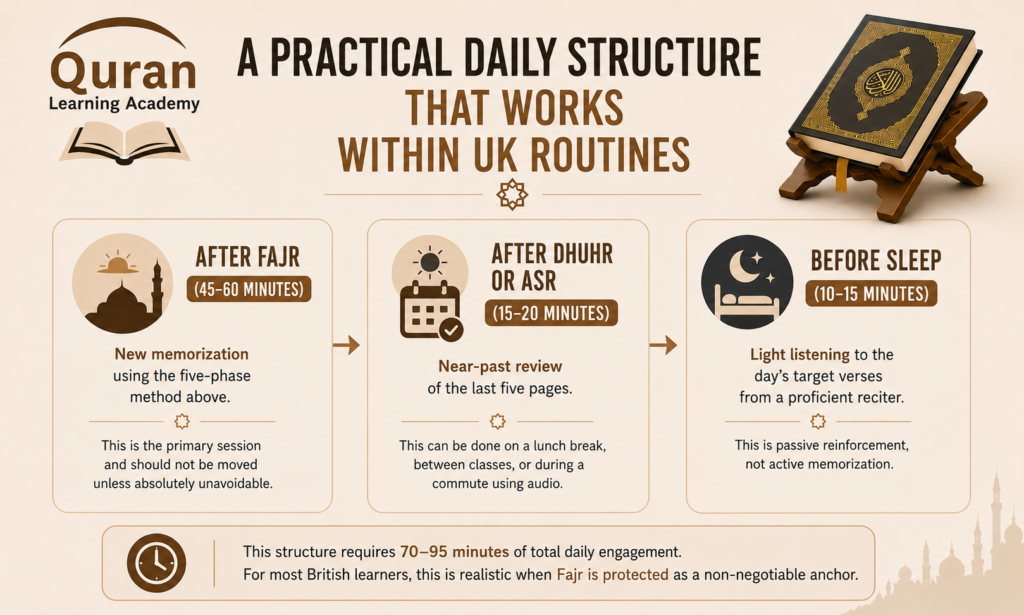
- After Fajr (45 to 60 minutes): New memorization using the five-phase method above. This is the primary session and should not be moved unless absolutely unavoidable.
- After Dhuhr or Asr (15 to 20 minutes): Near-past review of the last five pages. This can be done on a lunch break, between classes, or during a commute using audio.
- Before sleep (10 to 15 minutes): Light listening to the day’s target verses from a proficient reciter. This is passive reinforcement, not active memorization.
This structure requires between seventy and ninety-five minutes of total daily engagement. For most British learners, this is realistic when Fajr is protected as a non-negotiable anchor.
Allah ﷻ describes those who rise at this hour:
“تَتَجَافَىٰ جُنُوبُهُمْ عَنِ الْمَضَاجِعِ يَدْعُونَ رَبَّهُمْ خَوْفًا وَطَمَعًا وَمِمَّا رَزَقْنَاهُمْ يُنفِقُونَ”
Tatajāfā junūbuhum ‘ani al-maḍāji’i yad’ūna rabbahum khawfan wa ṭama’an wa mimmā razaqnāhum yunfiqūn.
“Their sides forsake their beds to supplicate their Lord in fear and hope, and they spend from what We have provided them.” Surah As-Sajdah: 16
Understanding Meaning Significantly Accelerates Memorization
Comprehension is not separate from memorization — it is a tool that makes memorization faster and retention stronger. When you understand what an ayah means, your brain creates multiple memory pathways for it rather than one. The sound of the words, the visual image of the Arabic text, and the conceptual meaning become three independent retrieval routes.
British learners often have access to strong English translations and tafseer resources that learners in purely Arabic-speaking environments may take for granted. Using this access deliberately as part of your Hifz method turns a potential disadvantage into a concrete benefit.
Practical meaning-based memorization does not require becoming a tafseer scholar. Reading a brief, trustworthy translation before each memorization session and noting the theme of the passage is sufficient to activate meaning-based memory pathways. If an ayah describes a scene, visualize it. If it contains a command, connect it to an action. These associations are not distractions from Hifz — they are structural supports for it.
Allah ﷻ draws attention to this directly:
“أَفَلَا يَتَدَبَّرُونَ الْقُرْآنَ أَمْ عَلَى قُلُوبٍ أَقْفَالُهَا”
Afalā yatadabbarūna al-Qur’āna am ‘alā qulūbin aqfāluhā.
“Then do they not reflect upon the Qur’an, or are there locks upon their hearts?” Surah Muhammad: 24
For learners who want structured access to Quranic meanings alongside their Hifz, the Quran Tafsir Course in the UK at UK Quran Learning Academy provides classical tafseer instruction under qualified teachers, helping comprehension and memorization reinforce each other rather than compete

. Explore the Quran Tafsir Course at UK Quran Learning Academy
Six Common Mistakes That Extend Your Hifz Timeline
Most British learners who struggle to complete Hifz are not failing because the goal is beyond them. They are failing because of specific, preventable errors that extend the timeline dramatically. Identifying these early saves months of repeated effort.
| Mistake | How It Extends Your Timeline |
| Skipping revision days | New memorization overwrites old material without consolidation |
| Changing the Mushaf mid-journey | Visual memory tied to page layout is disrupted |
| Memorizing at variable times | No habitual cue means no automatic recall |
| Reciting silently without vocalisation | Errors go undetected; Tajweed habits are not built |
| Memorizing too many pages too soon | Mental exhaustion causes sharp retention drops by week two |
| Continuing without a teacher | Mistakes compound silently until they are deeply embedded |
Beyond these structural errors, classical scholars across generations have noted that spiritual state affects memorization capacity. The Imam al-Shafi’i famously complained to his teacher Waki’ about his weak memory, and was advised to abandon sins — because the light of knowledge does not reach a heart darkened by disobedience. This is not a peripheral observation. For many British learners, returning to consistent prayer, reducing screen time, and maintaining good company has a measurable effect on memorization quality.
A Qualified Teacher Shortens Your Hifz Journey
Memorizing Quran without a teacher means you will almost certainly embed pronunciation errors, Tajweed mistakes, and incorrect verse boundaries that become extremely difficult to correct later. The oral transmission of the Quran is not incidental — it is the defining feature of how the Quran has been preserved across fourteen centuries.
Every word in the Mushaf today exists exactly as it does because of an unbroken chain of teachers and students transmitting it orally, with each student being corrected by their teacher in real time. Memorizing from recordings or text alone breaks this chain and removes the error-correction mechanism that is central to authentic Hifz.
A qualified teacher catches what self-study cannot:
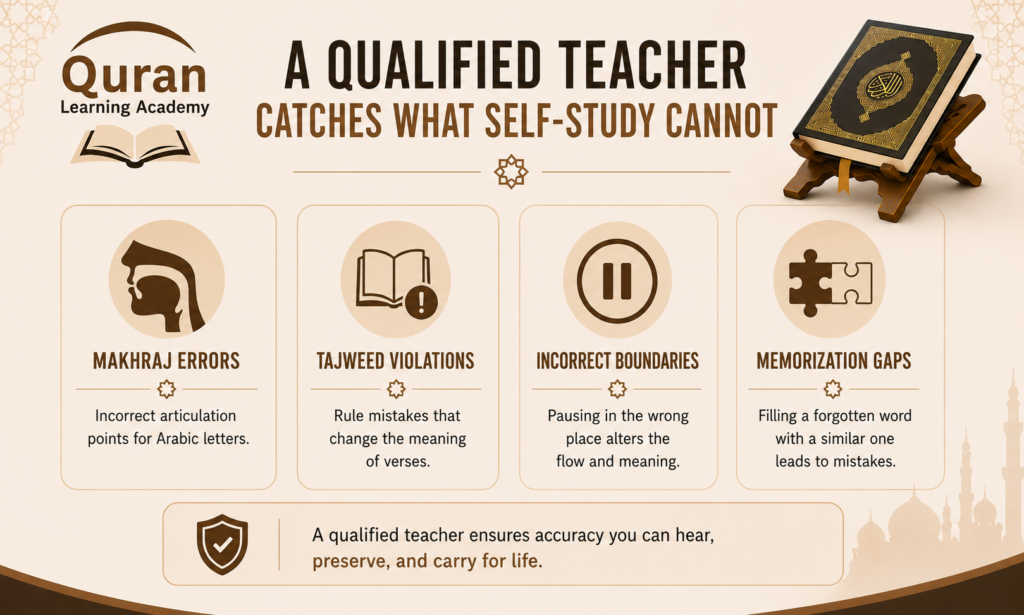
- Makhraj errors (incorrect articulation points for Arabic letters)
- Tajweed rule violations that sound minor but change the meaning of verses
- Incorrect verse boundaries that cause students to pause in the wrong place
- Memorization gaps where a student fills in a forgotten word with one that sounds similar but is incorrect
Step Inside Our Virtual Classrooms
See how our interactive lessons work. Watch these brief highlights of our students engaging with instructors.
Start Your Quranic Journey in the UK
Join our academy for structured online lessons with expert tutors, tailored to fit your schedule.
Book Your Free TrialBegin Your Hifz at UK Quran Learning Academy
Most British Muslims who struggle with Hifz are not lacking motivation — they are lacking structure, accountability, and qualified guidance. UK Quran Learning Academy offers a complete range of Hifz programmes designed for every type of learner, delivered one-to-one with certified Azhari teachers online from anywhere in the UK.
Whether you are just beginning or returning after a long break, the right programme exists for your situation. Every programme includes one-to-one sessions with a qualified teacher, structured daily and weekly review plans, real-time Tajweed correction, and scheduling that fits around British life. The fastest way to memorize the Quran is not a shortcut — it is a system. And the right system starts with the right teacher.
Enroll in a Hifz Programme at UK Quran Learning Academy Today
Discover Our Quran Courses
- Quran Online Academy
- Quran Recitation Classes
- Quran Reading Classes
- Online Quran Classes for Kids
- Quran Classes for Adults
- Quran Classes for Female / Sisters
- Learn Quran for Beginners
- Quran Memorization (Hifz) Course
- Hifz Classes for Adults
- Quran Memorization and Hifz for Kids
- Quran Hifz for Ladies
- Quran Ijazah Program
- Quran Qirat Learning Course
- Quran Tafsir Course
- Noorani Qaida Course
- Noorani Qaida Course for Kids
- Weekend Quran Classes
- Intensive Quran Course
- Al-Azhar Quran Course
- Online Tajweed Classes
- Tajweed Course for Kids
- Tajweed Course for Adults
- Tajweed Course for Ladies / Sisters
Start Your Quranic Journey in the UK
Join our academy for structured online lessons with expert tutors, tailored to fit your schedule.
Book Your Free TrialConclusion
How long it takes to memorize the Quran in the UK depends on one thing above all: how consistently you show up. A British learner who memorizes half a page every day after Fajr, reviews without exception, works with a qualified teacher, and protects their daily session through exams, Ramadan, and work pressures will complete their Hifz. A learner who waits for perfect conditions will not.
The timelines are real and achievable. Half a page daily brings you to the finish line in under three years. A full page daily gets you there in under two. Two pages daily, within a year. None of these require you to leave your job, abandon your studies, or relocate. They require a protected daily session, a structured review system, and a teacher who corrects you before mistakes become permanent.
UK Quran Learning Academy provides all of that through live, personalised online instruction with certified teachers — accessible from London, Manchester, Birmingham, Leeds, and every corner of Britain.
Frequently Asked Questions
Can most British adults memorize the Quran with daily commitment?
Yes, absolutely. Adults have stronger comprehension and greater discipline than children, which compensates well for any difference in raw memorization speed. The key adjustments for adult learners are understanding the meaning of verses, maintaining daily review without fail, and working with a teacher who provides live correction.
What is the realistic minimum daily time for UK Hifz progress?
To make meaningful, sustained progress, plan for a minimum of forty-five to sixty minutes after Fajr for new memorization, plus fifteen to twenty minutes at another point in the day for review. That totals roughly sixty to eighty minutes daily — achievable for most British learners who protect their Fajr window.
Do you need Tajweed knowledge before starting Hifz in the UK?
You do not need to master all Tajweed rules before beginning. However, you do need correct foundational pronunciation — particularly Makhraj (articulation points) and basic rules governing Noon Sakinah, Meem Sakinah, and Madd. Memorizing with incorrect pronunciation embeds errors that become very difficult to correct later. If your Tajweed foundation is weak, the Online Tajweed Classes in the UK at UK Quran Learning Academy can build it quickly before you begin.
Do children in the UK typically complete Hifz faster than adults?
Children generally memorize faster because their memory consolidation is stronger and their competing demands are fewer. A child attending a structured Hifz programme in the UK alongside school can typically complete the Quran in two to four years depending on daily volume. The Quran Memorisation for Kids in the UK programme at UK Quran Learning Academy provides age-appropriate methodology specifically designed for young British learners.
Does returning after a long memorization break require a gradual approach?
Stop adding new material immediately and spend the first two to three days reviewing only what you previously memorized. This reactivates the memory pathways before you attempt to build on them. After that, return to new memorization at half your previous daily volume and rebuild gradually over one to two weeks. Attempting to compensate for lost time all at once leads to exhaustion and another break.








Leave a Reply