 Quran
Quran

Thousands of Muslims across the UK begin their Hifz journey every year with genuine intention and real motivation, only to find themselves losing verses they had already memorised, falling behind their schedule after a fortnight, or quietly abandoning the goal without ever understanding what went wrong. The problem is rarely sincerity. It is almost always the absence of a structured method and reliable guidance.
These tips on how to memorise the Quran are designed to solve exactly that, giving British learners across London, Birmingham, Manchester, and beyond a clear, practical, and spiritually grounded framework to carry them from the first verse all the way to the last. Whether you are a working professional balancing Hifz with shift patterns, a parent fitting sessions around school runs, or a student starting completely from scratch, the principles below apply to every level and every schedule.
1. Begin with a Sincere and Clearly Stated Intention
Before any technique, schedule, or Mushaf selection matters, the student sitting down to memorise the Quran must be completely clear on why they are doing it. Scholars across the centuries have identified sincere intention as the foundational requirement because it governs every decision that follows.
A student who memorises for recognition will stop when recognition is delayed. A student who memorises as an act of worship will continue because the act itself is the reward. This distinction determines whether someone completes their Hifz or restarts it repeatedly.
“إِنَّمَا الْأَعْمَالُ بِالنِّيَّاتِ وَإِنَّمَا لِكُلِّ امْرِئٍ مَّا نَوَىٰ”
“The reward of deeds depends upon the intentions and every person will get the reward according to what he has intended.”
Writing your intention down and revisiting it during difficult days has a measurable effect on long-term persistence. Alongside a clear intention, decide whether your goal is completing Juz Amma first, memorising one Juz per month, or working toward a full Khatm over several years. A stated goal is far easier to sustain than a vague aspiration.
Read also: Time Management for Hifz Students – 9 Steps
The Two Spiritual Obstacles That Weaken Memorisation
Classical scholarship is consistent on a point that modern guides frequently omit: persistent sins weaken the capacity for memorisation. Imam Shafi’i noted that when his memory declined, his teacher directed him to leave sins. Regular repentance (Istighfar), maintaining the five daily prayers, and keeping righteous company are not spiritual add-ons to the memorisation process; they are part of the method itself.
The Difference between Firm Resolve and Vague Hope
A person who says “I want to memorise the Quran someday” will rarely begin in earnest. A person who says “I will memorise one page daily starting after Fajr tomorrow” has already created the conditions for success. Specificity is what separates an intention from a wish, and it is what classical scholars meant when they spoke of عزيمة (firm resolve) as a prerequisite for serious Hifz.
Choosing Your Endpoint Before You Begin
Selecting a realistic target before Day One prevents the common pattern of starting with enthusiasm and drifting without direction:

- Juz Amma first: Ideal for beginners and children building confidence before longer passages.
- One Juz per month: Sustainable for working adults across the UK balancing multiple responsibilities.
- Full Quran in two years: Requires roughly one page daily and consistent review without exception.
Read also: The Best Online Quran Memorisation Courses for Adults in the UK
2. Commit to One Mushaf and Never Replace It
Selecting a single Mushaf and committing to it throughout your entire Hifz journey is one of the most practically important tips on how to memorise the Quran that most beginners overlook entirely.
The brain does not store Quranic text as abstract information alone. It also encodes the visual position of every word on every page. When a student memorises from a Mushaf where a particular verse appears in the upper right corner of a specific page, the memory connects the text to that exact visual location. Switching editions mid-journey disrupts this spatial encoding and forces the brain to rebuild associations from scratch, adding weeks of unnecessary effort.
The Hafs Mushaf for UK-Based Learners
Most mosques and Islamic education programmes across Britain use the Hafs ‘an ‘Asim recitation, which is the standard riwayah for Quranic memorisation in the UK. Choosing a clear, large-print Hafs Mushaf with a consistent page layout allows the visual memory system to reinforce rather than compete with the auditory one.
Why Page Layout Matters More Than Print Quality
The key feature to look for is not font size or paper quality, but consistency: every page should begin and end at a complete verse boundary. Many purpose-made Hifz Mushafs are formatted this way specifically because the page-start and page-end points become memory anchors that help students recall where in a passage they are during recitation in Salah.
3. Protect a Fixed Daily Time for Memorisation
Consistency in timing matters more than the total number of hours spent memorising. A daily 30-minute session at the same time every morning will consistently outperform an irregular two-hour session that happens whenever circumstances allow.
The brain forms stronger memory traces when information is encountered at predictable intervals. Scholars have long recommended the time after Fajr specifically because the mind is rested, the environment is quiet, and the spiritual context of having just completed the morning prayer strengthens both focus and sincerity.
The Best Times of Day for Hifz
| Time of Day | Why It Works for Memorisation |
| After Fajr | Mind is fully rested, distractions are absent, highest retention window of the day |
| After Asr | Second-best option; well suited for reviewing material memorised in the morning |
| Before Sleep | Useful for listening and light revision, not recommended for new memorisation |
| Midday | Lowest recommended slot; mental fatigue after daily activity reduces retention |
Setting a minimum of 20 minutes daily as a non-negotiable Hifz window is more effective than waiting for longer free periods that may never arrive consistently. Even across busy UK schedules, the post-Fajr window is almost always available and almost always quiet.
Making the Daily Session Habitual
A habit requires a consistent cue, a routine, and a reward:
- The cue is completing Fajr prayer at the same time each morning.
- The routine is opening the same Mushaf to the same marked page immediately after.
- The reward is the spiritual satisfaction of completing the day’s portion before the household wakes.
Students who protect this sequence for four consecutive weeks report that missing the session begins to feel unusual, which is precisely the point at which Hifz stops being an effort and becomes a practice.
4. Prepare Each Verse Before You Attempt to Memorise It
Reading a verse before attempting to memorise it, listening to it, understanding its meaning, and seeing it on the page, reduces the number of repetitions needed to retain it by a significant margin.
When the brain encounters a verse for the first time during active memorisation, it is doing two separate jobs simultaneously: decoding the Arabic text and attempting to store it. If you have already heard the verse from a proficient reciter and understood its basic meaning, the memorisation session has only one job: retention.
The Pre-Memorisation Routine
- Listen to the target verses from a certified reciter the night before the memorisation session.
- Read through the verses from the Mushaf three to five times without attempting to memorise.
- Read a brief translation to understand the general meaning of the passage.
- Note any words that are difficult to pronounce and drill them separately before the session begins.
This preparation step is one of the most consistently overlooked shortcuts in practical Hifz frameworks. Students who skip it spend significantly more repetitions on verses that students who prepare them memorise in half the time.
5. Use Sequential Layered Repetition for Every Verse
Repeating each verse a minimum of twenty times before moving to the next one, then combining verses cumulatively rather than memorising them in isolation, is the core technique behind every reliable Hifz methodology used by scholars across the Arab world.
The threshold of twenty repetitions per verse is not arbitrary. It reflects the number of exposures typically required for information to move from working memory into long-term storage for an average adult learner. Children often need fewer; adults working with Arabic as a second language typically need more.
The Layering Protocol
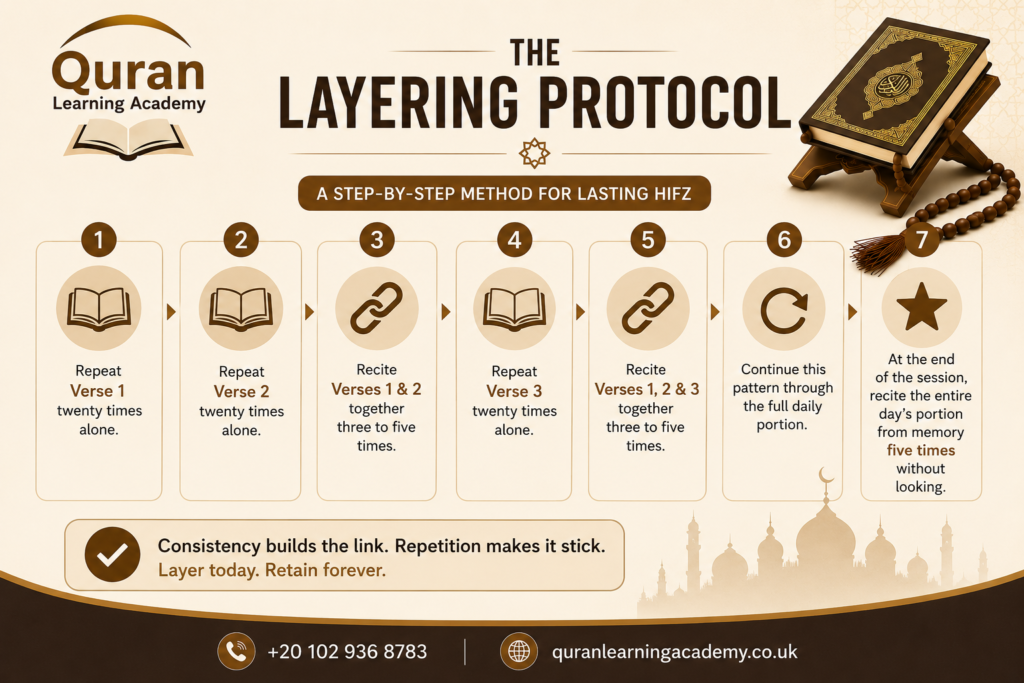
- Repeat Verse 1 twenty times alone.
- Repeat Verse 2 twenty times alone.
- Recite Verses 1 and 2 together three to five times to build the link between them.
- Repeat Verse 3 twenty times alone.
- Recite Verses 1, 2, and 3 together three to five times.
- Continue this pattern through the full daily portion.
- At the end of the session, recite the entire day’s portion from memory five times without looking.
The combination step is critical. Most memorisation failures happen not because individual verses are forgotten, but because the link between consecutive verses is weak. When a student loses the opening word of a verse during Salah, it is almost always because they memorised verses as separate units rather than as a connected passage.
Many students who want tips on how to memorise the Quran quickly default to reading a full page repeatedly rather than layering verse by verse. This approach produces surface-level familiarity that fades within days because it never crosses the threshold required for long-term storage. The layered method is slower per session but produces memorisation that genuinely holds under pressure.
6. Understand the Meaning of What You Are Memorising
Comprehension is not separate from memorisation. It is a tool that makes memorisation faster and retention significantly stronger.
When a student understands what an ayah means, the brain creates multiple independent memory pathways: the sound of the Arabic words, the visual image of the text on the page, and the conceptual meaning of the passage. If one pathway weakens under pressure, the others compensate. Students who memorise without any engagement with meaning are using only acoustic and visual memory, which makes them far more vulnerable to forgetting during Salah, when the mind is focused on worship rather than on mechanical recall.
“أَفَلَا يَتَدَبَّرُونَ الْقُرْآنَ أَمْ عَلَىٰ قُلُوبٍ أَقْفَالُهَا”
Afalā yatadabbarūna al-Qur’āna am ʿalā qulūbin aqfāluhā.
“Then do they not reflect upon the Quran, or are there locks upon their hearts?”
Reading a brief, trustworthy translation before each memorisation session, and noting the general theme of the passage, is sufficient to activate meaning-based memory pathways. This does not require becoming a Tafseer scholar. It requires two minutes of engagement before the session begins.
Many British Muslims find that understanding what they are reciting transforms Salah itself, because the words they have memorised begin to carry weight and presence rather than being recited mechanically. The Quran Tafsir Course in the UK at UK Quran Learning Academy gives students structured access to Quranic meanings under qualified teacher supervision, making comprehension and Hifz work together rather than in parallel.

Explore the Quran Tafsir Course in the UK
7. Listen to Proficient Reciters Every Single Day
Immersing your ears in high-quality recitation trains your tongue to reproduce what your memory cannot yet recall on its own. Listening is not passive activity when used deliberately for Hifz. Playing a recitation of the verses you are currently memorising while commuting, cooking, or walking reinforces the same neural patterns being built during your active memorisation sessions.
Scholars specifically recommend reciters known for precise Tajweed because accuracy matters enormously here. If you internalise a slightly incorrect pronunciation or rhythm through repeated listening, it becomes embedded in memory and is significantly harder to correct later. Using high-quality audio protects the accuracy of what you are building from the very beginning.
Practical Listening Habits for UK Learners
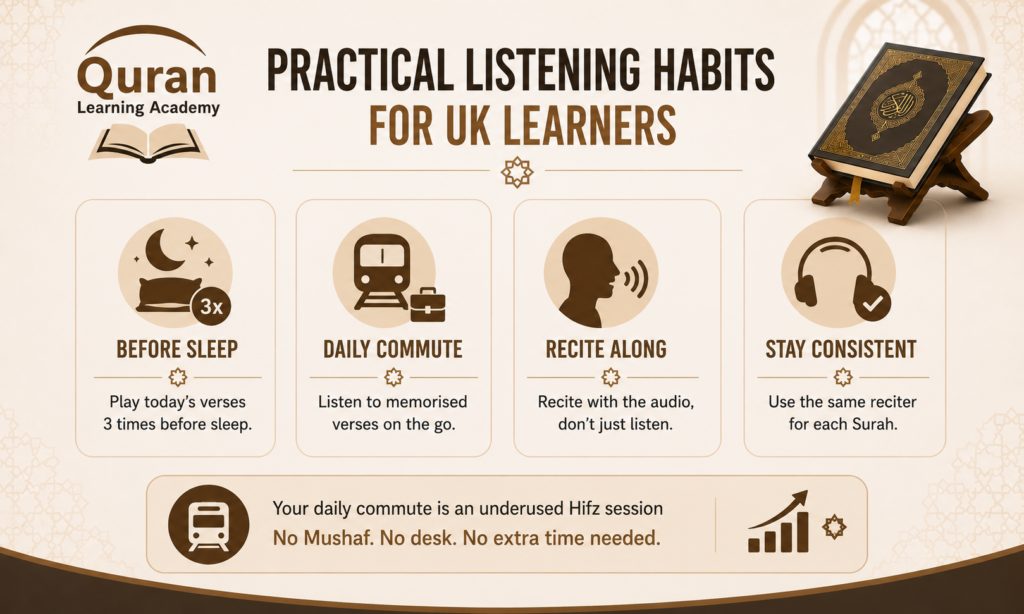
- Play the day’s target verses three times while preparing for sleep the night before the memorisation session.
- Listen to recently memorised material during the commute to work or university.
- Recite along with the audio rather than passively listening; this turns listening into active rehearsal.
- Use the same reciter consistently for a given Surah to build a stable auditory template.
The daily commute that many British Muslims make across London, Birmingham, or Manchester is not dead time. It is an underused Hifz session that requires no Mushaf, no desk, and no dedicated block of free time.
Step Inside Our Virtual Classrooms
See how our interactive lessons work. Watch these brief highlights of our students engaging with instructors.
Start Your Quranic Journey in the UK
Join our academy for structured online lessons with expert tutors, tailored to fit your schedule.
Book Your Free Trial8. Review What You Have Memorised Every Day Without Exception
New memorisation disappears without near-term review. What you memorised yesterday needs reinforcement today, and what you memorised last week needs reinforcement this week. This single principle is where the majority of self-guided Hifz attempts collapse.
Students focus entirely on new material and treat revision as something to do when time allows. Memory does not work that way. Recall strength decays rapidly in the first 24 to 48 hours after initial memorisation, then stabilises if the memory is revisited within that window. Skipping revision for even two or three consecutive days can undo an entire week of memorisation work.
The Three-Layer Daily Review System
| Review Category | Definition | Recommended Daily Amount |
| Near-Past Review | Last 5 pages memorised | Daily, non-negotiable |
| Mid-Past Review | Pages 6 to 20 behind current position | Daily, increasing gradually |
| Far-Past Review | Everything memorised before that | Weekly rotation covering all prior material |
On days when time is genuinely short, experienced teachers consistently advise reviewing existing material rather than adding new verses. Protecting what you have already memorised is more important than expanding it. A student who holds 10 Juz firmly is further ahead than a student who has “memorised” 15 Juz but cannot recite 8 of them accurately.
If balancing revision with a demanding UK schedule feels unmanageable alone, the Quran Memorisation Course in the UK at UK Quran Learning Academy builds daily and weekly revision cycles directly into the curriculum, so students are never left to manage the review structure on their own.

Explore the Quran Memorisation Course in the UK
9. Recite Memorised Verses in Your Daily Prayers
Salah is the built-in review system that every Muslim already has. Using it deliberately for Hifz turns five daily prayers into five reinforcement sessions without requiring any additional time.
Reciting memorised verses during prayer forces recall under mild performance pressure, which strengthens the memory trace more effectively than passive review does. It also builds the habit of using Hifz functionally, which is the actual purpose of memorising: to recite in worship, not to perform in examinations.
“يُقَالُ لِصَاحِبِ الْقُرْآنِ يَوْمَ الْقِيَامَةِ: اقْرَأْ وَارْتَقِ وَرَتِّلْ كَمَا كُنْتَ تُرَتِّلُ فِي الدُّنْيَا، فَإِنَّ مَنْزِلَتَكَ عِنْدَ آخِرِ آيَةٍ تَقْرَأُهَا”
“One who was devoted to the Quran will be told on the Day of Judgement: recite and ascend, and recite carefully as you recited carefully in this world, for your rank will be at the last verse you recite.”
How to Distribute Hifz Across the Five Prayers
- Recite new material in Fajr, when memory is freshest and recall is sharpest.
- Use Dhuhr and Asr for material memorised earlier in the same week.
- Use Maghrib and Isha for material memorised in the previous week.
This distribution means each segment of recently memorised Quran receives multiple retrieval opportunities across the day without requiring additional dedicated time outside of Salah itself.
10. Set a Realistic Daily Target and Never Exceed It
Memorising more than your retention capacity can handle in a single session produces memorisation that evaporates within 48 hours. A consistent half-page daily will always outperform an inconsistent two pages.
The most common mistake students make when searching for tips on how to memorise the Quran fast is equating speed with volume. Memorising three pages in one session feels productive, but the brain’s capacity to consolidate new declarative memory in a single session is limited. Exceeding that limit means material enters working memory but does not transfer to long-term storage before the next session overwrites it.
Recommended Daily Targets by Level
| Experience Level | Profile | Recommended Daily Target |
| Complete Beginner | No prior Hifz experience | 5 to 10 lines per day |
| Intermediate | Can read Arabic fluently | Half a page to one full page |
| Advanced | Strong Tajweed and prior Hifz experience | One to two pages, with full review maintained |
The discipline required here is restraint, not ambition. A student who memorises half a page every day for three years will outperform a student who memorises two pages some days and nothing on others, by a very wide margin.
11. Memorise Under a Qualified Teacher Who Corrects You
Memorising the Quran without a teacher means almost certainly embedding pronunciation errors, Tajweed mistakes, and incorrect verse boundaries that become extremely difficult to correct later. The oral transmission of the Quran is not incidental to its preservation; it is the defining feature of how the Quran has been preserved across fourteen centuries.
Every word in the Mushaf today exists exactly as it does because of an unbroken chain of teachers and students transmitting it orally, with each student being corrected in real time. Memorising from recordings or text alone breaks this chain and removes the error-correction mechanism that is central to authentic Hifz.
What a Qualified Teacher Catches That You Cannot
- Makhraj errors (incorrect articulation points for specific Arabic letters).
- Tajweed rule violations that sound minor but alter the meaning of verses.
- Incorrect verse boundaries that cause students to pause in the wrong place during recitation.
- Memorisation gaps where a student fills a forgotten word with a similar-sounding word that is wrong.
None of these can be reliably self-detected, and audio recordings cannot respond to what a specific student is saying in real time. Teacher-supervised Hifz is not a luxury option; it is what separates accurate memorisation from approximate memorisation.
Many British Muslims struggle to find qualified Hifz teachers locally, particularly those who offer flexible scheduling around work and family life. The Hifz Classes for Adults in the UK at UK Quran Learning Academy provide one-to-one online sessions with certified teachers, designed specifically around the real schedules of working professionals, parents, and mature learners across Britain.

Explore Hifz Classes for Adults in the UK
12. Build a Post-Memorisation Revision System Immediately
Completing the memorisation of a Juz or a full Quran is not the finish line. It is the beginning of the maintenance phase. Many students who complete significant portions of Hifz lose substantial sections within a few months because they do not transition immediately into a structured revision routine.
“تَعَاهَدُوا هَذَا الْقُرْآنَ فَوَالَّذِي نَفْسُ مُحَمَّدٍ بِيَدِهِ لَهُوَ أَشَدُّ تَفَصِّيًا مِنَ الإِبِلِ فِي عُقُلِهَا”
“Keep refreshing your knowledge of the Quran, for by the One in Whose hand is the soul of Muhammad, it is more prone to slip away than a camel from its tying rope.”
A Practical Weekly Revision Framework
- Days 1 to 6: Recite five Juz per day from memory, covering the complete Quran once each week.
- Day 7: Full listening session; follow along with a proficient reciter without looking at the Mushaf.
A Practical Monthly Revision Framework
- Week 1: Cover Juz 1 to 10 with focused attention on historically weak sections.
- Week 2: Cover Juz 11 to 20 with Tajweed self-audit on commonly mispronounced passages.
- Week 3: Cover Juz 21 to 30 with fast recitation to build fluency and flow.
- Week 4: Full Quran from memory, ideally incorporated into Salah or night prayer.
This monthly cycle ensures every part of the memorised Quran is actively recited at least four times per month, which keeps the memorisation fresh across all 30 Juz without disproportionate focus on recently completed material.
Sisters looking for a structured Hifz environment with qualified female teachers will find the Quran Hifz for Ladies in the UK at UK Quran Learning Academy built entirely around that need, offering private online sessions that combine Tajweed correction, revision scheduling, and spiritual support.

Explore Quran Hifz for Ladies in the UK
Experience the Academy in Action
Curious about our teaching style? Take a quick look inside a live session to see our immersive, supportive learning environment first-hand.
Start Your Quranic Journey in the UK
Join our academy for structured online lessons with expert tutors, tailored to fit your schedule.
Book Your Free TrialStart Your Hifz Journey with UK Quran Learning Academy
Most students who struggle with Hifz are not lacking motivation. They are lacking structure, consistent accountability, and access to qualified teachers who correct them in real time. UK Quran Learning Academy offers a complete range of Hifz and Quran programmes delivered entirely online, designed specifically for British learners balancing faith with the demands of everyday life in the UK.
Every programme includes one-to-one sessions with certified teachers, structured daily and weekly revision plans built into the curriculum, real-time Tajweed correction from the very first session, and flexible scheduling that fits around work, school, and family commitments.
Book Your Free Trial Session at UK Quran Learning Academy
Discover Our Quran Courses
- Quran Online Academy
- Quran Recitation Classes
- Quran Reading Classes
- Online Quran Classes for Kids
- Quran Classes for Adults
- Quran Classes for Female / Sisters
- Learn Quran for Beginners
- Quran Memorization (Hifz) Course
- Hifz Classes for Adults
- Quran Memorization and Hifz for Kids
- Quran Hifz for Ladies
- Quran Ijazah Program
- Quran Qirat Learning Course
- Quran Tafsir Course
- Noorani Qaida Course
- Noorani Qaida Course for Kids
- Weekend Quran Classes
- Intensive Quran Course
- Al-Azhar Quran Course
Start Your Quranic Journey in the UK
Join our academy for structured online lessons with expert tutors, tailored to fit your schedule.
Book Your Free TrialConclusion
These tips on how to memorise the Quran cover every dimension of the process: intention, Mushaf selection, timing, preparation, layered repetition, meaning engagement, listening immersion, daily revision, prayer-based reinforcement, realistic target-setting, teacher-supervised correction, and post-completion maintenance. Each tip addresses a specific failure point that causes most self-guided Hifz attempts to stall or collapse.
The fastest and most reliable path to Hifz is not a shortcut. It is a consistent daily system, built on sincere intention, structured method, and qualified guidance, that compounds quietly over time. Apply these principles in order, protect your daily session without exception, and take the step of enrolling with a qualified teacher who can correct you from the very first verse.
Frequently Asked Questions
How many verses should I memorise per day as a beginner in the UK?
Beginners with no prior Hifz experience should aim for 5 to 10 lines per day. Starting conservatively and maintaining consistency every day is far more effective than starting ambitiously and burning out within the first two weeks.
Is it possible to memorise the Quran as a working adult in Britain?
Yes. Many of the most effective Hifz strategies require no more than 20 to 30 minutes per day, specifically the post-Fajr window and the daily commute. The key is consistency of timing rather than volume of hours.
Do I need a teacher to memorise the Quran or can I do it alone?
A teacher is essential for accurate Hifz. Without live correction, Tajweed and pronunciation errors embed themselves into memory and become very difficult to remove later. Self-guided memorisation almost always produces memorisation that is approximate rather than accurate.
What is the best time of day to memorise the Quran?
After Fajr is the most effective memorisation window for most learners. The mind is rested, distractions are minimal, and the spiritual context strengthens both focus and sincerity. The period after Asr is the second-best option for review of material already memorised.
How do I stop forgetting what I have already memorised?
The solution is a structured three-layer daily review system covering near-past, mid-past, and far-past material, combined with reciting memorised verses during the five daily prayers. Revision must be treated as equal in priority to new memorisation, not as an optional extra.








Leave a Reply