 Quran
Quran

Many Muslims across the UK struggle to memorise the Quran despite strong motivation, mainly due to poorly timed sessions amidst busy routines. Trying to study after exhausting commutes or during noisy weekends makes retention nearly impossible, causing many to abandon their journey prematurely out of frustration.
Success relies heavily on strategic timing alongside proper technique, directly impacting how well your brain retains verses long-term. Finding what the best time to memorise Quran actually means—tailored to age and lifestyle—is essential for building a sustainable habit that yields lasting progress across Britain.
1. After Fajr Is the Strongest Memorisation Window
The period immediately following Fajr prayer is the most widely recommended time for new Quran memorisation, and the reasoning is both spiritual and cognitive.
From an Islamic standpoint, the Prophet ﷺ specifically invoked blessings upon the early morning:
“ اللَّهُمَّ بَارِكْ لأُمَّتِي فِي بُكُورِهَا ”
“O Allah, bless my nation in their early mornings.”
The Quran itself draws direct attention to the Fajr recitation:
“وَقُرْآنَ الْفَجْرِ ۖ إِنَّ قُرْآنَ الْفَجْرِ كَانَ مَشْهُودًا ﴿٧٨﴾”
Wa-Qur’āna al-fajri inna Qur’āna al-fajri kāna mashhūdā
“and [also] the Qur’an of dawn. Indeed, the recitation of dawn is ever witnessed.”
Beyond the spiritual dimension, memory science supports this timing. Sleep completes the consolidation process that transfers information from short-term into long-term storage. Sitting with new verses immediately after this process finishes means the brain enters memorisation at its most receptive point. Mental fatigue is at its lowest, digital noise has not yet begun, and no competing demands exist from work, school, or family.
The Brain After Fajr Absorbs New Material Fastest
After a full night’s rest, short-term memory is cleared and alert. Alertness, energy, and absence of distraction combine at this hour in a way that does not occur again until the following morning. For British Muslims in cities like London, Birmingham, and Leeds, the Fajr window in winter falls well before the working day begins, creating a naturally protected period that is genuinely difficult to interrupt.
Morning Hours Favour Precise Encoding Over Review
The brain is sharpest for short-term and detailed memory in the morning hours. This is the window for new material exclusively. Mixing new memorisation with heavy revision in the same Fajr session splits the mental resources needed for both, reducing the quality of each. New material belongs in the morning; review belongs in the evening.
Fluent Reading Makes the Fajr Window Far More Productive
Many British Muslims can recognise Arabic letters but cannot yet read Quran smoothly enough to memorise accurately. When you spend the Fajr session fighting over pronunciation rather than building memory traces, the most valuable window of the day is wasted.
The Quran Reading Classes in the UK at UK Quran Learning Academy build the accurate, fluent Arabic reading foundation that makes every memorisation session productive from the first word rather than losing the morning to decoding errors.

Join the Quran Reading Classes in the UK at UK Quran Learning Academy
2. Evening Sessions Serve Revision, Not New Material
The period after Asr and before Isha holds real value in a Hifz schedule, but its function is entirely distinct from the Fajr window. Evening sessions should carry the revision load exclusively.
From afternoon until early evening, the brain transitions from taking in new information to consolidating and integrating what it has already received during the day. This makes the post-Asr and pre-Isha window well-suited to reviewing recently memorised passages, identifying weak points, and reinforcing connections between verses.
Reviewing Before Sleep Strengthens Overnight Retention
Reviewing memorised material in the hour or two before sleep activates a powerful retention mechanism. The brain processes and consolidates whatever it encounters before sleep during the night’s rest. A student who reviews recently memorised verses before Isha and then sleeps benefits from overnight consolidation working directly in support of that material.
Post-Isha Review Closes the Daily Cycle Correctly
The period after Isha, when the household is quiet and the day’s demands have ended, is suitable for a final light review of the day’s memorisation. This is not the time to push into new material. It is the time to confirm what was memorised at Fajr is stable and connected before the night begins.
Evening New Memorisation Embeds Errors More Deeply
Attempting new memorisation after a full working day means the brain encodes verses while already depleted. Errors made under fatigue embed more deeply because the brain has fewer resources to self-correct in the moment. For working Muslims across Britain managing jobs, households, and family responsibilities, this is a real and specific risk. Evening new memorisation should only be a fallback when the morning window is completely unavailable.
Step Inside Our Virtual Classrooms
See how our interactive lessons work. Watch these brief highlights of our students engaging with instructors.
Start Your Quranic Journey in the UK
Join our academy for structured online lessons with expert tutors, tailored to fit your schedule.
Book Your Free TrialThe Best Times Compared Across the Day
| Time Window | New Memorisation | Revision | Practical Notes |
| After Fajr | Excellent | Good | Primary window for all new Hifz work |
| Mid-Morning (9–11 AM) | Good | Good | Strongest window specifically for children |
| After Dhuhr | Fair | Good | Mental fatigue begins to build noticeably |
| After Asr | Poor | Excellent | Ideal dedicated slot for daily review |
| After Maghrib | Fair | Good | Suited to cumulative recitation practice |
| After Isha | Poor | Good | Light review only, immediately before sleep |
| Tahajjud / Before Fajr | Good | Good | Strong for spiritually motivated adult learners |
What the Best Time to Memorise Quran Actually Means
A common mistake is treating the best time as a fixed slot on the clock that applies equally to everyone. The best time is the time when your alertness is highest, your distractions are fewest, your mental state is clear, and your commitment is firm enough to make the session happen every single day without negotiation.
This distinction separates two questions that are frequently confused:

- The optimal time is when the brain is neurologically most ready to encode new information
- The right time for you is the time you can actually protect and maintain daily without exception
The second question matters more in practice. A student who memorises at 7:30 AM every single day will outperform a student who aims for the ideal post-Fajr window but reaches it only three times a week. Consistency is a stronger predictor of Hifz success than any particular hour of the day.
Fixed Times Build Stronger Habit Pathways in the Brain
Memorisation performed at random hours does not build a habit. It builds inconsistency. When the brain encounters new Quranic material at the same time each day, it begins anticipating the session and priming itself for encoding. This is precisely why teachers across generations have insisted on a fixed daily memorisation time rather than a flexible one.
Self-Awareness Comes Before the Right Schedule
Choosing the right time requires honest self-assessment. Some people are genuinely alert at dawn. Others do not reach real mental clarity until mid-morning. The principle that applies to everyone is identical: identify the window where your focus is sharpest, your environment is quietest, and your schedule is most protected, then treat that window as untouchable.
Sincere Intention Anchors Any Chosen Time
Choosing a time and committing to it is itself an act of sincerity toward Allah. The Prophet ﷺ said:
“ إِنَّمَا الأَعْمَالُ بِالنِّيَّاتِ، وَإِنَّمَا لِكُلِّ امْرِئٍ مَا نَوَى”
“The reward of deeds depends upon the intentions and every person will get the reward according to what he has intended.”
Start Your Quranic Journey in the UK
Join our academy for structured online lessons with expert tutors, tailored to fit your schedule.
Book Your Free TrialFactors That Directly Affect Your Memorisation at Any Time
Choosing a time window is the first step. Several personal factors then determine whether your chosen window produces strong memorisation or weak memorisation, regardless of when it falls in the day.
| Factor | Strengthens Memorisation | Weakens Memorisation |
| Arabic reading fluency | Reads Quran smoothly and accurately | Stumbles over letters, stops frequently |
| Mental state at session time | Alert, calm, spiritually present | Stressed, distracted, or mentally drained |
| Environmental noise | Quiet dedicated space with no interruptions | Household noise, phone notifications, background TV |
| Revision consistency | Reviews daily without exception | Skips revision and focuses only on new material |
| Teacher accountability | Has a qualified teacher checking recitation | Memorising alone with no external correction |
| Physical condition | Rested, nourished, and healthy | Sleep-deprived, hungry, or unwell |
Environmental Protection Is Non-Negotiable in British Homes
A busy British household presents specific challenges that students in full-time Hifz environments do not face. Protecting the memorisation window requires deliberate management of the physical space.
A quiet room, phone on silent, and a consistent location used only for Quran work signals to the brain that this time is for focused encoding. Students who memorise in the same place at the same time every day build a conditioned readiness that strengthens progressively over weeks.
Tajweed Accuracy Determines What Gets Stored in Long-Term Memory
Memorising without Tajweed means storing incorrect pronunciation permanently. The brain does not distinguish between an accurately pronounced letter and a mispronounced one during the encoding process. It stores whatever it hears repeatedly.
A student who memorises 20 pages with consistent Tajweed errors has not completed 20 pages of Hifz. They have completed 20 pages of work that will need to be corrected and re-memorised.
The Online Tajweed Classes in the UK at UK Quran Learning Academy correct Makharij, Sifaat, and rule application before these errors become embedded in long-term memorisation. Strengthening your Tajweed is not a separate project from your Hifz. It is what determines whether your Hifz is valid.

Enrol in the Online Tajweed Classes in the UK at UK Quran Learning Academy
Children Memorise Best in the Mid-Morning Window
Children’s memorisation timing follows different rules from adults, and applying adult timing assumptions to young learners produces poor results across the board.
Younger students typically reach their sharpest cognitive focus in the mid-morning hours, between 9 and 11 AM, after a full night’s sleep and a proper breakfast. The post-Fajr window carries real spiritual benefit for children, but sustaining it requires a level of discipline that develops gradually rather than being imposed immediately.
Short Focused Sessions Beat Long Sitting for Young Learners
Children’s attention spans are fundamentally different from adults. A focused 15 to 20 minute session produces stronger memorisation than a 45 minute session where focus collapses halfway through. The goal is to end the session while the child is still engaged, not after attention has already broken down and frustration has set in.
Evening Review Must Stay Light and Familiar for Children
Evening sessions for children should be restricted entirely to light, familiar review of previously memorised material. Attempting new memorisation in the evening with a young learner who has already been through a school day produces errors, frustration, and a negative association with the Quran that is difficult to reverse. New material in the morning, familiar review in the evening is the rule without exception.
Structured Weekly Revision Prevents Children Losing What They Memorised
A child who misses several days does not simply pick up where they left off. The connections between recently memorised verses weaken rapidly without daily reinforcement. Without a structured weekly revision cycle, children memorise forward and lose backward, producing the frustrating pattern of always re-memorising the same material without progressing.
The Quran Memorisation for Kids in the UK programme at UK Quran Learning Academy teaches children aged 5 to 15 systematic memorisation through spaced repetition, auditory reinforcement, and structured review cycles designed specifically for developing minds learning Quran in a second language.

Enrol Your Child in the Quran Memorisation for Kids Programme at UK Quran Learning Academy
Building a Practical Daily Memorisation Schedule
A workable Hifz schedule is built around your real British life, not an idealised version of it. The most effective structure follows a two-session daily model: new memorisation in the morning, revision in the evening.
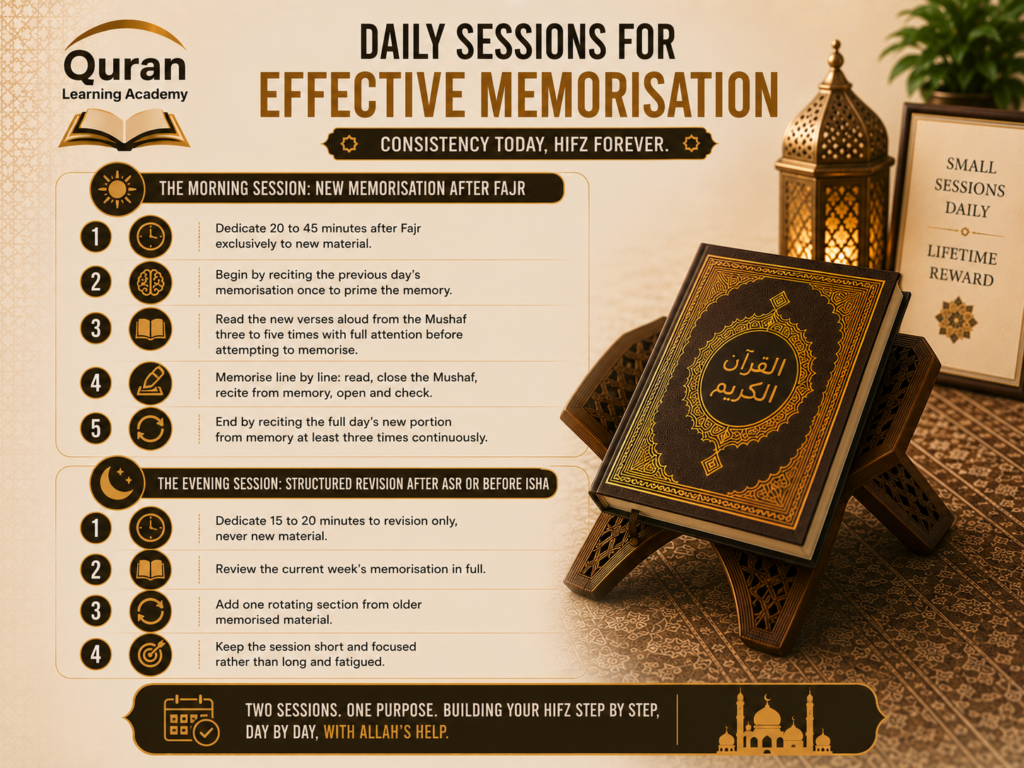
The Morning Session: New Memorisation After Fajr
- Dedicate 20 to 45 minutes after Fajr exclusively to new material
- Begin by reciting the previous day’s memorisation once to prime the memory
- Read the new verses aloud from the Mushaf three to five times with full attention before attempting to memorise
- Memorise line by line: read, close the Mushaf, recite from memory, open and check
- End by reciting the full day’s new portion from memory at least three times continuously
The Evening Session: Structured Revision After Asr or Before Isha
- Dedicate 15 to 20 minutes to revision only, never new material
- Review the current week’s memorisation in full
- Add one rotating section from older memorised material
- Keep the session short and focused rather than long and fatigued
Weekly Schedule for Sustainable Progress in the UK
| Day | Morning Session | Evening Session |
| Saturday | New memorisation after Fajr | Current week revision |
| Sunday | New memorisation after Fajr | Current week revision |
| Monday | New memorisation after Fajr | Current week revision |
| Tuesday | New memorisation after Fajr | Current week revision |
| Wednesday | New memorisation after Fajr | Current week revision |
| Thursday | New memorisation after Fajr | Current week revision |
| Friday | No new memorisation | Full week revision from beginning |
Friday as a dedicated full revision day protects the week’s memorisation before new material begins on Saturday. This structure aligns naturally with the British working week and the sacred status of Jumu’ah.
Start Your Quranic Journey in the UK
Join our academy for structured online lessons with expert tutors, tailored to fit your schedule.
Book Your Free TrialHow to Decide the Best Time Suitable for You
The right memorisation time is not prescribed uniformly. It is discovered through deliberate self-observation and then protected through structured commitment. The following process helps any British Muslim identify and lock in their strongest window.
Observe Your Natural Energy Pattern for One Week
Before committing to a memorisation time, spend one week noting when your mental clarity is highest, when distractions are fewest, and when you feel most spiritually present. Track this honestly without forcing the result toward Fajr. The observation itself will reveal your genuine window.
Test the Window with a Small Daily Commitment First
Rather than immediately committing to 45 minutes, begin with 15 minutes at the chosen time every day for two weeks. This tests whether the window is genuinely protectable in your specific circumstances: whether the flat in East London is quiet enough at that hour, whether the school run allows it, whether the shift pattern permits it.
Add External Accountability to Lock the Time in Place
A memorisation window that exists only in your own schedule is vulnerable to being cancelled by anything urgent. A memorisation window that is a scheduled session with a qualified teacher carries a commitment that makes cancellation genuinely difficult. For Muslims who have repeatedly started and stopped Hifz on their own, teacher accountability is frequently the single change that makes the habit hold permanently.
Read Also: How to Start Reading and Memorising Quran in the UK
Why Timing Protects Everything You Have Already Memorised
Most people who abandon Hifz do not fail because of weak memory or insufficient motivation. They fail because of structural errors in when and how they manage revision. Understanding why timing matters prevents the most common failure modes before they develop.
Memorisation Without Daily Revision Disappears Within 48 Hours
Recall strength decays rapidly in the first 24 to 48 hours after initial memorisation. A student who memorises at Fajr but does not review in the evening and again the following morning will find those verses significantly weaker by day three. Skipping revision for two or three consecutive days can undo an entire week of memorisation work.
Irregular Timing Breaks the Neural Habit Loop
The brain forms memorisation habits through repeated exposure at predictable intervals. Memorising on Monday at 6 AM, Wednesday at 9 PM, and Saturday at 11 AM does not build a habit. It builds three separate unconnected sessions that never compound into a system. The consistency of timing is what transforms individual sessions into a cumulative Hifz structure.
Read Also: How to Help the Kids to Hifz Quran in the UK?
The Quran Rewards the Consistent Over the Ambitious
The Prophet ﷺ warned about exactly this pattern:
” مَثَلُ الَّذِي يَقْرَأُ الْقُرْآنَ وَهْوَ حَافِظٌ لَهُ مَعَ السَّفَرَةِ الْكِرَامِ الْبَرَرَةِ، وَمَثَلُ الَّذِي يَقْرَأُ الْقُرْآنَ وَهْوَ يَتَعَاهَدُهُ وَهْوَ عَلَيْهِ شَدِيدٌ، فَلَهُ أَجْرَانِ ”.
“Such a person as recites the Qur’an and masters it by heart, will be with the noble righteous scribes (in Heaven). And such a person exerts himself to learn the Qur’an by heart, and recites it with great difficulty, will have a double reward.”
The student who memorises half a page every day at the same time, reviews it faithfully, and never misses the session will carry more Quran in five years than the student who memorises two pages some days and zero pages others.
Read Also: How to Memorize Surah Fast?
Experience the Academy in Action
Curious about our teaching style? Take a quick look inside a live session to see our immersive, supportive learning environment first-hand.
Start Your Quranic Journey in the UK
Join our academy for structured online lessons with expert tutors, tailored to fit your schedule.
Book Your Free TrialRead Also: Most Important Surahs to Memorize
Start Your Hifz at the Right Time with UK Quran Learning Academy
Most British Muslims who struggle with Hifz are not failing because of their memory. They are failing because they are memorising alone, at inconsistent times, without Tajweed correction, and without a structured revision plan built into the commitment.
UK Quran Learning Academy provides the complete framework that turns the right timing into lasting Hifz:
- One-to-one sessions with qualified Azhari instructors scheduled at your fixed weekly time
- Structured revision plans built into every programme from the first session
- Real-time Tajweed correction so what you memorise at Fajr is encoded correctly from day one
- Flexible scheduling designed around British work patterns, school schedules, and family commitments
- Dedicated programmes for every learner: adults, children, sisters, and beginners
The Intensive Quran Course in the UK at UK Quran Learning Academy is built for serious learners who want accelerated, structured progress with daily Quran reading drills, Makharij correction sessions, and a fixed accountability framework that protects their chosen memorisation window every single week.
Discover Our Quran Courses
- Quran Online Academy
- Quran Recitation Classes
- Quran Reading Classes
- Online Quran Classes for Kids
- Quran Classes for Adults
- Quran Classes for Female / Sisters
- Learn Quran Course for Beginners
- Quran Memorization (Hifz) Course
- Hifz Classes for Adults
- Quran Memorization and Hifz Course for Kids
- Quran Hifz Course for Ladies
- Quran Ijazah Program
- Quran Qirat Learning Course
- Quran Tafsir Course
- Noorani Qaida Course
- Noorani Qaida Course for Kids
- Weekend Quran Classes
- Intensive Quran Course
- Al-Azhar Quran Course
- Online Tajweed Classes
- Tajweed Course for Kids
- Tajweed Course for Adults
- Tajweed Course for Ladies

Enrol in the Intensive Quran Course in the UK at UK Quran Learning Academy
Conclusion
The best time to memorise Quran is after Fajr prayer for new material and after Asr or before Isha for revision. This two-session daily model aligns with how the brain encodes and consolidates information, and it fits the rhythm of Islamic worship in a way that reinforces rather than competes with your daily obligations.
For British Muslims managing jobs, families, and the particular pressures of life in the UK, the practical keys are three: choose a time you can genuinely protect every day, build your Arabic reading and Tajweed foundation before attempting serious memorisation, and add teacher accountability to make the chosen window non-negotiable. Timing without structure produces inconsistency. Timing with structure, a qualified teacher, and daily revision produces Hifz that holds.
Frequently Asked Questions
After Fajr Is Widely Recommended: Is It Right for Everyone?
After Fajr is the strongest memorisation window for most people due to mental freshness and the spiritual focus that follows prayer. However, shift workers, mothers of newborns, or those with specific health constraints may find late-night or post-Asr sessions equally effective. The best time is ultimately the one you can protect and maintain consistently every single day without exception.
A Daily Time Commitment for Quran Memorisation: What Is Realistic?
A sustainable daily commitment for adult part-time learners in the UK is 30 to 45 minutes split between new memorisation in the morning and revision in the evening. Students who attempt two-hour sessions without prior conditioning typically burn out within weeks. Building to longer sessions gradually produces far stronger long-term results than starting at maximum intensity.
Children and Adults Follow Different Timing Rules: What Changes?
Adults memorise best after Fajr in the early morning. Children typically reach peak focus in the mid-morning window between 9 and 11 AM, after sleep and breakfast have fully restored their attention. Evening sessions for children must stay light and familiar. Evening sessions for adults can carry more structured revision load but should never include new memorisation after a full working day.
Memorising Alone Without a Teacher: What Is the Real Risk?
The real risk is not slow progress. The real risk is embedding Tajweed and pronunciation errors that become increasingly difficult to correct the longer they are left unchecked. A student who has been memorising an incorrect pronunciation for three months has trained that error into long-term memory. Unlearning it is significantly harder than learning correctly from the start with a qualified teacher present.
Skipping Revision Days: What Actually Happens to the Memorisation?
Recall strength decays rapidly in the first 24 to 48 hours after initial memorisation. Skipping revision for two or three consecutive days can undo an entire week of memorisation work. Students who focus entirely on new material and treat revision as optional consistently find that their total memorised amount does not grow, because what is gained at the front is lost at the back at the same rate.








Leave a Reply