 Quran
Quran

British Muslim parents across London, Birmingham, Manchester, and beyond share a common frustration. Their child attends Quran sessions, repeats verses at home, then forgets everything within days. The school week is packed, homework arrives every evening, and by the time the weekend comes, the Hifz routine has quietly collapsed. This is not a failure of faith. It is a failure of method.
Children do not memorise the Quran because they are pushed harder. They memorise because the right structure, timing, and environment work together as a system. A child who completes Hifz before fourteen carries the full words of Allah through secondary school, university, and beyond. But reaching that point requires a method that matches how children in Britain actually live.
1- Complete the Noorani Qaida Before Starting Hifz
A child who begins Hifz before reading Arabic fluently memorises wrong pronunciation just as easily as correct pronunciation. Unlearning an embedded mistake is harder than learning correctly from the start. This is the single most common reason British children reach the end of Juz Amma and cannot recite it accurately in Salah.
| Foundational Skill | What It Enables in Hifz | Without It |
| Arabic letter recognition | Reads verses without confusion | Guesses letters, memorises inaccurate versions |
| Vowel mark application | Pronounces every word correctly | Swallows vowels or replaces them with English approximations |
| Joining letters into words | Reads continuously without stopping | Memorises syllables rather than words |
| Basic Tajweed markers | Applies stops and lengthening from day one | Embeds errors that feel correct after repetition |
Many British children in state schools encounter Arabic only through weekend Madrasa classes that move too quickly through Noorani Qaida. The result is a child who can recite something that sounds like the Quran but carries embedded errors in every verse.
The Noorani Qaida Course for Kids in the UK at UK Quran Learning Academy teaches children across Britain to recognise Arabic letters, master correct pronunciation, and build the reading accuracy that every Hifz journey depends on through age-appropriate lessons with qualified instructors.

Enrol your child in the Noorani Qaida Course for Kids in the UK
2- Build a Fixed Daily Routine Around Prayer Times
Hifz sessions that happen when everything else is finished usually never happen. The five daily prayers solve this problem because they are already fixed anchors in a Muslim child’s day. Prayer times are not just spiritual anchors.
They are built-in memorisation intervals spaced across the entire day, giving the brain recovery time between sessions while keeping Quranic material in constant contact with memory.
| Prayer | Session Focus | Duration |
| After Fajr | New memorisation — primary window | 20 to 30 minutes |
| After Dhuhr / school return | Quick review of morning material | 5 to 10 minutes |
| After Asr | Recite aloud, catch pronunciation errors | 10 to 15 minutes |
| After Maghrib | Full recitation of today’s learning | 10 minutes |
| After Isha | Listen to tomorrow’s target verses | 5 minutes |
A practical note for British families: Fajr in June falls around 3:00 AM, which is not realistic for school-age children. In December it falls around 6:00 AM, which works well. For summer months, shift the primary memorisation window to the first 20 minutes after waking. The minimum non-negotiable daily commitment is 20 minutes of focused Hifz even on the busiest school days.
Step Inside Our Virtual Classrooms
See how our interactive lessons work. Watch these brief highlights of our students engaging with instructors.
Start Your Quranic Journey in the UK
Join our academy for structured online lessons with expert tutors, tailored to fit your schedule.
Book Your Free Trial3- Divide Each Surah into Small Connected Segments
Asking a child to memorise a full Surah in one session produces frustration and shallow retention that disappears within 48 hours. The memorisation method used inside each session determines whether what is learned stays or disappears overnight.
The five-phase method used by classical Hifz teachers:
| Phase | What Happens |
| Reading | Read the full page once slowly, paying attention to meaning and visual layout |
| Segmenting | Divide the page into 3 or 4 segments; read the first segment 5 times with Mushaf open |
| Closing | Close the Mushaf and repeat from memory until the child recites 3 times without error |
| Connecting | Link each memorised segment to the previous one; recite 1+2, then 1+2+3, until the page flows as one unit |
| Page Connection | Recite the completed page together with the previous page from today’s session |
The connecting step is the most critical and the most frequently skipped. Most memorisation failures happen because the link between verses was never built. When a child forgets the opening word of a verse in Salah, it is almost always because that verse was memorised as an isolated unit rather than part of a connected passage.
4- Apply the Twenty-Repetition Rule for Every Verse
Repeating each verse twenty times before moving to the next reflects the number of exposures needed to move information from working memory into long-term storage. British children learning Arabic as a second language typically need more repetitions per verse than children raised in Arabic-speaking households.
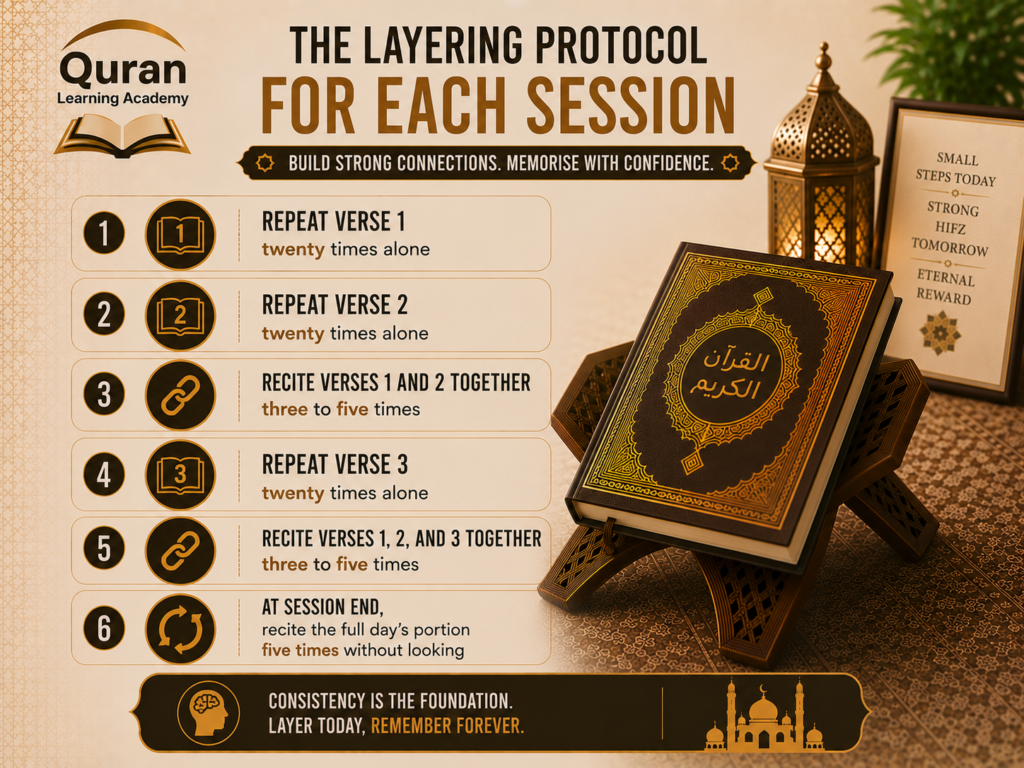
The layering protocol for each session:
- Repeat Verse 1 twenty times alone
- Repeat Verse 2 twenty times alone
- Recite Verses 1 and 2 together three to five times
- Repeat Verse 3 twenty times alone
- Recite Verses 1, 2, and 3 together three to five times
- At session end, recite the full day’s portion five times without looking
Daily targets must match retention capacity, not ambition. A child who memorises two pages and forgets them by Thursday has not made progress.
| Age Group | Daily Target | Weekly Output |
| 5 to 7 years | 5 to 10 lines | Half a page to one page |
| 8 to 10 years | Half a page to one full page | 3 to 5 pages |
| 11 to 13 years | One to two pages | 6 to 10 pages |
| 14 to 18 years | Two pages with full review maintained | Half a Juz or more |
5- Use Daily Listening as Active Reinforcement
Playing recitation of the verses the child is currently memorising during the school run, mealtimes, or before bedtime reinforces the same neural patterns built during active memorisation sessions. Auditory memory and active recall memory operate differently and reinforce each other when both are engaged consistently.
| Time of Day | Listening Activity | Purpose |
| Morning school run | Play today’s target verses | Pre-loads verses before the active session |
| Evening meal | Play this week’s material in the background | Maintains familiarity without dedicated session time |
| Before sleep | Play tomorrow’s target verses three times | Pre-loads auditory memory for the next morning |
The critical rule is accuracy in the audio source. A child who internalises incorrect pronunciation through repeated listening embeds that error across hundreds of repetitions. Use reciters known for precise Tajweed and the same reciter consistently for each Surah. Reciting along with the audio rather than listening passively turns listening into active rehearsal.
Start Your Quranic Journey in the UK
Join our academy for structured online lessons with expert tutors, tailored to fit your schedule.
Book Your Free Trial6- Embed Tajweed Correction from the First Verse
Tajweed is not a finishing step. It determines whether memorised verses are recited correctly in Salah or carry errors that alter the meaning of Allah’s words. British children face specific Tajweed challenges because English phonetics do not include sounds like the guttural Ayn (ع), the emphatic Sad (ص), or the deep Ha (ح).
| Common Error in UK Children | Correct Tajweed Rule |
| Replacing ع with ء | Ayn requires constriction from deep in the throat |
| Shortening Madd letters | Extension of 2, 4, or 6 counts depending on the rule |
| Ignoring Ghunnah on Noon and Meem | Nasal resonance must be audible for 2 counts |
| Dropping Qalqalah on ق ط ب ج د | Bouncing echo required when these letters carry sukoon |
| Merging Noon Sakinah without Idghaam | The Noon must disappear into the following letter |
A qualified teacher catches all of these in real time. Self-study and audio recordings cannot respond to what a specific child is saying. Teacher-supervised Hifz is what separates accurate memorisation from approximate memorisation.
The Tajweed Course for Kids in the UK at UK Quran Learning Academy teaches children aged 4 to 14 the precise rules of Quranic recitation through step-by-step instruction, covering Makharij al-Huroof, Sifaat, and practical Tajweed application using the short Surahs of Juz Amma that most British children memorise first.

Enrol your child in the Tajweed Course for Kids in the UK
7- Follow the Correct Surah Order for British Children
Memorising Surahs in a logical order builds on each previous success and keeps motivation high through visible progress. Many British Muslim families begin wherever the Madrasa happens to be teaching, which means children memorise Surahs in isolation rather than as a system building toward Juz Amma completion.
| Stage | Surahs | Reason |
| Stage 1 | Surah Al-Fatihah | Required for every unit of every Salah; immediate practical use |
| Stage 2 | Al-Ikhlas, Al-Falaq, An-Nas | Recited daily before sleep; short, high-frequency, builds confidence fast |
| Stage 3 | Short Surahs of Juz Amma backwards | Each Surah is a quick win; 37 Surahs completed at stage end |
| Stage 4 | Surah Al-Mulk | Authentic Sunnah to recite nightly; 30 verses build real Hifz stamina |
| Stage 5 | Surah Yasin | Major milestone; signals serious commitment to the journey |
| Stage 6 | Juz 29 then Juz 28 | Classical approach working backwards to maintain momentum |
| Stage 7 | From Surah Al-Baqarah forwards | For committed students aiming for complete memorisation |
A child who reaches the end of Stage 3 has memorised all 37 short Surahs of Juz Amma and has enough material to vary recitation across all five daily prayers, which itself functions as a built-in daily revision system.
Read Also: The Best Time to Memorise Quran for British Muslims
8- Make Daily Revision Non-Negotiable
New memorisation disappears without near-term review. Recall strength decays rapidly in the first 24 to 48 hours and only stabilises when the material is revisited. Skipping revision for two or three consecutive days can undo an entire week of memorisation work.
| Revision Category | Definition | Frequency |
| Near-Past | Last 5 pages memorised | Daily, before any new work begins |
| Mid-Past | Pages 6 to 20 behind current position | Daily, increasing as total memorised grows |
| Far-Past | Everything memorised before that | Weekly rotation covering all prior material |
Every seventh day should be dedicated entirely to revision with zero new material. The child recites everything memorised across the previous six days, ideally to a teacher who corrects errors in real time. On days when time is short, reviewing existing material is more valuable than adding new verses.
” مَثَلُ الَّذِي يَقْرَأُ الْقُرْآنَ وَهْوَ حَافِظٌ لَهُ مَعَ السَّفَرَةِ الْكِرَامِ الْبَرَرَةِ، وَمَثَلُ الَّذِي يَقْرَأُ الْقُرْآنَ وَهْوَ يَتَعَاهَدُهُ وَهْوَ عَلَيْهِ شَدِيدٌ، فَلَهُ أَجْرَانِ ”.
“Such a person as recites the Qur’an and masters it by heart, will be with the noble righteous scribes (in Heaven). And such a person exerts himself to learn the Qur’an by heart, and recites it with great difficulty, will have a double reward.”
Read Also: How to Start Reading and Memorising Quran in the UK
9- Create a Dedicated Distraction-Free Hifz Space
The environment directly affects how quickly and accurately material is retained. A child memorising while siblings watch television or a phone buzzes nearby is working against their own memory formation.
A dedicated Hifz space requires four elements:

- A clean surface at the right height for comfortable posture
- A single Mushaf used consistently throughout the entire journey
- Good natural or warm light with no screens in the immediate area
- A no-phone rule during the session, applying to parents as well
The same Mushaf must be used throughout the entire Hifz journey without exception. The brain stores the visual position of every verse on every page. Switching to a different Mushaf layout disrupts this visual memory and creates recall gaps that teachers diagnose regularly in students who changed their Mushaf mid-journey.
A visual progress tracker on the wall showing Surahs and pages completed gives children a concrete sense of how far they have come. A child who sees 23 Surahs marked complete on their wall has a visual anchor that motivates them through difficult days. This is particularly effective for British Muslim children between ages six and ten.
Read Also: How to Memorize Surah Fast?
Experience the Academy in Action
Curious about our teaching style? Take a quick look inside a live session to see our immersive, supportive learning environment first-hand.
Start Your Quranic Journey in the UK
Join our academy for structured online lessons with expert tutors, tailored to fit your schedule.
Book Your Free TrialRead Also: Most Important Surahs to Memorize
10- Memorise with a Qualified Teacher from Day One
Memorising without a teacher means embedding pronunciation errors, Tajweed mistakes, and incorrect verse boundaries that become extremely difficult to correct later. The oral transmission of the Quran is not incidental. It is the defining feature of how the Quran has been preserved across fourteen centuries.
| Error Type | Why the Child Cannot Self-Correct |
| Makhraj errors | The child hears their own pronunciation as correct |
| Tajweed rule violations | Without training, the child does not know a rule is being broken |
| Incorrect verse boundaries | Wrong pauses feel natural after many repetitions |
| Gap-filling with similar words | The brain fills gaps automatically; the child does not notice |
A daily recitation session with a qualified teacher serves three further purposes beyond error correction:
- Pronunciation correction before errors become permanent habit
- Pacing accountability so the child does not fall behind their weekly target
- Motivation continuity through external commitment that is harder to abandon than private resolve
The Online Quran Classes for Kids in the UK at UK Quran Learning Academy deliver live one-to-one sessions with qualified instructors trained in structured Islamic pedagogy. Children receive real-time Makharij correction, Tajweed instruction, and memorisation guidance in every session.

Enrol your child in Online Quran Classes for Kids in the UK
Give Your Child a Structured Hifz Foundation
Most British Muslim children who struggle with Hifz are not lacking motivation. They are lacking structure, qualified correction, and a programme designed around a British family’s actual life. School terms, half-term breaks, GCSE pressure, and weekend commitments all affect the Hifz routine. A programme that does not account for these realities will not survive them.
UK Quran Learning Academy delivers fully online, live, one-to-one Quran education for British Muslim families. Every session is taught by qualified Azhari instructors who correct in real time, adapt to the child’s pace, and build foundations that make Hifz accurate and lasting.
Every programme at UK Quran Learning Academy includes:
- Live one-to-one sessions with a qualified instructor, never pre-recorded content
- Structured weekly revision built into every programme from day one
- Real-time Tajweed correction so memorisation is accurate from the first verse
- Flexible scheduling around British school terms, exam seasons, and family commitments
- Age-appropriate methods designed for children learning Arabic as a second language in the UK
Discover Our Quran Courses
- Quran Online Academy
- Quran Recitation Classes
- Quran Reading Classes
- Online Quran Classes for Kids
- Quran Classes for Adults
- Quran Classes for Female / Sisters
- Learn Quran Course for Beginners
- Quran Memorization (Hifz) Course
- Hifz Classes for Adults
- Quran Memorization and Hifz Course for Kids
- Quran Hifz Course for Ladies
- Quran Ijazah Program
- Quran Qirat Learning Course
- Quran Tafsir Course
- Noorani Qaida Course
- Noorani Qaida Course for Kids
- Weekend Quran Classes
- Intensive Quran Course
- Al-Azhar Quran Course
- Online Tajweed Classes
- Tajweed Course for Kids
- Tajweed Course for Adults
- Tajweed Course for Ladies
Start your child’s Quran journey at UK Quran Learning Academy
Conclusion
Helping a British Muslim child memorise the Quran is not about finding a shortcut. It is about building a daily system that accounts for how children in the UK actually live and retain information. The ten strategies above cover every stage of the journey: securing the Noorani Qaida foundation, structuring sessions around prayer times, segmenting Surahs into connected units, applying the repetition rule, using daily listening, embedding Tajweed from the first verse, following the correct Surah order, making daily revision non-negotiable, creating a focused environment, and placing the child under qualified teacher supervision from day one. Together they form a complete system. The fastest way to help your child memorise the Quran is not pushing harder. It is building a structure that compounds quietly every single day.
Frequently Asked Questions
At what age should a British child start Hifz?
The ideal starting age is between five and seven years. Children at this stage absorb Arabic sounds naturally and the habit of daily Quran time is easiest to establish before school and social demands increase. However, beginning later is fully achievable provided the Noorani Qaida foundation is secure first.
How long does it take a British child to memorise Juz Amma?
With consistent daily sessions and qualified teacher supervision, most children aged eight to ten complete Juz Amma in 10 to 14 months. Children starting at five to seven typically take 18 to 24 months. Rushing the timeline produces inaccurate memorisation that requires correction later.
Can a child memorise the Quran while attending a UK state school?
Yes. The key is structuring Hifz sessions around the five daily prayers rather than adding them on top of an already full evening. Short consistent sessions of 15 to 20 minutes after Fajr and a brief review after school are sufficient for steady progress alongside a full school timetable.
Does my child need a teacher or can they memorise from recordings?
A qualified teacher is essential. Audio recordings cannot respond to what a specific child is saying. A child who memorises incorrect pronunciation from a recording embeds that error across hundreds of repetitions. A teacher catches the error immediately and prevents it from becoming permanent.
What is the most common reason Hifz stops in British households?
Lack of daily revision is the most frequent cause. Parents focus on new material and skip revision, causing memorised content to fade faster than new material is added. Within weeks the child is effectively re-memorising the same pages repeatedly rather than building genuine cumulative Hifz.








Leave a Reply