 Quran
Quran
Many British Muslims carry the intention to memorise the Quran for years without taking a single structured step. The will is there. The time never seems to be. And when they finally sit down to begin, the questions pile up immediately: Do I start with Juz Amma or Surah Al-Baqarah? Do I need to fix my Arabic first? Should I focus on understanding the meaning, or just memorise the words? Is my Tajweed good enough to begin?
This guide answers how to start reading and memorising Quran in the UK directly, in the sequence you actually need them. If you are a busy professional in London, a parent in Birmingham trying to start alongside your children, or a student in Manchester fitting Hifz around a full schedule, this is built for your reality, not an idealised version of it.
1- Assess Your Current Level Before Choosing a Starting Point
The most important action before enrolling in any course or opening a Mushaf is to assess your starting level accurately — not the level you wish you were at, but your actual current ability.
Many British learners register at the wrong level. They can recite short Surahs from memory but cannot read Arabic text independently. This is a critical distinction: memorisation by ear is not the same as reading ability.
Ask yourself four honest questions:
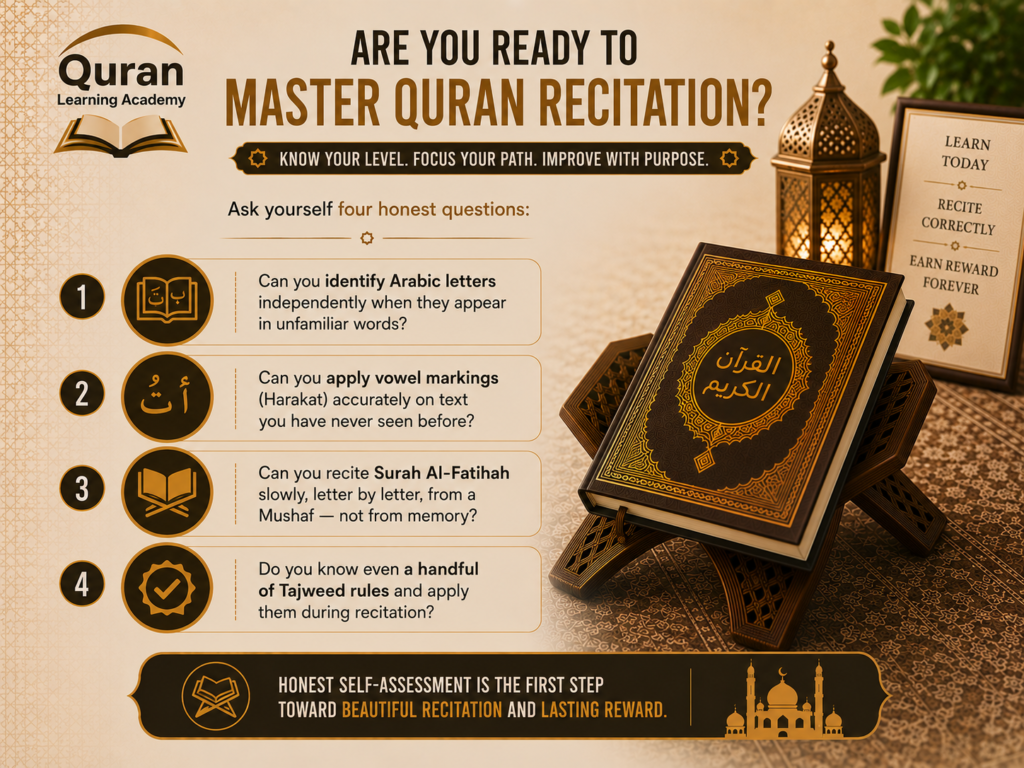
- Can you identify Arabic letters independently when they appear in unfamiliar words?
- Can you apply vowel markings (Harakat) accurately on text you have never seen before?
- Can you recite Surah Al-Fatihah slowly, letter by letter, from a Mushaf — not from memory?
- Do you know even a handful of Tajweed rules and apply them during recitation?
| Your Current Ability | Correct Starting Point |
| Cannot identify Arabic letters independently | Noorani Qaida |
| Recognises letters but reads slowly and uncertainly | Quran Reading foundations |
| Reads fluently but Tajweed rules are unknown | Tajweed course |
| Reads with Tajweed, wants Hifz or certification | Hifz or Ijazah programme |
This honest assessment saves months of frustration. Most adult beginners in the UK — even those who attended mosque as children — belong in the first or second row of that table.
Read also: How Long Does It Take to Memorize the Quran in the UK?
2- Noorani Qaida Builds the Foundation You Cannot Skip
If your assessment shows you cannot read Arabic text independently, Noorani Qaida is your mandatory starting point. It is not a shortcut or a children’s programme — it is the structured phonetic system that takes a learner from letter recognition through vowel application and joined text, in the correct sequence, with correct pronunciation from the very first lesson.
The most damaging habit among British adult beginners is attempting to read Quran from transliteration — using English letters to approximate Arabic sounds. This creates pronunciation patterns that take many months to undo and permanently delays genuine reading ability.
Noorani Qaida, taught properly by a qualified instructor, builds:
- Recognition of all 28 Arabic letters in their isolated, initial, medial, and final forms.
- Correct Makhraj (articulation point) for each letter from the beginning.
- Vowel application — Fatha, Kasra, Dammah, Sukoon, Shaddah, and Tanween.
- Joining rules that allow connected Arabic text to be decoded accurately.
Many parents in the UK also start Noorani Qaida alongside their children. This creates a shared learning environment at home and gives parents the phonetic foundation to support their child’s progress between lessons.
Adults who feel they are starting too late consistently find the course moves faster than expected. Most reach independent Quran reading within a few months of consistent one-to-one sessions.
If you cannot yet read Arabic fluently and want to build the foundation that every stage of Quran learning depends on, the Noorani Qaida Course in the UK at UK Quran Learning Academy provides systematic phonetic instruction — from letter recognition through joined text reading — delivered one-to-one by qualified instructors who specialise in teaching British learners from scratch.

Enrol in the Noorani Qaida Course at UK Quran Learning Academy
3- Tajweed Belongs at the Beginning, Not Later
A very common question among beginners is whether they should care about Tajweed at the start, or whether it is something to address after they can read fluently. The answer from every serious Hifz framework is the same: Tajweed must be introduced from the beginning.
The reason is straightforward. Incorrect pronunciation, once embedded through repeated practice, becomes extremely difficult to correct. A student who spends six months reading Arabic without Tajweed correction has spent six months reinforcing the wrong sounds. Unlearning those habits then takes longer than learning correctly from the start would have.
” مَثَلُ الَّذِي يَقْرَأُ الْقُرْآنَ وَهْوَ حَافِظٌ لَهُ مَعَ السَّفَرَةِ الْكِرَامِ الْبَرَرَةِ، وَمَثَلُ الَّذِي يَقْرَأُ الْقُرْآنَ وَهْوَ يَتَعَاهَدُهُ وَهْوَ عَلَيْهِ شَدِيدٌ، فَلَهُ أَجْرَانِ ”.
“Such a person as recites the Qur’an and masters it by heart, will be with the noble righteous scribes (in Heaven). And such a person exerts himself to learn the Qur’an by heart, and recites it with great difficulty, will have a double reward.”
The most frequent Tajweed challenge for British learners is Urdu-influenced pronunciation — particularly the letters ع (Ayn), غ (Ghayn), ح (Ha), and خ (Kha). These letters have no equivalent in English or Urdu phonetics and require specific Makhraj training to produce correctly.
Basic Tajweed rules beginners must learn from the start:
- Makharij Al-Huroof: The articulation point of each letter — where in the throat or mouth each sound originates.
- Madd (Elongation): When to extend vowel sounds and for how long.
- Ghunnah (Nasalisation): The nasal sound required for certain letter combinations.
- Ikhfa, Idgham, Iqlab, Izhar: The four rules governing how Noon Sakinah and Tanween interact with following letters.
The good news is that introducing basic Tajweed at the reading stage does not slow progress. When taught by a qualified instructor who corrects in real time, it becomes natural quickly.
Step Inside Our Virtual Classrooms
See how our interactive lessons work. Watch these brief highlights of our students engaging with instructors.
Read also: Who Was the First Person to Memorize the Holy Quran?
Start Your Quranic Journey in the UK
Join our academy for structured online lessons with expert tutors, tailored to fit your schedule.
Book Your Free Trial4- The Three Starting Points for Hifz and Which Fits You
Once reading fluency with basic Tajweed is established, the next question is where to begin memorisation itself. Three main approaches exist, each suited to a different learner profile.
Starting with Juz Amma (The 30th Part)
This is the most widely recommended starting point for beginners, children, and returning adult learners. The Surahs in Juz Amma are short, rhythmic, and frequently heard — most British Muslims have partial familiarity with them already from prayer.
The advantages are significant:
- Short Surahs create early wins, which build momentum and confidence
- Completing a full Surah quickly gives the learner a tangible milestone
- These Surahs are used in daily Salah, so memorisation is tested and reinforced five times every day
- The rhythmic structure of Juz Amma makes Tajweed patterns easier to recognise and apply
Most beginners start from Surah An-Nas and work backwards toward Surah An-Naba. This reverse order is standard in classical Hifz pedagogy and reflects the increasing length and complexity of Surahs as you move toward the beginning of Juz Amma.
Starting with Surah Al-Baqarah
This approach is described as a marathon strategy — suited to learners with strong reading fluency, significant daily time, and a long-term commitment from day one.
The logic: Surah Al-Baqarah is the longest Surah in the Quran. Completing it requires intense, sustained mental effort. Many scholars note that successfully memorising Al-Baqarah unlocks cognitive capacity and builds the mental stamina needed for the full Hifz journey. Once this largest hurdle is cleared, every remaining Surah feels comparatively manageable.
This starting point is not recommended for absolute beginners or those with limited daily time. It is best suited to full-time Hifz students or those who have prior memorisation experience and strong Arabic reading ability.
Starting with Specific Surahs by Personal Connection
Some learners choose to begin with a Surah they have heard throughout their lives — Surah Ar-Rahman, Surah Yasin, Surah Al-Mulk, or Surah Ad-Dhuha. The familiarity creates a lower barrier to the first memorisation session and builds early confidence.
This approach works well as an entry point but is generally integrated into a broader structured plan rather than used as the sole strategy for complete Hifz.
| Starting Point | Best For | Requires |
| Juz Amma (reverse order) | All beginners, children, returning adults | Basic fluent reading |
| Surah Al-Baqarah | Advanced readers, full-time students | Strong Tajweed and sustained daily time |
| Specific Surahs | Learners with existing familiarity | Some prior reading ability |
Start Your Quranic Journey in the UK
Join our academy for structured online lessons with expert tutors, tailored to fit your schedule.
Book Your Free Trial5- The Daily Memorisation System That Actually Works in the UK
Understanding where to start is only one part of the equation. The other is building a daily system that survives contact with British life — full-time work, school runs, unpredictable schedules, and the absence of dedicated memorisation environments that learners in other contexts take for granted.
The key principle from every serious Hifz framework is this: consistency beats volume. A student who memorises half a page every day for three years will outperform a student who memorises two pages some days and zero pages other days.
Recommended daily session structure:
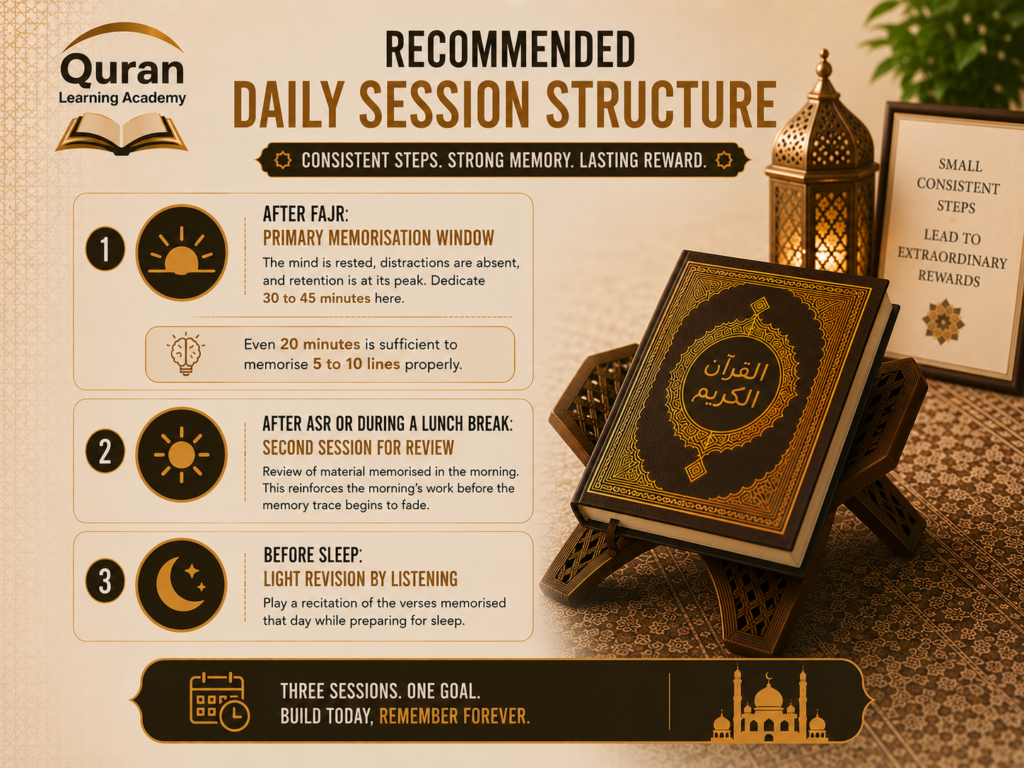
- After Fajr: Primary memorisation window. The mind is rested, distractions are absent, and retention is at its peak. Dedicate 30 to 45 minutes here. Even 20 minutes is sufficient to memorise 5 to 10 lines properly.
- After Asr or during a lunch break: Second session for review of material memorised in the morning. This reinforces the morning’s work before the memory trace begins to fade.
- Before sleep: Light revision by listening — play a recitation of the verses memorised that day while preparing for sleep.
Daily targets by experience level:
- Complete beginners with no prior Hifz: 5 to 10 lines daily.
- Intermediate readers who can read Arabic fluently: half a page to one full page daily.
- Advanced students with strong Tajweed and prior Hifz: one to two pages daily, with full review maintained.
The layering method inside each session:
- Repeat Verse 1 twenty times alone
- Repeat Verse 2 twenty times alone
- Recite Verses 1 and 2 together three to five times
- Continue this pattern through the full day’s portion
- At the end of the session, recite the entire portion from memory without looking
The combination step — linking verses together rather than memorising them as isolated units — is critical. Most memorisation failures happen not because individual verses are forgotten but because the link between them is weak.
6- Review Is More Important Than New Memorisation
This is the point where most self-guided Hifz attempts collapse in the UK. Learners focus entirely on adding new material and treat review as optional. Memory does not work that way.
Recall strength decays rapidly in the first 24 to 48 hours after initial memorisation, then stabilises if the memory is revisited. Skipping review for even two or three consecutive days can undo an entire week of memorisation work.
| Review Category | Definition | Recommended Frequency |
| Near-Past Review | Last 5 pages memorised | Daily, non-negotiable |
| Mid-Past Review | Pages 6 to 20 behind current position | Daily, increasing gradually |
| Far-Past Review | Everything memorised before that | Weekly rotation covering all prior material |
On days when time is short, experienced Hifz teachers consistently advise the same thing: review existing material rather than add new verses. Protecting what you have is more important than expanding it.
” إِنَّا نَحْنُ نَزَّلْنَا الذِّكْرَ وَإِنَّا لَهُ لَحَافِظُون “
Innā naḥnu nazzalnā al-dhikra wa-innā lahu laḥāfiẓūn
“Indeed, it is We who sent down the Qur’an and indeed, We will be its guardian. (9).”
Read Also: How to Help the Kids to Hifz Quran in the UK?
7- A Qualified Teacher Is Not Optional for Hifz
Memorising without a teacher means embedding pronunciation errors, Tajweed mistakes, and incorrect verse boundaries that become extremely difficult to correct later. This is not a modern pedagogical preference — it reflects the fundamental nature of how the Quran has been transmitted across fourteen centuries.
Every word in the Mushaf today exists exactly as it does because of an unbroken chain of teachers and students transmitting it orally, with each student corrected in real time. Memorising from recordings or text alone breaks this chain and removes the error-correction mechanism that is central to authentic Hifz.
What a qualified teacher catches that self-study cannot:
- Makhraj errors — incorrect articulation points for Arabic letters
- Tajweed rule violations that sound minor but change the meaning of verses
- Incorrect verse boundaries that cause students to pause in the wrong place
- Memorisation gaps where a forgotten word is unconsciously replaced with one that sounds similar
None of these can be reliably identified by the student themselves. Audio recordings cannot respond to what a specific student is doing in real time. Teacher-supervised Hifz is not a luxury for those who can afford it — it is what separates accurate memorisation from approximate memorisation.
Many British adults specifically cite accountability as the reason they finally maintained consistent Hifz progress after years of failed solo attempts. An external commitment — a teacher expecting recitation at a fixed time — is far harder to abandon than private resolve.
Sisters across the UK who want to pursue Hifz in a private, structured environment with qualified female teachers will find the Quran Hifz for Ladies in the UK at UK Quran Learning Academy provides exactly this — one-to-one sessions with experienced female instructors who track memorisation and review simultaneously, at times that fit around family and work commitments.
Read Also: The Best Time to Memorise Quran for British Muslims
Begin Your Hifz Journey at UK Quran Learning Academy
8- Understanding and Arabic Are Tools, Not Prerequisites
A question that comes up consistently among British beginners is whether they should focus on understanding the meaning before memorising, or whether they should learn Arabic first.
The answer has two parts.
Understanding aids memorisation but is not a prerequisite for beginning. When you understand what an ayah means, your brain creates multiple memory pathways for it — the sound, the visual layout on the page, and the conceptual meaning. If one pathway weakens, the others compensate.
Memorising without any comprehension uses only acoustic and visual memory, making retention more fragile under pressure — during Salah, for example, when the mind is focused on worship rather than mechanical recitation.
Reading a brief translation before each memorisation session — understanding the general theme of the passage — is sufficient to activate meaning-based memory pathways. You do not need to be a Tafseer scholar before starting Hifz.
Arabic learning and Hifz can run in parallel. Many British learners make the mistake of believing they must reach Arabic fluency before beginning memorisation.
This is not accurate. Hifz builds familiarity with Quranic vocabulary naturally. Pairing it with a structured Arabic course accelerates both skills simultaneously.
“أَفَلَا يَتَدَبَّرُونَ الْقُرْآنَ أَمْ عَلَىٰ قُلُوبٍ أَقْفَالُهَا “
Afalā yatadabbarūna al-Qur’āna am ʿalā qulūbin aqfāluhā
“Then do they not reflect upon the Qur’an, or are there locks upon [their] hearts? (24)”
For British learners who want to deepen their understanding of Quranic vocabulary alongside their memorisation, the Quranic Arabic Course in the UK at UK Quran Learning Academy progresses through Classical Arabic grammar, Quranic vocabulary, and direct Quranic text analysis — giving students the tools to read and understand verses independently rather than reciting words whose meaning remains opaque.
Enrol in the Quranic Arabic Course at UK Quran Learning Academy
9- Six Mistakes That Prevent Beginners From Making Progress
Most beginners in the UK who start Hifz and abandon it do not fail because the goal is too difficult. They fail because of specific, preventable errors that were made before or during the early sessions.
| Mistake | Why It Destroys Progress |
| Starting without assessing Arabic reading ability | Leads to memorising with incorrect pronunciation from day one |
| Using transliteration instead of the Arabic Mushaf | Prevents genuine reading ability from developing |
| Changing the Mushaf mid-way through | Disrupts visual memory — the brain stores the position of verses on specific pages |
| Skipping Tajweed correction early on | Errors become embedded habits that require months to undo |
| Memorising at variable, inconsistent times | No habitual cue means no automatic recall |
| Continuing without a qualified teacher | Mistakes compound silently until they are locked in |
There is also a dimension that classical scholars consistently identified: the state of the heart affects memorisation capacity. Maintaining consistency in daily prayers, keeping good company, and approaching Hifz with sincere intention are not separate from the technical process — they are part of it.
Read Also: How to Memorize Surah Fast?
Experience the Academy in Action
Curious about our teaching style? Take a quick look inside a live session to see our immersive, supportive learning environment first-hand.
Start Your Quranic Journey in the UK
Join our academy for structured online lessons with expert tutors, tailored to fit your schedule.
Book Your Free TrialRead Also: Most Important Surahs to Memorize
10- Building a Routine That Fits British Life
British Muslim life in 2026 involves full-time jobs, school-age children, commutes across London, Birmingham, Manchester, Leeds, and beyond, and the persistent sense that there is no “right time” to start. The routine that works is not the ideal one — it is the realistic one.
Practical daily habits that sustain Hifz in the UK:

- Protect a 20-minute post-Fajr block as a non-negotiable minimum. Even on difficult days, this single window — when the house is quiet and the mind is rested — produces more lasting retention than any other time of day.
- Use commute time for listening. Play the verses you memorised that morning during the train or bus journey. This passive reinforcement strengthens the neural pattern built during active memorisation.
- Recite recently memorised material in daily Salah. Five daily prayers are five built-in review sessions. Rotating recently memorised Surahs across the prayers reinforces each segment multiple times per day without requiring additional time.
- Reserve one day per week as a full review day with no new material. This weekly reset prevents the most common Hifz failure: memorising forward while losing what was already learned.
For working adults across the UK who want structured Hifz guidance built around professional and family schedules, the Hifz Classes for Adults in the UK at UK Quran Learning Academy offers one-to-one sessions with qualified instructors — designed for people who cannot fit a madrasa schedule but are serious about completing memorisation with accuracy.

Start Your Adult Hifz Programme at UK Quran Learning Academy
Start Your Journey at UK Quran Learning Academy
Every British Muslim reading this guide has the same thing: the intention. What separates those who memorise from those who intend to memorise is a structured environment, a qualified teacher, and a realistic system built around their actual life.
UK Quran Learning Academy delivers one-to-one online Quran, Tajweed, Hifz, and Arabic instruction for adults, children, sisters, and beginners across the UK — with flexible scheduling built for British work and family life.
What every programme includes:
- One-to-one sessions with qualified, experienced instructors.
- Real-time Tajweed correction so memorisation is accurate from day one.
- Structured daily and weekly review plans built into the curriculum.
- Flexible scheduling that fits around work, school, and family commitments in the UK.
- A welcoming environment for absolute beginners, returning learners, and those with no prior Arabic knowledge.
The fastest route to memorising the Quran is not a shortcut — it is the right system with the right teacher. Both are available to you today.
Discover Our Quran Courses
- Quran Online Academy
- Quran Recitation Classes
- Quran Reading Classes
- Online Quran Classes for Kids
- Quran Classes for Adults
- Quran Classes for Female / Sisters
- Learn Quran Course for Beginners
- Quran Memorization (Hifz) Course
- Hifz Classes for Adults
- Quran Memorization and Hifz Course for Kids
- Quran Hifz Course for Ladies
- Quran Ijazah Program
- Quran Qirat Learning Course
- Quran Tafsir Course
- Noorani Qaida Course
- Noorani Qaida Course for Kids
- Weekend Quran Classes
- Intensive Quran Course
- Al-Azhar Quran Course
- Online Tajweed Classes
- Tajweed Course for Kids
- Tajweed Course for Adults
- Tajweed Course for Ladies
Book Your Free Trial at UK Quran Learning Academy
Conclusion
Starting to read and memorise the Quran in the UK is entirely achievable when the process follows a clear sequence. Assess your Arabic reading level first. Build the phonetic foundation with Noorani Qaida if needed. Introduce Tajweed from day one rather than retrofitting it later.
Choose a starting point for Hifz that matches your level and available time — Juz Amma for most beginners, Al-Baqarah for those with prior experience and strong fluency. Build a daily routine that is realistic for British life, not an ideal schedule that collapses under the first busy week. Review without exception. And memorise under qualified teacher supervision, not alone.
None of these steps requires years of preparation before beginning. The first step is the only one that matters today.
Frequently Asked Questions
Where should beginners start memorizing the Quran?
Most beginners should start with Juz Amma, beginning with Surah An-Nas and gradually working back toward Surah An-Naba. These short surahs are easier to memorize, commonly recited in Salah, and help build confidence early in the Hifz journey.
Should I learn Tajweed before or while memorizing the Quran?
Yes. Tajweed should be learned from the very beginning of Quran memorization. Learning correct pronunciation, Makharij, Madd, Ghunnah, and other basic rules early helps prevent mistakes that become difficult to correct later.
Do I need to know Arabic before starting Hifz?
No. You can begin memorizing the Quran without being fluent in Arabic. Reading a translation before each memorization session and studying Arabic alongside Hifz can improve understanding and make memorization easier.
Can adults memorize the entire Quran?
Yes. Adults can successfully complete Hifz with a structured plan, consistent daily practice, regular revision, correct Tajweed, and guidance from a qualified Quran teacher.
How long does it take to memorize the Quran?
The timeline depends on your daily memorization goal and consistency. Memorizing about half a page per day may take around three to four years, while memorizing one page per day can reduce the journey to approximately one and a half to two years.






Leave a Reply