 Quran
Quran

Thousands of Muslim parents enrol their children in Hifz programmes every year for spiritual reasons, and the reward is real and confirmed. But a separate question is increasingly asked by educators, researchers, and Muslim families worldwide: does engaging deeply with Quranic memorisation actually change the way the brain functions?
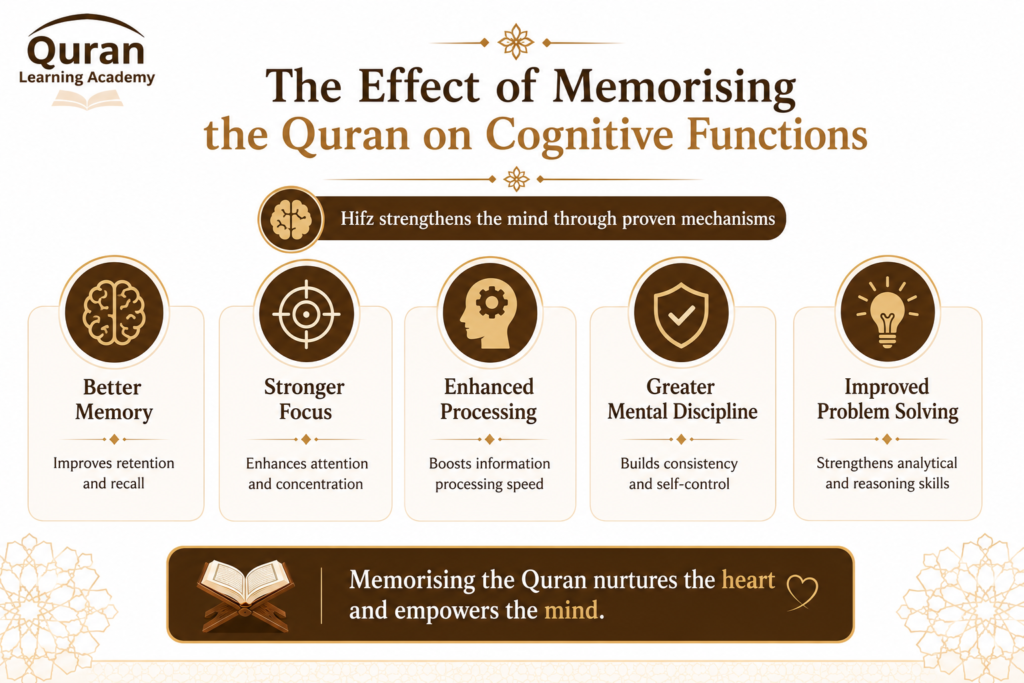
The research now available answers this clearly. Memorising the Quran produces measurable cognitive improvements that extend far beyond the act of memorisation itself, affecting memory, focus, academic performance, and the brain’s capacity to acquire new knowledge throughout life.
Does Memorising the Quran Improve Memory?
Studies examining the cognitive profiles of Hifz students consistently report improvements in verbal memory, visual memory, sustained attention, and cognitive fluency — the same functions measured in academic aptitude assessments.
Research confirms that students engaged in Hifz demonstrate significantly stronger performance across these areas compared to peers who are not memorising. The brain, trained to encode and retrieve large volumes of complex Arabic text with precise pronunciation, develops enhanced retrieval pathways that transfer directly to other learning tasks.
Step Inside Our Virtual Classrooms
See how our interactive lessons work. Watch these brief highlights of our students engaging with instructors.
Start Your Quranic Journey in the UK
Join our academy for structured online lessons with expert tutors, tailored to fit your schedule.
Book Your Free TrialQuran Memorisation Produces Measurable Improvements in Memory
The evidence here is specific, not general. Studies examining the cognitive profiles of Hifz students consistently report improvements in verbal memory, visual memory, sustained attention, and cognitive fluency. These are the same functions measured in academic aptitude assessments and neuropsychological evaluations.
Research confirms that students engaged in Hifz demonstrate significantly stronger performance across these areas compared to peers who are not memorising. The brain, trained to encode and retrieve large volumes of complex Arabic text with precise pronunciation, develops enhanced retrieval pathways that transfer directly to other learning tasks.
Allah describes the Quran’s effect on those who engage with it sincerely:
“يَا أَيُّهَا النَّاسُ قَدْ جَاءَتْكُم مَّوْعِظَةٌ مِّن رَّبِّكُمْ وَشِفَاءٌ لِّمَا فِي الصُّدُورِ وَهُدًى وَرَحْمَةٌ لِّلْمُؤْمِنِينَ ﴿٥٧﴾
” Yā-ayyuhā n-nāsu qad jā’atkum maw’iẓatun min rabbikum wa-shifā’un li-mā fi ṣ-ṣudūri wa-hudan wa-raḥmatun lil-mu’minīn
” O mankind, there has to come to you instruction from your Lord and healing for what is in the breasts and guidance and mercy for the believers. (57)”
The Quran Memorisation Course in the UK at UK Quran Learning Academy is structured to develop both memorisation accuracy and comprehension simultaneously, ensuring students engage with Quranic text in a way that maximises every cognitive benefit the research identifies.

Enrol in the Quran Memorisation Course in the UK at UK Quran Learning Academy
The Effect of Memorising the Quran on Cognitive Functions Is Documented Across Three Areas
The effect of memorising the Quran on cognitive functions operates through several distinct mechanisms, each documented in independent research. Understanding these mechanisms helps explain why Hifz produces benefits that extend far beyond the act of memorisation itself.
Working Memory Capacity Grows Through Dual-Load Practice
Daily Hifz practice requires a student to hold new verses in active recall while simultaneously reviewing previously memorised material. This dual-load process trains the brain’s working memory system in a way that few other learning activities replicate.
Specialists in child cognitive development confirm that memorising large volumes of structured text from a young age directly improves working memory capacity and accelerates learning acquisition.
Processing Speed Increases With Phonological Training
The brain becomes accustomed to recognising and retrieving complex Arabic phonological patterns rapidly through sustained Hifz practice.
Students who complete significant portions of Hifz demonstrate faster information processing across unrelated academic subjects, because the same neural pathways trained for rapid phonological retrieval support faster processing generally.
Sustained Attention Is Directly Trained by Revision Sessions
Hifz revision sessions require uninterrupted concentration on precise linguistic detail for extended periods.
The ability to maintain focused attention without distraction is among the most transferable cognitive skills the memorisation process builds, and it is measurably stronger in Hifz students compared to non-memorising peers across all age groups studied.
Read Also: Memorizing Quran by Listening
Quran Memorisation Builds the Cognitive Architecture Behind Intelligence
Does memorising Quran increase IQ? The relationship between Hifz and measured intelligence is not incidental. Cognitive scientists understand IQ as a composite of working memory capacity, processing speed, and fluid reasoning — the same functions Quran memorisation directly trains through daily practice.
Research confirms this connection. One specialist noted that the brain functions like a muscle: consistent, disciplined use strengthens it progressively. A student who memorises the Quran rigorously is simultaneously building the cognitive architecture that underpins stronger measured intelligence. The improvement is a byproduct of the discipline, not the stated goal.
The Prophet ﷺ said:
“خَيْرُكُمْ مَنْ تَعَلَّمَ الْقُرْآنَ وَعَلَّمَهُ ”
“The best among you (Muslims) are those who learn the Qur’an and teach it.”
Read Also: Memorising Quran Without Understanding
Quran Memorisation Improves Academic Performance Across Subjects
Research into the academic outcomes of Hifz students reveals a consistent pattern: stronger Quran memorisation correlates with stronger academic achievement, even in subjects unrelated to Quranic study. The following table summarises the key findings:
| Study Focus | Effect Strength | Key Finding |
| General academic performance | Moderate to strong | 22–46% of variance explained by memorisation level |
| Quranic and Arabic subjects | Strong | 52% correlation in subject-specific performance |
| Overall academic achievement | Weak to moderate | Correlation coefficient of approximately 0.18 |
| Verbal and visual memory | Significant improvement | Consistent across structured cognitive assessments |
| Sustained attention and fluency | Measurable enhancement | Documented across multiple age groups |
One study found that each measurable increase in memorisation attainment corresponded to a 0.58 increase in overall academic marks. The mechanism behind this operates through three transferable academic skills that Hifz develops in parallel:
- Self-regulated learning — students who manage daily memorisation and revision develop the same self-discipline that drives academic consistency across all subjects.
- Critical thinking — progression from memorisation to understanding Quranic meanings trains analytical reasoning applicable to every learning context.
- Memory consolidation habits — the structured revision cycles required for Hifz train the brain to retain information effectively, benefiting every subject a student studies.
The Quran Tafsir Course in the UK at UK Quran Learning Academy bridges memorisation and comprehension, enabling students to understand the grammatical structure of what they have committed to memory. This deepens retention and accelerates the cognitive benefits the research documents.
Read Also: The Best Gift for Hafiz-e-Quran
Enrol in the Quran Tafsir Course in the UK at UK Quran Learning Academy
Physical Movement During Recitation Strengthens Memory Consolidation
Research on the relationship between movement and memory retention is directly relevant to Hifz students. Studies confirm that light physical activity during recitation — such as pacing or walking — measurably improves memory consolidation and cognitive performance. One study found that 20 minutes of walking enhances memory retrieval and overall cognitive function.
The Brain Forms Stronger Memories Through Context Association
When a student memorises while moving or changing location, the brain forms associations between the physical context and the verses being learnt. This context-dependent memory mechanism makes individual verse recall more reliable, particularly when reciting under mild performance pressure such as in Salah or examination conditions.
Recitation During Daily Activities Extends Revision Time Naturally
Incorporating recitation into routine physical activities — walking, household tasks, or commuting — extends the daily revision window without requiring additional dedicated study time. This approach reinforces memorisation through acoustic repetition across varied contexts, which research identifies as one of the most effective retention strategies available.
Read Also: Can I Memorise Quran During Periods?
Light Exercise Before a Hifz Session Primes the Brain for Encoding
Studies from the University of British Columbia found that regular aerobic exercise increases the size of the hippocampus — the brain region responsible for memory formation. Five to ten minutes of light movement before sitting for a memorisation session measurably improves focus, reduces mental fatigue, and activates the memory-forming regions of the brain before new material is introduced.
Many adults in the UK find that without structured support, Hifz routines collapse within weeks under the pressure of work and family commitments. The Hifz Classes for Adults in the UK at UK Quran Learning Academy provide structured memorisation training designed specifically for working professionals and parents balancing faith with daily responsibilities.
Read Also: How Many Sahaba Memorised the Quran?
Experience the Academy in Action
Curious about our teaching style? Take a quick look inside a live session to see our immersive, supportive learning environment first-hand.
Start Your Quranic Journey in the UK
Join our academy for structured online lessons with expert tutors, tailored to fit your schedule.
Book Your Free Trial
Enrol in the Hifz Classes for Adults in the UK at UK Quran Learning Academy
Start Your Hifz Journey With UK Quran Learning Academy
Memorising the Quran while also building the Arabic comprehension needed to understand it is the approach that produces the strongest cognitive and spiritual outcomes. UK Quran Learning Academy offers one-on-one live sessions with certified Azhari instructors designed to develop both dimensions simultaneously.
Every programme at UK Quran Learning Academy includes:
- Certified Azhari instructors holding Ijazah in recitation or degrees in Islamic studies from recognised institutions.
- One-on-one live sessions tailored specifically to each student’s individual level and memorisation goals.
- Real-time Makharij correction using audio-visual feedback during every session.
- Flexible scheduling that fits around work, school, and family commitments across the UK.
- Structured daily and weekly revision plans built into every curriculum.
Discover Our Quran Courses
- Quran Online Academy
- Quran Recitation Classes
- Quran Reading Classes
- Online Quran Classes for Kids
- Quran Classes for Adults
- Quran Classes for Female / Sisters
- Learn Quran Course for Beginners
- Quran Memorization (Hifz) Course
- Hifz Classes for Adults
- Quran Memorization and Hifz Course for Kids
- Quran Hifz Course for Ladies
- Quran Ijazah Program
- Quran Qirat Learning Course
- Quran Tafsir Course
- Noorani Qaida Course
- Noorani Qaida Course for Kids
- Weekend Quran Classes
- Intensive Quran Course
- Al-Azhar Quran Course
- Online Tajweed Classes
- Tajweed Course for Kids
- Tajweed Course for Adults
- Tajweed Course for Ladies
Enrol now at UK Quran Learning Academy
Conclusion
Does memorising Quran improve memory? The research is consistent: Hifz produces measurable improvements in verbal memory, visual memory, sustained attention, processing speed, and working memory capacity. The effect of memorising the Quran on cognitive functions extends into academic performance, discipline, time management, and the brain’s overall capacity to acquire and retain new knowledge.
Does memorising Quran increase IQ? It builds the cognitive architecture that underpins measured intelligence — working memory, processing speed, and fluid reasoning — through disciplined daily practice. A student who completes a serious Hifz programme does not merely carry the Quran in their heart. They carry a mind shaped by one of the most demanding and rewarding cognitive disciplines in the world of Islamic scholarship.
FAQ
Does Quran memorisation improve academic performance?
Research shows Hifz students often achieve better academic results, with memorisation linked to stronger performance across multiple subjects.
How does Hifz strengthen working memory?
Daily memorisation and revision improve working memory, supporting better learning, concentration, and information retention.
Why is it better to start Hifz at a young age?
Children benefit from greater brain plasticity, making memorisation easier and supporting stronger long-term cognitive development.
Is memorising the Quran without understanding its meaning enough?
Memorisation is valuable, but combining it with understanding improves analytical thinking and long-term retention.
Why is Quran revision more important than new memorisation?
Regular revision strengthens memory retrieval and helps preserve previously memorised verses more effectively than memorising new ones alone.








Leave a Reply