 Quran
Quran

Many older Muslims sincerely want to memorise the Quran but struggle to retain verses despite repeated practice. This does not mean the mind is incapable of Hifz; it means the learning approach must match the needs of older learners. Understanding how to memorize Quran in old age requires smaller portions, deeper repetition, longer review cycles, and structured practice that supports long-term retention. This guide provides a practical step-by-step approach, from the first session to maintaining what you have memorized.
1. Limit Your Daily Portion to 3 to 5 Lines to Match the Ageing Memory’s Capacity
The most damaging mistake older learners make is starting with portions that are too large, such as half a page or a full page. For those learning how to memorize Quran in old age, smaller portions are more effective because mature memory benefits from repeated, focused practice.
Starting with 3–5 lines allows deeper encoding and more accurate retention, while larger portions can lead to quick forgetting and discouragement. The difference is not effort but giving the brain enough time and repetition to consolidate what has been memorized.
The correct progression for an older learner:
| Period | Daily Target | Condition to Progress |
| Weeks 1 to 4 | 3 to 5 lines | All lines recalled without hesitation |
| Weeks 5 to 8 | 5 to 7 lines | Only if previous weeks are holding firmly |
| Month 3 onward | Up to half a page | Based on honest self-assessment with a teacher |
Never increase the daily target until what has already been memorised is holding cleanly through revision. Patience at this stage is not passivity — it is the method.
2. Memorise After Fajr When the Ageing Brain Is at Peak Capacity
For older learners, when you memorise can be as important as how you memorise. Mental fatigue can reduce the ability to encode new information as the day progresses, making early practice more effective.
After Fajr is an ideal time for memorization because the mind is rested after sleep and better prepared to focus on new verses. Using this early window can reduce the repetitions needed and help new memorization remain stronger for longer before revision.
The practical daily structure for an older learner:
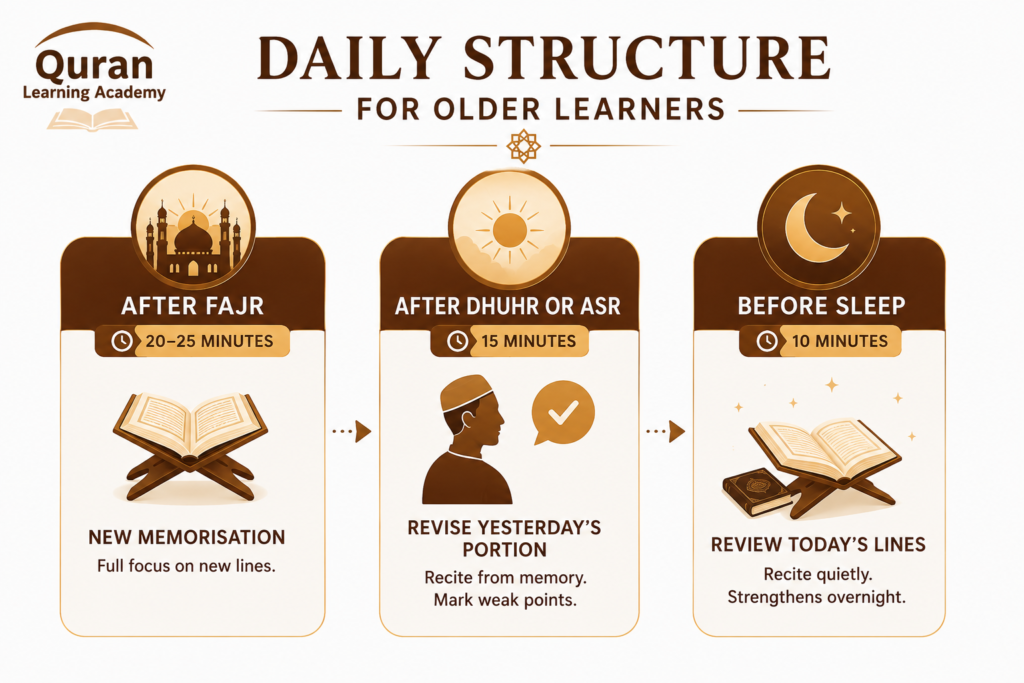
- After Fajr (20 to 25 minutes): New memorisation only. No revision in this slot — full cognitive focus on the new lines.
- After Dhuhr or Asr (15 minutes): Recite yesterday’s portion from memory without looking. Mark any weak points immediately.
- Before sleep (10 minutes): Recite today’s memorised lines quietly before closing your eyes. The brain reinforces material during sleep cycles — what is reviewed immediately before sleep consolidates significantly more deeply overnight.
The before-sleep recitation carries particular importance for older learners. The sleeping brain replays recently encoded material during deep sleep cycles. Senior learners who recite their new lines just before sleeping consistently report stronger recall the following Fajr compared to those who do not.
Read also: Motivation to Read Quran: 8 Powerful Reasons That Keep You Going
3. Begin with Juz Amma to Build Momentum Before Tackling Longer Surahs
Where an older learner begins can strongly affect confidence, motivation, and long-term commitment. For later-life Hifz, Juz Amma (the 30th Juz) is an effective starting point because its shorter Surahs are often already familiar from years of daily Salah. This familiarity can reduce the repetitions needed and build early confidence.
Juz Amma also provides natural revision through daily prayers. Reciting memorized Surahs in Salah five times a day reinforces them without requiring additional study time, making it especially practical for older learners with limited memorization windows.
The recommended sequence within Juz Amma for older learners:
- Al-Ikhlas, Al-Falaq, An-Nas — already partially known, anchor the habit first.
- Al-Kawthar, Al-Asr, Al-Fil — short, rhythmically distinct, easy to fix firmly.
- Al-Humazah, Al-Ma’un, Quraysh — medium length, build endurance gradually.
- An-Naba and An-Nazi’at — only after the method is fully established and revision is running smoothly.
For adults who are either beginning Hifz for the first time or restarting after years away, the Hifz Classes for Adults in the UK at UK Quran Learning Academy provide structured, one-to-one online sessions with qualified teachers — personalised pacing built around where you are now, not where a child in a Hifz school would be.

Enrol in Hifz Classes for Adults at UK Quran Learning Academy
4. Apply the 10-Then-3 Repetition Method Designed for Slower Encoding
The repetition method used inside each session determines whether what is memorised holds for weeks or disappears overnight. For younger learners, a standard repetition cycle is sufficient. For older learners, the encoding process requires more passes at the initial stage and a structured recall test before moving forward.
The 10-then-3 method works as follows:
- Read the target verse 10 times from the Mushaf, with deliberate attention to every word and its meaning.
- Close the Mushaf completely and recite the verse 3 times from memory.
- If any hesitation occurs during the 3 recitations, return to the Mushaf for 5 more readings and attempt the 3 recitations again.
- Only move to the next verse when the current one flows 3 times consecutively without any pause or correction.
- At the end of the session, recite the entire day’s portion from beginning to end as one connected passage — not verse by verse with pauses between them.
The final connected recitation is where older learners most commonly cut corners — and where the most common failure occurs. The ageing memory tends to store verses as isolated units rather than a flowing chain. The bridge between the end of one verse and the opening word of the next is the weakest point. Reciting the full day’s portion as one unbroken passage, every single session, builds exactly that bridge.
Read also: How to Concentrate While Reading Quran: 9 Practical Steps That Work
Step Inside Our Virtual Classrooms
See how our interactive lessons work. Watch these brief highlights of our students engaging with instructors.
Start Your Quranic Journey in the UK
Join our academy for structured online lessons with expert tutors, tailored to fit your schedule.
Book Your Free Trial5. Prioritise Revision Over New Memorisation in Every Daily Session
For older learners, the ratio of revision time to new memorisation time is not a preference — it is the structural foundation of the entire plan. Without consistent revision, new memorisation fades within 48 hours regardless of how many times a verse was repeated during the initial session.
The ageing memory’s forgetting curve is steeper than a younger learner’s in the early days after memorisation. A verse memorised on Monday without Wednesday’s revision may be entirely gone by Friday. This is not a sign of failure — it is how the mature memory works, and the revision plan must account for it.
A practical daily revision structure for an older learner:
| Revision Type | What It Covers | Time Required |
| Same-day revision | Lines memorised in today’s Fajr session | 10 minutes after Dhuhr |
| Recent revision | Everything memorised in the past 7 days | 15 minutes daily, non-negotiable |
| Full past revision | All material memorised before the past 7 days | 20 minutes, rotating weekly |
The total daily time split should favour revision over new memorisation. For an older learner spending 45 minutes per day on Hifz, approximately 30 minutes should be revision and 15 minutes should be new material. This ratio feels counterintuitive — but it is the reason some older learners complete Hifz while others restart repeatedly.
On days when time is genuinely short — illness, family demands, fatigue — skip new memorisation entirely and protect revision. What has already been memorised is more valuable than what has not yet been started.
Read also: How to Learn Quran Recitation: A Complete Step-by-Step Guide
6. Understand the Meaning of Every Verse Before Attempting to Memorise It
For older learners, understanding the meaning is a powerful tool for Quran memorization, not merely an added benefit. When a verse is understood, its sounds, visual structure, and meaning create multiple retrieval pathways that strengthen memory.
Unlike younger learners who may rely heavily on repetition, older learners often benefit more from meaning-based anchors. Connecting Arabic words to their meaning makes verses easier to retain than memorizing unfamiliar sounds alone.
Allah ﷻ Himself invites this reflection:
“أَفَلَا يَتَدَبَّرُونَ الْقُرْآنَ أَمْ عَلَىٰ قُلُوبٍ أَقْفَالُهَا ﴿٢٤﴾”
Afalā yatadabbarūnal-Qur’āna am ʿalā qulūbin aqfāluhā.
“Then do they not reflect upon the Qur’an, or are there locks upon [their] hearts? (24)”
The practical application is straightforward. Before each memorisation session, read a brief English translation of the verses to be memorised that day. Note the theme — what is Allah describing, commanding, or promising in this passage.
Then begin the 10-then-3 repetition method with that meaning held in mind. The difference in retention between memorising with meaning and memorising without it is immediate and measurable.
For those who want structured Tafseer alongside their Hifz — understanding the Quran deeply while memorising it — the Quran Tafsir Course in the UK at UK Quran Learning Academy provides classical commentary through live, one-to-one instruction, making comprehension and memorisation work together rather than separately.

Join the Quran Tafsir Course at UK Quran Learning Academy
7. Listen to a Consistent Reciter Daily to Build Accurate Auditory Memory
Listening is one of the most effective memorization tools for older learners. Hearing each verse repeatedly from a skilled, consistent reciter creates an auditory model that the tongue can follow. Combining listening with repeated recitation strengthens both auditory and motor memory.
This is especially useful for older learners, as distinguishing similar Arabic sounds can become more difficult with age. Regular exposure to accurate recitation helps prevent incorrect sounds from becoming deeply embedded during memorization and revision.
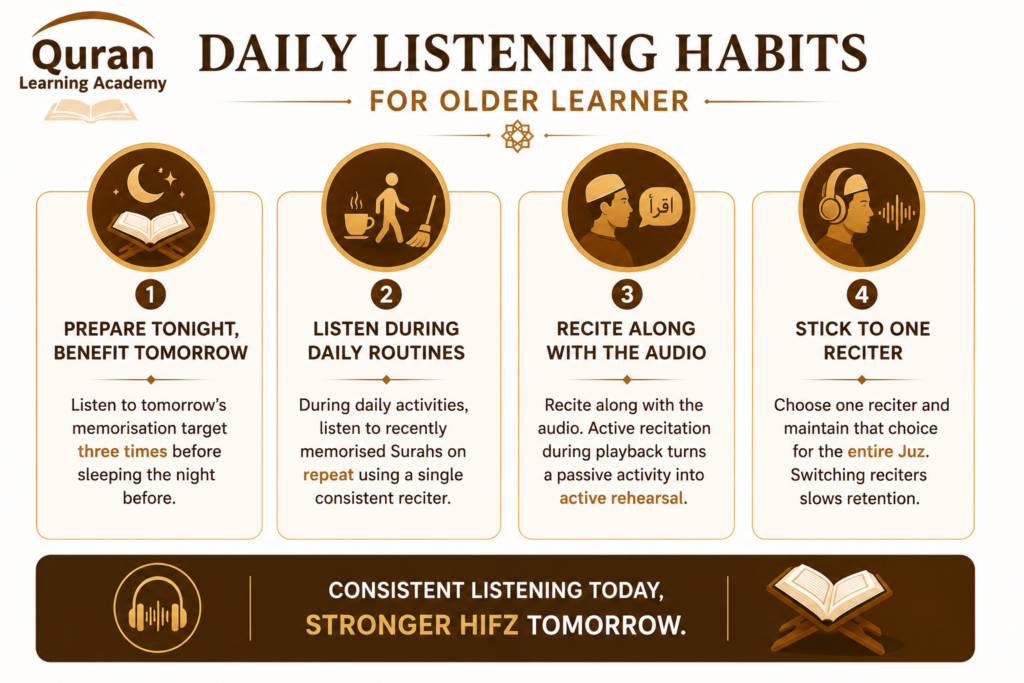
Practical daily listening habits for an older learner:
- Listen to tomorrow’s memorisation target three times before sleeping the night before — the brain begins processing the verses during sleep, making the next morning’s memorisation session significantly easier.
- During routine daily activities — morning tea, walking, household tasks — listen to recently memorised Surahs on repeat using a single consistent reciter.
- Recite along with the audio rather than passively listening. Active recitation during playback turns a passive activity into active rehearsal.
- Choose one reciter and maintain that choice for the entire Juz. Switching reciters disrupts the auditory template and slows retention.
Reciters known for precise, measured Tajweed and clear articulation — such as Sheikh al-Husary and Sheikh al-Minshawi — are particularly recommended for learners using audio as a memorisation tool, because the clarity of their pronunciation leaves no ambiguity in what is being heard.
8. Work with a Qualified Teacher Who Corrects Pronunciation in Real Time
Memorising alone in old age carries a specific and serious risk that younger self-taught learners can sometimes recover from more easily: pronunciation errors become embedded through repetition far more quickly in older learners, and they are far more difficult to correct once fixed.
Every time a verse is repeated with an incorrect Makhraj (articulation point), that error is reinforced. After weeks of revision, the incorrect pronunciation is not just a mistake — it is the memory itself. Attempting to correct it at that stage requires not just learning the right pronunciation but actively overwriting a deeply held pattern, which the ageing brain resists strongly.
A qualified teacher provides three things that no recording, app, or self-study method can replace:
- Real-time correction of Tajweed errors before they are embedded through repetition.
- Identification of weak transitions between verses — the points where memory chains break — which the learner cannot detect alone.
- Consistent accountability that sustains commitment through the months when progress feels slow and motivation is tested.
The oral transmission of the Quran has been preserved through an unbroken chain of teacher-to-student correction since the time of the Prophet ﷺ. That chain exists precisely because accuracy at this level cannot be achieved through self-study.
The Prophet ﷺ said:
“خَيْرُكُمْ مَنْ تَعَلَّمَ الْقُرْآنَ وَعَلَّمَهُ”
“Khayrukum man ta’allamal-Qur’āna wa ‘allamah.”
“The best among you (Muslims) are those who learn the Qur’an and teach it.”
There is no age qualifier in this hadith. The reward belongs to the learner at sixty as fully as to the student at ten.
9. Recite Memorised Verses in Every Prayer to Anchor Them Permanently
The five daily prayers are the most powerful and most available revision tool for any learner — and for older learners who have prayed consistently for decades, they carry an additional advantage: Salah is already a deeply ingrained habit. Adding memorised Surahs to that existing habit requires no new discipline — it simply elevates what is already being done.
Reciting memorised verses in Salah forces genuine recall under the specific pressure of prayer — no Mushaf, no external prompt, no ability to glance ahead. The mind must retrieve the verse entirely from memory. This active retrieval under mild pressure is significantly more effective at strengthening memory than passive revision from the page.
For an older learner, the rotation across the five prayers works as follows:
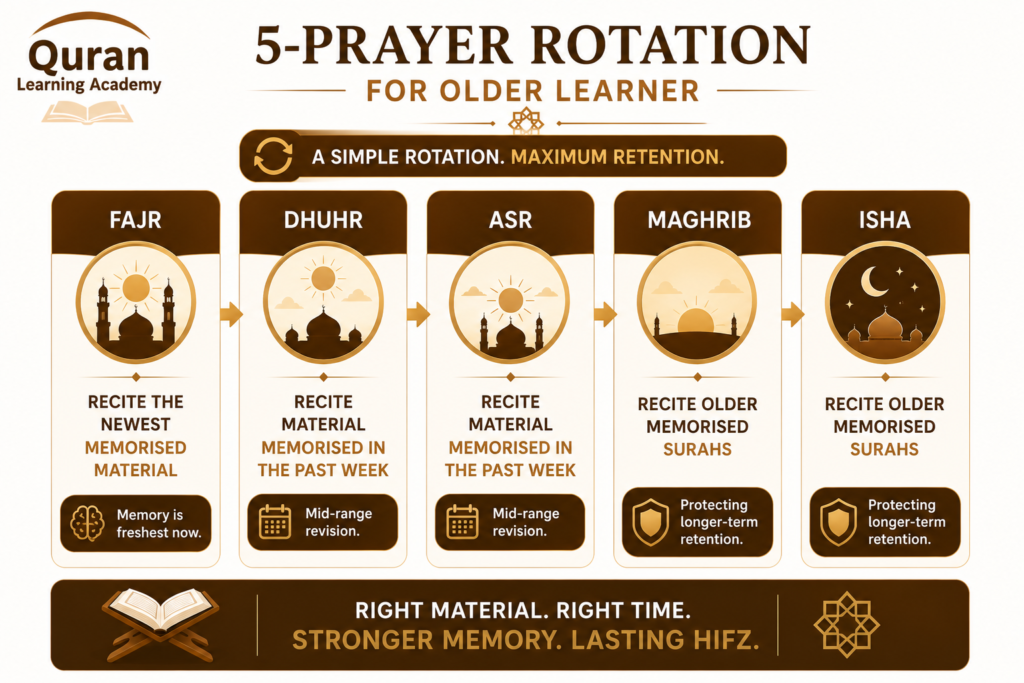
- Fajr: Recite the newest memorised material — memory is freshest at this point.
- Dhuhr and Asr: Recite material memorised in the past week — mid-range revision.
- Maghrib and Isha: Recite older memorised Surahs — protecting longer-term retention.
This distribution means each portion of memorised Quran receives multiple active retrieval sessions per day without requiring any additional dedicated time. Every prayer becomes both an act of worship and a Hifz session simultaneously.
10. Track Progress in Writing to Sustain Motivation Through a Long Journey
Hifz in old age is a multi-year commitment. Unlike a young student who receives daily feedback in a classroom, an older learner working with a weekly teacher session and a personal daily schedule can easily lose sight of how much has been accomplished — particularly during the slow middle phase of the journey when early momentum has faded and completion still feels distant.
Tracking progress in a written log is not organisational tidiness — it is a psychological tool that sustains the long-term commitment Hifz requires. Older learners who keep a written record of memorised verses, Surahs, and pages report significantly stronger motivation during difficult periods, because the log provides visible, concrete evidence of accumulated effort that the memory itself does not naturally surface.
A simple weekly log should include:
- Lines and Surahs memorised that week, with dates.
- Which portions were revised and how they performed during recall testing.
- Any verses where hesitation or error occurred — marked for extra attention next week.
- A brief note on the day’s session — one sentence is sufficient.
This record also serves the teacher in weekly or fortnightly sessions, providing specific information about where revision is weak rather than a general sense that “some parts feel shaky.”
The Quran Memorisation Course in the UK at UK Quran Learning Academy is the structured starting point — a proven pathway from the first verse to as far as Allah enables you to go, with qualified support at every step.

Book a Free Trial at UK Quran Learning Academy
Experience the Academy in Action
Curious about our teaching style? Take a quick look inside a live session to see our immersive, supportive learning environment first-hand.
Start Your Quranic Journey in the UK
Join our academy for structured online lessons with expert tutors, tailored to fit your schedule.
Book Your Free TrialStart Your Hifz Journey with UK Quran Learning Academy
The greatest obstacle for older learners is not memory — it is the absence of a structured system and qualified support to carry the commitment through its inevitable difficult phases. Without both, even the most sincere intention stalls within weeks.
UK Quran Learning Academy provides fully structured Hifz programmes delivered one-to-one through live online sessions with certified teachers — personalised pacing, real-time Tajweed correction from the first session, and a built-in revision plan that protects progress at every stage. Flexible scheduling means sessions fit around health, family, and daily life — not the other way around.
Every programme includes one-to-one sessions with a qualified, experienced teacher, a structured daily and weekly revision plan built into the curriculum, real-time pronunciation correction so memorisation is accurate from day one, and flexible timing that works around your commitments and energy levels.
Discover Our Quran Courses
- Quran Online Academy
- Quran Recitation Classes
- Quran Reading Classes
- Online Quran Classes for Kids
- Quran Classes for Adults
- Quran Classes for Female / Sisters
- Learn Quran Course for Beginners
- Quran Memorization (Hifz) Course
- Hifz Classes for Adults
- Quran Memorization and Hifz Course for Kids
- Quran Hifz Course for Ladies
- Quran Ijazah Program
- Quran Qirat Learning Course
- Quran Tafsir Course
- Noorani Qaida Course
- Noorani Qaida Course for Kids
- Weekend Quran Classes
- Intensive Quran Course
- Al-Azhar Quran Course
- Online Tajweed Classes
- Tajweed Course for Kids
- Tajweed Course for Adults
- Tajweed Course for Ladies
Book a Free Trial at UK Quran Learning Academy
Start Your Quranic Journey in the UK
Join our academy for structured online lessons with expert tutors, tailored to fit your schedule.
Book Your Free TrialConclusion
Memorising the Quran in old age is not a lesser form of Hifz, but a different journey with its own pace and method. Older learners benefit from small daily portions, deep repetition, consistent revision, meaning-based anchors, qualified teacher correction, and practice after Fajr. Begin with 3–5 lines, review more than you memorize, understand what you learn, and use the five daily prayers for revision. With sincerity, consistency, and the right structure, age does not prevent a learner from carrying the Quran in the heart.
Frequently Asked Questions
Is it possible to memorise the whole Quran in old age?
Yes. There is no age limit in Islamic scholarship or the Sunnah. Many learners complete full or partial Hifz in their fifties, sixties, and beyond. The key is using a method adapted to the mature memory — smaller portions, deeper repetition, and consistent revision — rather than methods designed for young students.
How many lines should an older learner memorise per day?
Start with 3 to 5 lines daily. This may feel modest, but it produces retention that holds across revision cycles. Increase the target only when the current amount is being recalled cleanly and consistently — not because a certain number of weeks have passed.
What is the best time of day for an older person to memorise Quran?
After Fajr prayer is the most effective window. The brain is rested, working memory is clear, and the spiritual context of having just completed Salah strengthens focus. The period immediately before sleep is the best time for revision — the brain consolidates reviewed material during sleep.
Do I need a teacher to memorise Quran in old age?
Yes. Without real-time correction, Tajweed and pronunciation errors embed quickly through repetition — and for older learners, these errors are significantly harder to correct once established. A qualified teacher also provides the accountability that sustains a multi-year commitment through its difficult phases.
Where in the Quran should an older learner begin?
Juz Amma — the 30th Juz — is the correct starting point. Its shorter Surahs carry partial familiarity for most adults who have prayed regularly, reducing the initial memorisation burden. These Surahs are also recited naturally in daily prayers, providing built-in revision without additional time commitment.








Leave a Reply