 Quran
Quran

You begin reading the Quran, but within minutes your mind drifts to work, messages, or unrelated thoughts, and you finish the page having absorbed little. This is a common challenge, especially with busy schedules, high screen time, and fragmented attention. Learning how to concentrate while reading Quran requires more than simply trying harder. This guide presents nine practical steps, grounded in Islamic scholarship and how attention works, to help you develop genuine focus whenever you open the Mushaf.
1. Renew Your Intention Before Every Session Begins
The quality of your attention during Quran recitation is shaped before you open the Mushaf. Scholars across generations have noted that a clear, sincere intention orients the heart toward what you are about to do and filters out competing thoughts before they take hold.
The Prophet ﷺ established this principle with directness:
“إِنَّمَا الأَعْمَالُ بِالنِّيَّاتِ، وَإِنَّمَا لِكُلِّ امْرِئٍ مَا نَوَى”
Innamā al-aʿmālu bin-niyyāt, wa innamā li-kulli imri’in mā nawā.
“The reward of deeds depends upon the intentions and every person will get the reward according to what he has intended.”
Setting an intention is not a formality. It is a mental act that shifts the framing of what you are about to do from routine habit to deliberate worship. Before sitting down, take a moment and state internally why you are reading: to seek guidance, to draw closer to Allah, to understand His words.
This single act reduces the likelihood that the mind treats recitation as a background task. A reading session with a clear purpose holds attention differently from one that begins mechanically.
Read also: How to Learn Quran Recitation: A Complete Step-by-Step Guide
2. Choose a Dedicated, Distraction-Free Space
The environment in which you read directly shapes how long your concentration holds. A clean, quiet, consistent space for Quran recitation creates a mental cue that tells the brain it is time to focus.
The most common concentration killers in a British household setting include:
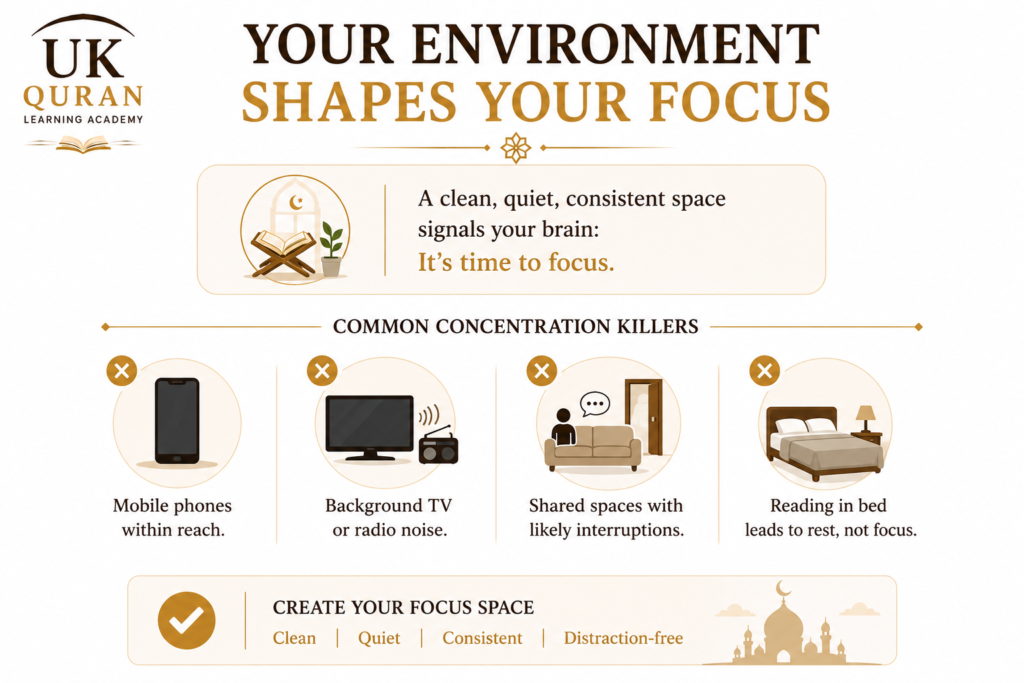
- Mobile phones within reach or in the same room.
- Background television or radio noise.
- Sitting in a shared space where interruptions are likely.
- Reading in bed, which associates the location with rest rather than focus.
Scholars have consistently recommended choosing a peaceful space free from all avoidable distraction and treating each recitation session as a formal occasion.
Ibn Hubayrah stated plainly that among Shaytan’s strategies is to prevent the believer from reflecting on the Quran, because he knows that guidance is reached through reflection. Every distraction you remove is a barrier you are erecting against that interference.
A dedicated prayer corner, a quiet room after the household has settled, or a consistent spot in the local masjid all serve this function. The physical consistency of the space itself becomes part of what triggers the mental shift into focused recitation.
Read also: How to Read the Quran with a Beautiful Voice: 8 Proven Steps
3. Begin with Wudu to Activate Spiritual Readiness
Performing Wudu before reciting the Quran from the Mushaf is not merely a matter of fiqh — it is a preparation of the whole self for an act of worship. The majority of Islamic scholars hold that Wudu before handling the Mushaf is obligatory, and strongly recommended before reciting from memory or a device.
The practical effect of this step on concentration is significant. When you perform Wudu, wash each limb, and move through the structured acts of purification, you are creating a transitional ritual that signals a change of state.
The mind does not move smoothly from checking your phone to engaging with the Quran. Wudu provides that transition: it is a physical boundary between the dunya and the act of recitation.
Scholars note that this state of physical and spiritual purity reflects the honour due to the Quran and allows the heart to engage more fully. When the body is prepared and the environment is clean, the conditions for sustained concentration are in place before a single word is recited.
Step Inside Our Virtual Classrooms
See how our interactive lessons work. Watch these brief highlights of our students engaging with instructors.
Start Your Quranic Journey in the UK
Join our academy for structured online lessons with expert tutors, tailored to fit your schedule.
Book Your Free Trial4. Recite Aloud Rather Than Reading Silently
Silent reading invites the mind to wander. Reciting aloud, even at a low volume, engages both the vocal and auditory faculties simultaneously, which keeps attention anchored in the present moment.
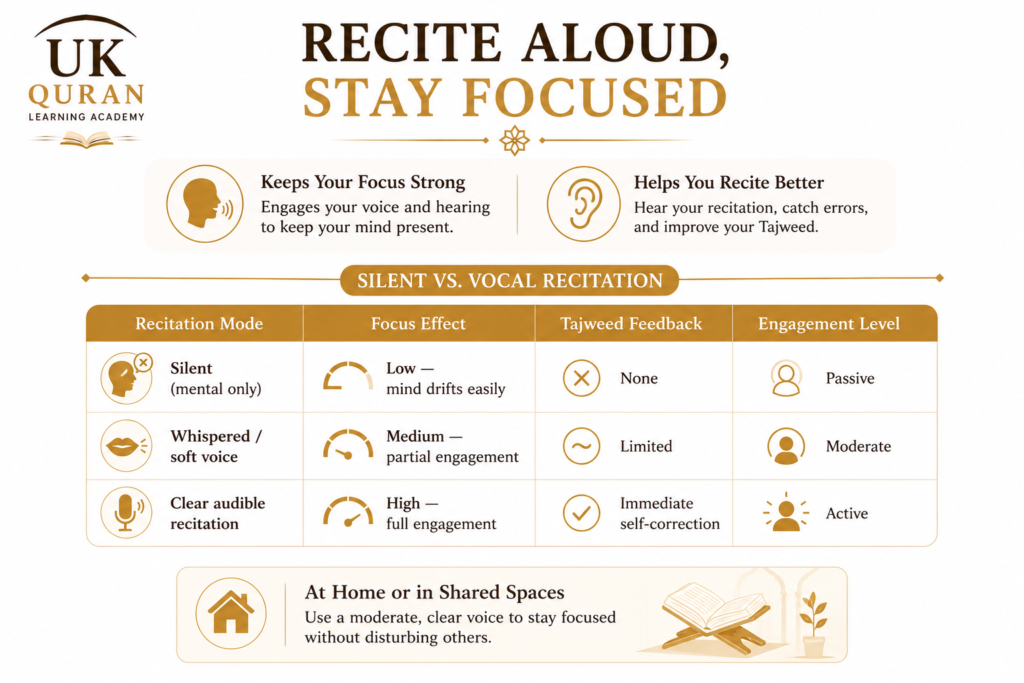
Scholars emphasise that reciting aloud softly helps the reciter hear their own Tajweed errors, maintain focus, and avoid the mental drifting that silent recitation invites. This is not simply a traditional preference — it reflects how multisensory engagement supports concentration. When you hear your own voice reciting, the brain processes the words on two simultaneous tracks: production and reception. That dual engagement leaves far less cognitive space for distraction.
The comparison between silent and vocal recitation approaches is worth understanding clearly:
| Recitation Mode | Focus Effect | Tajweed Feedback | Engagement Level |
| Silent (mental only) | Low — mind drifts easily | None | Passive |
| Whispered / soft voice | Medium — partial engagement | Limited | Moderate |
| Clear audible recitation | High — full vocal and auditory engagement | Immediate self-correction | Active |
For recitation at home, a moderate, clear voice is ideal. In a shared space such as a library or office prayer room, a controlled low voice achieves the same anchoring effect without disturbing others.
Read also: Does Memorising the Quran Improve Memory?
5. Understand the Meaning of What You Are Reciting
Reciting Arabic words whose meaning you do not know is like reading a page of text in an unfamiliar language. The sounds move through your mouth but nothing registers, and the mind, finding nothing to hold onto, wanders.
Allah explicitly connects concentration with understanding:
“أَفَلَا يَتَدَبَّرُونَ الْقُرْآنَ أَمْ عَلَىٰ قُلُوبٍ أَقْفَالُهَا ﴿٢٤﴾ “
Afalā yatadabbarūna al-Qur’āna am ʿalā qulūbin aqfāluhā
“Then do they not reflect upon the Qur’an, or are there locks upon [their] hearts? (24)”
This verse makes tadabbur — deep reflection — the expected condition of the believer engaging with the Quran, not an advanced pursuit reserved for scholars. Tadabbur is the antidote to mechanical recitation.
When you understand what an ayah means, your brain creates multiple memory and attention pathways: the sound of the words, the visual shape of the Arabic, and the conceptual meaning. These three routes work together to keep the mind engaged.
This does not require mastery of Arabic grammar. Reading a reliable translation before each session, noting the theme of the passage, and pausing briefly at each verse to let its meaning settle is sufficient to activate meaning-based engagement. A few minutes of preparation before recitation changes the entire quality of the session.
Many learners in the UK find that their lack of Arabic comprehension is the root cause of their inability to concentrate while reading Quran. If understanding Arabic directly is your long-term goal, the Quranic Arabic Course in the UK at UK Quran Learning Academy teaches classical grammar, Quranic vocabulary, and direct text analysis.
Read also: Common Mistakes When Reading the Quran and How to Correct Them

Explore the Quranic Arabic Course at UK Quran Learning Academy
Read also: Is It Mandatory to Memorise the Quran? The Complete Islamic Answer
6. Recite Slowly and Pause at Each Verse
Speed and concentration are directly opposed when it comes to Quran recitation. Rushing through pages produces the illusion of progress while delivering almost no genuine engagement.
Ibn al-Qayyim, among others, prioritised slow recitation (tarteel) over covering more text quickly, on the basis that reflection is the purpose that lies beneath every act of recitation. The Quran itself commands this explicitly:
“وَرَتِّلِ الْقُرْآنَ تَرْتِيلًا ”
Wa rattil il-Qur’āna tartīlā
“and recite the Qur’an with measured recitation.”
Slow recitation serves concentration in a concrete way: it gives each verse time to land before the next one begins. When you reach the end of an ayah and pause, even for two seconds, you allow the meaning to register. That brief pause is the point at which tadabbur actually occurs.
A practical reading structure that supports this:
- Read each verse once from the Mushaf slowly, paying attention to the visual layout of the line.
- Pause at the end of the verse and allow the meaning to settle for a moment.
- Recite the verse again from memory, then check the Mushaf.
- Move to the next verse only once the first feels secure.
This structure keeps the mind active throughout each session rather than passive.
7. Correct Your Tajweed to Remove Recitation Uncertainty
One of the most overlooked causes of poor concentration while reading Quran is weak Tajweed. When a reader is uncertain about how to pronounce a letter, elongate a sound, or apply a rule, a significant portion of mental energy goes toward managing that uncertainty rather than engaging with the meaning.
The impact of Tajweed on concentration follows a clear pattern:
| Tajweed Level | Effect on Concentration | Effect on Meaning Engagement |
| No Tajweed knowledge | High cognitive load on pronunciation | Very low — focus on decoding |
| Basic Tajweed (partial rules) | Medium load — some hesitation | Moderate |
| Solid Tajweed foundation | Low cognitive load — recitation flows | High — attention freed for meaning |
When Tajweed rules are internalised, the mechanics of recitation become automatic. The mouth and tongue produce the correct sounds without conscious deliberation, and the freed cognitive capacity transfers directly into attention and reflection.
Scholars note that correct pronunciation of the Quran also reaches the hearts of those who listen to it. Tajweed is not decorative — it is the means by which recitation achieves its intended effect on both reciter and listener.
If mispronunciation or Tajweed uncertainty is undermining your focus during every session, the Online Tajweed Classes in the UK at UK Quran Learning Academy cover Makharij, Sifaat, and rule application through structured, live instruction from qualified teachers.

Join the Online Tajweed Classes at UK Quran Learning Academy
8. Set a Specific Time and Protect It Without Exception
Consistency in timing builds a habitual concentration cue. When recitation happens at the same time every day, the mind begins to shift into a focused state automatically as that time approaches, rather than requiring effort to transition.
The brain forms stronger routines when an action is linked to a consistent cue — a time, a place, and a preceding activity. The most powerful cue available to every Muslim is Salah. Attaching Quran recitation directly to prayer time, particularly after Fajr, creates exactly this kind of reliable trigger.
After Fajr, the mind is rested, the household is quiet, and the heart is already turned toward worship. Even twenty minutes of focused recitation after Fajr every day produces measurable improvement in concentration over a fortnight — not because of the length of the session, but because of the regularity.
The worst concentration pattern is variable timing: some days after work, some days at lunch, some days before sleep. Without a consistent cue, the mind never develops the automatic shift into recitation mode. Every session begins with effort to settle and focus, rather than already being in that state.
Protect a minimum daily window. On busy days in London or Manchester, where work schedules and commutes consume most of the daylight hours, even fifteen focused minutes at a fixed time outperforms an hour of distracted reading at variable times.
Start Your Quranic Journey in the UK
Join our academy for structured online lessons with expert tutors, tailored to fit your schedule.
Book Your Free Trial9. Return Your Attention Without Self-Criticism Each Time It Wanders
Distraction during Quran recitation is not a sign of spiritual failure — it is a predictable feature of how the human mind functions, particularly in an era of constant digital stimulation. The response to distraction matters far more than the distraction itself.
The correct response when the mind wanders is simple: notice it, and return. Not frustration, not self-criticism, not stopping the session. Just return to the verse.
Scholars describe Shaytan’s role in interrupting recitation as deliberate and persistent. The effort required to bring the mind back is itself an act of worship. Productive Muslim captured this well: Allah loves the effort of the one who keeps returning even when distracted. The return, not the unbroken attention, is the practice.
A structured approach to managing distraction:
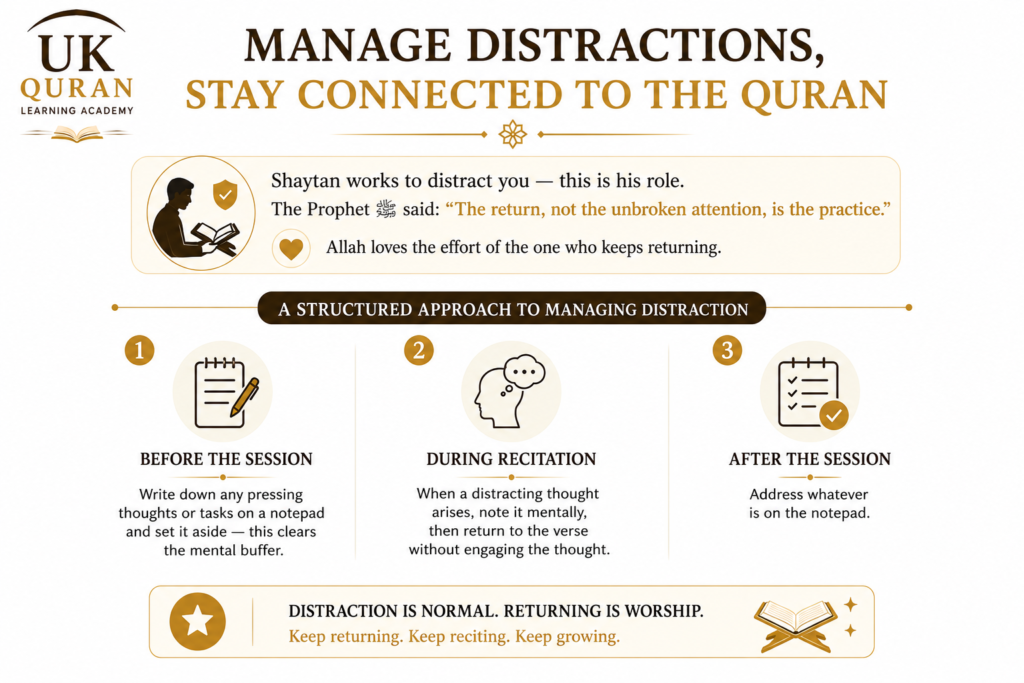
- Before the session, write down any pressing thoughts or tasks on a notepad and set it aside — this clears the mental buffer.
- When a distracting thought arises during recitation, note it mentally, then return to the verse without engaging the thought.
- After the session, address whatever is on the notepad.
This technique separates engagement with practical concerns from the recitation window, allowing the session itself to remain clean.
Experience the Academy in Action
Curious about our teaching style? Take a quick look inside a live session to see our immersive, supportive learning environment first-hand.
Start Your Quranic Journey in the UK
Join our academy for structured online lessons with expert tutors, tailored to fit your schedule.
Book Your Free TrialBuild the Foundation with Structured Guidance at UK Quran Learning Academy
Most learners who struggle to concentrate while reading Quran are dealing with more than one challenge at the same time: unfamiliarity with Arabic meanings, uncertainty in Tajweed, an inconsistent schedule, and no external accountability. Addressing these in isolation produces limited results.
UK Quran Learning Academy provides live, one-to-one online Quran instruction with qualified Azhari teachers, designed to meet the needs of British learners balancing work, family, and worship commitments. Lessons are tailored to each student’s level, learning pace, and goals, with real-time correction and structured progress tracking.
The academy supports learners at different stages, from those building a strong foundation in Quran reading to students seeking to improve their recitation, Tajweed, and understanding. With flexible scheduling, personalised instruction, and consistent teacher guidance, UK Quran Learning Academy provides British Muslims across London, Birmingham, Manchester, and beyond with a structured and accessible way to develop their Quran learning.
Discover Our Arabic Courses
- Online Arabic Academy
- Online Arabic Course
- Classical Arabic Course
- Arabic Course for Beginners
- Advanced Arabic Course
- Quranic Arabic Course
- Arabic Grammar Course
- Modern Standard Arabic Course
- Arabic Conversation / Speaking Course
- Intensive Arabic Course
- Online Arabic Classes for Kids
- Arabic Classes for Adults
- Arabic Classes for Ladies
- Fusha Arabic Course
- Business Arabic Course
- Al Azhar Arabic Course
- Madinah Arabic Course
- Learning Arabic for Non-Arabic Speakers
- Arabic Elementary School
- Arabic Intermediate School
- Arabic Lessons for Kindergarten
Book a Free Trial at UK Quran Learning Academy
Start Your Quranic Journey in the UK
Join our academy for structured online lessons with expert tutors, tailored to fit your schedule.
Book Your Free TrialConclusion
Learning how to concentrate while reading Quran is not a matter of willpower alone — it is a matter of structure. The nine steps above address every level of the problem: preparation of intention, purification and environment, recitation method, comprehension, pacing, Tajweed accuracy, scheduling, and attention management. Each step removes a specific barrier that causes the mind to disengage. Applied together, they transform recitation from a mechanical routine into a genuine act of engaged worship.
Frequently Asked Questions
My mind always wanders during Quran recitation. Is this a spiritual problem?
It is a concentration problem, not a spiritual failure. The mind wanders because it has not been given the right conditions — intention, environment, engagement with meaning, and consistent routine. Addressing these structural issues resolves most wandering without requiring supernatural effort.
Reciting aloud is difficult when others are home. What is the alternative?
A controlled whisper still activates the vocal and auditory feedback loop that anchors attention. Even a very low voice, one you can hear yourself but others in the room cannot, produces the same concentration benefit as full-volume recitation.
How long should a single Quran reading session be to maintain concentration?
Fifteen to twenty minutes of fully focused recitation is more valuable than an hour of distracted reading. Start with a manageable window and extend it gradually as your ability to sustain attention develops. Regularity matters more than length.
Does reading a translation before reciting reduce the spiritual value of the session?
No. Reading a brief, reliable translation before reciting the Arabic activates meaning-based engagement, which scholars consistently identify as the purpose of Quranic recitation. The Arabic recitation remains the primary act of worship; the translation prepares the heart to receive it.
I struggle with Tajweed rules. Is it better to wait until I have learned them before focusing on concentration?
Work on both simultaneously rather than sequentially. Tajweed uncertainty does reduce concentration by increasing the cognitive load of recitation, but a teacher can correct errors in real time while you build focus at the same pace. Waiting for perfect Tajweed before working on concentration delays both.








Leave a Reply