 Quran
Quran
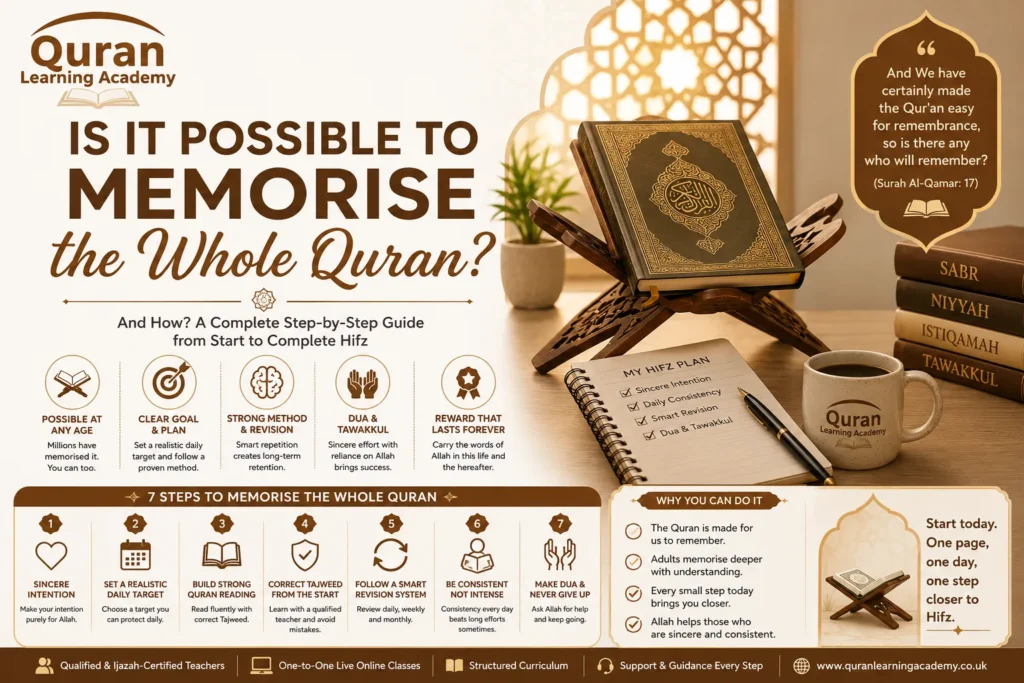
You have recited the same short Surahs in every prayer for years, but 604 pages can feel impossibly far away. Full-time work, family, and limited evenings may make Hifz seem possible only for children in Islamic schools. But Is It Possible to Memorise the Whole Quran as an adult? More than 200 million people worldwide have memorised it, including adults with jobs and families.
The Quran is the most memorised book in human history. Completing Hifz depends not on age, background, or exceptional memory, but on method, structure, and consistent guidance—from the first page to the last.
Is It Possible to Memorise the Whole Quran?
Yes, Memorising the Whole Quran Is Possible at Any Age. It is entirely possible — not only for children, not only for those in full-time Islamic study, and not only for those with exceptional memory.
Allah ﷻ stated this plainly:
“وَلَقَدْ يَسَّرْنَا الْقُرْآنَ لِلذِّكْرِ فَهَلْ مِن مُّدَّكِرٍ ﴿١٧﴾”
Wa laqad yassarnal-Qur’āna lidh-dhikri fahal min muddakir.
“And We have certainly made the Qur’an easy for remembrance, so is there any who will remember? (17)”
Scholars explain this verse to mean that Allah actively enables whoever sincerely pursues Hifz. Adults complete memorisation regularly in their thirties, forties, and beyond. Children memorise faster, but adults memorise deeper — their comprehension of meaning creates stronger memory anchors that hold the text more firmly over time.
The Quran contains 6,236 verses across 114 Surahs and 604 pages in the standard Madinah Mushaf. Broken into a sustainable daily target, that number becomes entirely manageable for any learner who prioritises consistency over intensity.
1. Set a Sincere Intention and a Realistic Daily Target
Before opening the Mushaf with the goal of memorisation, two things must be settled: why you are doing this, and what you can genuinely commit to every single day.
Read also: How to Memorise Quran in Old Age
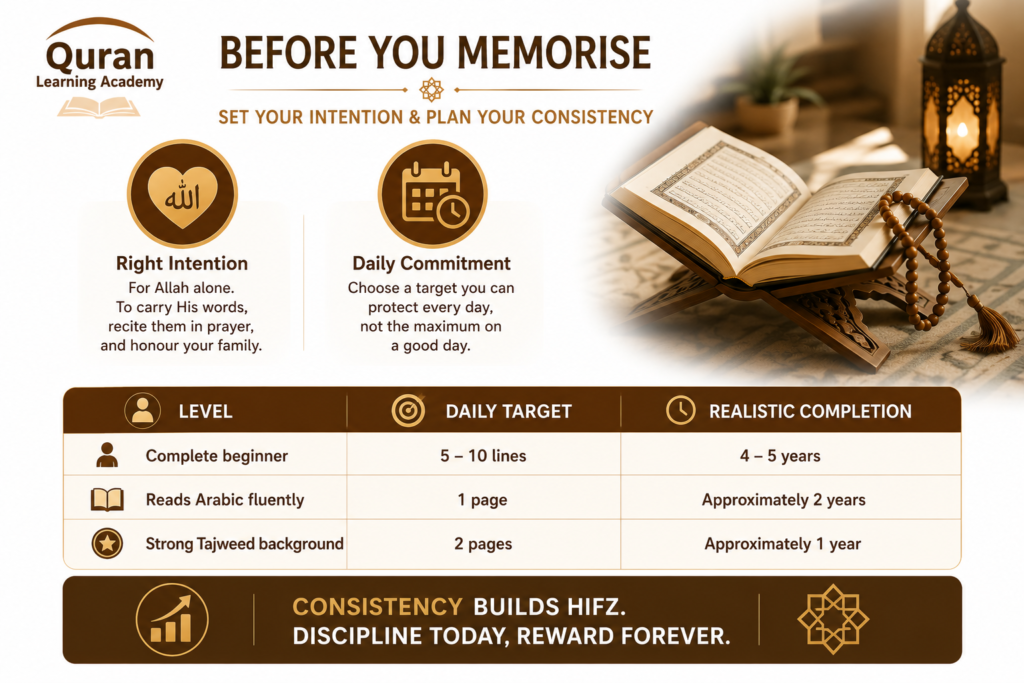
Hifz undertaken for social recognition fades within weeks. Scholars across centuries have noted that sincerity of intention directly shapes both motivation and memory. The intention must be for Allah alone — to carry His words, to recite them in prayer, to honour your family through them.
The Prophet ﷺ said:
“إِنَّمَا الأَعْمَالُ بِالنِّيَّاتِ، وَإِنَّمَا لِكُلِّ امْرِئٍ مَا نَوَى”
“Innamal-a’mālu bin-niyyāt, wa innamā li-kulli mri’in mā nawā.”
“The reward of deeds depends upon the intentions and every person will get the reward according to what he has intended.”
Once the intention is clear, choose a daily target you can protect every day — not the maximum possible on a good day.
| Level | Daily Target | Realistic Completion |
| Complete beginner | 5 to 10 lines | 4 to 5 years |
| Reads Arabic fluently | 1 page | Approximately 2 years |
| Strong Tajweed background | 2 pages | Approximately 1 year |
A student who memorises half a page daily for three years will far outperform one who memorises two pages some days and nothing on others. The discipline required here is restraint, not ambition.
Read also: Motivation to Read Quran: 8 Powerful Reasons That Keep You Going
2. Build Fluent Quran Reading Before Memorisation Begins
Attempting to memorise before you can read the Quran with accuracy and flow is one of the most common reasons learners stall early. Memorisation demands your full mental energy for retention. If part of that energy is still being spent decoding Arabic letters, the process becomes exhausting and produces unstable results.
Fluent Quran reading for Hifz means three specific things:
- Reading any page of the Mushaf without hesitation or spelling out words.
- Applying basic Tajweed markers automatically without stopping to think about each rule.
- Distinguishing similar-sounding verses and passages accurately.
Many adults who attended weekend mosque classes during childhood carry reading gaps they are not fully aware of. These gaps surface immediately when memorisation begins and slow progress significantly.
The Quran Reading Classes in the UK at UK Quran Learning Academy cover letter recognition, vowel application, sukoon placement, and foundational Tajweed through live one-to-one sessions — building the reading accuracy that Hifz depends on from page one.

Build your reading foundation at UK Quran Learning Academy
Read also: How Many Sahaba Memorised the Quran?
3. Correct Your Tajweed Before Errors Become Permanent
Tajweed is not added on top of memorisation — it is embedded inside it. Every time you repeat a verse during Hifz, you are reinforcing the exact pronunciation pattern you are using. A mistake repeated a thousand times across weeks of revision is no longer a mistake — it is a deeply embedded habit that resists correction.
The most commonly embedded errors in unsupervised memorisation:
- Confusing heavy and light letters, which changes meaning entirely in some verses.
- Incorrect elongation lengths, disrupting the rhythm of recitation in prayer.
- Missing nasalisation on noon and meem, altering how verses sound.
- Wrong stopping points that split verses incorrectly, affecting the meaning heard by a congregation.
A student who memorises six months of material with an incorrect articulation point does not have six months of Hifz. They have six months of a mistake reinforced thousands of times — and unlearning that is significantly harder than learning it correctly from the start.
The Online Tajweed Classes in the UK at UK Quran Learning Academy cover Makharij, Sifaat, Ghunnah rules, Qalqalah application, and Madd elongation through structured modules taught by qualified instructors — building recitation accuracy before it is locked into long-term memory.

Enrol in Online Tajweed Classes at UK Quran Learning Academy
4. Use One Mushaf Exclusively for the Entire Journey
This rule sounds minor. It is one of the most practically important decisions in the entire Hifz process.
The brain encodes Quranic memory through multiple simultaneous pathways — the sound of the words, the movement of the tongue, and crucially, the visual memory of the page. When you look at a verse on a specific page repeatedly, your brain stores its position: which line it sits on, what appears above and below it, where the page ends. This visual map becomes a retrieval cue.
Switching Mushafs disrupts this visual memory entirely. Words that appeared on the right side of a page now appear on the left. Verses that ended a page now sit in the middle. Students who switch report needing to effectively re-memorise large sections from the beginning.
The Madinah Mushaf — 604 pages, 15 lines per page, 20 pages per Juz — is the globally recommended choice for Hifz because of its uniform, standardised layout. Choose it on Day One and do not change it.
Step Inside Our Virtual Classrooms
See how our interactive lessons work. Watch these brief highlights of our students engaging with instructors.
Start Your Quranic Journey in the UK
Join our academy for structured online lessons with expert tutors, tailored to fit your schedule.
Book Your Free Trial5. Apply the Line-by-Line Method Inside Every Session
The memorisation method used inside each session determines whether what you learn holds for years or fades within days. The most reliable approach works in five connected phases:
Phase 1: Reading
Read the full target page once slowly. Pay attention to meaning, pauses, and the visual layout of each line before attempting any memorisation.
Phase 2: Segmenting
Divide the page into three or four small portions. Take the first segment and read it five times with the Mushaf open, focusing on each word.
Phase 3: Closing
Close the Mushaf and repeat those lines from memory until you can recite the segment three times consecutively without any error.
Phase 4: Connecting
Once each segment is memorised, link it to the one before. Recite Segment 1 and 2 together, then 1, 2, and 3, until the full page flows as one connected unit — not isolated pieces.
Phase 5: Page connection
After memorising a full page, recite it together with the previous page memorised that day. By session’s end, everything memorised that day should flow as one continuous block.
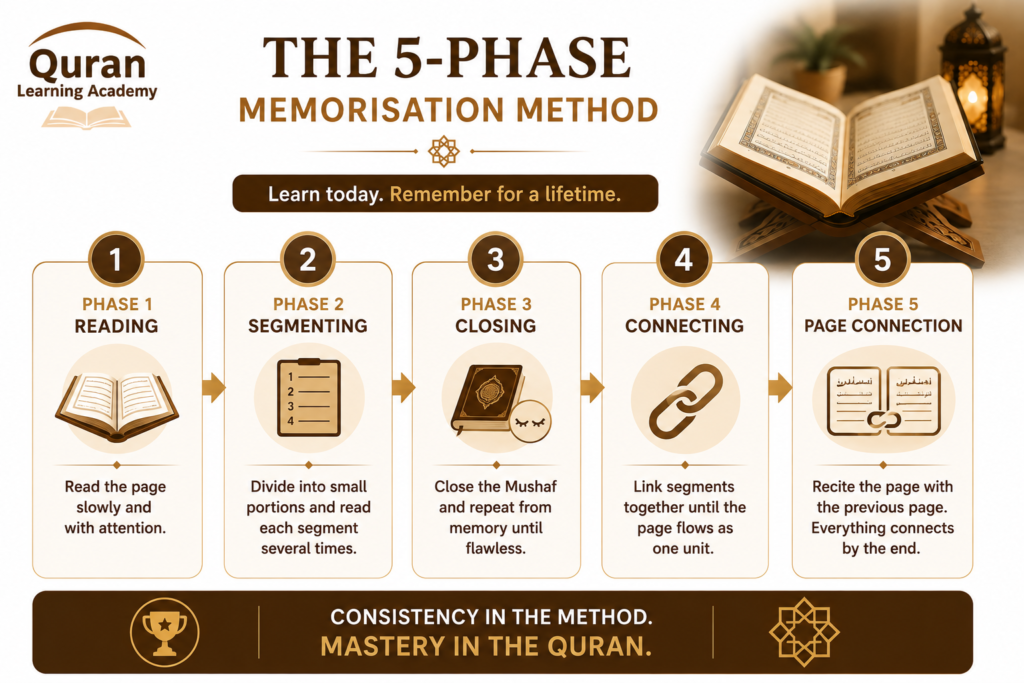
The connection phase is the most commonly skipped and the most important. Most Hifz failures happen not because individual verses are forgotten, but because the link between them is weak. A learner forgets the opening word of a verse because they memorised units in isolation rather than as a flowing passage.
Read also: How to Concentrate While Reading Quran: 9 Practical Steps That Work
6. Prioritise Revision Over New Memorisation Every Single Day
New memorisation disappears without consistent revision. Memory strength decays rapidly in the first 24 to 48 hours after initial learning, then stabilises only if the material is revisited. Missing revision for even two or three consecutive days can undo an entire week of memorisation work.
This is where most self-guided Hifz attempts collapse. The learner focuses entirely on progressing forward and treats revision as optional. Memory does not work that way.
A practical daily revision structure for working adults:
| Revision Type | What It Covers | When to Do It |
| Recent revision | Last 5 to 7 pages memorised | Daily, before new memorisation |
| Mid-range revision | Pages 8 to 20 behind current position | Daily, rotating portions |
| Full past revision | Everything memorised before that | Weekly, covering all prior material |
On days when time is short, experienced teachers advise skipping new material entirely and spending the full session on revision. Protecting what you already hold is always more important than adding to it.
7. Recite Memorised Portions in Your Daily Prayers
The five daily prayers are the most underused Hifz tool available to every Muslim. Reciting memorised verses in Salah forces genuine recall under mild performance pressure — which strengthens the memory trace far more than passive review does.
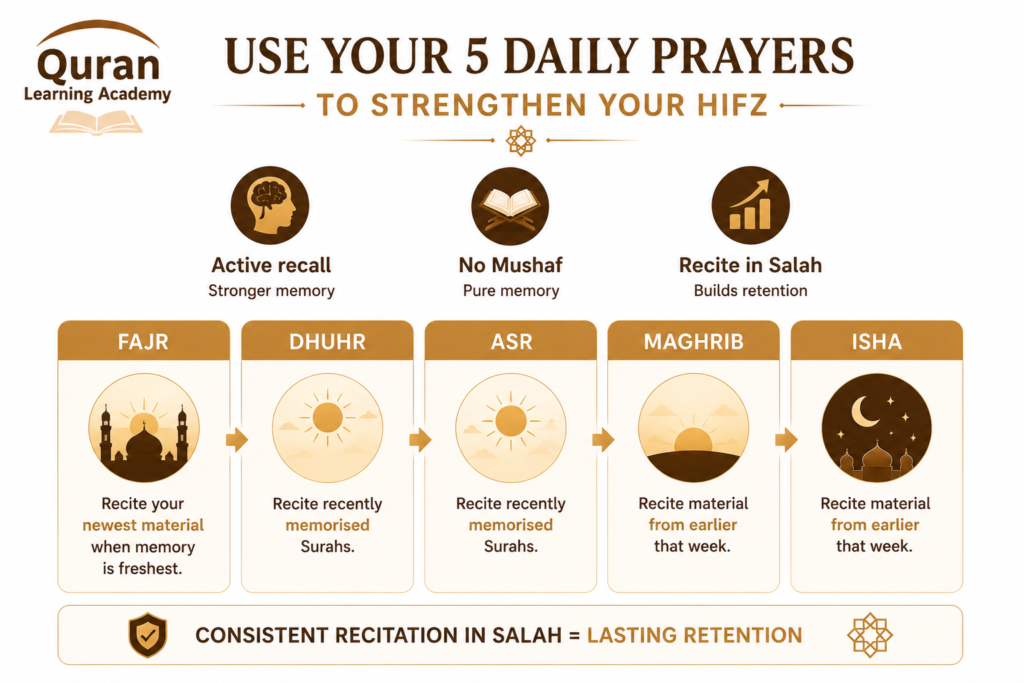
When you recite in prayer, there is no Mushaf, no external prompt, and no option to glance ahead. The mind must retrieve the verse entirely from memory. This is active recall in its purest form, and it produces measurably stronger retention than reading the same verse from the page.
The Prophet ﷺ said:
“ يُقَالُ لِصَاحِبِ الْقُرْآنِ اقْرَأْ وَارْتَقِ وَرَتِّلْ كَمَا كُنْتَ تُرَتِّلُ فِي الدُّنْيَا فَإِنَّ مَنْزِلَكَ عِنْدَ آخِرِ آيَةٍ تَقْرَؤُهَا .”
“One who was devoted to the Qur’an will be told to recite, ascend and recite carefully as he recited carefully when he was in the world, for he will reach his abode when he comes to the last verse he recites.”
Rotate different recently memorised Surahs across the five prayers. Use Fajr for your newest material when memory is freshest, and Maghrib and Isha for material memorised earlier that week.
8. Memorise Under a Qualified Teacher Who Corrects in Real Time
Memorising alone means embedding errors with no mechanism to catch them. The Arabic language contains sounds, Tajweed rules, and letter distinctions that the untrained ear cannot reliably self-audit — particularly when those patterns are being reinforced through daily repetition.
A qualified teacher serves three functions that no recording, app, or self-study method can replicate:
- Catching Makhraj errors before they become embedded — articulation mistakes that change the sound and sometimes the meaning of verses.
- Identifying weak points in recall that a student cannot detect themselves, particularly similar-sounding passages where one verse gets substituted for another.
- Providing accountability that sustains commitment through the months when motivation dips and progress feels slow.
The oral transmission of the Quran has been preserved through an unbroken chain of teacher-to-student correction since the time of the Prophet ﷺ. That chain exists precisely because this level of accuracy cannot be achieved alone.
For sisters who want structured Hifz in a private, female-only environment, the Quran Hifz for Ladies in the UK at UK Quran Learning Academy provides one-to-one online sessions with qualified female instructors, covering Tajweed-compliant memorisation, structured revision schedules, and personalised pacing built around your commitments.

Join the Quran Hifz for Ladies programme at UK Quran Learning Academy
9. Avoid the Six Mistakes That End Most Hifz Journeys
Most learners who stall do not fail because the goal is too hard. They fail because of specific, identifiable, and entirely preventable errors. Recognising them before you start saves the entire journey.
| Mistake | Why It Destroys Hifz |
| Skipping revision days | New memorisation overwrites old material without consolidation |
| Switching the Mushaf mid-journey | Visual memory tied to page layout is disrupted entirely |
| Memorising at variable, inconsistent times | No fixed habit means no automatic recall trigger |
| Reciting silently without vocalisation | Errors go undetected and pronunciation habits are not built |
| Overloading pages early to “make up time” | Mental exhaustion causes retention to collapse within days |
| Continuing without teacher correction | Mistakes compound silently until they are permanently embedded |
Beyond method errors, scholars across generations have consistently noted that the state of the heart affects the capacity for memorisation. Consistent sinful habits harden the heart and weaken memory. Sincere repentance, maintaining prayer, and keeping good company are not incidental to Hifz — they are part of the method.
10. Follow a Structured Schedule That Fits Your Real Life
The two-year plan is the most widely recommended timeline for working adults and is considered the most sustainable by experienced Hifz teachers. It requires memorising approximately half a page to one full page daily — a target that fits into 60 to 90 minutes protected each day.
A realistic daily schedule for someone in full-time employment:
- After Fajr (25 to 30 minutes): New memorisation only. The mind is clearest at this point and distraction is lowest. This is the most productive window of the day for retention.
- Lunch break or commute (15 to 20 minutes): Listening to recently memorised material from a consistent reciter. Passive reinforcement of the same neural patterns built in the morning session.
- After Maghrib (20 to 25 minutes): Revision of material memorised over the past week. No new memorisation in this slot — only strengthening what already exists.
- Before sleep (10 minutes): Light listening to the next day’s target verses. Preparation today means fewer repetitions needed tomorrow.
The key insight across all schedules is that shorter, consistent daily sessions outperform longer, irregular ones. The brain forms stronger memory traces when information is encountered at predictable intervals — which is why a daily 30-minute session beats an irregular two-hour session every time.
Experience the Academy in Action
Curious about our teaching style? Take a quick look inside a live session to see our immersive, supportive learning environment first-hand.
Start Your Quranic Journey in the UK
Join our academy for structured online lessons with expert tutors, tailored to fit your schedule.
Book Your Free TrialStart Your Hifz the Right Way with UK Quran Learning Academy
The single most common reason capable learners fail to complete Hifz is not lack of effort — it is lack of structure, accountability, and qualified correction at every stage of the journey.
UK Quran Learning Academy provides fully structured Hifz programmes delivered one-to-one through live online sessions with certified teachers, built around the realistic schedules of adults balancing work, family, and faith. Every programme includes personalised pacing, a structured revision plan built into the curriculum, real-time Tajweed correction from the very first session, and flexible scheduling that fits around your commitments.
For adults who want to begin or restart their Hifz journey, the Hifz Classes for Adults in the UK provide a structured path designed specifically for working professionals, parents, and mature learners — with qualified teachers who understand the specific challenges of memorising as an adult.
Discover Our Quran Courses
- Quran Online Academy
- Quran Recitation Classes
- Quran Reading Classes
- Online Quran Classes for Kids
- Quran Classes for Adults
- Quran Classes for Female / Sisters
- Learn Quran Course for Beginners
- Quran Memorization (Hifz) Course
- Hifz Classes for Adults
- Quran Memorization and Hifz Course for Kids
- Quran Hifz Course for Ladies
- Quran Ijazah Program
- Quran Qirat Learning Course
- Quran Tafsir Course
- Noorani Qaida Course
- Noorani Qaida Course for Kids
- Weekend Quran Classes
- Intensive Quran Course
- Al-Azhar Quran Course
- Online Tajweed Classes
- Tajweed Course for Kids
- Tajweed Course for Adults
- Tajweed Course for Ladies

Book a Free Trial at UK Quran Learning Academy
Start Your Quranic Journey in the UK
Join our academy for structured online lessons with expert tutors, tailored to fit your schedule.
Book Your Free TrialConclusion
Memorising the whole Quran is not a myth or reserved for the exceptionally gifted. More than 200 million people have completed it, proving that Is it possible to memorize the whole Quran? With the right method and support, it is. The process requires fluent reading, Tajweed accuracy, one consistent Mushaf, line-by-line memorisation, daily revision, prayer-based reinforcement, and qualified teacher correction.
Set your intention, protect your time after Fajr, revise consistently, and memorise with guidance. The Quran you carry in your heart is worth every day of the journey.
Frequently Asked Questions
Is it too late to start memorising the Quran as an adult?
No. Adults bring advantages that children do not — deeper understanding of meaning, stronger discipline, and a more conscious relationship with the material. Many learners complete full Hifz in their thirties, forties, and beyond. The key is a realistic daily target and consistent revision.
How many pages of Quran should I memorise per day?
It depends on your current level. Complete beginners should start with 5 to 10 lines daily. Those who read Arabic fluently can aim for one full page. Advanced learners with strong Tajweed can target two pages. Consistency at a lower target always outperforms inconsistency at a higher one.
Do I need a teacher to memorise the Quran?
Yes. Self-taught memorisation almost always produces embedded Tajweed and pronunciation errors that become extremely difficult to correct later. A qualified teacher catches mistakes in real time, tracks your progress, and provides the accountability that keeps a multi-year commitment on track.
How long does it realistically take to memorise the whole Quran?
At one page per day with consistent revision, approximately two years. At two pages per day, approximately one year. At half a page per day, three to four years. The most important variable is not speed — it is whether your revision keeps pace with your new memorisation.
What is the best time of day to memorise Quran?
After Fajr prayer is the most effective window. The mind is rested, distractions are absent, and memory consolidation from sleep makes retention significantly stronger in the early morning. Evening sessions after Maghrib are best used for revision of already-memorised material rather than new learning.







Leave a Reply