 Quran
For Muslims in Britain, Juz 30 is often the starting point for improving Quran recitation, as its short surahs are familiar from daily Salah. However, reciting from memory does not always mean applying Tajweed correctly, particularly when it comes to Ghunnah, Qalqalah, and Madd.
Learning how to learn Quran reading with Tajweed Juz 30 begins with recognising these common mistakes and practising the correct pronunciation of each ayah. With consistent guidance, learners can improve their recitation and develop greater confidence in the surahs they already know.
1. Identify Which Tajweed Rules Dominate Juz 30 Before You Start
Before reciting a single verse, a learner needs to know which Tajweed rules appear most frequently across Juz 30 specifically. This juz is not a random sample of the Quran.
Its 37 surahs are short, rhythmic, and dense with particular rule types that repeat across almost every surah. Understanding this in advance means you practise the right rules, not a generic Tajweed syllabus disconnected from the text in front of you.
The three rules that dominate Juz 30 are:
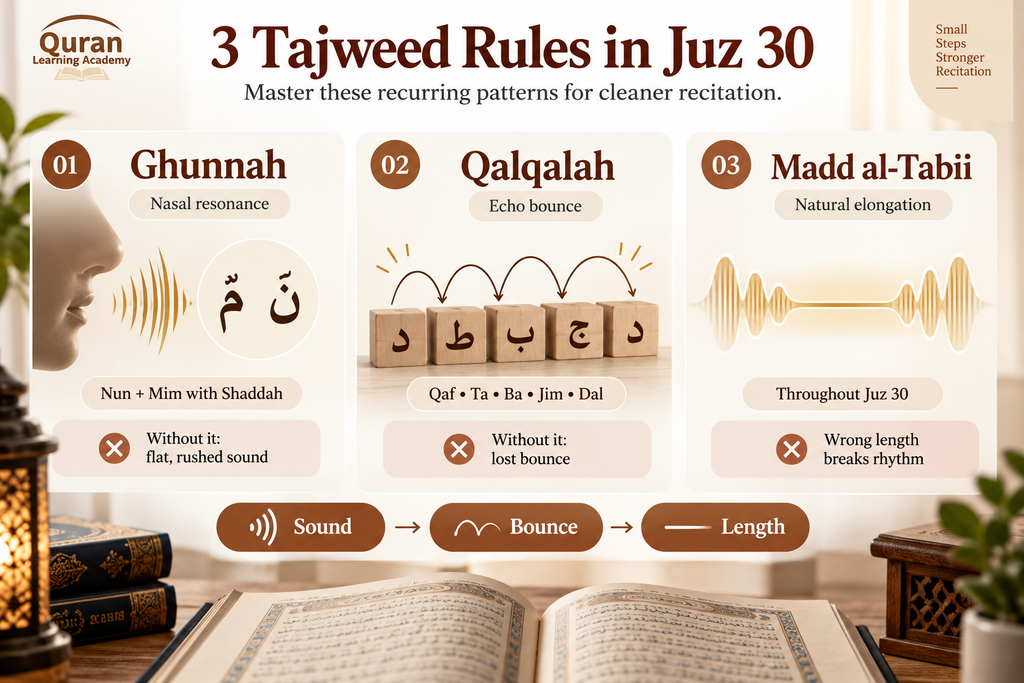
| Tajweed Rule | Where It Appears Most in Juz 30 | What Happens When It Is Wrong |
| Ghunnah (nasal resonance) | Nun and Mim with Shaddah throughout An-Naba, An-Nazi’at, Al-Mutaffifin | Nasalisation is lost; recitation sounds flat and rushed |
| Qalqalah (echo bounce) | Letters Qaf, Ta, Ba, Jim, Dal in Al-Qadr, Al-Buruj, Al-Tariq | Letters land dead; the characteristic bounce of Quranic recitation disappears |
| Madd al-Tabii (natural elongation) | Every surah without exception | Vowels are either cut short or stretched incorrectly, breaking the rhythmic pattern |
A learner who enters Juz 30 without knowing these three rules will make the same mistakes across all 37 surahs, because the same patterns repeat from An-Naba to An-Nas.
2. Correct Your Makharij on the Letters That Juz 30 Tests Repeatedly
Juz 30 places specific Arabic letters under pressure that English speakers consistently struggle with. These are not scattered randomly across the juz; they cluster in its most recited surahs, which means errors here are errors you repeat five times a day in Salah.
The letters that require direct Makharij work before Juz 30 recitation are:
- Qaf (ق): Produced at the back of the tongue meeting the uvula. It appears in Al-Qadr (verse 1: إِنَّا أَنزَلْنَاهُ فِي لَيْلَةِ الْقَدْرِ), Al-Qari’ah, and Al-Buruj. English speakers habitually replace it with a back “k” sound, which flattens the letter entirely.
- Ayn (ع): A voiced pharyngeal produced deep in the throat. It opens Surah Al-Alaq (اقْرَأْ) and appears in Abasa. No English equivalent exists; learners must train this from scratch.
- Tha (ث): An interdental fricative like the “th” in “think.” It appears in Al-Mutaffifin and Al-Inshiqaq. British learners frequently replace it with “s” or “f.”
- Dhal (ذ): Voiced interdental like the “th” in “this.” It appears in Al-Zilzalah and An-Naba. Often collapsed into “z” or “d” by English speakers.
Allah reminds us of the precision with which the Quran was revealed. Before reciting with Tajweed, this precision must begin at the letter level:
“وَرَتِّلِ الْقُرْآنَ تَرْتِيلًا”
Wa rattil il-Qur’aana tartiilaa
“and recite the Qur’an with measured recitation.”
This verse appears in Juz 29, one juz before the text you are about to study. It is a direct instruction that Tarteel, the measured and precise delivery of each letter, is not optional. Makharij correction is where that instruction begins practically.
Learners who have never had their Makharij formally assessed will find that the Online Tajweed Classes in the UK from UK Quran Learning Academy include structured Makharij correction sessions with qualified Azhari instructors who identify articulation errors specific to English-speaking students.

3. Apply the Ghunnah Rule Correctly Across Juz 30 Surahs
Ghunnah is the nasal resonance held for two counts on Nun and Mim when they carry a Shaddah (ّ). It is the single most frequently occurring Tajweed rule in Juz 30, and it is almost universally shortened by British learners who have never been corrected on it.
The two counts of Ghunnah are not approximate. They correspond to a consistent, measurable duration. In classroom Tajweed, teachers use finger taps to establish this duration physically.
The learner taps twice at a steady pace while producing the nasal sound, then releases into the next letter. Without this physical training, the Ghunnah collapses into a single beat or disappears entirely.
In Juz 30, Ghunnah on Nun with Shaddah appears in:
- An-Naba (78): إِنَّ (inna) in verses 21, 29, and 40.
- Al-Mutaffifin (83): إِنَّ (inna) in verses 7, 18, and 34.
- Al-Inshiqaq (84): إِنَّهُ (innahu) in verse 15.
- Al-Fajr (89): إِنَّ (inna) in verse 14.
Ghunnah on Mim with Shaddah appears in:
- Al-Humaza (104): verse 4 (هُمَزَةٍ لُّمَزَةٍ) where the Mim Shaddah must be held.
- Al-Masad (111): مِمَّا (mimma) requires full two-count Ghunnah on the doubled Mim.
The practical drill for Ghunnah in Juz 30 is to go surah by surah and mark every Nun and Mim Shaddah in the text before reciting. Then recite slowly, pausing on each marked letter and counting the two beats aloud before continuing. Speed comes only after accuracy is established.
Step Inside Our Virtual Classrooms
See how our interactive lessons work. Watch these brief highlights of our students engaging with instructors.
Start Your Quranic Journey in the UK
Join our academy for structured online lessons with expert tutors, tailored to fit your schedule.
Book Your Free Trial4. Distinguish Between the Three Madd Lengths That Appear in Juz 30
Madd, the elongation of vowels, has multiple types in Tajweed, and Juz 30 contains at least three of them in high density. British learners who have not been taught Madd formally apply a single, inconsistent elongation to every long vowel, which produces a recitation that sounds approximate rather than correct.
The three Madd types most relevant to Juz 30 reading are:
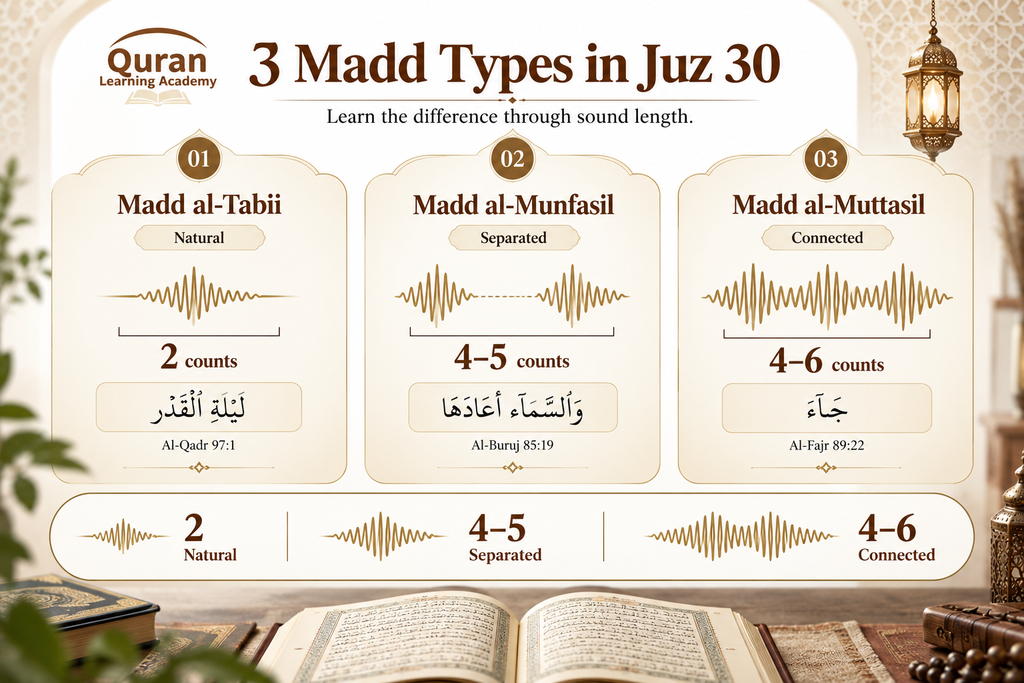
| Madd Type | Duration | Example in Juz 30 |
| Madd al-Tabii (natural) | 2 counts | لَيْلَةِ الْقَدْرِ in Al-Qadr (97:1), every long alif and waw |
| Madd al-Munfasil (separated) | 4 to 5 counts | وَالسَّمَاءِ أَعَادَهَا in Al-Buruj (85:19) where the Madd letter meets a Hamza in the next word |
| Madd al-Muttasil (connected) | 4 to 6 counts | جَاءَ in Al-Fajr (89:22) where the Madd letter and Hamza are in the same word |
The distinction between Madd al-Munfasil and Madd al-Muttasil is where most intermediate learners make consistent errors. Both involve a Madd letter followed by a Hamza, but the position of that Hamza, whether in the same word or the next word, determines the length applied. In Juz 30, this distinction appears across Al-Buruj, Al-Ghashiyah, and Al-Fajr in particular.
The drill that fixes this is to read each surah in isolation, mark every Madd occurrence, label its type, and then recite with deliberate counting before attempting a fluent read-through.
Read more: How Much Quran Should I Memorise Daily?
5. Build Your Juz 30 Reading Session Around a Specific Daily Structure
The structure of a Tajweed-focused reading session for Juz 30 is different from a general Quran reading session. The goal is not to cover pages; it is to recite fewer verses with greater accuracy.
A session that corrects three verses of An-Naba to Tajweed standard is worth more than a session that races through a full surah with persistent errors. A 25-minute session structured specifically for Juz 30 Tajweed reading:
- Minutes 1 to 5: Listen to your chosen reciter reading the target surah or passage without following the text. Focus on where they place the Ghunnah, how long they hold the Madd, and where the Qalqalah bounces.
- Minutes 6 to 15: Open the text. Read each verse aloud, slowly, applying the rules you identified by listening. Stop at every Tajweed marker and apply it consciously before continuing.
- Minutes 16 to 20: Close the text. Recite the same passage from memory. Note where you stumble. These stumble points are almost always where a Tajweed rule was applied incorrectly in the listening phase.
- Minutes 21 to 25: Return to the text. Correct only the verses where you stumbled. Recite them three times correctly before moving on.
The Prophet Muhammad ﷺ emphasised the merit of precise, careful recitation:
“الْمَاهِرُ بِالْقُرْآنِ مَعَ السَّفَرَةِ الْكِرَامِ الْبَرَرَةِ وَالَّذِي يَقْرَأُ الْقُرْآنَ وَيَتَتَعْتَعُ فِيهِ وَهُوَ عَلَيْهِ شَاقٌّ لَهُ أَجْرَانِ”
“One who is proficient in the Qur’an is associated with the noble, upright, recording angels; and he who falters in it, and finds it difficult for him, will have two rewards.”
This hadith applies directly to the learner working through Juz 30 verse by verse. Difficulty with Tajweed, when engaged with sincerely, carries its own reward. The instruction is not to give up because it is hard, but to continue precisely because it is hard.
6. Handle the Qalqalah Letters Specific to Juz 30 Surahs
Qalqalah is the echoing bounce applied to five letters when they appear with a Sukoon (no vowel) or at the end of a verse: ق، ط، ب، ج، د. In Juz 30, these letters appear at verse endings constantly, which means Qalqalah is not an occasional rule but a structural feature of almost every surah in this juz.
There are two levels of Qalqalah that Juz 30 demands:
Qalqalah Sughra (minor) applies when the Qalqalah letter carries a Sukoon in the middle of a verse. The bounce is light and brief. This appears in Al-Buruj (85): وَالسَّمَاءِ ذَاتِ الْبُرُوجِ, where the Jim in Buruj at the end of verse 1 requires a minor Qalqalah.
Qalqalah Kubra (major) applies when the Qalqalah letter falls at a complete stop, the end of a verse where recitation pauses. The bounce here is stronger and more sustained. This appears throughout Al-Tariq (86), Al-Qadr (97), and Al-Zalzalah (99), where Qaf and Dal appear repeatedly at verse endings.
The error British learners make is applying a uniform, weak Qalqalah to both types. The major Qalqalah at a verse ending must be audibly stronger than the minor one mid-verse.
A qualified teacher listening to your recitation will identify this immediately; self-assessment on Qalqalah strength is unreliable because the learner cannot hear the difference in their own voice accurately without comparison to a trained standard.
Experience the Academy in Action
Curious about our teaching style? Take a quick look inside a live session to see our immersive, supportive learning environment first-hand.
Start Your Quranic Journey in the UK
Join our academy for structured online lessons with expert tutors, tailored to fit your schedule.
Book Your Free Trial7. Revise What You Have Read Before Advancing to the Next Surah
Juz 30 Tajweed reading has a specific revision failure that most learners fall into. They apply Tajweed rules carefully to Surah An-Nas, move to Al-Falaq, apply the rules there, then move to Al-Ikhlas. Three weeks later, they return to An-Nas and recite it without Tajweed because the rules were never consolidated, only visited once. This is not progress; it is rotation.
The revision structure that prevents this is straightforward:
Before beginning any new surah in Juz 30, recite every previously studied surah from memory with full Tajweed application.
This means if you are on Surah Al-Humazah, you first recite An-Nas, Al-Falaq, Al-Ikhlas, Al-Masad, An-Nasr, Al-Kafirun, Al-Kawthar, Al-Ma’un, and Quraysh with all Tajweed rules applied, before touching Al-Humazah. Only after that revision does new material begin.
This ratio, revising all old material before adding new, is the mechanism that produces durable Tajweed-compliant reading rather than surface familiarity that dissolves under pressure.
Learners who want structured revision built into a formal programme will find the Quran Reading Classes in the UK from UK Quran Learning Academy incorporate systematic revision cycles where each session begins with assessed recitation of previously covered surahs before new material is introduced.

8. Distinguish Between Idghaam, Ikhfaa, and Iqlaab in Juz 30 Verses
The rules governing Nun Sakinah and Tanwin are among the most technically demanding in Tajweed, and Juz 30 contains all four outcomes of these rules within a relatively small number of verses.
A learner who cannot distinguish between them will apply a single, approximate nasalisation to all of them, which violates the rule in three out of four cases. The four outcomes of Nun Sakinah and Tanwin in Juz 30:
| Rule | Condition | Example in Juz 30 | Sound Produced |
| Idhar (clear) | Nun Sakinah before throat letters (ء ه ع ح غ خ) | مِن عِلْمٍ in An-Naba (78:2) | Clear Nun, no nasalisation |
| Idghaam (merging) | Nun Sakinah before ي ن م و ل ر | مَن يَعْمَلْ in Al-Zalzalah (99:7) | Nun merges into next letter, with or without Ghunnah depending on the letter |
| Iqlaab (conversion) | Nun Sakinah before Ba | أَنبِئُونِي in Al-Fajr (89:25) | Nun converts to hidden Mim sound with Ghunnah |
| Ikhfaa (concealment) | Nun Sakinah before remaining 15 letters | مِن دُونِ in An-Naba (78:37) | Partial nasalisation held for two counts |
These four rules together account for every occurrence of Nun Sakinah and Tanwin across all 37 surahs of Juz 30. Identifying them in the text before reciting, rather than applying them reactively during recitation, is the correct approach for a learner building Tajweed reading accuracy.
Read more: How to Remember Quran Verse Numbers.
9. Work with a Qualified Instructor Who Corrects in Real Time
Everything covered in steps one through eight can be understood intellectually and still applied incorrectly in practice.
Tajweed is a physical discipline. The mouth produces sounds, and those sounds must be heard and assessed by someone whose ear is trained to identify error.
Self-study produces fluency in the wrong version of the recitation, reinforced by daily repetition, which is harder to correct later than ignorance would have been.
The specific things a qualified instructor corrects in Juz 30 Tajweed reading that self-study cannot:
- The exact duration of your Ghunnah, whether it is genuinely two counts or a shortened approximation.
- Whether your Qalqalah Kubra at verse endings is audibly distinct from your Qalqalah Sughra mid-verse.
- Whether your Makharij for Qaf and Ayn are produced from the correct anatomical position or substituted with a near-equivalent English sound.
- Whether your Madd al-Muttasil is consistently four to six counts or varying randomly across surahs.
None of these corrections can be delivered by an app, a recorded reciter, or a written guide. They require a trained listener in a live session who stops you, models the correct production, and has you repeat until the correction is stable.
UK Quran Learning Academy connects British learners with qualified Azhari instructors who specialise in Tajweed correction for English-speaking students, delivering live one-to-one sessions structured around the specific rules and surahs of Juz 30.
Begin Your Juz 30 Tajweed Journey with UK Quran Learning Academy
British Muslims deserve access to the same quality of Tajweed instruction that has been available in Egyptian and Saudi institutions for centuries. UK Quran Learning Academy brings that standard online, with qualified instructors who hold Ijazah in recitation and who understand precisely where English speakers struggle with Arabic phonetics.
Sessions are fully online, scheduled around work, school, and family commitments. Instruction is live, not recorded. Correction is real-time, not algorithmic. The curriculum is structured around the specific Tajweed demands of Juz 30 reading, not a generic syllabus disconnected from the text you are working with.
Every learner begins with a free trial session assessed by a qualified instructor, so you know exactly where your recitation stands before committing to anything.
Discover Our Quran Courses
- Online Tajweed Classes in the UK
- Quran Reading Classes in the UK
- Hifz Classes for Adults
- Tajweed Course for Kids
- Tajweed Course for Adults

Conclusion
To learn Quran reading with Tajweed Juz 30 is to bring the precision that these 37 surahs have always deserved to recitations that most British Muslims already perform daily. The rules are specific, the surahs are familiar, and the path is structured.
What closes the gap between reciting from habit and reciting with accuracy is a qualified instructor, a daily session with real correction, and a disciplined approach that revises every surah already covered before introducing the next. That is not a complicated formula. It is the one that works.
Frequently Asked Questions
How long does it take to read Juz 30 with correct Tajweed?
For a British adult with no prior Tajweed instruction, reaching consistent accuracy across all 37 surahs of Juz 30 typically takes three to five months of structured daily sessions. This assumes 20 to 30 minutes of focused practice with instructor correction each week. Learners who already recite these surahs in Salah will progress faster because the vocabulary is familiar; the correction work is on the rules applied to words already known.
Which surahs in Juz 30 are hardest to read with Tajweed?
An-Naba and An-Nazi’at present the greatest challenge because they are the longest surahs in the juz, at 40 and 46 verses respectively, and they contain dense Ghunnah, Madd, and Ikhfaa applications across long passages. The shorter surahs at the end of Juz 30 are technically demanding in different ways; Al-Tariq contains heavy Qalqalah, and Al-Ghashiyah contains multiple Madd al-Munfasil occurrences that require consistent four to five count elongation.
Can I learn Juz 30 Tajweed reading without knowing how to read Arabic?
Not effectively. Tajweed is a system of rules applied to Arabic text. Without the ability to recognise Arabic letters and vowel markers, there is no way to identify where a Ghunnah, Madd, or Qalqalah applies. The correct sequence is to establish Arabic letter recognition first, then introduce Tajweed rules on those letters, then apply those rules to Juz 30 surah text. Attempting to learn Tajweed through transliteration produces approximate pronunciation, not rule-based accuracy.
What is the difference between reciting Juz 30 from memory and reading it with Tajweed?
Reciting from memory means producing words correctly in sequence, which most Muslims can do for the shorter surahs of Juz 30 after years of Salah. Reading with Tajweed means applying the correct rule to every letter, every Nun Sakinah, every Madd, and every Qalqalah letter during that recitation. The words are the same; the precision applied to each letter is fundamentally different. Many British Muslims recite Juz 30 from memory daily with uncorrected Tajweed errors they are unaware of.
Do ladies need a female instructor for Juz 30 Tajweed classes?
Many British Muslim women prefer to study with a qualified female instructor for reasons of comfort and focus. UK Quran Learning Academy offers female-only Tajweed instruction through qualified female instructors who specialise in Makharij and Sifaat correction for English-speaking women, delivered entirely online with fully flexible scheduling.








[…] Read more: How to Learn Quran Reading with Tajweed Juz 30. […]