 Quran

If you want to learn Quran reading without knowing Arabic, you can begin at any age without prior language study. Understanding how to read Quran if you don’t know Arabic starts with learning the Arabic alphabet, recognising letter sounds, and practising pronunciation step by step.
Reading the Quran and speaking Arabic are separate skills, so you do not need to master conversation or grammar first. With a structured learning sequence, guidance from a qualified teacher, and regular practice, you can develop accurate reading skills from the beginning and build confidence in reciting the Quran.
1. Understand Why Transliteration Cannot Teach You to Read Quran for Beginners
Before the first lesson, one decision must be made correctly. Many British adults who want to read Quran for beginners begin with transliteration: English letters used to represent Arabic sounds, such as writing “Al-hamdu lillahi” instead of “الْحَمْدُ لِلَّهِ.”
This appears to be the fastest route. It is not. It is a detour that creates problems the learner cannot yet see. The Arabic alphabet contains 28 letters. Approximately 16 of them have reasonable English equivalents.
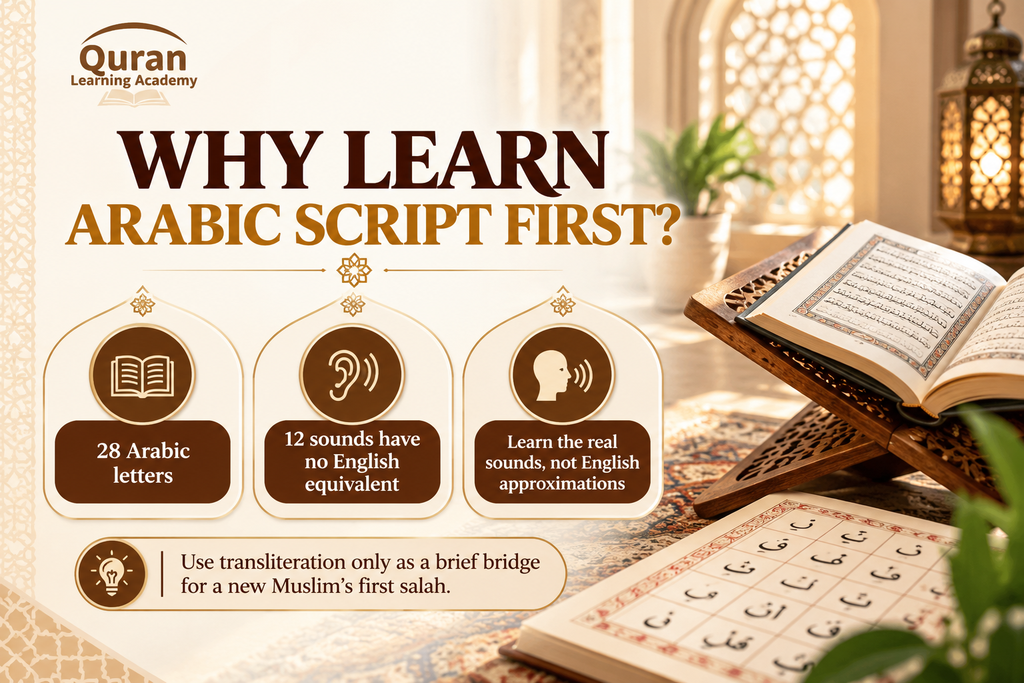
The remaining 12 have no English equivalent at all. Al-Azhar’s formal position on this is precise: Latin script cannot fully correspond to Arabic script because several Arabic sounds simply do not exist in the Latin phonetic system.
When an English letter is used to represent ع (Ayn), ح (Ha), خ (Kha), غ (Ghayn), or ق (Qaf), the learner practises an English approximation of those sounds thousands of times and never produces the actual Arabic. That pattern becomes a fixed habit.
Transliteration is permissible as a very short-term bridge for a new Muslim learning Al-Fatiha for their first salah before they begin structured reading lessons. It must then be abandoned entirely.
A learner who continues with transliteration past the first week is not learning to read Quran for beginners. They are learning to recite English phonetics over Quranic text, which is a different and incorrect thing.
The Learn Quran for Beginners Classes in the UK at UK Quran Learning Academy begin every student on Arabic script from the first session, with Azhari-certified instructors who prevent the transliteration habit before it can form.
2. Learn the 28 Arabic Letters Through 17 Base Shapes, Not 28 Individual Items
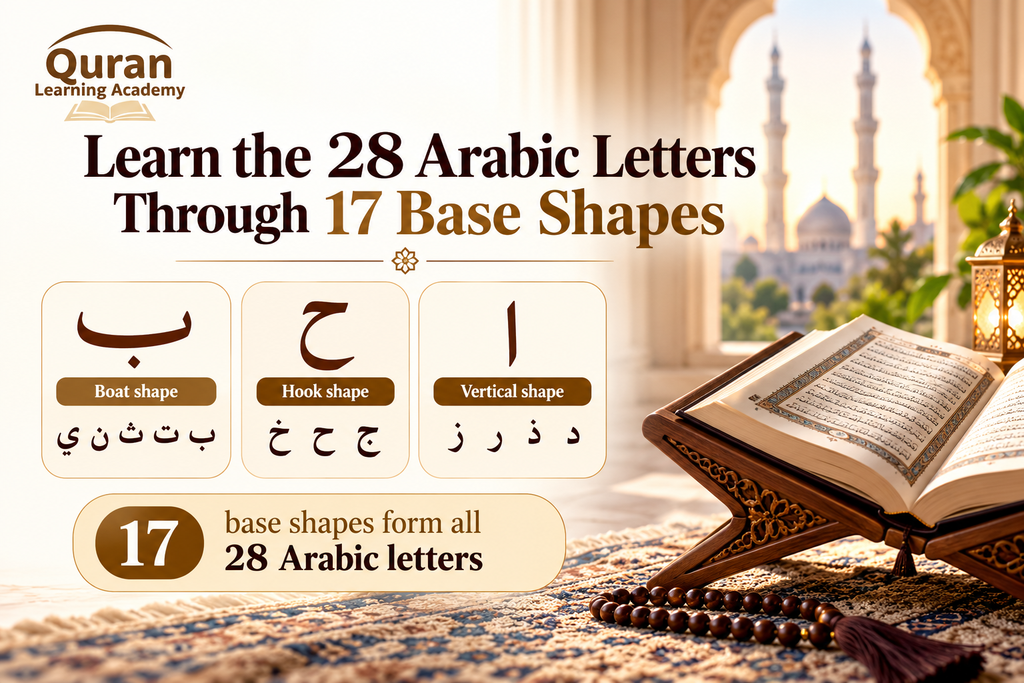
The standard approach to the Arabic alphabet presents 28 letters in sequence and asks the learner to memorise each one individually. This is inefficient and slower than necessary. A structurally better approach is to learn the 17 base shapes that the 28 letters are built from, because most letters share a skeletal form and differ only in the number and position of dots.
The shape-grouping principle in practice:
| Base Shape | Letters That Share It | Difference |
| Boat shape | ب ت ث ن ي | Number and position of dots |
| Hook shape | ج ح خ | Number of dots |
| Fence shape | د ذ | Number of dots |
| Curved vertical | ر ز | Number of dots |
| Sine wave | س ش | Number of dots |
| Closed loop | ص ض | Number of dots |
| T-bar | ط ظ | Number of dots |
| Open loop | ع غ | Number of dots |
| Angled stroke | ف ق | Number of dots |
Learning 17 shapes instead of 28 isolated items reduces the memorisation load by 40% while covering every letter in the alphabet. A beginner who approaches it this way typically recognises all 28 letters reliably within two weeks of daily 15-minute practice.
The letters that require specific sound drilling because they have no English equivalent are: ع، ح، خ، غ، ق، ص، ض، ط، ظ. These nine letters must be heard from a qualified teacher and produced correctly from the start.
An English description of their sounds is insufficient because the sounds require precise anatomical positioning of the tongue, pharynx, and lips that English speakers have never been trained to produce.
3. Master the Four Positional Forms Before Reading Any Word
This is the step where most self-taught beginners stall. They learn the isolated form of each Arabic letter from an alphabet chart, then open the Quran and find that the letters they recognise do not look like what is on the page.
The reason is that every Arabic letter changes shape depending on where it appears in a word. Each of the 28 letters has four positional forms:
| Position | What It Means | Connection |
| Isolated | The letter stands alone | Connects to nothing |
| Initial | The letter begins a word | Connects only to the left (forward) |
| Medial | The letter is in the middle of a word | Connects both right and left |
| Final | The letter ends a word | Connects only to the right (backward) |
The initial and medial forms are often identical because in both positions the letter must connect forward. The final and isolated forms are similarly close because in both positions the letter does not connect to anything following it. A beginner who learns this pairing reduces the memorisation load from four distinct forms to two for most letters.
The six non-connector letters complicate this in a specific and important way. Six Arabic letters never connect to the letter that follows them, regardless of their position in a word.
These six are: ا (Alif), د (Dal), ذ (Dhal), ر (Ra), ز (Zay), و (Waw). When any of these letters appears in a word, the cursive chain breaks after it, and the next letter begins in its initial or isolated form rather than its medial form.
A practical example: the word “مدرسة” (school) contains the letter د in the middle. Because د is a non-connector, the letters after it cannot attach to it. A beginner who does not know this tries to read it as a single connected flow and cannot make sense of what they see.
A beginner who knows the six non-connectors immediately recognises the break and segments the word correctly.
The Quran Reading Classes in the UK at UK Quran Learning Academy drill all four positional forms and all six non-connectors in the first stage of instruction, before any Harakaat or word-joining is attempted.
4. Learn the Three Short Vowels and Apply Them Across Every Letter
The Arabic alphabet in its base form consists almost entirely of consonants. Short vowels are represented by small diacritical marks written above or below the letters.
In the Quran specifically, these marks are always fully written, which is one of the reasons the Quran is significantly easier to read than standard Arabic text. Every vowel is visible. Nothing is left for the reader to infer.
The three short vowels and their precise sounds:
| Vowel | Arabic Name | Symbol Position | Sound |
| Fatha | فَتْحة | Above the letter (ـَ) | Short “a” as in “cat” |
| Kasra | كَسْرة | Below the letter (ـِ) | Short “i” as in “bit” |
| Damma | ضَمَّة | Above the letter (ـُ) | Short “u” as in “put” |
Every beginner must practise each of the 28 letters with all three vowels before progressing. The drill is: بَ بِ بُ, then تَ تِ تُ, then ثَ ثِ ثُ, continuing through all 28 letters. This is not revision. It is the mechanical foundation on which all subsequent reading is built.
A student who cannot move through any letter with any vowel instantly, without hesitation, is not ready for joining or word reading.
Two additional symbols at this stage carry equal importance:
- Sukoon (ـْ): written above a letter to indicate it carries no vowel and is pronounced as a pure consonant. In the word “قُلْ” (say), the Lam carries Sukoon, meaning it is pronounced as a clean “l” with no following vowel sound. Beginners who are not taught Sukoon add a phantom vowel after every consonant and read entirely incorrect words.
- Shaddah (ـّ): written above a letter to indicate it is doubled. The first instance of the doubled letter carries Sukoon, the second carries the written vowel.
In “رَبِّ” (Lord), the Ba carries Shaddah and Kasra, producing “rabb-i.” Beginners who ignore the Shaddah read it as a single Ba, which changes the word.
Step Inside Our Virtual Classrooms
See how our interactive lessons work. Watch these brief highlights of our students engaging with instructors.
Start Your Quranic Journey in the UK
Join our academy for structured online lessons with expert tutors, tailored to fit your schedule.
Book Your Free Trial5. Use the Noorani Qaida to Bridge Letters and Quranic Text
The Noorani Qaida is the structured sequence that takes a learner from knowing individual letters to reading Quranic words and verses. It is not an optional supplement.
It is the bridge that every read Quran for beginners pathway requires, because it introduces skills in the exact order they need to be learned: joined pairs, then short words, then longer words, then simple Quranic sentences, then basic Tajweed rules in context.
What the Noorani Qaida teaches in sequence:
- Letters in isolation with correct sound production.
- Letters with each of the three Harakaat.
- Joined letter pairs in initial, medial, and final forms.
- Long vowels (Alif Madd, Waw Madd, Ya Madd) held at 2 counts each.
- Sukoon in joining contexts, including letters that cluster without vowels between them.
- Shaddah in word context.
- Tanween (double vowels at word endings): Fathatayn (ـً), Kasratayn (ـٍ), Dammatayn (ـٌ).
- Basic Noon Sakinah and Tanween rules: Idh-har and Idgham at introductory level.
- Basic Qalqalah: the echo produced by the five letters ق ط ب ج د when they carry Sukoon.
The reason the Noorani Qaida cannot be replaced by opening the Mushaf directly is structural. The Mushaf presents all of these skills simultaneously on every page, with no sequence and no scaffolding.
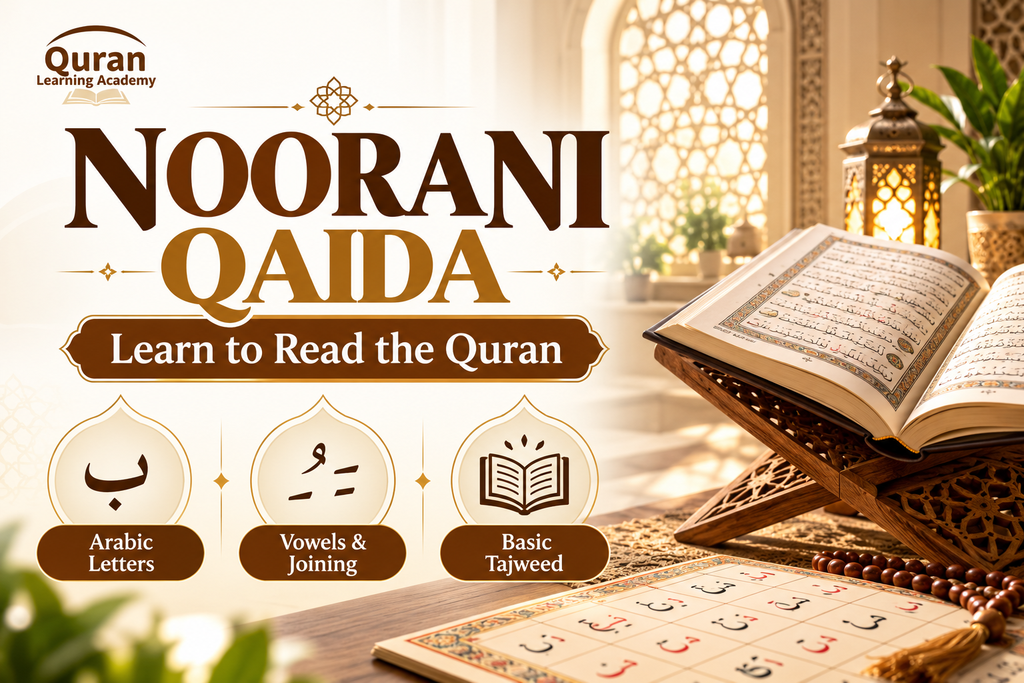
A beginner confronting the Mushaf without the Qaida encounters Shaddah, Sukoon, Tanween, long vowels, and joining rules all at once, with no framework for any of them. The result is guessing, which produces incorrect habits, which take far longer to correct than to build correctly from the start.
Read more:How to Memorise a Page of Quran in 5 to 30 Minutes
6. Begin Reciting the Quran from Surah Al-Fatiha with a Qualified Teacher
Once the Noorani Qaida is complete, the correct starting point for Quranic recitation is Surah Al-Fatiha. Not Surah Al-Baqarah, which opens the Mushaf.
Not any Surah chosen randomly. Al-Fatiha is 7 verses, recited 17 times every day in salah, and contains every foundational reading skill within a short and manageable text.
Al-Fatiha contains:
- A Shaddah on the Ba of “بِسْمِ اللَّهِ” (Bismillah).
- A long Alif Madd in “الرَّحْمَٰنِ.”
- A Shaddah and Tafkhim on the Lam of “اللَّهِ” which is light due to the preceding Kasra.
- A prohibited stopping point in “صِرَاطَ الَّذِينَ أَنْعَمْتَ عَلَيْهِمْ” that must not be broken mid-verse.
- A Shaddah on the Lam and Dal of “الضَّالِّينَ.”
A teacher must be present and listening during this stage. Reading Al-Fatiha alone at this point produces undetected errors in every single one of the positions listed above, because the learner has no reference for what their own voice should sound like.
The teacher hears the error in real time, names it precisely, and corrects it before the next repetition re-embeds it.
After Al-Fatiha is stable, the next stage is the short Surahs of Juz Amma: Al-Ikhlas (4 verses), Al-Falaq (5 verses), An-Nas (6 verses), Al-Kawthar (3 verses). These Surahs are short, phonetically manageable, and recited in salah daily.
Errors corrected in them are corrected in every subsequent recitation of those Surahs for the rest of the learner’s life.
The Quran Recitation Classes in the UK at UK Quran Learning Academy cover exactly this transition, with live one-to-one sessions where instructors listen to every verse of Al-Fatiha and the Juz Amma Surahs and provide targeted correction within the same session.
7. Build a Daily Practice Routine That Fits UK Life
Progress when learning to read Quran for beginners depends on two variables: how often you practise and whether a teacher is listening to correct errors between sessions.
For UK adults managing work in London, Birmingham, Manchester, Bradford, or Leicester, the sustainable model is structured lessons twice weekly with a qualified teacher, combined with 10 to 15 minutes of daily solo revision.
A realistic daily solo practice structure:
- 5 minutes: Letter and Harakaat drilling. Take 5 letters from the Noorani Qaida and read each with all three vowels until automatic.
- 5 minutes: Recite Al-Fatiha slowly, checking each letter and Harakaat consciously rather than from habit.
- 5 minutes: Read the current Noorani Qaida page or current Juz Amma Surah at slow pace.
The reason most self-taught attempts to read Quran for beginners fail is not inability. It is that sessions happen irregularly, errors accumulate silently between sessions, and there is no teacher to reset the errors before the next stage begins.
Twice-weekly sessions with a qualified teacher cost less time than most British adults spend on a single evening of television, and they produce measurable, documented progress within 8 to 12 weeks.
The Noorani Qaida Course in the UK at UK Quran Learning Academy is designed entirely around this model: structured twice-weekly live sessions with Azhari-certified instructors, flexible evening and weekend scheduling for UK adults, and a clear curriculum that shows the learner exactly which milestone they are working toward at every point.
Join your first free trial now
8. Understand What Reading Quran for Beginners Does Not Require
A significant number of British adults postpone learning to read Quran for beginners because they believe preconditions that do not exist. Clarifying these directly removes a barrier that has nothing to do with the actual learning process.
Reading the Quran does not require:
- Fluency or even basic knowledge of spoken Arabic. The skill being learned is phonetic recognition of a script, not conversational language.
- Prior Quranic memorisation. A student who has memorised Al-Fatiha from sound alone but cannot read the Arabic script is still a complete reading beginner.
- Attendance at a physical masjid class. Live online instruction with a qualified teacher produces identical results to in-person teaching and removes the scheduling constraints that cause most UK adults to drop out of mosque-based programmes.
- Children’s-level materials. Adults learn the Arabic alphabet faster than children when taught with adult-appropriate methodology. The Noorani Qaida is used for both age groups because it is structurally sound, not because it is only suitable for children.
What reading the Quran does require is a correct sequence, a teacher who can hear errors, and a consistent practice schedule. Those three things, in combination, produce a result within a timeline that is well within the reach of any British adult starting from zero.
Experience the Academy in Action
Curious about our teaching style? Take a quick look inside a live session to see our immersive, supportive learning environment first-hand.
Start Your Quranic Journey in the UK
Join our academy for structured online lessons with expert tutors, tailored to fit your schedule.
Book Your Free TrialStart Your Quran Journey with UK Quran Learning Academy Today
If you have wanted to read Quran for beginners but have never known exactly where to start or who to learn from, UK Quran Learning Academy removes both obstacles simultaneously.
Every instructor holds Ijazah in Hafs ‘an ‘Asim through verified chains of narration connected to Al-Azhar. Every session is live and one-to-one.
Every lesson is built around your specific current level, not a generic curriculum that assumes knowledge you do not yet have. Scheduling is flexible across evenings and weekends to fit the realities of British professional and family life.
You do not need to know Arabic. You do not need to have tried before. You need one session with a qualified teacher who listens to where you are and builds the next step from exactly that point
Discover Our Quran Courses
- Learn Quran for Beginners Classes in the UK
- Quran Reading Classes in the UK
- Quran Recitation Classes in the UK
- Noorani Qaida Course in the UK
- Quran Online Academy
- Quran Recitation Classes
- Tajweed Course for Ladies
.

Start your Quran journey with UK Quran Learning Academy today
Conclusion
Learning how to read Quran if you don’t know Arabic is achievable when you follow a clear plan and practise consistently. Begin with the Arabic alphabet and vowel sounds, then progress through the Noorani Qaida before reading directly from the Mushaf.
A qualified teacher can correct pronunciation errors early and help you apply the rules accurately. You do not need to speak or understand Arabic to learn Quran reading.
With regular lessons, patience, and realistic goals, you can steadily improve your recitation and establish a lasting connection with the Quran.
Read more: How to Read Quran for Beginners: Where to Start and What to Do First.
Frequently Asked Questions
Can beginners learn to read the Quran without knowing Arabic?
Yes. Beginners can learn Quran reading by starting with the Arabic alphabet, Harakaat, and Noorani Qaida. With regular practice and qualified instruction, basic reading may take 6 to 12 months.
Why is transliteration unreliable for Quran reading?
Transliteration replaces Arabic letters with approximate English sounds, which cannot accurately represent every Arabic letter. Learning directly from Arabic script helps beginners develop correct pronunciation.
What are the six non-connector letters in Arabic?
The six non-connector letters are ا د ذ ر ز و. They connect to the preceding letter but not the following one, helping learners recognise word patterns.
Where should beginners start reading the Quran after learning the letters?
Beginners should start with Surah Al-Fatiha under a teacher’s guidance, then practise short Surahs from Juz Amma to strengthen pronunciation and reading skills.
How long does it take to learn Quran reading from scratch?
Most UK adults can complete Noorani Qaida in 2 to 4 months and reach basic Quran reading within 6 to 12 months with regular lessons and daily practice.






Leave a Reply