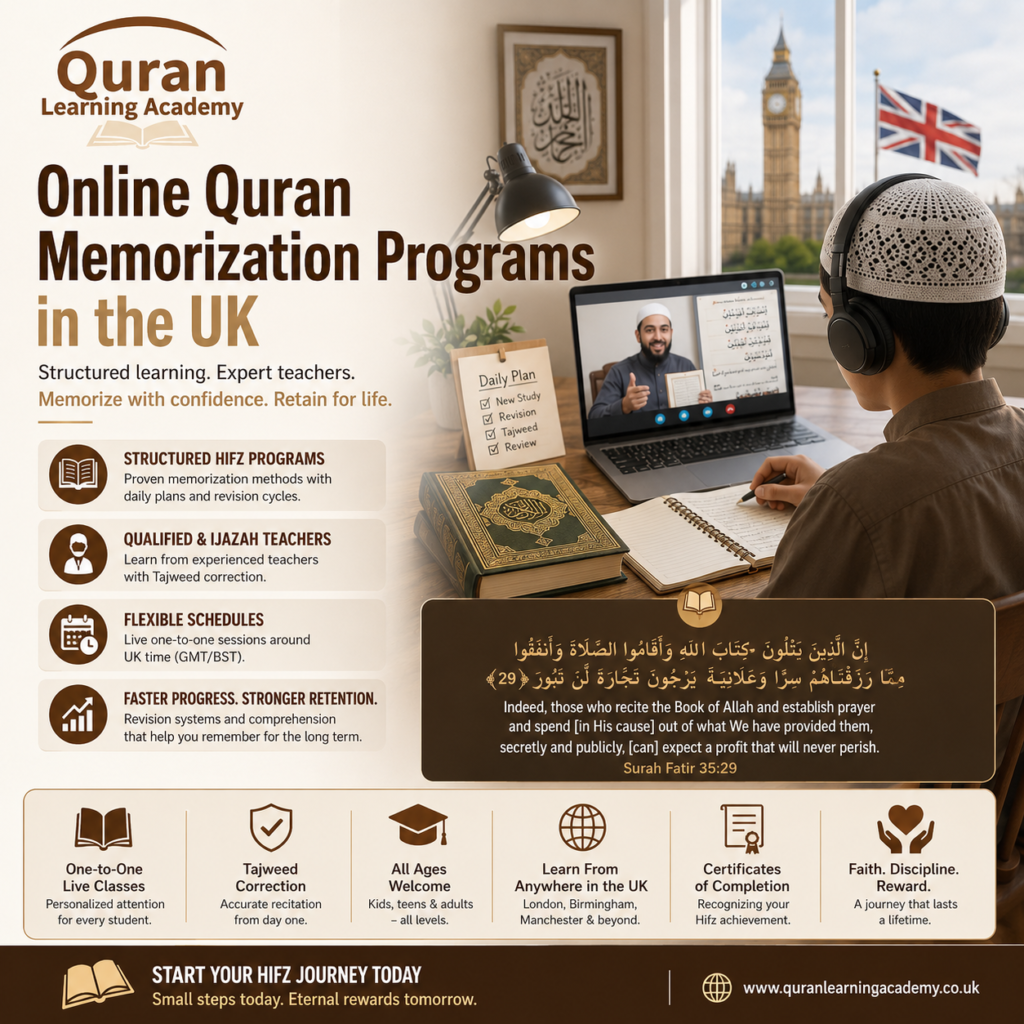
 Quran
Learning How to Get Better at Reading Quran in the UK starts with building a strong foundation in Arabic letters, pronunciation, and Tajweed rules.
Whether you are a beginner or looking to improve your existing skills, regular practice, reliable learning resources, and guidance from qualified teachers can help you develop accurate recitation and greater confidence while fitting Quran study into your daily routine.
1. Return to the Arabic Alphabet Before Anything Else
Most adult learners in the UK make the same critical mistake: they jump straight to Surah recitation while their Arabic letter recognition is still shaky.
Letters like ع (Ayn), غ (Ghayn), ح (Ha), and خ (Kha) do not exist in English, and guessing their sounds builds habits that take years to undo.
The correct starting point is the Noorani Qaida, the foundational Arabic phonics system that isolates each letter, teaches its correct articulation point (Makhraj), and drills joining rules before a single verse is attempted. Skipping this step is like learning to drive before understanding what the pedals do.
Many British adults feel embarrassed returning to basics they associate with childhood, but this step is not a regression. It is the fastest route to genuine reading accuracy. Many learners across the UK who feel stuck in their recitation actually have a letter recognition problem, not a fluency problem.
Two or three weeks with structured phonetic drills on the alphabet alone produces measurable change in reading speed and confidence.
The Noorani Qaida Course in the UK from UK Quran Learning Academy covers Arabic letter recognition, vowel movements, and joining rules through systematic phonetic drills, built for adults who need to rebuild from the correct foundation.
Begin your Quran journey from the right starting point.
2. Understand What Tajweed Actually Requires of You
There is widespread confusion in the UK Muslim community about what Tajweed means in practice. Many learners believe it is about beautifying recitation for advanced readers, when in reality it governs the basic validity of how every Muslim reads the Quran.
Allah (SWT) commands in the Quran that the Book must be recited with care and precision. Before mentioning this, it is worth noting that the command applies to every Muslim, not only scholars or Hafidh students:
“وَرَتِّلِ الْقُرْآنَ تَرْتِيلًا”
Wa rattili al-Qur’ana tartīlā.
“and recite the Qur’an with measured recitation.”
The word “Tarteel” in this verse refers directly to deliberate, precise, unhurried recitation. It is a Quranic obligation, not an advanced optional skill.
Core Tajweed Rules Every UK Reader Must Know
The following are the primary Tajweed areas that British learners typically struggle with most:
| Tajweed Rule | What It Controls | Common UK Mistake |
| Makharij al-Huroof | Articulation point of each letter | Pronouncing ق like “k” or ع like a glottal stop |
| Sifaat | Letter characteristics (heavy/light) | Treating all letters with equal weight |
| Ghunnah | Nasal sound duration on Noon and Meem | Cutting the nasalisation too short |
| Madd | Vowel elongation lengths | Inconsistent elongation across recitation |
| Qalqalah | Echo sound on specific letters | Applying it to the wrong letters |
Understanding these categories tells you exactly where your reading breaks down and what to correct first.
The Online Tajweed Classes in the UK from UK Quran Learning Academy teach authentic recitation through structured lessons in Makharij, Sifaat, and pronunciation rules, progressing from foundational articulation to advanced recitation fluency.

3. Recite Aloud Every Single Session
Silent reading is the enemy of Quran improvement. When you read quietly, you hide mistakes from yourself and from any teacher or correction system. The tongue, ears, and mind must work together simultaneously for recitation to improve.
This principle is especially relevant for British learners who typically study alone at home. Reading aloud:
- Forces you to confront incorrect letter sounds immediately.
- Builds the muscle memory that makes correct pronunciation automatic over time.
- Allows you to record yourself and identify errors you cannot hear in the moment.
- Trains your ear to recognise the difference between what you think you are saying and what you are actually producing.
A simple method that produces results: read three verses aloud, record the audio on your phone, then listen back immediately before moving on. The gap between what most learners believe they are saying and what they actually say is always larger than expected on first listen.
Step Inside Our Virtual Classrooms
See how our interactive lessons work. Watch these brief highlights of our students engaging with instructors.
Start Your Quranic Journey in the UK
Join our academy for structured online lessons with expert tutors, tailored to fit your schedule.
Book Your Free Trial4. Fix Pronunciation Letter by Letter, Not Verse by Verse
The instinct of most self-studying British Muslims is to work through the Quran page by page, measuring progress by how far they have read. This approach accumulates errors faster than it fixes them.
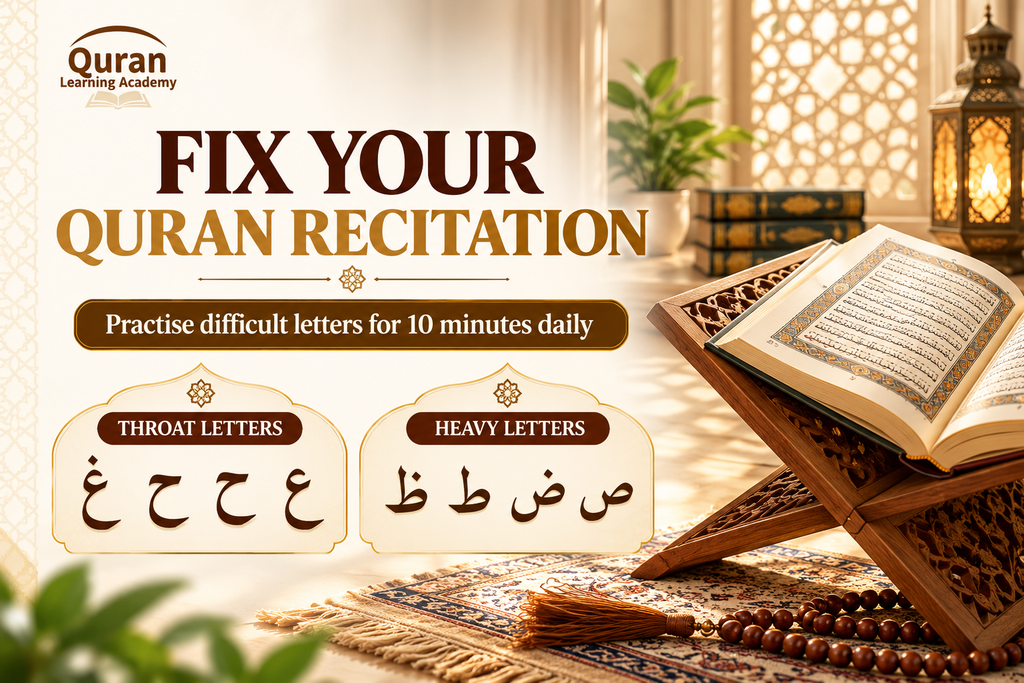
Effective Quran reading improvement works differently. Identify the specific Arabic letters that consistently cause you problems. For most English-speaking learners, these fall into two categories:
Throat letters requiring specific articulation:
- ع (Ayn) produced from mid-throat.
- ح (Ha) produced from the middle of the throat.
- خ (Kha) produced from the upper throat area.
- غ (Ghayn) produced from the upper throat with a slight friction sound.
Heavy letters that must be distinguished from their light counterparts:
- ص (Saad) versus س (Seen).
- ض (Dad) versus د (Dal).
- ط (Taa) versus ت (Ta).
- ظ (Dhaa) versus ذ (Dhal).
Drilling these letters in isolation for 10 minutes daily produces faster results than reading 20 pages with undetected errors throughout.
Read more:Best Wishes for Hafiz e Quran in English and Arabic
5. Build a Daily Reading Habit Around Your UK Schedule
One of the most consistent barriers for British Muslims is not motivation, it is schedule. Shift work, school runs, commutes, and long working hours in cities like London and Birmingham mean that Quran time gets pushed to whenever a gap appears, which often means never.
The solution is habit stacking, attaching Quran reading to an existing daily habit rather than treating it as a separate task requiring willpower.
Practical attachment points that work for UK schedules:
- Recite five verses immediately after Fajr, before checking your phone.
- Listen to a Qari during your morning commute on the train or bus.
- Read one page during your lunch break.
- Recite the last Surah of your prayer slowly and deliberately instead of rushing through it.
A 15-minute daily session, done consistently every day for 30 days, produces greater reading improvement than two hours once a week. The daily repetition is what trains the tongue and fixes the neural pathways that support correct recitation.
The Quran Reading Classes in the UK from UK Quran Learning Academy teach students to recognise Arabic letters, join them into words, and recite complete verses with accuracy, structured for learners managing full UK working schedules.
6. Learn Directly Under a Qualified Instructor
Self-study produces effort without guarantee of correctness. The fundamental problem with teaching yourself Quran reading is that you cannot hear your own mistakes the way a trained teacher can.
Errors become embedded over months and years, and what feels like fluency is often just comfort with incorrect recitation. The Prophet Muhammad (ﷺ) said:
“خَيْرُكُمْ مَنْ تَعَلَّمَ الْقُرْآنَ وَعَلَّمَهُ”
“The best among you (Muslims) are those who learn the Qur’an and teach it.”
The Prophetic model of Quran learning was always teacher-to-student, chain by chain, correction by correction. This is not an accident. It reflects the nature of recitation as a living, transmitted practice that cannot be fully acquired from books or recordings alone.
For UK adults specifically, the challenge is finding instructors who:
- Hold verified Ijazah credentials with authenticated chains of narration.
- Understand the phonetic challenges that English speakers face with Arabic sounds.
- Can teach around a UK schedule with flexible evening and weekend slots.
- Are trained in systematic Islamic pedagogy rather than informal community-level instruction.
The Adult Quran Classes in the UK from UK Quran Learning Academy connect British learners with qualified Azhari Quran teachers who specialise in recitation, Tajweed, and Quranic Arabic comprehension, with lessons structured around adult UK schedules.
7. Use Listening to Reinforce What You Practise
Active listening to skilled Qaris is one of the most underused tools for Quran reading improvement. Your ear needs to know what correct recitation sounds like before your tongue can reproduce it accurately.
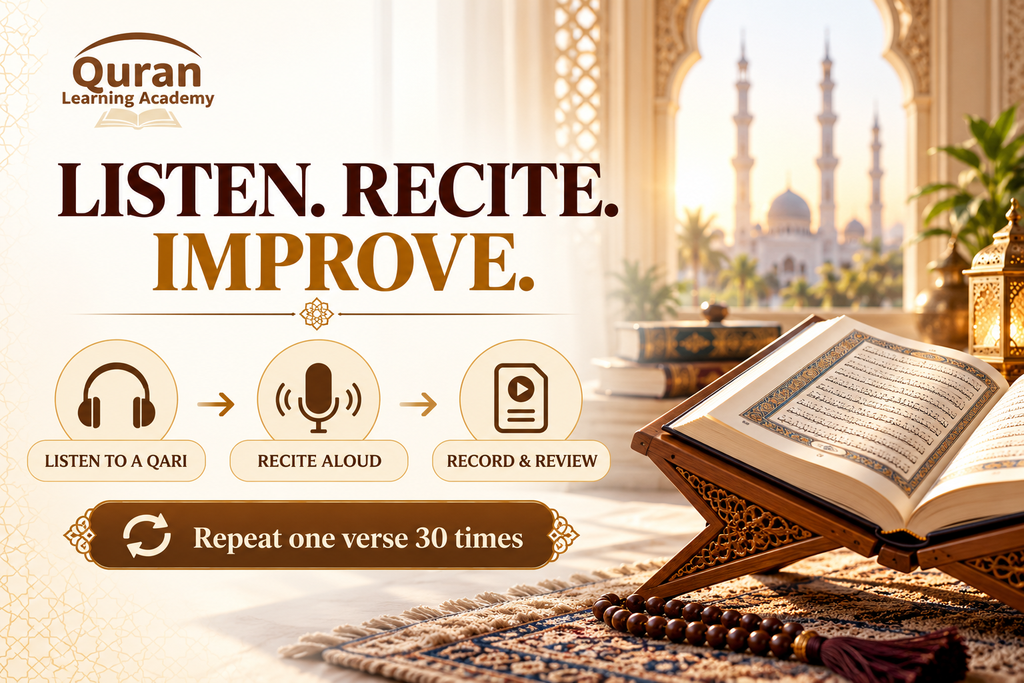
The listening and reading combination works as follows:
| Stage | Activity | Purpose |
| Before reading | Listen to the passage from a Qari | Establish correct sound pattern in memory |
| During reading | Recite aloud slowly | Activate muscle memory |
| After reading | Record and listen back | Identify gap between intention and output |
| Daily passive | Listen during commute or at home | Reinforce correct patterns subconsciously |
Repetition within a single passage matters more than covering new material. Reading one verse correctly thirty times is more valuable for long-term fluency than reading thirty different verses once each.
Experience the Academy in Action
Curious about our teaching style? Take a quick look inside a live session to see our immersive, supportive learning environment first-hand.
Start Your Quranic Journey in the UK
Join our academy for structured online lessons with expert tutors, tailored to fit your schedule.
Book Your Free Trial8. Work Towards Understanding What You Recite
Many British Muslims spend years reciting the Quran without understanding a word of what they are saying. This is not a criticism; it reflects a system of Quran education that prioritised phonetic accuracy over comprehension.
But understanding the meaning transforms recitation from a mechanical exercise into a living connection with the text. When you understand even basic Quranic Arabic vocabulary, several things change.
Reading slows to the natural Tarteel pace because each word carries meaning worth pausing on. Mistakes become more obvious because you know what you are trying to say. Attention sharpens because the mind engages with content rather than just sound.
Allah (SWT) invites this engagement directly. As a foundation for this point, consider that the Quran describes itself as a Book sent for reflection, not only recitation:
“كِتَابٌ أَنزَلْنَاهُ إِلَيْكَ مُبَارَكٌ لِّيَدَّبَّرُوا آيَاتِهِ وَلِيَتَذَكَّرَ أُولُو الْأَلْبَابِ”
Kitābun anzalnāhu ilayka mubārakun liyaddabbarū āyātihī wa liyatadhakkara ulū al-albāb.
” [This is] a blessed Book which We have revealed to you, [O Muhammad], that they might reflect upon its verses and that those of understanding would be reminded.”
The Quranic Arabic Course in the UK from UK Quran Learning Academy is built for learners who want to understand the Quran in its original language, not just recite it, progressing through Classical Arabic grammar, Quranic vocabulary, and direct text analysis.
Start Your Quran Journey with UK Quran Learning Academy
British Muslims face a unique combination of challenges when it comes to Quran reading: no Arabic-speaking environment growing up, busy UK working schedules, a shortage of qualified local instructors, and decades of self-doubt built up around recitation.
UK Quran Learning Academy was built specifically to address all of these. The Academy connects British learners with qualified Azhari instructors who hold authenticated Ijazah credentials and understand exactly where English-speaking tongues struggle with Arabic sounds.
Every lesson is live, one-to-one, and built around your actual schedule, whether you are a professional in London, a parent in Birmingham, or a student in Manchester.
Courses run across flexible time slots including evenings and weekends, meaning how to get better at reading Quran is no longer limited by when your nearest mosque holds classes. Your improvement is structured, measured, and corrected by a teacher who can hear what you cannot.
Discover Our Quran Courses
- Noorani Qaida Course in the UK
- Online Tajweed Classes in the UK
- Quran Reading Classes in the UK
- Adult Quran Classes in the UK
- Quranic Arabic Course in the UK
- Weekend Quran Classes
- Intensive Quran Course
- Al-Azhar Quran Course

Conclusion
Knowing How to Get Better at Reading Quran in the UK can help learners take practical steps towards accurate and confident recitation. Consistent practice, structured lessons, and feedback from qualified teachers can improve pronunciation and strengthen understanding of Tajweed. By setting realistic goals and maintaining a regular reading routine, learners can gradually develop their skills and build a stronger connection with the Quran.
Read more: How to Memorise 2 Pages of Quran a Day.
Frequently Asked Questions
How long does it take to noticeably improve Quran reading as an adult in the UK?
Most adults see clear improvement in letter accuracy and reading flow within four to eight weeks of daily practice under instructor correction. The timeline depends heavily on current reading level, consistency of daily sessions, and whether mistakes are being corrected in real time rather than self-assessed.
Is it too late to learn Tajweed as an adult who learned to read years ago?
No. Adults who already read the Quran at a basic level often progress faster than complete beginners because they have familiarity with the text. Tajweed correction at any age is effective when taught systematically. Many UK adults in their 30s, 40s, and 50s have achieved significant recitation improvement within a year of structured study.
What is the difference between Quran reading and Quran recitation?
Reading refers to the ability to decode Arabic script and produce the words accurately. Recitation adds the layer of Tajweed application: correct articulation points, letter characteristics, elongation, and pausing rules. Improvement must address both levels, starting with reading accuracy, then building recitation quality on top.
Can a complete beginner with no Arabic background learn to read the Quran in the UK?
Yes. The correct starting point is Noorani Qaida, which introduces Arabic phonetics systematically without assuming any prior knowledge of the language. Many UK adults who could not recognise a single Arabic letter have reached independent Quran reading ability within six to twelve months of structured weekly lessons.
How many days a week should I practise to improve Quran reading?
Daily practice, even 10 to 15 minutes, produces better results than three longer sessions per week. The tongue and ear need daily repetition to build correct phonetic habits. Consistency across seven days beats intensity across three.






[…] Read more: How to Get Better at Reading Quran in the UK. […]
[…] Read more: How to Get Better at Reading Quran in the UK. […]