 Quran
Learning How to Learn to Read Quran by Yourself in the UK can be a practical starting point for Muslims who want to improve their Quran reading skills at their own pace.
With reliable learning resources, regular practice, and a clear study plan, beginners can learn Arabic letters, recognise vowel marks, and develop basic recitation skills while fitting Quran study around their daily responsibilities.
1. Master the Arabic Alphabet Before Opening the Quran
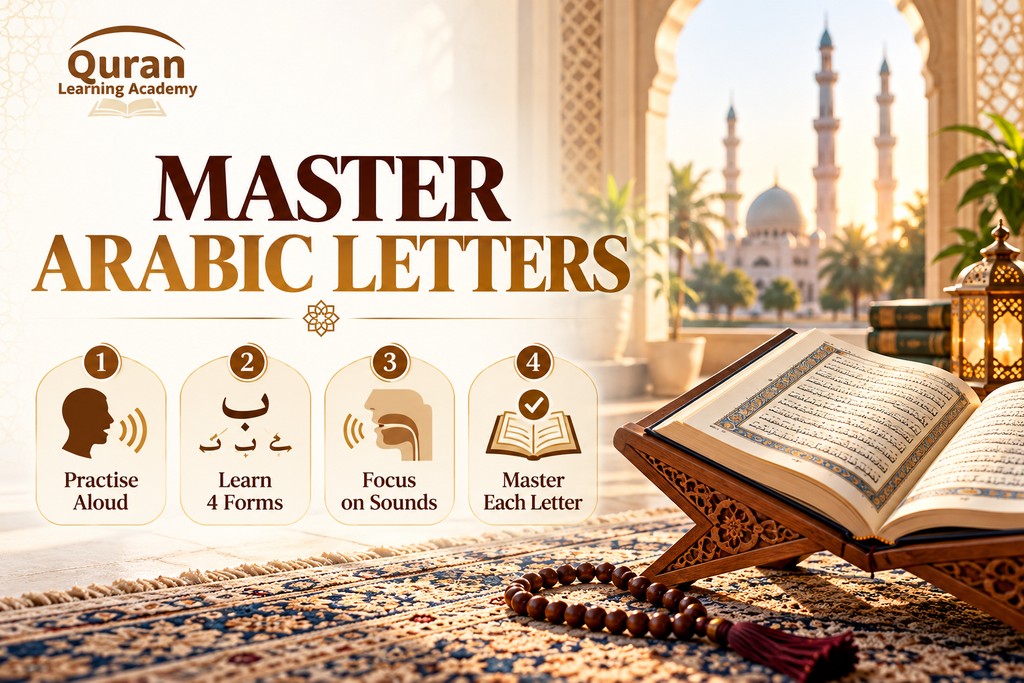
The Arabic alphabet has 28 letters, each with up to four written forms depending on its position in a word. Every letter also has a Makharij — a precise anatomical point in the mouth or throat from which it originates.
Letters like ض, ظ, ق, and ح have no equivalent sound in English, which means your mouth has never been trained to produce them.
Beginning with the alphabet is not a concession for slow learners; it is the only logical starting point for anyone learning a language whose script, sound system, and reading direction are all foreign.
The single biggest mistake adult learners in the UK make at this stage is treating the alphabet as a passive memorisation task, watching a few YouTube videos, recognising the letters visually, then assuming they can move forward.
Visual recognition and phonetic production are two completely different skills. You may be able to identify the letter ع on a page without being able to pronounce it correctly, which means every Quranic word containing that letter will be recited incorrectly in every prayer you make from that point forward.
The correct approach at this stage is:
- Practise each letter in isolation, out loud, repeatedly.
- Work through all four written forms of every letter until recognition is automatic.
- Focus on the physical position of your mouth and throat for each sound, not just the visual shape.
- Do not proceed to the next letter until the current one is stable and consistent.
2. Build Your Foundation Through Noorani Qaida
Noorani Qaida is a structured phonetic primer traditionally attributed to the scholar Noor Muhammad Haqqani.
It was designed specifically to teach Arabic letters, vowel markings, joining rules, and basic reading mechanics before a student ever attempts continuous Quranic text. Every fluent Quran reader, without exception, has passed through a foundational stage equivalent to what Noorani Qaida teaches.
The booklet is small, but its influence on your long-term relationship with the Quran is significant. Noorani Qaida introduces content in a deliberate sequence:
| Stage | What You Learn |
| Single letters | All 28 letters in their isolated forms |
| Vowel marks | Fatha, kasra, damma, sukoon, tanween, shaddah |
| Letter joining | How letters connect and change form within words |
| Compound words | Joining rules applied to short phonetic words |
| Basic Quranic words | Reading real Quranic vocabulary with correct vowelling |
The reason this sequence works is that each stage builds a physical habit, not just an intellectual concept. By the time you reach actual Quranic text, your mouth already knows what to do with most of the sounds it will encounter.
Many adult self-learners in Britain underestimate how long Noorani Qaida takes to complete properly.
A realistic timeline for adults studying independently is three to five months of consistent daily practice. Rushing through it in six weeks produces the illusion of progress without the actual foundation.
If you want to learn to read Quran by yourself with lasting accuracy, Noorani Qaida is the stage that determines everything that follows.
The Noorani Qaida Course in the UK at UK Quran Learning Academy teaches Arabic letter recognition, vowel movements, and joining rules through structured phonetic drills that build pronunciation accuracy before any Quranic recitation begins.
Start building the foundation that actually lasts.
3. Understand Short Vowels and Letter Joining Rules
Once individual letters are stable, Noorani Qaida moves you into vowel marks and joining rules. These are the mechanics that turn isolated letters into readable words. In Arabic, short vowels are written as small marks above or below the letters, they are not full letters themselves.
Understanding them is the difference between being able to read a vowelled Quranic text (as most beginners’ Mushafs are) and being completely unable to read. The core vowel marks you need to learn are:
- Fatha: a short diagonal mark above a letter producing the “a” sound.
- Kasra: a mark below the letter producing the “i” sound.
- Damma: a small loop above the letter producing the “u” sound.
- Sukoon: a small circle above a letter indicating it carries no vowel.
- Tanween: doubled vowel marks indicating nunation at the end of a word.
- Shaddah: a small “w” shape indicating a doubled consonant.
Letter joining is the stage where most self-taught learners hit their first real difficulty. Arabic letters change shape depending on whether they appear at the beginning, middle, or end of a word.
Some letters do not join to the letter that follows them, which breaks the visual flow of a word in ways that feel unpredictable until the rule is understood. Working through these joining patterns systematically, rather than guessing from context, is what separates readers who are genuinely fluent from readers who are half-decoding, half-guessing.
Step Inside Our Virtual Classrooms
See how our interactive lessons work. Watch these brief highlights of our students engaging with instructors.
Start Your Quranic Journey in the UK
Join our academy for structured online lessons with expert tutors, tailored to fit your schedule.
Book Your Free Trial4. Learn Tajweed Rules Progressively, Not All at Once
Tajweed is the science of correct Quranic recitation. It governs pronunciation, elongation, nasalisation, stopping points, and the specific qualities of each Arabic letter.
The Prophet Muhammad (peace be upon him) received the Quran with Tajweed as an intrinsic part of its transmission, which is why the scholarly tradition insists on its observance. Allah says in the Quran:
“وَرَتِّلِ الْقُرْآنَ تَرْتِيلًا “
Wa rattili l-qur’āna tartīlā.
“and recite the Qur’an with measured recitation.”
This verse is not a suggestion about aesthetic style — it is a direct instruction about precision. Tajweed is what “measured recitation” means in practice.
The mistake most self-learners make with Tajweed is one of two extremes: either they ignore it entirely, planning to “add it later,” or they try to master all of its rules simultaneously before reading a single verse. Neither works.
The correct approach is progressive introduction alongside actual reading practice:
| Tajweed Rule | When to Introduce It |
| Makharij (articulation points) | From the very beginning, integrated with alphabet learning |
| Ghunnah (nasalisation) | After letter joining is stable |
| Qalqalah (echo sound) | When reading short Surahs begins |
| Madd (elongation) | Alongside Juz Amma reading practice |
| Idgham and Ikhfa | After basic fluency is established |
The most problematic pattern for British adult learners is internalising incorrect articulation early. Letters like ض and ظ, ح and خ, س and ص produce different sounds that carry no distinction in English.
Without real-time correction from someone who can hear you, you will consistently collapse these into the nearest English sound and train yourself to recite incorrectly without realising it. No amount of later self-study can tell you that your ض sounds like a D, only someone listening can catch it.
UK Quran Learning Academy’s Online Tajweed Classes in the UK deliver structured instruction in Makharij, Sifaat, and pronunciation rules — moving you from foundational articulation points to recitation fluency without leaving errors undetected.

5. Practise Reading Juz Amma from the Short Surahs
Juz Amma is the final thirtieth of the Quran, containing the short Surahs most British Muslims hear repeatedly in Salah, Surah Al-Fatiha, Surah Al-Ikhlas, Surah Al-Nas, and Surah Al-Falaq among others.
Beginning your practical Quranic reading from Juz Amma rather than from the beginning of the Mushaf is not arbitrary. The Surahs here are short, their vocabulary is frequently repeated, and their recitation in daily prayers gives you an immediate context in which fluency becomes meaningful.
The recommended sequence within Juz Amma for beginners is to start from the final Surahs and work backwards, beginning with Surah Al-Nas and progressing toward Surah Al-Duha.
This approach means each Surah you encounter becomes progressively longer, maintaining a manageable difficulty curve rather than confronting you with a long Surah before your reading mechanics are stable.
At this stage, a practical daily practice structure makes the difference between progress and stagnation:
- Read one short Surah aloud at least three times per session.
- Identify any word that caused you to pause or guess, and isolate it.
- Trace that word back to its letters and vowel marks, reading it syllable by syllable.
- Return to the full Surah and read it again without stopping.
This process is slow in the beginning and accelerates sharply within four to six weeks of consistent application.
Experience the Academy in Action
Curious about our teaching style? Take a quick look inside a live session to see our immersive, supportive learning environment first-hand.
Start Your Quranic Journey in the UK
Join our academy for structured online lessons with expert tutors, tailored to fit your schedule.
Book Your Free Trial6. Build a Daily Recitation Routine That Fits British Life
Consistency is the single factor that determines whether you successfully learn to read Quran by yourself, or whether you remain in the same place for years. The challenge for most adults in Britain is not motivation — it is structure. A full-time job, children, a commute into central London or the drive to a business park in Birmingham, evening responsibilities: these leave genuinely limited windows for independent study.
The most effective daily recitation routines for working adults in the UK share several characteristics:
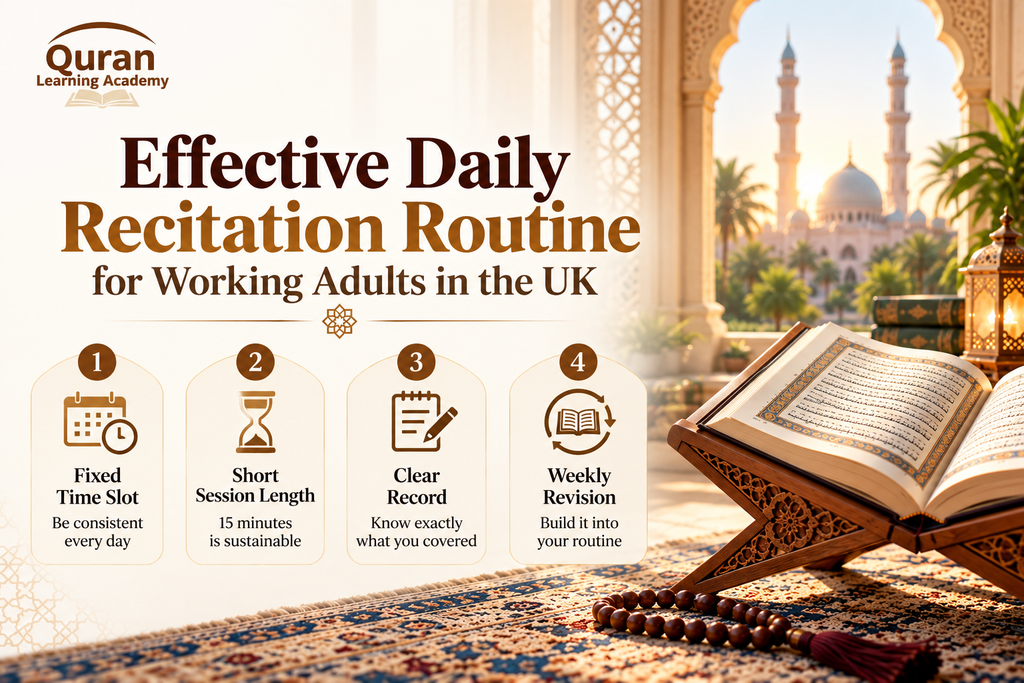
- A fixed time slot with no flexibility about the slot itself, only about the content covered.
- A session length short enough to be maintained on a difficult day — fifteen minutes is more sustainable than ninety.
- A clear record of what was covered, so the next session has a defined starting point.
- Weekly revision built into the routine rather than added as an afterthought.
The timing that works for most British Muslim adults is either immediately after Fajr prayer — before the day begins and when the mind is quiet — or after Isha prayer when the children are in bed. Both windows work because they are already anchored to a religious practice, making the additional commitment easier to maintain.
Read more: How to Get Better at Reading Quran in the UK.
7. Know the Limits of Self-Study and When to Seek Guidance
There is a meaningful difference between learning to read Quran by yourself — meaning without a classroom or a prescribed institutional programme — and learning entirely without any qualified listener. The first is achievable and rewarding. The second produces a category of persistent error that self-assessment cannot detect.
The core limitation of pure self-study is phonetic. You cannot hear your own mispronunciation because your brain is processing what you intend to say, not what you are actually producing. This is not a reflection of effort or intelligence — it is how human auditory processing works. Research on adult language learning consistently shows that self-taught readers who have never been assessed by a qualified teacher carry mispronunciation of specific Arabic phonemes for years, often permanently.
The specific sounds most commonly mispronounced by British adult learners include:
- ع — the voiced pharyngeal fricative, produced deep in the throat with no English equivalent.
- غ — similar to a French “r” but further back in the throat.
- ق — the uvular stop, produced further back than the English “k.”
- ض — a pharyngealised “d” with no English equivalent.
If these sounds are not corrected before they become habitual, they become part of your recitation identity and are extremely difficult to unlearn. This is why even highly motivated self-learners benefit from periodic assessment with a qualified Quran teacher, even if the majority of their practice is independent.
The Learn Quran for Beginners Classes in the UK at UK Quran Learning Academy guide first-time students through foundational Quran reading skills, basic Tajweed rules, and Arabic alphabet recognition using step-by-step instruction built specifically for absolute beginners.
8. Progress to Continuous Reading with Tajweed Applied
Once you can read Juz Amma reliably without pausing on individual words, the next stage is extending your reading into longer Surahs and applying Tajweed rules with consistent accuracy rather than selective attention.
This is the stage where the gap between self-taught readers and formally trained readers becomes most visible. Self-taught readers at this stage can typically decode individual words correctly.
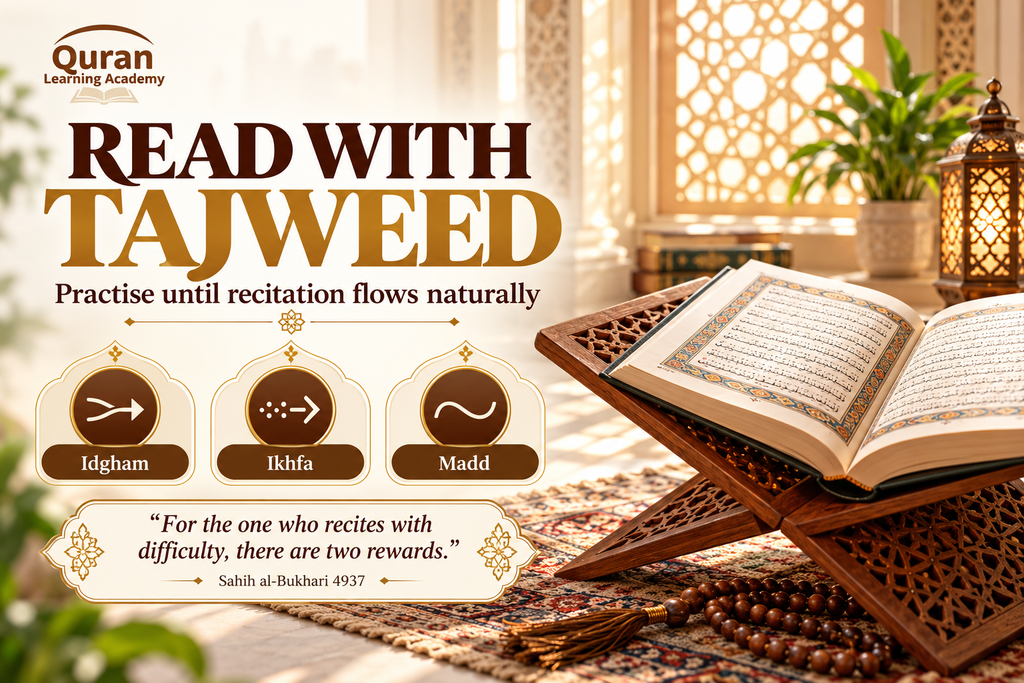
What they struggle with is reading continuously, maintaining the correct Tajweed application across a full Surah without reverting to habits, applying the rules of Idgham (assimilation), Ikhfa (concealment), and Madd (elongation) simultaneously while reading, and maintaining the correct pace without either rushing or halting.
Continuous reading requires that the mechanics have become automatic. When Tajweed rules still require conscious thought, they cannot be applied during continuous recitation — the mental load is simply too high.
The path to automaticity is volume: reading the same text many times until the rules execute without deliberate attention.
Allah’s Messenger (peace be upon him) said:
“مَثَلُ الَّذِي يَقْرَأُ الْقُرْآنَ وَهْوَ حَافِظٌ لَهُ مَعَ السَّفَرَةِ الْكِرَامِ الْبَرَرَةِ، وَمَثَلُ الَّذِي يَقْرَأُ الْقُرْآنَ وَهْوَ يَتَعَاهَدُهُ وَهْوَ عَلَيْهِ شَدِيدٌ، فَلَهُ أَجْرَانِ
“Such a person as recites the Qur’an and masters it by heart, will be with the noble righteous scribes (in Heaven). And such a person exerts himself to learn the Qur’an by heart, and recites it with great difficulty, will have a double reward.”
This hadith addresses directly the reality most British beginners face: the recitation that comes with difficulty and effort carries its own reward. The instruction is not to stop because it is hard — it is to continue regardless, and to take that difficulty seriously enough to keep improving.
9. Connect Your Reading to Meaning and Daily Salah
Reading the Quran fluently and understanding what you are reading are different but related goals. At the beginner stage, the priority is accurate recitation. But as fluency develops, connecting the recitation to meaning deepens both the experience of reading and the motivation to continue.
British Muslims who reach basic Quranic fluency and then engage with Tafsir consistently report that the quality of their Salah changes in a way they had not anticipated — the words they recite in Fajr are no longer sounds, they are meanings.
For a British adult who has grown up hearing Arabic in prayer without understanding it, the transition from phonetic reading to meaning-connected recitation is one of the most significant experiences in their religious development.
Allah says in the Quran:
“إِنَّ هَٰذَا الْقُرْآنَ يَهْدِي لِلَّتِي هِيَ أَقْوَمُ”
Inna hādhā l-qur’āna yahdī lillatī hiya aqwam.
“Indeed, this Qur’an guides to that which is most suitable.”
The Quran’s guidance operates through understanding, not only recitation. Basic engagement with translation, even simply reading a reliable English translation alongside your recitation, begins to build the semantic connection that makes the Quran genuinely present in daily life rather than a ritual text recited at a distance.
The Quran Tafsir Course in the UK at UK Quran Learning Academy teaches students to read the Quran with an interpretation of Quranic verses through classical Tafsir works including Ibn Kathir, al-Tabari, and al-Qurtubi.
Join UK Quran Learning Academy and Recite with Confidence
UK Quran Learning Academy connects British learners with qualified Azhari instructors who hold Ijazah and specialise in teaching students who are starting from zero.
Every instructor has been trained in the structured classical methodology and understands the specific phonetic challenges that English-speaking adults face with Arabic sounds.
Lessons are delivered live and online, which means there is no commute, no classroom schedule, and no waiting for a seat in a local masjid class. Sessions are structured around UK time zones and designed to fit around work and family commitments.
Whether you are based in Manchester, Birmingham, Leeds, or London, access to a qualified Quran teacher is available whenever your schedule allows.
What sets the academy apart is not the technology, it is the pedagogical rigour. The teachers are not self-taught enthusiasts; they are qualified scholars trained in the same institutions that have produced generations of Quran readers across the Islamic world.
Their instruction is corrective in real time, which means errors do not compound session after session.
Discover Our Quran Courses

Book Your Free Trial at UK Quran Learning Academy Today
Conclusion
Understanding How to Learn to Read Quran by Yourself in the UK begins with consistent practice, suitable learning resources, and achievable daily goals.
Self-study can help beginners build essential reading skills, while feedback from a qualified Quran teacher can correct pronunciation mistakes and improve Tajweed.
With patience and commitment, learners can gradually develop confidence and strengthen their connection with the Quran.
Read more: How to Read the Quran? A Step-by-Step Guide for British Muslims
Frequently Asked Questions
Can an adult with no Arabic background genuinely learn to read Quran by yourself from scratch?
Yes, adults in the UK with no Arabic background can learn to read the Quran independently through consistent practice and structured resources. However, periodic guidance from a qualified Quran teacher is important for correcting pronunciation and preventing mistakes from becoming permanent habits.
How long does it realistically take to learn to read Quran by yourself as a British adult?
Most adults starting from scratch may need six to twelve months of consistent daily practice to read Juz Amma with basic Tajweed accuracy. Practising for thirty to forty five minutes daily, alongside structured guidance, can help learners build their reading skills more effectively.
Is it better to use apps or structured classes when trying to learn to read Quran by yourself?
Apps and audio resources help adults recognise Arabic letters and listen to correct Quranic recitation, but they cannot reliably identify every pronunciation error. Structured classes with a qualified teacher provide personalised feedback, particularly on challenging Arabic letters such as ع, غ, ق, and ض.
What is the best starting resource to learn to read Quran by yourself in the UK?
Noorani Qaida is a widely used starting resource for adults learning to read the Quran from scratch. It introduces Arabic letters, vowel marks, joining rules, and basic word reading progressively, helping learners develop foundational skills through regular practice and teacher feedback.
At what stage should I stop learning independently and seek a qualified Quran teacher?
Ideally, adults should seek guidance from a qualified Quran teacher from the beginning, especially when learning Arabic letter pronunciation and articulation points. If independent study is necessary initially, arrange an assessment before progressing into regular Quranic reading to identify and correct established mistakes.






Leave a Reply