 Quran

Most people who attempt to memorise 2 pages of Quran a day hit the same wall: they sit with the Mushaf for three hours, feel productive, then discover the next morning that most of it has gone. The problem is not effort. The problem is that unstructured effort at this pace does not produce durable retention.
British Muslims balancing work, university, or family commitments face a specific version of this challenge. Time is limited, mental bandwidth is distributed, and there is no teacher sitting across from you catching errors in real time. This guide addresses that precise situation with methods drawn from established Hifz pedagogy and applied to a 2-page daily target.
1. Establish Correct Tajweed Before Beginning Any New Page
Incorrect pronunciation memorised through repetition becomes deeply embedded and extraordinarily difficult to remove. A student who used to memorise 2 pages of Quran a day with consistent errors in Ghunnah duration or Qalqalah application does not simply need to re-learn those errors; they must actively overwrite a pattern that repetition has already reinforced.
Before approaching a 2-page daily target, every student must be confident in the following:
- Letter articulation from the correct Makhraj.
- Noon sakinah and Meem sakinah rules applied consistently.
- Basic Madd elongation distinguished from shortened vowels.
For UK-based learners who are not yet at this level, the Tajweed Course for Adults in the UK from the UK Quran Learning Academy covers Makharij, Sifaat, Ghunnah rules, Qalqalah application, and Madd elongation through live instruction structured specifically for British adult learners.

2. Divide Your Daily Target Across Two Focused Sessions
Memorising both pages in a single sitting is one of the most common structural mistakes at this pace. Cognitive fatigue increases as the session continues, and material encoded in the second hour is retained less reliably than material encoded in the first. The gap between sessions is not rest; it is consolidation time for what was encoded in the morning.
A practical daily structure for the 2-page pace is as follows:
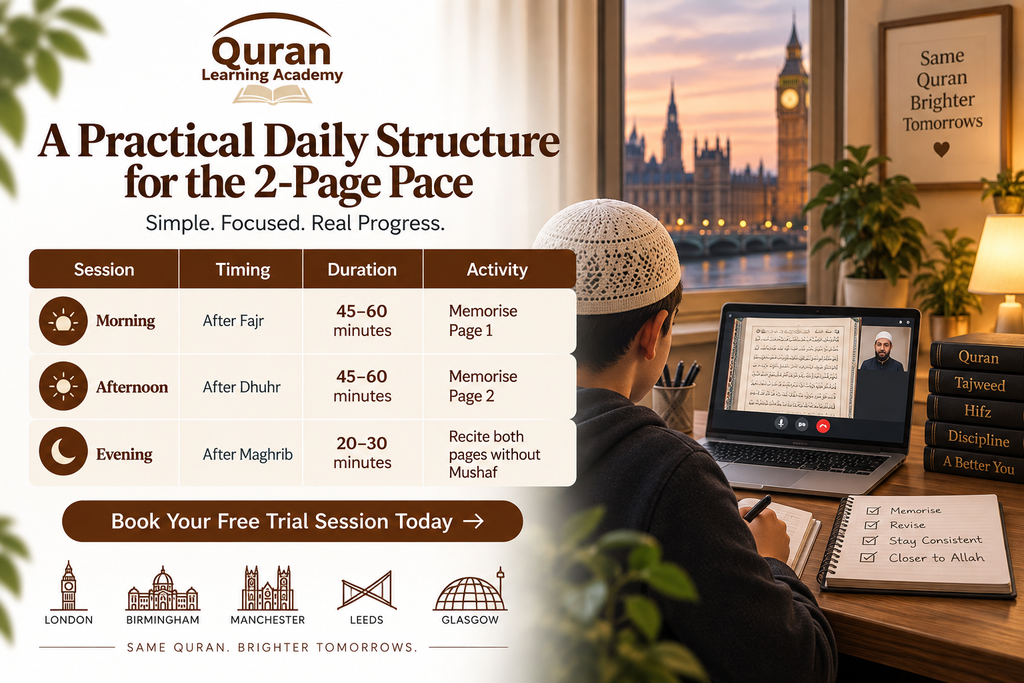
| Session | Timing | Duration | Activity |
| Morning | After Fajr | 45 to 60 minutes | Memorise Page 1 using the 20-repetition method |
| Afternoon | After Dhuhr | 45 to 60 minutes | Memorise Page 2 |
| Evening | After Maghrib | 20 to 30 minutes | Recite both pages without Mushaf |
The post-Fajr window is specifically effective for new memorisation. The mind is rested, the environment in most UK homes is quiet, and the early morning carries a distinctive focus that later hours simply do not replicate. Students who attempt to move both sessions to the evening consistently report weaker retention by the following morning.
Step Inside Our Virtual Classrooms
See how our interactive lessons work. Watch these brief highlights of our students engaging with instructors.
Start Your Quranic Journey in the UK
Join our academy for structured online lessons with expert tutors, tailored to fit your schedule.
Book Your Free Trial3. Apply the 20-Repetition Rule Before Connecting Any Verse
Before linking a new verse to the one before it, that verse must be recited alone a minimum of 20 consecutive times without looking at the Mushaf. Repetition below this count typically produces short-term recall only. The student can repeat the verse immediately but cannot retrieve it reliably 24 hours later.
The correct sequence for each new verse is:
- Listen to a trusted recitation of the verse before reading it yourself.
- Read the verse once with full attention to Tajweed, without rushing.
- Recite aloud 20 times, looking only when genuinely unable to continue.
- Close the Mushaf and recite 5 additional times from memory.
- Link the new verse to the previous one and recite both together 10 times.
Students who memorise entire pages before testing individual verses consistently find their retention collapses within 48 hours. The 20-repetition threshold is the point at which encoding shifts from surface recall to deeper retention. This method is the foundation on which the Quran Memorisation Course in the UK at the UK Quran Learning Academy is structured, combining classical Hifz methodology with live instructor correction.

4. Link Yesterday’s Pages Before Opening New Material
Every new page must be connected to the page memorised the previous day, and that connection must be recited without the Mushaf before any new material is approached. This linking step is where most self-directed students at the 2-page pace begin to fail. They memorise forward with discipline but neglect to bind new learning to what came before. The result is isolated fragments rather than a continuous, flowing memorisation.
The standard linking sequence before each morning session:
- Recite the previous two pages completely from memory before touching new material.
- Mark any point where you stumble and consolidate it before moving forward.
- Begin new memorisation only after completing the previous pages without significant error.
This mirrors the classical approach in traditional Hifz pedagogy: no student advances until what came before is secure. UK students memorising independently often discover this gap in the second or third week, when they find themselves unable to recite across page boundaries without breaking down.
Read more:How to Memorise a Page of Quran in 5 to 30 Minutes
5. Dedicate One Full Day Each Week Exclusively to Revision
At a 2-page daily pace, a student memorises 12 new pages per week. Without a dedicated revision day, older portions begin to fade faster than new material is added. One day each week must be reserved entirely for reviewing previously memorised material, with zero new memorisation on that day.
A practical weekly revision structure at this pace:
| Week | New Pages Added | Cumulative Total | Revision Focus |
| Week 1 | 12 pages | 12 pages | Pages 1 to 12 |
| Week 2 | 12 pages | 24 pages | Pages 1 to 24, prioritise 1 to 12 |
| Week 4 | 12 pages | 48 pages | Full accumulated portion |
| Week 12 | 12 pages | 144 pages | Rotating review across all Juz |
The revision day is not optional at this pace. Students who skip it consistently find that by week four, earlier pages have deteriorated to a level requiring full re-memorisation. That re-memorisation then delays new progress, creating a cycle that eventually stalls the entire programme.
6. Record Your Recitation and Listen Back Before Each Teacher Session
Recording your recitation and listening critically before a teacher session is among the most underused self-correction tools available to Hifz students. When a student hears their own recitation played back, errors in rhythm, Madd duration, and Tafkhim and Tarqiq become immediately audible. These are errors the memorising brain frequently masks during active recitation because it fills gaps from memory rather than from what is actually being said aloud.
This habit is particularly valuable for British students whose first language is English, as the phonological inventory of English does not include pharyngeal consonants such as Ayn and Ha, or the emphatic consonants Sad, Dad, Ta, and Dha. Hearing the playback makes these distinctions audible in a way that reciting alone does not.
Catching even 30 percent of these errors before a teacher session saves correction time and builds the independent recitation confidence that sustained Hifz ultimately requires.
Experience the Academy in Action
Curious about our teaching style? Take a quick look inside a live session to see our immersive, supportive learning environment first-hand.
Start Your Quranic Journey in the UK
Join our academy for structured online lessons with expert tutors, tailored to fit your schedule.
Book Your Free Trial7. Begin From Juz Amma Rather Than From Al-Baqarah
Most structured Hifz programmes recommend beginning memorisation from Juz Amma before proceeding in reverse order toward Al-Baqarah, rather than starting from the beginning of the Quran. The shorter Surahs of Juz Amma build early confidence and are frequently recited in Salah, which reinforces repetition naturally throughout the day.
Their rhythmic patterns also create phonological familiarity with Quranic Arabic before the longer verses of the earlier Juz are encountered.
After Juz Amma, classical programmes typically move to Juz 29, then Juz 28, before eventually reaching Al-Baqarah when memorisation skills and stamina are fully developed. Students who begin with Al-Baqarah at a 2-page daily pace frequently find that the syntactic complexity and verse length of the early Juz produce a discouraging and unsustainable workload before foundational memorisation habits are established.
For students who want structured guidance on sequencing their Hifz journey, the Hifz Classes for Adults in the UK at the UK Quran Learning Academy provide personalised memorisation plans built around each student’s current level, schedule, and long-term target.

8. Work With a Certified Instructor at Least Three Times Per Week
Memorising 2 pages of Quran daily without regular teacher correction is one of the highest-risk approaches a Hifz student can take. Errors accumulate silently. Confidence grows while the foundation beneath it contains systematic Tajweed mistakes that will require painful revision later. A certified instructor catches these errors within seconds of hearing the first recitation.
Three weekly sessions with a qualified teacher represent the minimum for maintaining accuracy at this pace. Students on three-session-per-week programmes progress more reliably than those on weekly sessions because the error-correction window remains short enough that mistakes never become deeply embedded habits. Daily instruction, where schedule permits, is optimal.
For UK students managing full-time work or studies alongside their Hifz, the Online Quran Classes for Kids in the UK and adult programmes at the UK Quran Learning Academy offer flexible scheduling that fits around existing commitments, with qualified Azhari instructors delivering live one-to-one correction across all time zones.

The UK Quran Learning Academy Is Built for This Commitment
Memorising 2 pages of Quran a day requires more than personal discipline. It requires consistent, expert correction from instructors who understand the specific challenges British learners face when applying classical Hifz methodology to modern, busy lives.
The UK Quran Learning Academy connects learners across London, Birmingham, Manchester, and beyond with qualified Azhari instructors who hold verified credentials and teach through live, interactive sessions. Flexible scheduling, structured progression, and one-to-one attention make it possible to maintain a 2-page daily pace without sacrificing accuracy or retention quality.
Discover Our Quran Courses
- Tajweed Course for Adults in the UK
- Quran Memorisation Course in the UK
- Hifz Classes for Adults in the UK
- Online Quran Classes for Kids in the UK
- Quran Classes for Adults
- Quran Classes for Female / Sisters
- Learn Quran Course for Beginners

Conclusion
Memorising 2 pages of Quran a day is achievable, but only within a system built around the right structure. The students who sustain this pace are those who protect their Tajweed from the very first verse, divide their daily effort across focused sessions, apply the 20-repetition rule before connecting each new verse, and never advance without linking new material to everything that came before.
The revision day, the self-recording habit, and consistent teacher correction are not optional additions. They are the mechanisms that separate students who complete their Hifz from those who plateau at 50 or 100 pages with fragments that no longer hold together.
How to memorise 2 pages of Quran a day is ultimately a question answered not by motivation but by method.
Read more: Easy Quran Verses To Memorise For Daily Life.
Frequently Asked Questions
Is memorising 2 pages of Quran a day suitable for complete beginners?
Two pages per day is an intermediate to advanced Hifz pace. Beginners should typically begin at half a page to one page daily for the first four to six weeks, building memorisation stamina and establishing correct Tajweed habits before increasing volume. Rushing to 2 pages without a solid foundation typically results in weak, error-filled memorisation that requires full revision later.
What is the best time of day to memorise 2 pages of Quran?
The post-Fajr window is the most effective time for Quran memorisation according to both classical scholarship and the teaching experience of certified instructors. The mind is rested, the environment is quiet, and the early morning produces a focus that later hours rarely replicate. Splitting the 2-page goal between post-Fajr and post-Dhuhr optimises retention better than a single long sitting.
How do I stop forgetting pages I memorised weeks ago while adding new ones?
A structured rolling revision system is the only reliable answer. Each day, recite the previous two pages before beginning new memorisation. Each week, dedicate one full day to reviewing all memorised material from the past month. As your total memorised portion grows, use a rotating revision schedule that revisits each Juz at least once every two weeks. Without this system, forgetting is not a risk; it is a certainty.
How long does it realistically take to memorise the full Quran at this pace?
At six memorisation days per week plus one full revision day, a student memorises 12 pages weekly. The standard Mushaf contains 604 pages, which places the realistic completion timeline at approximately 50 to 51 weeks when revision days are factored in accurately. Students who plan around the raw calculation without accounting for revision, illness, or life interruptions consistently find themselves discouraged when the timeline extends.








[…] Read more: How to Memorise 2 Pages of Quran a Day. […]