 Quran
Many Muslims in the UK want to Improve Recitation of the Quran but struggle with pronunciation, pauses, and Tajweed rules. Busy schedules and limited access to expert feedback can make progress difficult.
With structured lessons, regular practice, and guidance from qualified teachers, learners can correct common mistakes and develop more accurate, confident recitation.
1- Correct Your Makharij Before Everything Else

Most recitation errors among English-speaking Muslims in the UK trace back to a single root cause: mispronounced letters. English and Arabic do not share the same phonetic system.
Arabic contains sounds produced from the throat, the back of the tongue, the lips, and positions in the mouth that English never requires. When a learner maps Arabic letters onto familiar English sounds, the recitation breaks down at the most fundamental level.
Makharij al-Huroof refers to the precise exit points of each Arabic letter. The ح (ha) is produced from the middle of the throat, not the top.
The ق (qaf) originates from the back of the tongue against the soft palate, entirely unlike the English “k.” The ع (ayn) requires a constriction of the lower throat that most native English speakers have never been asked to produce.
Correcting these before moving to Tajweed rules means every subsequent lesson builds on an accurate foundation rather than a flawed one. Practical steps for Makharij correction:
- Identify which letters consistently sound incorrect by recording your own recitation.
- Work through Noorani Qaida systematically, as it is specifically structured to isolate and train each letter’s articulation point.
- Practise each letter in isolation, then in two-letter combinations, then in Quranic words before reading full verses.
- Repeat each letter exercise until you can produce it consistently without thinking about the mechanics.
Many British learners who studied independently for years find that targeted Makharij correction in even a few structured weeks transforms the clarity of their recitation entirely. Online Tajweed Classes in the UK at the UK Quran Learning Academy open with Makharij correction before any rule instruction begins.

Start improving your recitation today
2. Learn Tajweed Rules Systematically, Not Randomly
Tajweed is not decoration added on top of recitation. It is the science that governs how each letter is produced, modified, and joined in context.
Reading the Quran without Tajweed is possible, but it introduces regular errors in meaning that the reader often cannot detect. The obligation to recite correctly is grounded in a clear Quranic command. Allah says:
” وَرَتِّلِ الْقُرْآنَ تَرْتِيلًا”
Wa rattil il-Qur’ana tartila.
“and recite the Qur’an with measured recitation.”
The verse does not instruct Muslims to recite quickly, or loudly, or frequently. It instructs measured, precise recitation — which is precisely what Tajweed delivers.
The core rules every learner must internalise before reaching intermediate recitation level are:
| Tajweed Rule | What It Governs | Common Mistake in UK Learners |
| Ghunnah | Nasalisation held for two counts on noon and meem | Skipping the nasal hold entirely |
| Qalqalah | Echo vibration on five specific letters when in sukoon | Over-lengthening the bounce sound |
| Madd Tabi’i | Natural elongation of two beats | Under-elongating, producing a short vowel instead |
| Madd Wajib Muttasil | Compulsory elongation of four to five beats | Applying natural Madd duration instead of extended |
| Idgham | Merging of noon sakinah into following letters | Pronouncing the noon clearly when it should disappear |
| Ikhfa | Concealing the noon between clear and merged | Defaulting to either full Izhar or full Idgham incorrectly |
Learning these rules in sequence matters. A learner who jumps to Madd types before understanding Noon Sakinah rules will hit contradictions they cannot resolve, and their recitation will become inconsistent rather than more accurate.
The Tajweed Course for Adults in the UK at the UK Quran Learning Academy covers every rule in the table above through structured modules designed for adult learners who have no prior Tajweed background.

3. Build a Consistent Daily Practice Routine
The biggest obstacle to sustained improvement for Muslims in the UK is not motivation. It is consistency. A professional working in Leeds or a mother managing school schedules in Coventry does not lack commitment.
What breaks down is the expectation that meaningful practice requires long uninterrupted blocks of time.
Research into language acquisition and skill development consistently shows that short, focused, daily sessions outperform infrequent long ones. The same principle applies directly to recitation training.
A practical daily routine structured around a British working week might look like this:
| Time Available | Suggested Practice |
| 10 minutes (weekday mornings) | Recite a fixed passage with full Tajweed attention. Record and listen back. |
| 15 minutes (weekday evenings) | Review one specific rule and apply it across five to ten verses. |
| 30 minutes (weekend) | Full recitation session with instructor feedback or against a reference recording. |
| 5 minutes (any gap) | Listen to a qualified Qari reciting the passage you are currently working on. |
Three principles that determine whether a daily routine produces measurable improvement:
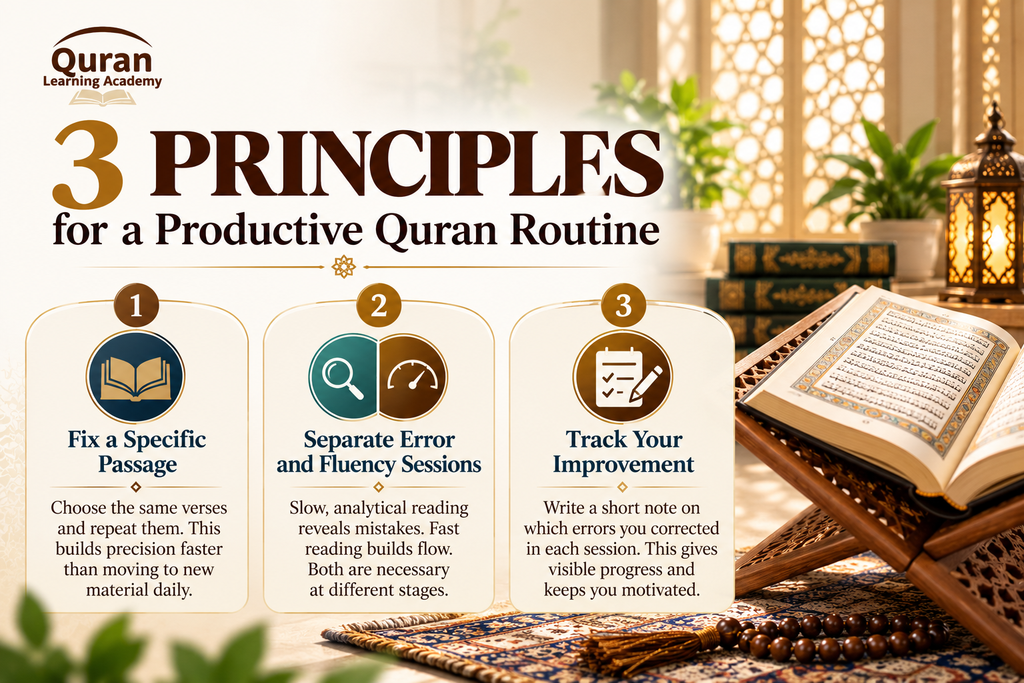
- Fix a specific passage, not a general intention to “recite something.” Repetition of the same verses builds precision faster than moving through new material daily.
- Separate error-identification sessions from fluency sessions. Slow, analytical reading reveals mistakes. Fast reading builds flow. Both are necessary at different stages.
- Track what you improve, not just what you recite. A short note on which errors you corrected in each session provides visible evidence of progress, which sustains motivation over weeks and months.
Step Inside Our Virtual Classrooms
See how our interactive lessons work. Watch these brief highlights of our students engaging with instructors.
Start Your Quranic Journey in the UK
Join our academy for structured online lessons with expert tutors, tailored to fit your schedule.
Book Your Free Trial4. Train Your Ear Alongside Your Voice
Quran recitation is an auditory art before it is a technical one. The Prophet Muhammad, peace be upon him, received the Quran through listening and recitation, and the scholarly tradition of transmitting the Quran has always been oral, teacher to student, for over fourteen centuries.
An untrained ear cannot catch its own errors, which is why learners who practise without listening reference reach a ceiling they cannot break through independently.
“خَيْرُكُمْ مَنْ تَعَلَّمَ الْقُرْآنَ وَعَلَّمَهُ “
“The best among you (Muslims) are those who learn the Qur’an and teach it.”
The hadith frames Quran learning as a transmission process. Learning from a teacher, and transmitting what you learn, is built into the Islamic understanding of proper Quran education.
To train the ear effectively alongside voice practice:
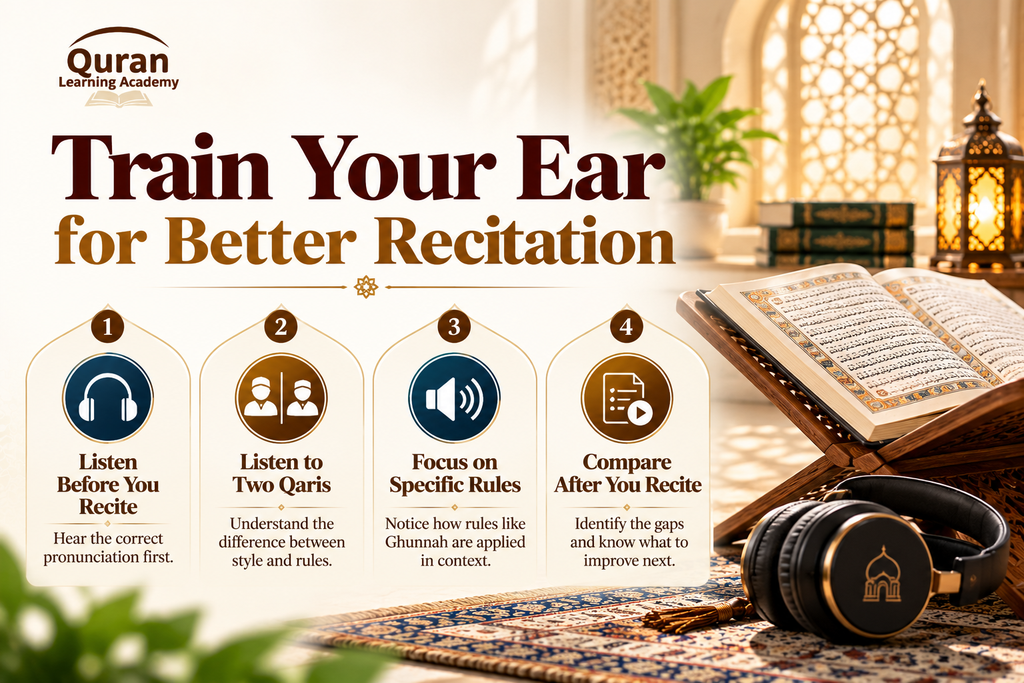
- Listen to the passage you plan to practise before you recite it, not after. This sets a correct phonetic blueprint before your own errors become the reference point.
- Listen to at least two different qualified Qaris reciting the same passage to distinguish between stylistic variation and rule application.
- Use listening sessions to specifically track the rules you are currently studying. When you hear Ghunnah applied correctly in a recitation, your brain stores both the sound and the context.
- After your own recitation, compare it directly against a reference recording. The gap between the two tells you exactly where to focus next.
Read more: How to Get Better at Reading Quran in the UK.
5. Understand What You Recite with Basic Tafsir
Recitation accuracy improves significantly when a learner understands the meaning of what they are reading. This is not only a spiritual observation, it is a practical one.
When you understand that a verse is commanding, or consoling, or describing a scene, your natural vocal delivery shifts to match the content.
Pauses fall where the meaning requires them. Elongations feel purposeful rather than mechanical. Scholars of Tajweed from the earliest generations consistently noted that understanding the Quran and reciting it correctly reinforce each other.
The Quran Tafsir Course in the UK at the UK Quran Learning Academy teaches students to read Quranic verses through classical interpretive methodology, working with the works of Ibn Kathir, al-Tabari, and al-Qurtubi.
6. Master the Foundations with Noorani Qaida First
Many adult Muslims in the UK who learned to recite as children were rushed through Noorani Qaida before they had genuinely mastered it.
The result is a recitation built on shaky phonetic foundations that were never properly corrected. Noorani Qaida is not a children’s text. It is a systematic phonetic training programme that isolates every Arabic sound, every vowel movement, every joining rule, and every sukoon position.
Adults who return to it with seriousness typically discover that several letters they believed they were producing correctly were slightly or significantly off.
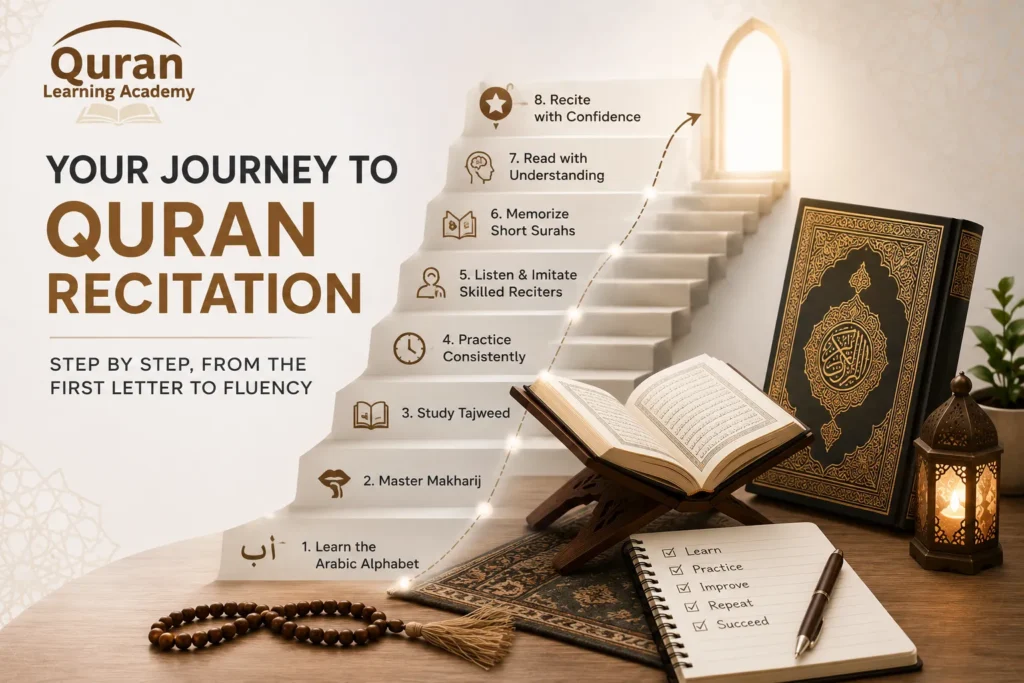
The correct progression through Noorani Qaida moves through:
- Individual Arabic letter recognition and production.
- Short vowel application (fatha, kasra, damma) on single letters.
- Sukoon rules and letter joining patterns.
- Tanween application and double-letter (shaddah) production.
- Combined reading of short Quranic words using all learned rules.
Skipping any stage to reach Quranic reading faster consistently produces the same result: a learner who reads at speed but with embedded errors they cannot identify without structured correction.
Experience the Academy in Action
Curious about our teaching style? Take a quick look inside a live session to see our immersive, supportive learning environment first-hand.
Start Your Quranic Journey in the UK
Join our academy for structured online lessons with expert tutors, tailored to fit your schedule.
Book Your Free Trial7. Learn the Authenticated Styles of Quranic Recitation
The Quran was revealed and transmitted through ten authenticated styles of recitation known as the Qira’at. In the UK, virtually all community recitation follows Hafs ‘an ‘Asim, the style taught in most mosques and Islamic centres from Birmingham to Glasgow.
Understanding that this style is one of ten, each with its own validated chain of transmission reaching back to the Prophet, gives a learner accurate context for their own recitation development. It also opens access to the study of other authenticated styles for those who reach advanced levels.
Even within Hafs ‘an ‘Asim, the recitation modes of Tarteel (measured recitation), Tadweer (moderate pace), and Hadr (rapid recitation) each require different levels of rule application. Most learners in the UK practise Tarteel but have never explicitly studied how Tajweed rules shift across these modes.
The Quran Qirat Learning Course in the UK at the UK Quran Learning Academy teaches British students the authenticated recitation styles through classical scholarship.

8. Work with a Qualified Instructor Who Hears Your Errors
Every step above can be studied from books and recordings. None of them can be completed without a teacher who listens to your specific errors and corrects them in real time.
This is the most consistent finding across every tradition of Quran education: self-study produces generalised improvement at best and entrenched errors at worst.
A qualified instructor does not merely explain rules, they hear where your recitation breaks from the rule in actual application, which is something no recording or written guide can do.
For Muslims in the UK, the practical barrier has historically been access. In-person classes at local mosques often run at fixed times that conflict with work and family schedules. Travel adds another layer of difficulty, particularly for those in areas with smaller Muslim communities.
Online live instruction resolves both barriers without reducing the quality of feedback. A qualified instructor can hear every letter, correct every error, and provide targeted exercises for specific problems, whether the student is in central London or rural Lincolnshire.
The Quran Recitation Classes in the UK at the UK Quran Learning Academy deliver live, interactive instruction covering Makharij al-Huruf, Tajweed rules, recitation rhythm, and melodic application for all age groups. Sessions fit around working and family schedules.
Take Your First Step Towards Better Recitation with The UK Quran Learning Academy
Every element of UK Quran Learning Academy‘s programme is designed around the specific realities that British Muslims face: structured careers, school schedules, weekend commitments, and the challenge of finding consistent Islamic education that does not require choosing between faith and daily life.
The Academy’s instructors are qualified Azhari scholars who hold verified Ijazah chains reaching back to the Prophet Muhammad, peace be upon him.
They understand the phonetic distance between English and Arabic, and they teach recitation correction accordingly, not with generic instruction but with targeted feedback built around where English-speaking learners specifically struggle.
All sessions run live online, accessible from anywhere in the UK, at times that accommodate morning, evening, and weekend availability. No commute. No fixed classroom. No missed lessons because of a work commitment or a school run.
Start with a free trial session and receive your first professional recitation assessment from a qualified instructor.
Discover Our Quran Courses
- Online Tajweed Classes in the UK
- Tajweed Course for Adults in the UK
- Quran Tafsir Course in the UK
- Quran Qirat Learning Course in the UK
- Quran Recitation Classes in the UK
- Quran Classes for Female / Sisters
- Quran Online Academy
- Quran Memorization (Hifz) Course

Begin your free trial at the UK Quran Learning Academy today.
Conclusion
To improve recitation of the Quran is not a matter of reciting more. It is a matter of reciting correctly. Every step covered in this article, from Makharij correction to Tajweed rule mastery, from consistent daily practice to working with a qualified instructor, builds on the one before it.
British Muslims carry a particular advantage: access to live, expert instruction that did not exist a generation ago, combined with the flexibility of online learning that fits around real life.
The question is no longer whether structured improvement is possible. The question is when you start. Begin with a free trial at the UK Quran Learning Academy and receive an honest assessment of exactly where your recitation stands and what it needs next.
Read more: How to Read Quran for Beginners: Where to Start and What to Do First.
FAQ
What is the most important step to improve recitation of the Quran for beginners?
Makharij correction comes first. Without accurate letter articulation, every subsequent Tajweed rule will be applied to mispronounced sounds, meaning the errors compound rather than reduce. Beginners should complete a structured Noorani Qaida programme before moving to full Quranic recitation.
How long does it take to noticeably improve recitation of the Quran?
Learners who practise consistently for fifteen to thirty minutes daily under qualified instruction typically notice measurable improvement in letter accuracy and rule application within four to eight weeks. The timeline depends heavily on the consistency of practice and the quality of feedback received.
Can adults genuinely improve their Quran recitation after years of incorrect habits?
Yes. Incorrect habits take longer to correct than habits that were never formed, but they are fully correctable under qualified instruction. Adults who return to Noorani Qaida foundations and work with an instructor consistently achieve accurate recitation, often faster than they expect.
Is online instruction as effective as in-person classes for Quran recitation?
For recitation correction specifically, live online instruction with a qualified teacher delivers the same quality of feedback as in-person sessions. The instructor hears every letter and can correct errors in real time. The only format that produces inferior results is pre-recorded video courses with no live teacher interaction.
What Tajweed rule do most British Muslims get wrong?
Ghunnah is the most consistently missed rule among English-speaking learners in the UK. The two-count nasal hold on noon and meem in specific positions does not exist in English phonetics, so learners default to either skipping it entirely or applying it inconsistently without structured correction.






Leave a Reply