 Quran
Many British Muslims struggle to stay focused while reading the Quran amid busy schedules and daily responsibilities.
Learning how to Make Reading Quran More Interesting in the UK starts with understanding the verses, improving recitation, and following a structured reading routine.
These practical steps can help readers build a stronger connection with the Quran and make their daily reading more meaningful.
1. Start With Five Minutes, Not an Hour
One of the most common mistakes British Muslims make is setting unrealistic daily targets. Committing to a full juz every evening while managing a full-time job, family responsibilities, and evening prayer is a formula for guilt rather than growth.
Research in habit formation consistently shows that small, anchored habits build more durable consistency than ambitious targets.

Five focused minutes immediately after Fajr, before the day begins, is more productive than an hour attempted sporadically. Once that slot becomes fixed, the duration extends naturally.
The key is anchoring your reading to an existing habit. After Fajr prayer is the most effective anchor for British Muslims because it occurs before the day’s demands take over.
Alternatively, the period just before sleeping works well for those with early morning commitments.
| Starting Approach | Outcome |
| One hour, infrequent | High drop-off rate, guilt cycle |
| Five minutes daily, anchored | Builds lasting habit, grows naturally |
2. Understand What You Are Reading, Not Just the Sounds
Reading Arabic without knowing its meaning is the primary reason recitation feels disconnected. Five minutes of reading Quranic Arabic with understanding produces far greater spiritual engagement than thirty minutes of phonetic recitation without comprehension.
A practical starting point is keeping a reliable English translation open alongside the Arabic text. The Sahih International translation is widely respected and accessible. Reading the English meaning first, then reciting the Arabic, immediately shifts the experience from sound production to genuine communication.
Building even a basic Quranic vocabulary changes everything. Words like رَحْمَة (mercy), صَبْر (patience), and تَوَكُّل (reliance on Allah) appear across hundreds of verses.
Recognising these words during recitation creates moments of direct connection that make reading Quran more interesting at every session.
The Quran Tafsir Course at UK Quran Learning Academy is structured precisely for learners who want to move beyond recitation into real comprehension.
The course covers classical Tafsir methodology using Ibn Kathir and al-Qurtubi as primary sources, helping British learners understand the wisdom behind the verses they already recite daily.

Explore the Quran Tafsir Course
3. Learn Tajweed to Transform the Sound of Your Recitation
There is a significant difference between reading Arabic and reciting the Quran. Tajweed is the set of rules that governs correct pronunciation, and its impact on engagement is immediate. When letters are produced from their correct articulation points, the recitation carries a quality that is not achievable through guesswork.
Allah says in the Quran:
“وَرَتِّلِ الْقُرْآنَ تَرْتِيلًا ”
Wa rattil il-Qur’ana tartila.
This measured recitation is not an aesthetic preference. It is a command that directly shapes the quality of the reader’s spiritual experience. Slowing down and attending to each letter produces a mindfulness that rushed reading cannot achieve.
Incorrect pronunciation can also change the meaning of Quranic words, sometimes significantly. Mispronouncing a single letter in a word like قَلْب (heart) or كَلْب (dog) completely changes what is being said. Tajweed removes this risk and gives the reader confidence.
The practical benefits of applying Tajweed rules include:
- Recitation becomes clearer and more melodious.
- Focus during prayer increases because each word is produced deliberately.
- Spiritual connection deepens as the reader slows down to engage with each verse.
- Mistakes that can alter meaning are eliminated.
The Online Tajweed Classes at UK Quran Learning Academy teach Makharij, Sifaat, Ghunnah, and Madd elongation principles through live, structured sessions designed for adult British learners who want to correct their recitation without prior Arabic knowledge.

4. Reflect on Verses That Connect to Your Daily Life
Tadabbur, the act of reflecting deeply on Quranic verses, is what transforms recitation from a linguistic exercise into a living conversation.
The Quran addresses patience during hardship, gratitude for provision, justice in dealings, and care for family. Every one of these themes is directly relevant to a British Muslim navigating a busy modern life.
A practical method is to select one verse each week and trace its relevance throughout daily situations. A verse about patience, for instance, becomes a lens through which Monday’s difficult meeting, Wednesday’s traffic, and Friday’s crowded commute are reframed.
This is not a stretch of interpretation. It is how the Quran was always intended to function. Allah encourages this directly:
“أَفَلَا يَتَدَبَّرُونَ الْقُرْآنَ أَمْ عَلَىٰ قُلُوبٍ أَقْفَالُهَا”
Afala yatadabbarun al-Qur’ana am ‘ala qulubin aqfaluha.
“Then do they not reflect upon the Qur’an, or are there locks upon [their] hearts?”
The verse is a direct challenge to passive recitation. Reflection is not optional. It is the purpose of the reading.
Step Inside Our Virtual Classrooms
See how our interactive lessons work. Watch these brief highlights of our students engaging with instructors.
Start Your Quranic Journey in the UK
Join our academy for structured online lessons with expert tutors, tailored to fit your schedule.
Book Your Free Trial5. Read at Night for Deeper Spiritual Engagement
Choosing the right time to read significantly affects how engaging the experience feels. The tranquillity of the night, particularly after Isha and before sleep, creates conditions that daytime reading rarely offers.
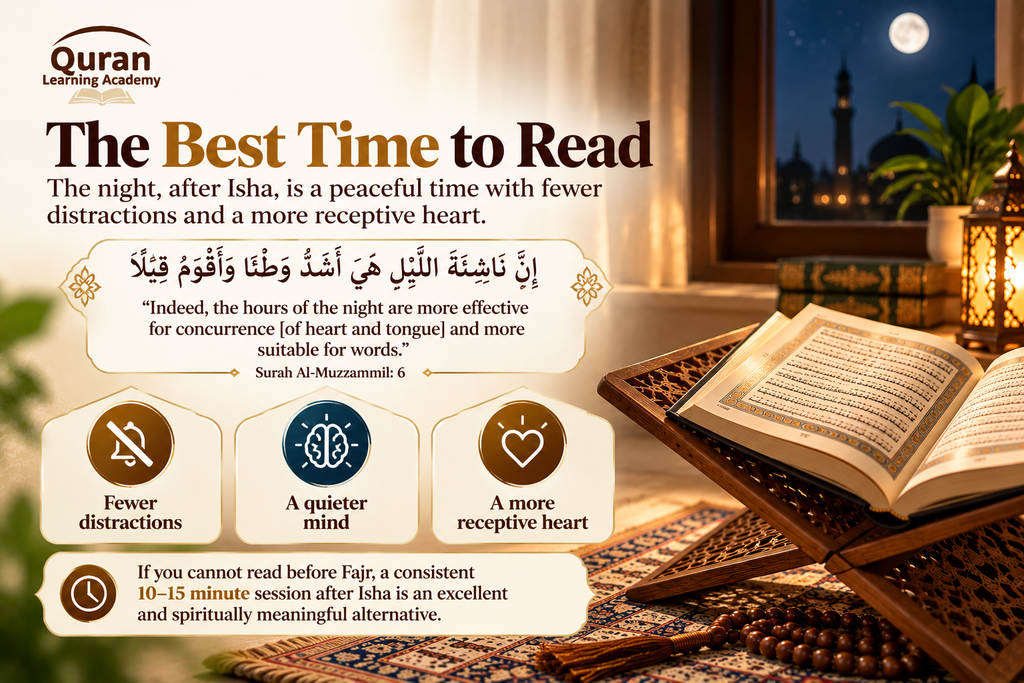
Distractions are minimal, the mind is naturally quieter, and the heart is more receptive. This is not simply a practical observation. It is mentioned explicitly in the Quran:
“إِنَّ نَاشِئَةَ اللَّيْلِ هِيَ أَشَدُّ وَطْئًا وَأَقْوَمُ قِيلًا”
Inna nashi’ata al-layli hiya ashaddu wat’an wa aqwamu qila.
“Indeed, the hours of the night are more effective for concurrence [of heart and tongue] and more suitable for words.”
For British Muslims who cannot manage a pre-Fajr reading slot due to early professional commitments, a consistent post-Isha session of ten to fifteen minutes serves as an effective and spiritually meaningful alternative. The consistency of the slot matters more than its length.
Read more: How to Memorise 2 Pages of Quran a Day.
6. Study Quranic Arabic to Read With Full Awareness
There is a ceiling to how interesting Quran reading can become when the language itself remains inaccessible. A learner who understands even a basic Quranic vocabulary reads every verse differently. Words land with weight when they are understood, not just sounded out.
Quranic Arabic is distinct from Modern Standard Arabic in vocabulary, morphology, and structure. Learning it specifically for Quran comprehension is more efficient than studying general Arabic, because the goal is targeted: to understand the Book of Allah as you read it.
Common Quranic vocabulary roots that appear across hundreds of verses include:
- ع ل م (knowledge and derivatives).
- ر ح م (mercy and related words).
- ص ب ر (patience and endurance).
- ه د ي (guidance in all its forms).
- ت ق و (God-consciousness, piety).
Recognising these roots while reciting creates an experience of genuine understanding rather than phonetic performance.
The Quranic Arabic Course at UK Quran Learning Academy is built specifically for learners who want to understand the Quran in its original language. The programme moves through Classical Arabic grammar, Quranic vocabulary, and Arabic morphology, giving students the tools to read and comprehend Quranic verses independently.
7. Read Aloud With Correct Rhythm and Pause
Silent reading and recitation are different cognitive experiences. Reading the Quran aloud, even quietly, engages both the mouth and the ear simultaneously, which reinforces attention and prevents the mind from drifting.
This is one of the simplest adjustments a reader can make to make reading Quran more interesting immediately. The rules of Waqf, knowing where to pause and where to continue, are part of Tajweed and have a direct effect on how the meaning lands.
Pausing at the correct position allows the verse to be received as a complete thought. Stopping mid-thought or running two ideas together flattens the experience.
The Prophet Muhammad (ﷺ) said:
“مَثَلُ الَّذِي يَقْرَأُ الْقُرْآنَ وَهْوَ حَافِظٌ لَهُ مَعَ السَّفَرَةِ الْكِرَامِ الْبَرَرَةِ”
“Such a person as recites the Qur’an and masters it by heart, will be with the noble righteous scribes (in Heaven).”
The hadith establishes that the quality of recitation carries its own reward and standing. Attending to pronunciation, rhythm, and pause is not perfectionism. It is an act of respect for the text.
Experience the Academy in Action
Curious about our teaching style? Take a quick look inside a live session to see our immersive, supportive learning environment first-hand.
Start Your Quranic Journey in the UK
Join our academy for structured online lessons with expert tutors, tailored to fit your schedule.
Book Your Free Trial8. Build a Weekly Hifz Goal to Anchor Your Reading
Memorisation is one of the most effective tools for making reading Quran more interesting, not because it makes reading easier, but because it brings the reader into a completely different relationship with the text.
A verse you have memorised travels with you. You recite it in prayer, recall it during difficulty, and hear it differently every time it is recited by someone else.
British Muslims who are balancing work, family, and community commitments often believe Hifz is only possible for full-time students.
This is not the case. A structured memorisation goal of three to five lines per week, maintained consistently, produces genuine progress within a realistic schedule.
The psychological benefit of memorisation is also significant. Knowing that a verse is secured in memory creates a form of ownership over the text that passive reading does not provide. The Quran becomes something you carry, not something you visit.
The Quran Memorisation Course at UK Quran Learning Academy trains British students in systematic Hifz techniques rooted in classical pedagogy.
The programme includes structured memorisation cycles, revision schedules, and Tajweed-compliant recitation, specifically addressing the challenges of balancing Hifz with professional and family life in the UK.

Why the UK Quran Learning Academy Supports Your Journey?
British Muslims face a specific set of challenges when trying to build a consistent Quran practice: work schedules that begin before sunrise, school runs, evening responsibilities, and very limited time for structured learning.
Generic online courses designed for learners in different time zones or life circumstances do not address these realities. UK Quran Learning Academy was built with these pressures in mind. Every programme is delivered live by qualified Azhari instructors who hold verified Ijazah credentials, through flexible scheduling that fits around UK working hours and school terms.
There are no commutes, no fixed mosque timings to navigate, and no compromise on the quality of instruction.
Whether you are a complete beginner who has never read the Quran formally, an adult who reads but does not understand, or a parent who wants to build a home environment centred on Quranic learning, the Academy has a programme designed for your specific situation.
Discover Our Quran Courses
- The Quran Tafsir Course
- The Online Tajweed Classes
- The Quranic Arabic Course
- The Quran Memorisation Course
- Quran Recitation Classes
- Quran Ijazah Program
- Quran Classes for Adults

Start Your Free Trial at UK Quran Learning Academy
Conclusion
Finding ways to Make Reading Quran More Interesting in the UK can help Muslims develop a more meaningful and consistent reading habit.
By exploring Quranic meanings, practising correct recitation, and setting realistic daily goals, readers can improve their focus and understanding.
With patience and regular practice, reading the Quran can become a more engaging part of everyday life and strengthen their connection with its guidance.
Read more: How to Improve Recitation of the Quran in the UK.
Frequently Asked Questions
How long should I read the Quran each day to build a genuine habit?
Start with five to ten minutes daily, anchored to an existing habit such as the period after Fajr or before sleeping. Consistency over duration is the principle that builds lasting engagement. A short daily session is significantly more effective than long, infrequent reading.
Does learning Tajweed make reading Quran more interesting or more complicated?
Tajweed initially requires attention and effort, but the result is a recitation that sounds cleaner, carries more meaning, and produces stronger focus during prayer. Most learners report that correct pronunciation makes the experience considerably more engaging, not more burdensome.
Can I make reading Quran more interesting without understanding Arabic?
Yes. Using a reliable translation alongside the Arabic text is an immediate and effective step. However, learning even a basic Quranic vocabulary significantly deepens the experience. Both approaches can run in parallel.
Is Tafsir study suitable for British Muslims with no prior Islamic education background?
Tafsir study is structured for all levels. Beginners start with accessible classical explanations and verse-by-verse context before moving into linguistic and jurisprudential analysis. No prior Islamic education is required to begin.
How does Quran memorisation help with making reading more interesting?
Memorised verses travel with you outside dedicated reading time. You recite them in prayer, recall them during difficulty, and hear them differently each time. This creates a continuous relationship with the text that scheduled reading alone cannot produce.







Leave a Reply