 Quran

For British Muslims balancing work, family, and community commitments, learning how to memorise one page of Quran a day can seem challenging without a practical system that fits modern life.
The real challenge is often the method rather than memory itself. A structured approach can make daily memorisation more manageable while strengthening revision, retention, and accurate pronunciation over time.
1. Divide Every Page into Three Fixed Segments Before You Begin
The single most damaging approach to memorise one page of Quran a day is reading the full page repeatedly from start to finish. After ten reads, students feel a sense of familiarity that they mistake for memorisation. When they close the Mushaf and attempt independent recall, they discover they cannot produce a single verse without prompting.
The correct method is segmentation. On a standard 15-line Medina Mushaf, divide the page into three segments of five lines each. Treat each segment as a completely independent memorisation unit. Do not advance to the next segment until the current one can be recited independently from memory.
The following table shows how a 15-line page breaks into segments and the repetition target for each:
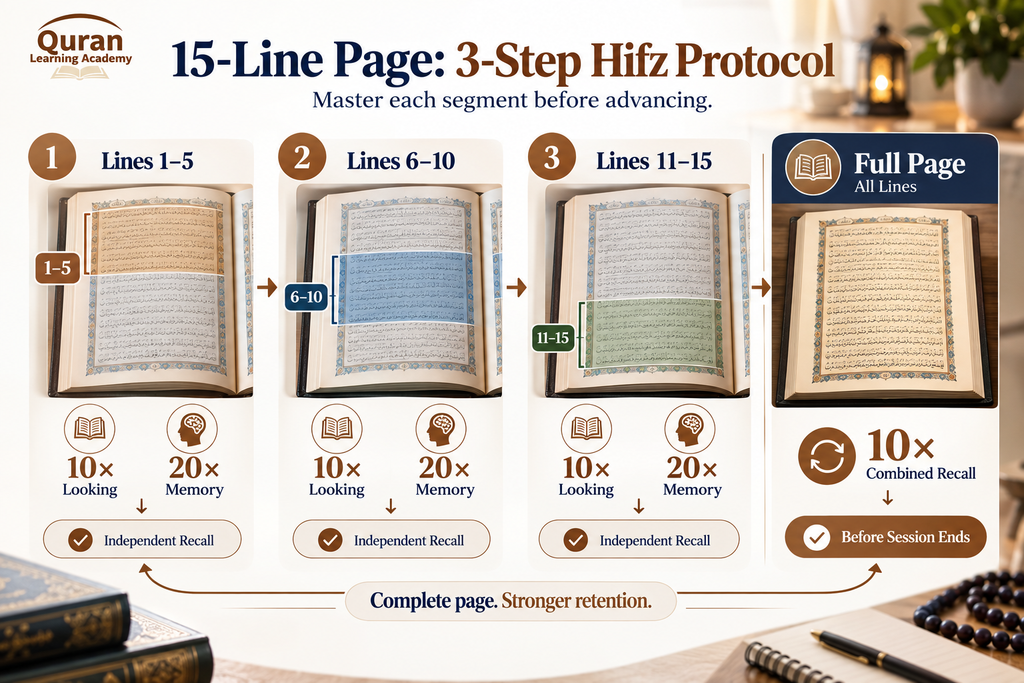
| Segment | Lines | Repetitions (Looking) | Repetitions (From Memory) | Before Advancing |
| Segment 1 | Lines 1 to 5 | Read aloud 10 times | Recite 20 times | Full independent recall |
| Segment 2 | Lines 6 to 10 | Read aloud 10 times | Recite 20 times | Full independent recall |
| Segment 3 | Lines 11 to 15 | Read aloud 10 times | Recite 20 times | Full independent recall |
| Full Page | All lines | — | Recite combined 10 times | Before session ends |
Students who repeat fewer than 15 times per segment consistently report forgetting within 24 hours. Students who reach 20 to 25 repetitions retain the segment for three to five days with minimal review effort. The repetition count is not a formality; it is the mechanism by which short-term familiarity becomes reliable recall.
Step Inside Our Virtual Classrooms
See how our interactive lessons work. Watch these brief highlights of our students engaging with instructors.
Start Your Quranic Journey in the UK
Join our academy for structured online lessons with expert tutors, tailored to fit your schedule.
Book Your Free Trial2. Memorise During the Post-Fajr Window Exclusively
The time immediately after Fajr prayer, roughly 30 to 40 minutes before the household wakes and daily obligations begin, is the most neurologically effective window for new Quran memorisation. Short-term memory has been cleared by sleep, environmental distractions are minimal, and the brain is in its highest state of receptivity to new encoding.
Allah’s words point to the special status of the Fajr recitation. Regarding the recitation at this time, it is important to note what has been established in the Quran about the dawn:
“أَقِمِ الصَّلَاةَ لِدُلُوكِ الشَّمْسِ إِلَىٰ غَسَقِ اللَّيْلِ وَقُرْآنَ الْفَجْرِ ۖ إِنَّ قُرْآنَ الْفَجْرِ كَانَ مَشْهُودًا”
Aqimi as-salata li-duluuki ash-shamsi ila ghasaqi al-layli wa-qurana al-fajri inna qurana al-fajri kana mashhuda.
“Establish prayer at the decline of the sun [from its meridian] until the darkness of the night and [also] the Qur’an of dawn. Indeed, the recitation of dawn is ever witnessed.”
British Muslims who memorise post-Fajr before commuting or beginning their workday consistently retain new pages for 48 to 72 hours with standard review. Those who attempt memorisation in the evening, after a full day of cognitive demands, report near-total forgetting by the following morning.
For working adults in the UK, this means treating the post-Fajr session as a fixed, non-negotiable appointment, exactly as one would treat an early morning meeting or school run.
Read more: Country With Most Quran Memorizers.
3. Establish Tajweed Accuracy Before Encoding Each Page
To memorise one page of Quran a day with Tajweed errors is structurally more damaging than not memorising it at all. Every mispronounced letter encoded through 25 repetitions becomes increasingly resistant to correction, because the brain treats the repeated version as correct. Undoing this after months of reinforcement requires active re-encoding, which is significantly harder than initial memorisation.
Before beginning any new page, spend five to eight minutes with a reliable audio recitation. Listen to a single verse, pause, recite it aloud, then advance. Do this for the full page before the segmented memorisation session begins.
The three Tajweed rules most commonly encoded incorrectly by British learners are:
- Ghunnah on Noon and Meem Mushaddad: two full counts of nasal resonance are required, not a rapid transition through the letter.
- Madd al-Asli versus extended Madd: the two-count original Madd must be consistently distinguished from the four or six-count Madd Lazim.
- Qalqalah on its five letters: the echo must occur with the mouth in the open position of the letter, not swallowed at the end of the word.
UK Quran Learning Academy offers the Online Tajweed Classes in the UK, a structured programme that builds Makharij, Sifaat, and rule application specifically for English-speaking adult learners before they advance to Hifz.
Students who correct their Tajweed foundations before beginning daily page memorisation consistently progress faster because they are not second-guessing pronunciation on every repetition.

Start your Tajweed foundation today
4. Apply the 24-Hour Recall Test Before Advancing to the Next Page
A page is not memorised when it can be recited once without looking. This is the most common misconception that causes students to build Hifz on an unstable foundation. A page is only genuinely memorised when, after 24 hours without any review, the student can recite it independently from beginning to end.
This test reveals three distinct outcomes:

| Recall Result | What It Indicates | Next Step |
| Full recitation without prompting | Page is genuinely encoded | Move to revision bank |
| Stumbles on one or two words | Partial encoding, near solid | One reinforcement session of 15 repetitions |
| Cannot recall more than a few verses | Familiarity only, not memorisation | Return to full three-segment protocol |
Students who mark pages as complete without applying this test discover weeks later that their earlier pages have deteriorated entirely. The 24-hour gap is not optional. It is the mechanism that reveals whether short-term recall has transferred to long-term retention.
5. Run a Parallel Daily Revision Session Alongside New Memorisation
New memorisation without structured daily revision produces a consistent and predictable result: for every new page gained, an earlier page deteriorates beyond reliable recall within seven days. A student memorising one page daily without revision is running to stay in place, not moving forward.
The sustainable model for how to memorise a page of Quran in 1 hour total daily input is a dual-session structure:
| Session | Timing | Content | Duration |
| New Memorisation | Post-Fajr | One new page, three-segment method | 30 to 40 minutes |
| Active Revision | Post-Dhuhr or Asr | Last seven pages memorised | 15 to 20 minutes |
The seven most recently memorised pages form the critical consolidation window. These pages are strong enough to recall but not yet locked into long-term memory. Reviewing them daily for seven days before rotating them into older revision ensures reliable long-term retention.
UK Quran Learning Academy offers the Quran Memorisation Course in the UK, structured specifically around the dual-session model for British learners managing work and family schedules. The course provides personalised revision tracking alongside new memorisation guidance from qualified Azhari instructors.

Explore the structured memorisation programme
6. Recite the New Page to a Qualified Teacher Within 24 Hours
Solo memorisation and recitation to a qualified teacher are two fundamentally different activities, and both are required for reliable long-term Hifz. Solo memorisation builds the initial encoding. Teacher recitation stress-tests that encoding under conditions where the student cannot self-correct errors they cannot hear.
The reason teacher accountability matters neurologically is timing. Errors caught within 24 hours of memorisation are corrected before they solidify into long-term encoding. Errors left for three to five days require active unlearning, which disrupts the memorisation of subsequent pages as well.
UK Quran Learning Academy provides the Hifz Classes for Adults in the UK, offering structured 1-on-1 sessions with qualified instructors who listen to new daily memorisation, provide real-time Tajweed correction, and adjust revision schedules based on each student’s demonstrated retention, not a generic template.

Book your first accountability session
7. Track Every Page with a Written Log and Set Weekly Targets
Memorising 604 pages cannot be sustained by motivation alone. Motivation is variable; a written tracking system is not. Students who log their memorisation outperform those who rely on mental accounting, because the act of recording creates accountability and reveals retention patterns before they become serious gaps.
Each daily entry in your log should include:
- The page number memorised and the date.
- The number of repetitions completed per segment.
- A quality rating for each segment: strong, needs reinforcement, or weak.
- The pages reviewed that day and their quality rating.
- Any Tajweed errors noted during the session.
At one page per day, the milestone progression is measurable: Juz Amma in approximately 20 days, the first complete Juz in roughly 30 days, and the full Quran in approximately 604 days of uninterrupted daily practice.
UK Quran Learning Academy offers the Quran Hifz for Ladies in the UK, a programme that includes structured progress tracking alongside personalised revision plans, led by qualified female instructors for sisters across Britain who prefer a private, accountable learning environment.

Begin your tracked Hifz journey
8. Optimise Your Session to Stay Within 45 Minutes
How to memorise 1 page of Quran fast comes down to eliminating session inefficiency rather than reducing repetition count. A well-structured session of 30 to 45 minutes produces better results than an unfocused 90-minute sitting, because cognitive fatigue after 60 minutes actively degrades new encoding.
The three most common session inefficiencies that extend sessions beyond 45 minutes are:
- Reading silently instead of aloud: silent reading does not engage the phonological loop required for auditory-based Quranic memory encoding.
- Taking breaks between segments longer than three minutes: cold restarts reset recall momentum, requiring additional repetitions to return to the same encoding depth.
- Combining segments before each individual segment is independently solid: premature combination creates apparent fluency that collapses under the 24-hour recall test.
Reciting at slightly above a whisper, audible to yourself but not disruptive to others, engages both auditory and motor memory pathways simultaneously.
This single adjustment reduces the repetitions required per segment from 30 to approximately 22 to 25 for most adult learners, shortening total session time without reducing memorisation quality.
Experience the Academy in Action
Curious about our teaching style? Take a quick look inside a live session to see our immersive, supportive learning environment first-hand.
Start Your Quranic Journey in the UK
Join our academy for structured online lessons with expert tutors, tailored to fit your schedule.
Book Your Free TrialBegin Your Daily Hifz at UK Quran Learning Academy
UK Quran Learning Academy connects British learners with qualified Azhari instructors who specialise in structured Quran memorisation for adults, children, and sisters across the UK.
Every instructor holds verified credentials and experience teaching non-native Arabic speakers, with flexible scheduling built around the realities of British working life.
The academy provides live, interactive sessions with real-time Tajweed correction, personalised revision plans, and 1-on-1 accountability that solo memorisation simply cannot replicate.
Whether you are beginning Hifz for the first time or returning after a break, the structure is adapted to your actual pace and retention, not a fixed template.
Discover Our Quran Courses
- Online Tajweed Classes in the UK
- Quran Memorisation Course in the UK
- Hifz Classes for Adults in the UK
- Quran Hifz for Ladies in the UK
- Quran Classes for Female / Sisters
- Learn Quran Course for Beginners
- Quran Memorization (Hifz) Course

Start your free trial session today
Conclusion
Learning how to memorise one page of Quran a day is not a matter of exceptional memory or unlimited time. It is a matter of applying the right system with consistent daily execution.
The steps above form a complete, tested method: three-segment division with 20 to 25 repetitions each, post-Fajr timing, Tajweed accuracy before encoding, the 24-hour recall test, parallel revision, teacher accountability, written tracking, and session efficiency.
Each step addresses a specific failure point that prevents British learners from reaching a full page per day. Apply the system without skipping steps, and how to memorise a page of Quran in 1 hour of total daily input becomes an achievable daily reality.
Read more: Memorise Quran Fast in the UK.
Frequently Asked Questions
How long does it take to memorise one page of Quran using the three-segment method?
Most adult learners complete the three-segment session, including full-page combination, in 30 to 45 minutes. Students new to Hifz may need up to 60 minutes in the first two to three weeks. As the method becomes habitual, typically within four weeks, session times shorten naturally without any reduction in memorisation quality.
Is it realistic to memorise one page of Quran daily while working full-time in the UK?
Yes, provided the post-Fajr session is treated as a fixed, non-negotiable commitment rather than a flexible task. The memorisation session requires 30 to 45 minutes, and the revision session an additional 15 to 20 minutes distributed across the day. British Muslim professionals who structure these sessions around commuting and prayer times consistently maintain the pace.
What should I do if the 24-hour recall test shows I have not genuinely memorised the page?
Return to the full three-segment protocol without advancing. Do not attempt to memorise the next page until the current page passes the recall test. Building on a page that has not been genuinely encoded creates a cascading instability in all subsequent memorisation.
Why does the revision session focus on the last seven pages specifically?
The seven most recently memorised pages fall within the critical consolidation window, strong enough to recall but not yet locked into long-term memory. Daily review for seven days before rotating pages into older revision ensures reliable transfer to long-term retention rather than gradual deterioration.
How does Tajweed correction affect the pace of daily page memorisation?
Students who correct Tajweed errors after encoding them require additional re-memorisation sessions that disrupt daily page progress. Students who establish Tajweed accuracy before encoding memorise faster overall, because they are not simultaneously memorising new content and unlearning existing errors.








[…] Read more: How to Memorise One Page of Quran a Day. […]