 Quran
Quran
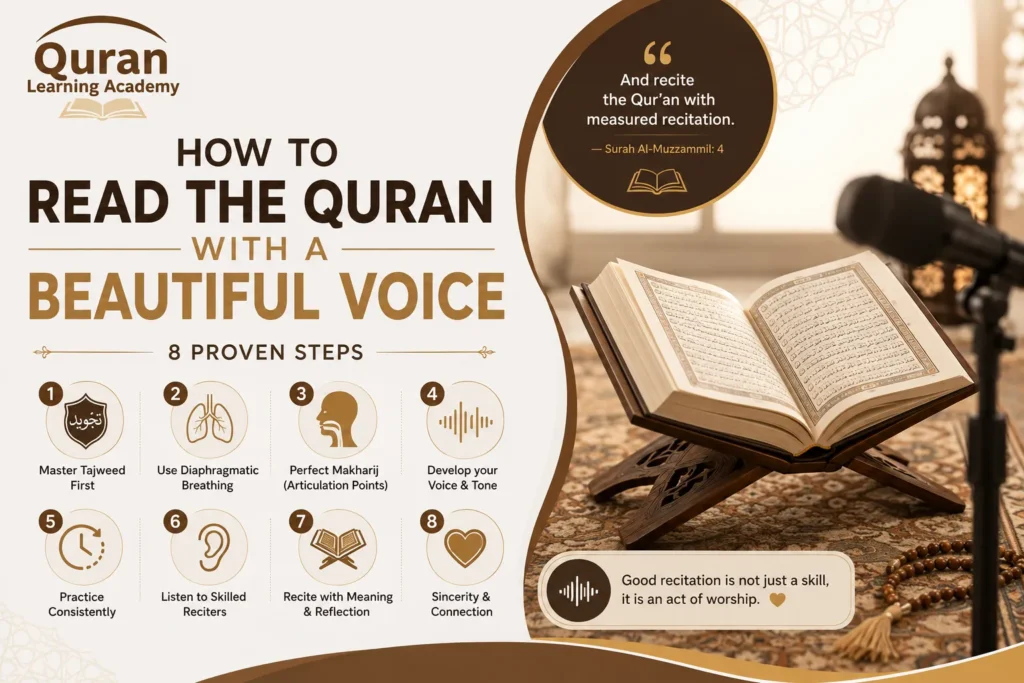
You open the Mushaf and recite correctly, yet the recitation feels flat compared with skilled Qaris. Many assume beautiful Quran recitation is an inherited gift, but it can be developed. The Prophet ﷺ praised Abu Musa Al-Ash’ari’s voice, and Abu Musa replied that had he known the Prophet was listening, he would have beautified his recitation further.
This shows that the Companions actively refined their recitation. Learning to read the Quran beautifully is a practical skill built through Tajweed, breath control, consistent practice, and vocal care.
1. Tajweed Is the Non-Negotiable Starting Point
Attempting to beautify the voice before mastering Tajweed is like trying to decorate a house that has no foundation. Every element of beautiful recitation — rhythm, flow, emotional resonance — depends entirely on correct letter production and rule application.
Allah commands measured recitation explicitly:
“وَرَتِّلِ الْقُرْآنَ تَرْتِيلًا”
Wa rattili l-Qur’āna tartīlā
“and recite the Qur’an with measured recitation.”
Scholars explain that Tarteel in its fullest sense is Tajweed applied completely — every letter produced from its correct articulation point, every characteristic preserved, every rule of interaction between letters observed. This is what the Quran calls beautiful recitation at its foundation.
The three Tajweed layers that most directly produce beauty in the voice are:
| Tajweed Layer | What It Covers | Effect on Recitation |
| Makharij al-Huruf | Exact articulation point of each letter | Clarity and distinctness of every sound |
| Sifaat al-Huruf | Letter characteristics: heaviness, lightness, echoing (Qalqalah), nasalisation (Ghunnah) | Tonal richness and texture |
| Ahkam al-Tajweed | Rules for how letters interact: Idgham, Ikhfa, Madd, Iqlab | Natural rhythm, elongation, and flow |
When these three layers are internalised, recitation develops an automatic natural rhythm. That rhythm is the audible foundation of everything that sounds beautiful in skilled Quranic recitation. Without it, no amount of vocal effort produces genuine beauty — only the appearance of it.
Many learners have adequate general pronunciation but uncertain Tajweed: they know rules exist but cannot apply them fluently during actual recitation. The Online Tajweed Classes in the UK at UK Quran Learning Academy cover Makharij, Sifaat, and all rule application through structured live sessions with qualified instructors who correct errors in real time.

Start with Online Tajweed Classes at UK Quran Learning Academy
Read also: Common Mistakes When Reading the Quran and How to Correct Them
2. Diaphragmatic Breathing Supports the Entire Voice
Running out of breath mid-verse is one of the most common obstacles to how to recite Quran beautifully. It produces a shaky, strained, or abruptly cut sound that breaks the flow of the passage and forces the reciter into rushed phrasing.
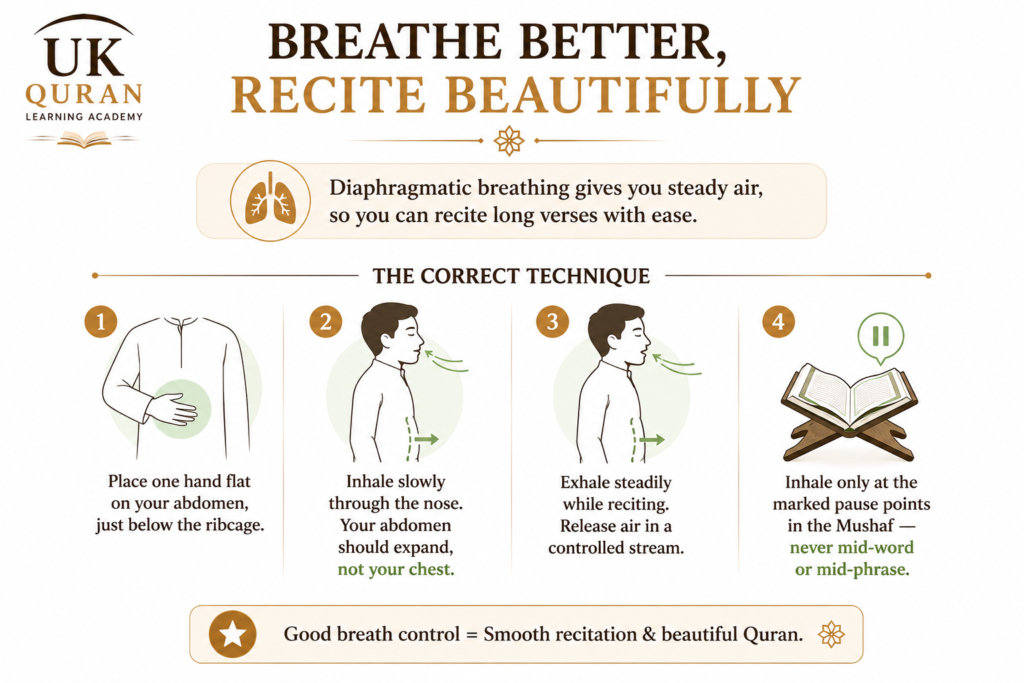
Professional reciters do not breathe from the chest — they breathe from the diaphragm. This fills the lower lungs and creates a steady, sustained reservoir of air that supports long verses without strain.
The correct technique:
- Place one hand flat on the abdomen, just below the ribcage.
- Inhale slowly through the nose. The hand should move outward as the abdomen expands, not the chest.
- Exhale steadily while reciting, releasing air in a controlled stream rather than all at once.
- Inhale only at the marked pause points in the Mushaf — never mid-word or mid-phrase.
A daily breathing exercise that builds recitation capacity:
- Inhale through the nose for four counts.
- Hold for two counts.
- Exhale steadily for eight counts.
- Repeat ten times before any recitation session.
Within weeks, this measurably extends how long you can sustain a phrase on a single breath. The improvement carries directly into prayer recitation — longer verses in Salah become manageable without the interruptions that break both focus and flow.
Read also: How to Memorise Quran in 6 Months?
3. Makharij Mastery Produces Letter Clarity
Arabic contains sounds with no equivalent in English. Letters such as ع (Ayn), ح (Ha), خ (Kha), ض (Dad), ظ (Dha), and ق (Qaf) are produced from specific points in the throat, tongue, and oral cavity that English speech never requires.
When these articulation points are not mastered, the recitation sounds muffled or substituted — and no vocal effort compensates for letters produced from the wrong physical location. The result is a recitation that feels indistinct regardless of how much care is taken over tone.
The five primary Makharij regions:
| Region | Arabic Term | Letters Produced |
| Throat | Al-Halq | ء، ه، ع، غ، خ، ح |
| Tongue (back) | Aqsal-Lisan | ق، ك |
| Tongue (middle and sides) | Wastal/Hafatal-Lisan | ج، ش، ي، ض، ل، ن، ر |
| Tongue (tip) | Tarful-Lisan | ط، د، ت، ص، ز، س، ظ، ذ، ث |
| Lips | Al-Shafatayn | ب، م، و، ف |
Makharij cannot be learned from text alone. Letters like ع and ح must be heard produced correctly by a teacher and then corrected as the student imitates. This is why Islamic scholarship has always treated oral transmission as the only valid method for authentic recitation learning — the ear and tongue must be trained together under direct guidance.
Makharij cannot be learned from text alone. Letters like ع and ح must be heard produced correctly by a teacher and then corrected as the student imitates. This is why Islamic scholarship has always treated oral transmission as the only valid method for authentic recitation learning — the ear and tongue must be trained together under direct guidance.
Many learners struggle with throat letters specifically because they have never had their production checked by a qualified instructor. If your recitation still sounds muffled or indistinct despite consistent practice, the Quran Recitation Classes in the UK at UK Quran Learning Academy provide structured Makharij correction through live one-to-one sessions with qualified instructors who identify and fix articulation errors at their source.

Start with Quran Recitation Classes at UK Quran Learning Academy
4. Reciting Aloud in Tarteel Pace Builds Vocal Quality
Tarteel — the measured, unhurried pace of recitation — is not a stylistic preference. It is the mode in which the voice has time to produce each letter fully, apply every Tajweed rule, and allow each sound to carry before the next one begins.
Ibn al-Qayyim documented the Prophet’s ﷺ recitation precisely: he recited letter by letter, verse by verse, extending the Madd letters such as the Alif in الرَّحْمَٰن and the Ya in الرَّحِيم to their full duration. He never compressed what should be extended and never rushed past a letter.
Tarteel pace achieves four things simultaneously:
- Madd (elongation) is applied at the correct duration — two, four, or six counts depending on the rule.
- Ghunnah (nasalisation) receives its full two-beat count.
- Qalqalah (the echoing bounce in letters ق ط ب ج د) is produced clearly rather than swallowed.
- The reciter has time to modulate tone between different verse types, which is what audible beauty actually consists of.
Reciting silently does not build these habits. Scholars note that reciting aloud, even softly, keeps the reciter’s ear engaged in their own production — which means pronunciation errors surface immediately rather than becoming embedded over months of silent practice.
Read also: Is It Possible to Memorise the Whole Quran? And How?
5. Find Your Natural Vocal Register and Work Within It
Every person has a natural vocal range — a zone where the voice resonates comfortably, carries clearly, and sustains without strain. Beautiful recitation is developed within this range, not by forcing the voice above or below it.
A common mistake among learners is attempting to imitate a favoured Qari’s exact pitch or vocal depth. A person whose voice does not naturally carry deep tones cannot force that quality without producing strain, and that strain is audible. The recitation sounds effortful rather than flowing.
The principle is: identify the pitch where your voice feels most resonant, stable, and comfortable, then develop beauty within that range. Abu Musa Al-Ash’ari had his own distinctive voice — the Prophet ﷺ praised it, not compared it unfavourably to another Companion’s different style.
A practical method to find your natural register:
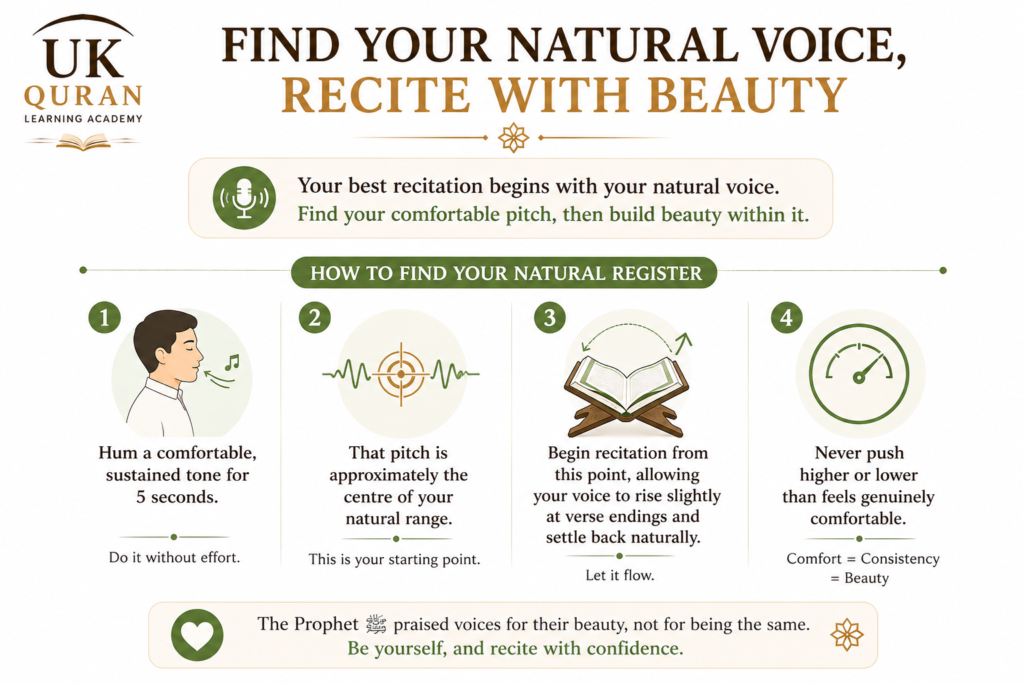
- Hum a comfortable, sustained tone for five seconds without effort.
- That pitch is approximately the centre of your natural range.
- Begin recitation from this point, allowing the voice to rise slightly at verse endings and settle back naturally.
- Never push higher or lower than feels genuinely comfortable.
Over time, this natural range develops in clarity and quality through daily practice. Forcing the voice beyond it produces strain that damages both the recitation and the vocal cords.
6. Active Imitation of a Single Skilled Reciter Builds Skill
There is a fundamental difference between listening to recitation and imitating it. Listening develops appreciation. Imitation builds the skill. For anyone serious about how to recite Quran beautifully, active imitation is the fastest practical method of improvement.
The Prophet ﷺ said:
“ مَا أَذِنَ اللَّهُ لِشَىْءٍ مَا أَذِنَ لِلنَّبِيِّ أَنْ يَتَغَنَّى بِالْقُرْآنِ ”
“Allah does not listen to a prophet as He listens to a prophet who recites the Qur’an in a loud and pleasant tone.”
This hadith establishes that Allah attends especially to beautiful, audible recitation — which is itself the greatest motivation to work on improving it.
The active imitation method used in classical recitation training:
- Choose one reciter whose vocal pace and range are close to your own.
- Listen to a single verse twice, focusing on pause points, tone variation, and elongation.
- Pause the recording and recite the same verse aloud immediately after.
- Record your attempt.
- Compare your recording to the original, noting every point of difference.
- Repeat the verse until the gap narrows.
The three reciters most frequently recommended as models for learners at different stages:
| Reciter | Style Characteristic | Best Suited Stage |
| Sheikh Mishary Rashid Alafasy | Clear, moderate pace, clean pronunciation | Beginners — easy to follow alongside the text |
| Sheikh Abdul Rahman Al-Sudais | Slightly slower, natural voice modulation | Intermediate — demonstrates Tajweed producing natural flow |
| Sheikh Mahmoud Khalil Al-Husary | Precise, full Tajweed application, tarteel pace | All levels — the most commonly recommended for accurate learning |
The essential rule is consistency: choose one reciter and stay with them for the Surah or section you are working on. Switching between multiple reciters too early prevents deep internalisation of any single style’s patterns and produces a confused blend.
The essential rule is consistency: choose one reciter and stay with them for the Surah or section you are working on. Switching between multiple reciters too early prevents deep internalisation of any single style’s patterns and produces a confused blend.
For learners who want to go beyond imitation and study the authenticated recitation styles transmitted through classical Islamic scholarship, the Quran Qirat Learning Course in the UK at UK Quran Learning Academy covers Maqamat foundations, Tarteel application, and the authentic Qira’at variations under qualified supervision.

Explore the Quran Qirat Learning Course at UK Quran Learning Academy
7. Record Your Recitation and Review It Weekly
Self-recording is used by every serious student of recitation at every level — and the reason is straightforward. The ear processes its own voice differently during production than during playback. Errors that are invisible during live recitation become immediately audible on a recording.
A structured weekly review session:
- Record five to ten minutes of recitation covering passages you consider solid.
- Listen back with the Mushaf open, pausing at any point that sounds unclear or incorrect.
- Note every specific point of divergence: Makharij, Madd duration, Ghunnah presence, pace, breath placement.
- Bring these notes to your next lesson with a teacher for targeted correction.
Specific things to listen for in your own recording:
- Are the throat letters ع، ح، خ produced distinctly, or does the voice smooth over them.
- Are elongations (Madd) held for the correct number of counts, or are they shortened under recitation pressure.
- Does the voice place breath only at marked pause points, or does it interrupt mid-phrase.
- Is the pace genuinely Tarteel, or does it speed up at familiar passages.
This cycle of record, listen, identify, and correct closes the gap between knowing Tajweed rules theoretically and applying them fluently during actual recitation. Without it, the same errors repeat indefinitely because they are never heard objectively.
Read also: The Most Powerful Duas for Studying, Fast Memorisation, And Memory
8. Vocal Care Protects What You Build
The voice is a physical instrument. Everything built through Tajweed study, breathing practice, and daily recitation can be undone by poor vocal habits that damage or strain the vocal cords over time.
The habits that protect recitation quality:
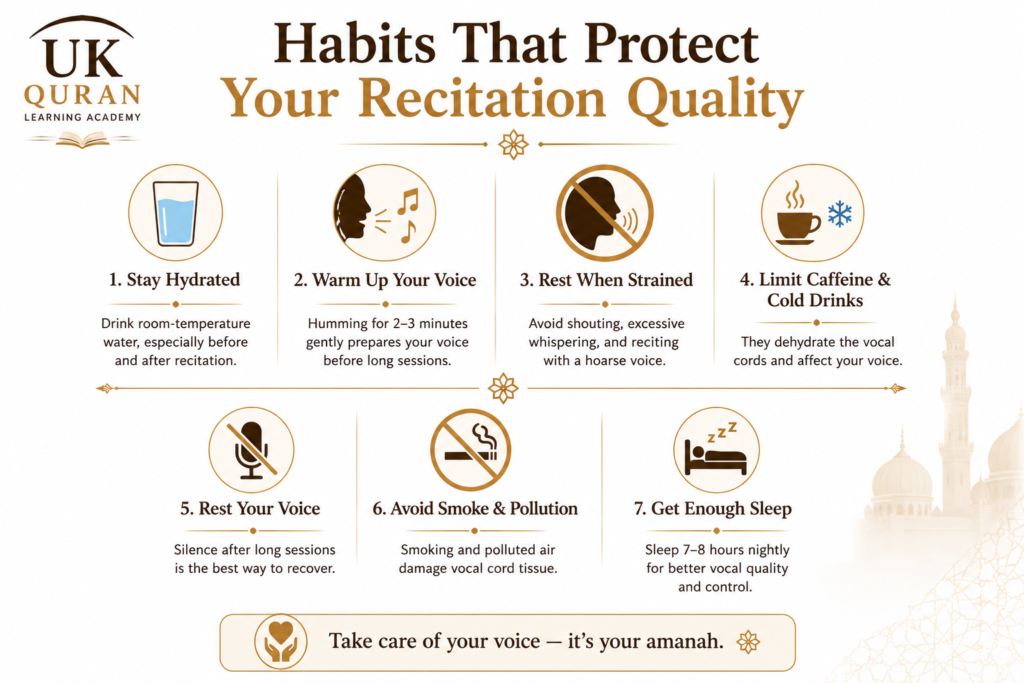
- Drink room-temperature water throughout the day, and especially before and after any extended recitation session. Cold drinks constrict the throat and reduce vocal flexibility.
- Warm up the voice before any long recitation session with gentle humming for two to three minutes at a comfortable pitch.
- Avoid shouting, excessive whispering, and reciting when the voice is hoarse or strained. Continuing to use a fatigued voice damages the vocal cords progressively.
- Avoid caffeine and very cold beverages on days of extended recitation, as both dehydrate the vocal cords.
- Rest the voice properly after long sessions — silence is the most effective vocal recovery tool.
- Avoid smoking and air pollution where possible, as both degrade vocal cord tissue over time.
- Sleep at least seven to eight hours per night. Fatigue has a measurable negative effect on vocal quality and control.
Scholars who were known for their exceptional recitation were also known for the care they took of their voices outside of recitation. This is not incidental — it reflects the understanding that the voice used to recite the words of Allah deserves the same deliberate care as the recitation itself.
Read also: Memorising Quran Without Understanding
Experience the Academy in Action
Curious about our teaching style? Take a quick look inside a live session to see our immersive, supportive learning environment first-hand.
Start Your Quranic Journey in the UK
Join our academy for structured online lessons with expert tutors, tailored to fit your schedule.
Book Your Free TrialDevelop Your Recitation at UK Quran Learning Academy
The gap between correct recitation and beautiful recitation cannot be closed through self-study alone. Tajweed errors embedded without correction become harder to reverse over time. Breath habits formed incorrectly create obstacles that practice alone cannot fix. Pronunciation problems that the reciter cannot hear themselves require a qualified ear to catch and correct.
UK Quran Learning Academy delivers one-to-one live instruction from qualified Azhari teachers who correct errors in real time, track individual progress, and structure each learner’s development around their specific starting point.
Lessons are fully online with flexible scheduling, making consistent recitation study achievable around any routine. Every session is personalised — not pre-recorded content, not group classes where individual errors go uncorrected.
Discover Our Quran Courses
- Quran Online Academy
- Quran Recitation Classes
- Quran Reading Classes
- Online Quran Classes for Kids
- Quran Classes for Adults
- Quran Classes for Female / Sisters
- Learn Quran Course for Beginners
- Quran Memorization (Hifz) Course
- Hifz Classes for Adults
- Quran Memorization and Hifz Course for Kids
- Quran Hifz Course for Ladies
- Quran Ijazah Program
- Quran Qirat Learning Course
- Quran Tafsir Course
- Noorani Qaida Course
- Noorani Qaida Course for Kids
- Weekend Quran Classes
- Intensive Quran Course
- Al-Azhar Quran Course
- Online Tajweed Classes
- Tajweed Course for Kids
- Tajweed Course for Adults
- Tajweed Course for Ladies
Book a Free Trial at UK Quran Learning Academy
Start Your Quranic Journey in the UK
Join our academy for structured online lessons with expert tutors, tailored to fit your schedule.
Book Your Free TrialConclusion
Learning how to read the Quran with a beautiful voice depends on method, not talent. Tajweed builds accuracy, diaphragmatic breathing improves control, and Makharij mastery produces clear letters. Tarteel creates a measured pace, while developing your natural vocal register prevents strain. Verse-by-verse imitation of skilled reciters, weekly recording and review, and consistent vocal care further improve recitation. With the right guidance and patient practice, beautiful Quran recitation can be developed over time.
Frequently Asked Questions.
My voice is not naturally beautiful. Can I still recite the Quran beautifully?
Yes, without exception. The Prophet ﷺ commanded every Muslim to adorn the Quran with their voice — and scholars clarify this means each person beautifies their recitation to the best of their individual capacity. Correct Tajweed, controlled breathing, and Tarteel pace produce beautiful recitation regardless of the natural quality of the starting voice.
How long does it take to develop a noticeably better recitation voice?
With consistent daily practice of fifteen to twenty minutes, most learners notice clear improvement within four to eight weeks. The improvement is gradual and compounds — each week’s practice builds directly on the previous one. The reciter who practises daily for three months consistently outperforms one who practises intensively but irregularly.
Is it better to recite silently or aloud when practising?
Aloud, without exception. Silent recitation does not activate the vocal and auditory feedback loop that anchors pronunciation habits. Reciting aloud — even at a low volume — means the reciter hears their own production and can identify errors in real time. Scholars note that reciting aloud also helps the reciter maintain focus and prevents Tajweed rules from being skipped over mentally.
How do I know which famous Qari to imitate?
Choose a reciter whose natural vocal pace is closest to your own — not whose voice is most impressive to listen to. A reciter who recites at a pace that feels sustainable for you to follow verse-by-verse is the right choice for imitation practice. Sheikh Al-Husary’s Tarteel recitation is the most commonly recommended starting point for learners because of its precision and measured pace.
What foods and drinks should I avoid before a recitation session?
Avoid very cold drinks, caffeine, dairy products immediately before recitation, and anything spicy or acidic. These either constrict the throat, dehydrate the vocal cords, or increase mucus production. Room-temperature water is the ideal preparation, taken steadily throughout the day rather than only just before reciting.






Leave a Reply